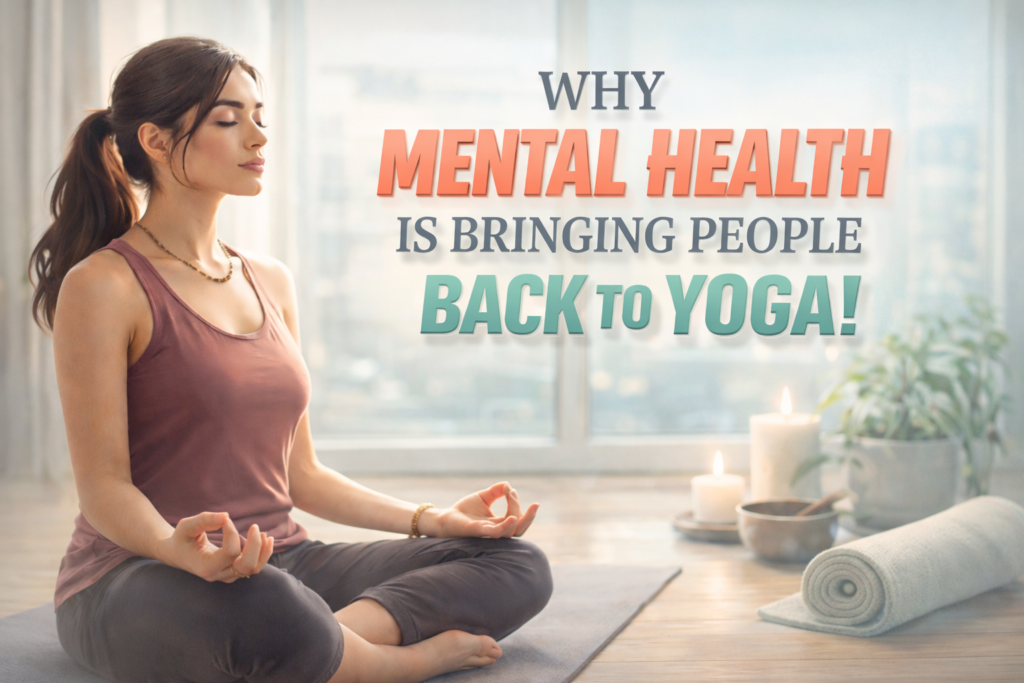
Mental health awareness is bringing people back to yoga. Learn the true aim of yoga and why it must be lived as a lifestyle for mental balance and well-being.
Over the past few years, mental health has moved from the margins of public conversation to its center. Anxiety, burnout, depression, emotional fatigue, and chronic stress are no longer seen as rare or private struggles. They are discussed openly in workplaces, schools, healthcare systems, and homes. As awareness grows, so does a collective search for solutions that go beyond temporary relief.
In the middle of this global mental health conversation, yoga has quietly returned to relevance not as a fitness trend, but as a tool for psychological balance. What is drawing people back to yoga today is not flexibility or physical performance, but the need for inner stability in an increasingly unstable world.
This return is not accidental. It reflects a deeper realization: modern life has outpaced the mind’s ability to cope, and purely external solutions are no longer enough.
A Global Mental Health Turning Point
Mental health challenges have increased across age groups and professions. Constant connectivity, rising performance pressure, uncertainty about the future, and lack of mental rest have created an environment of continuous psychological stimulation. Even when physical needs are met, many people feel overwhelmed, emotionally drained, and mentally scattered.
What makes the present moment different is that these struggles are no longer dismissed as personal weakness. Mental health is now understood as something shaped by lifestyle, work culture, and daily habits. As people look for sustainable ways to cope, interest is shifting away from quick fixes toward practices that help regulate the mind and nervous system.
Yoga is re-entering this conversation precisely because it addresses mental imbalance at its root.
Why Conventional Approaches Feel Incomplete
Modern mental health care has made important progress in recognition and treatment. Therapy, counseling, and medication have helped millions. Yet many people feel that these approaches alone do not address the daily mental strain caused by how life itself is structured.
Stress is no longer occasional; it has become a constant background state.
People are beginning to understand that mental health is not only about treatment. It is about how the mind functions every day how it reacts, how it processes emotion, and how it handles uncertainty. This understanding has opened the door to yogic practices that build inner stability rather than simply managing symptoms.
Yoga’s Original Focus on the Mind
Yoga’s renewed relevance lies in its original purpose. In classical yoga philosophy, the central concern was never physical performance. The Yoga Sutras of Patanjali define yoga as the regulation of mental activity. This definition places the mind not the body at the center of yogic practice.
This perspective feels especially relevant today, as many mental health challenges stem from constant mental overactivity: overthinking, emotional reactivity, and lack of inner rest. Yoga offers tools to calm these patterns through awareness, breath, and attention.
For people experiencing anxiety or burnout, yoga feels less like exercise and more like mental self-care.
What Is the Aim of Yoga?
As mental health brings people back to yoga, an important question is being rediscovered: what is yoga actually meant to do?
The aim of yoga is not to eliminate thoughts or escape life. Its aim is to create clarity and stability within the mind so that life can be lived consciously. Yoga seeks to reduce unconscious mental reactions that create suffering and replace them with awareness and balance.
Rather than changing external circumstances, yoga changes how experience is processed. When the mind is steady, perception becomes clearer. When perception is clear, choices become wiser. This inner clarity is the true goal of yoga, and it is precisely what many people are seeking today.
In a time when mental overload has become normal, yoga’s original aim feels both practical and necessary.
The Nervous System Connection
Another reason yoga is gaining attention in mental health discussions is its effect on the nervous system. Chronic stress keeps the body in a constant state of alert. Over time, this state becomes exhausting and destabilizing.
Yoga practices such as conscious breathing, gentle movement, and stillness activate the body’s relaxation response. This helps reduce mental agitation and supports emotional regulation. As people experience this directly, yoga begins to feel like a form of mental hygiene rather than a physical workout.
This shift is bringing a new audience to yoga people who may never have been interested in fitness, but are deeply motivated to regain mental balance.
Why Yoga Must Be Implemented as a Lifestyle
One of the key reasons yoga is becoming relevant again is the realization that mental health cannot be supported by isolated practices alone. A few minutes of meditation or a weekly class cannot counterbalance an overstimulated, unconscious lifestyle.
Yoga was always designed as a way of living, not an activity limited to a mat. Its principles apply to how one eats, works, rests, communicates, and responds to stress. When yoga is implemented only as an exercise routine, its deeper benefits remain limited.
Mental health challenges are pushing people to integrate yoga into daily life through awareness, simplicity, rhythm, and conscious action. This lifestyle approach aligns directly with yoga’s original intent and explains why it feels effective in today’s world.
From Performance to Presence
Modern culture emphasizes performance, comparison, and constant achievement. Even rest is often treated as something to optimize. This mindset has contributed significantly to mental exhaustion.
Yoga offers a different approach. It values presence over performance and awareness over achievement. Progress is measured internally, not externally. For individuals experiencing burnout, this shift feels deeply restorative.
Yoga legitimizes stillness in a culture addicted to movement.
Awareness as the Bridge Between Yoga and Mental Health
Awareness is the common ground between yoga and modern mental health understanding. Learning to observe thoughts and emotions without immediately reacting to them improves emotional regulation and resilience.
Yoga integrates this awareness into everyday life. Rather than separating mental health from daily living, it recognizes that the mind is shaped continuously by habits and attention. As awareness increases, people become less reactive and more stable.
This change is subtle, but its impact is profound.
Yoga as Prevention, Not Just Relief
A major reason mental health discussions are bringing people back to yoga is the growing emphasis on prevention. Waiting until stress turns into illness is no longer seen as sustainable.
Yoga supports mental balance before crisis occurs. It helps people recognize early signs of overload and respond with awareness. This preventative aspect makes yoga especially relevant in modern society.
Rather than treating the mind only when it breaks down, yoga helps maintain balance over time.
A Cultural Return, Not a Trend
What is happening today is not a new yoga trend. It is a return to yoga’s original purpose. Mental health challenges have revealed the limits of constant stimulation and external control.
Yoga re-emerges at this moment not as an escape from reality, but as a way to meet reality with clarity. The Bhagavad Gita describes inner steadiness amid action a teaching that feels especially relevant now.
Yoga does not promise to remove life’s difficulties. It offers tools to navigate them without being overwhelmed.
Looking Ahead
As mental health continues to shape global conversation, yoga’s role is likely to grow. Not as a replacement for therapy or medicine, but as a foundation for everyday mental balance.
Mental health is bringing people back to yoga because yoga was always meant to care for the mind.
In a world that no longer slows down, practices that cultivate inner steadiness are no longer optional they are essential.