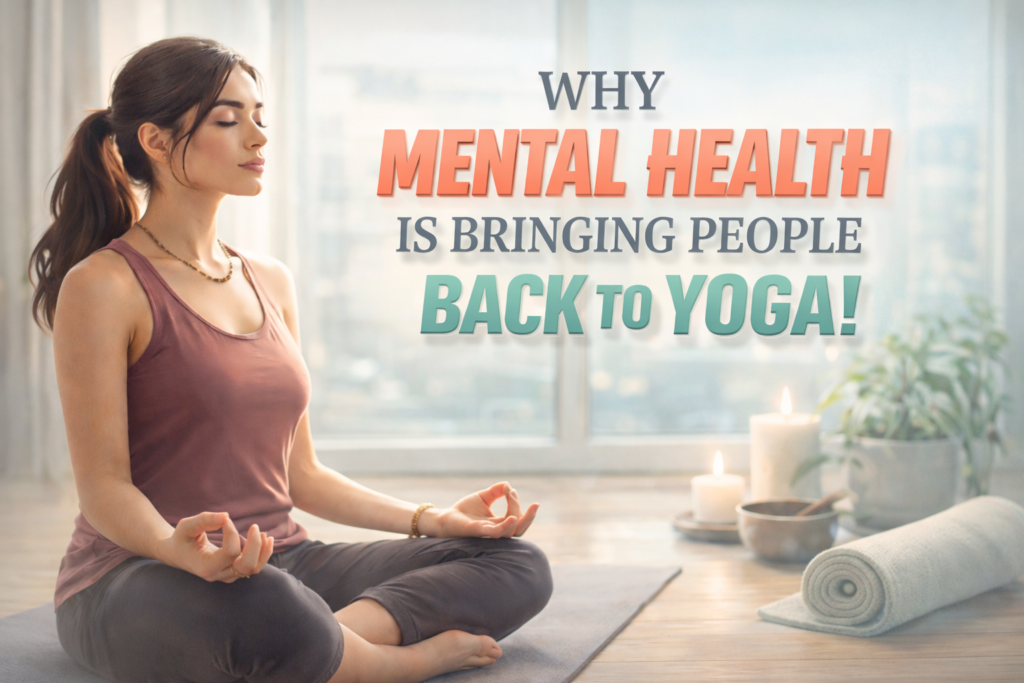
Learn how to design a lifestyle that calms the mind through yogic wisdom. Discover how daily habits, awareness, and balance create lasting inner peace.
Modern life is fast, demanding, and mentally noisy. Even when basic needs are met, many people live with constant inner tension. The mind jumps from one thought to another, worries about the future, replays the past, and rarely rests in the present moment. As a result, calmness is often treated as a luxury something to be achieved during vacations, retreats, or rare moments of silence.
Classical yoga offers a very different perspective. According to yogic wisdom, calmness is not an occasional experience. It is a natural state of the mind when life is lived in alignment with awareness. From this point of view, mental disturbance is not caused only by external pressure, but by the way life itself is structured. A restless lifestyle creates a restless mind. A balanced lifestyle supports inner calm.
Designing a lifestyle that calms the mind is therefore not about escaping the world. It is about living in the world more consciously. Yoga was always intended as a complete way of living, not a technique practiced in isolation. When daily life supports awareness, the mind gradually settles on its own.
The Yogic Understanding of Mental Calm
In yoga philosophy, mental calm is not the absence of activity. It is the absence of unnecessary disturbance. The mind is meant to function, think, remember, and decide. Problems arise when these functions become excessive, repetitive, and uncontrolled.
The Yoga Sutras of Patanjali describes yoga as the regulation of mental fluctuations. These fluctuations are created and reinforced by habits habits of thought, action, consumption, and attention. Lifestyle, therefore, plays a central role in mental health.
When life is lived in constant stimulation, comparison, urgency, and excess, the mind mirrors that pattern. Calmness cannot be forced on such a system. It must be supported structurally.
Why Calmness Cannot Be Forced
Many people try to calm the mind through techniques while keeping the rest of life unchanged. They meditate for a few minutes a day, but spend the remaining hours overstimulated, stressed, and mentally scattered. This creates inner conflict. The mind is asked to be calm while the lifestyle trains it to be restless.
Yoga does not work this way. It approaches the problem at its root. If the mind is disturbed, the conditions that create disturbance must be addressed. Calmness is not produced through effort alone. It emerges when resistance, excess, and unconscious patterns reduce.
Designing a calming lifestyle means reducing unnecessary friction in daily living.
The Role of Awareness in Lifestyle Design
Awareness is the central principle of yogic living. Without awareness, lifestyle becomes automatic. Habits form unconsciously, and the mind reacts continuously. With awareness, even small changes have a powerful effect.
Awareness begins by observing how daily choices influence the mind. How does the mind feel after waking up? After meals? After social interaction? After work? After screen time? These observations are not meant to judge, but to understand.
When awareness is present, lifestyle begins to design itself more intelligently. What disturbs the mind becomes obvious. What supports calm becomes clear.
Morning Rhythm and Mental Tone
Yoga places great importance on how the day begins. The mind is most impressionable in the early hours. A rushed, chaotic morning sets a restless tone for the entire day. A calm, intentional morning supports mental stability.
In yogic living, mornings are meant to be quiet, simple, and inward-oriented. Even a few moments of silence, gentle movement, or conscious breathing create a foundation of steadiness. This is not ritual for its own sake. It is psychological hygiene.
When the mind begins the day without immediate stimulation, it remains more balanced throughout daily activities.
Simplicity as a Support for Calmness
Modern culture promotes constant accumulation more information, more possessions, more commitments. Yoga recognizes excess as a major cause of mental disturbance. A cluttered environment creates a cluttered mind.
Simplicity does not mean austerity. It means clarity. Reducing unnecessary choices, distractions, and obligations frees mental energy. The mind relaxes when it does not have to constantly process excess.
Yogic living encourages simplicity in food, speech, consumption, and daily routines. This simplicity naturally calms the nervous system.
Food, Routine, and Mental Stability
As explored in yogic texts, food directly affects the mind. A lifestyle that calms the mind includes eating in a way that supports balance rather than stimulation. Regular meals, moderate portions, and mindful eating reduce internal agitation.
Routine also plays an important role. An irregular lifestyle keeps the mind alert in an unhealthy way. When sleep, meals, and work are unpredictable, the nervous system remains unsettled.
Yoga encourages rhythm, not rigidity. A stable routine gives the mind a sense of safety. From that safety, calmness grows.
Managing Sensory Overload
The senses constantly feed information into the mind. In the modern world, this input has become intense and continuous. Screens, notifications, noise, advertising, and social comparison overstimulate the senses and exhaust attention.
Yogic living recognizes the need to protect sensory space. Reducing unnecessary sensory input calms mental activity. This does not require rejecting technology, but using it consciously.
Moments of sensory rest- silence, natural environments, stillness allow the mind to reset. These moments are essential, not optional.
Work, Effort, and Inner Balance
Work itself is not a problem for the mind. The problem arises when work is driven by constant pressure, fear, or comparison. Yoga does not oppose effort. It opposes compulsive effort.
The Bhagavad Gita emphasizes balanced action engagement without inner agitation. This teaching is highly relevant today. A lifestyle that calms the mind allows space between effort and identity. One works sincerely, but does not carry work mentally at all times.
Learning to disengage mentally after action is a crucial skill for inner calm.
Relationships and Mental Peace
Relationships are one of the greatest sources of mental disturbance and growth. Unconscious interaction leads to conflict, resentment, and emotional turbulence. Conscious interaction supports clarity and understanding.
A calming lifestyle includes awareness in communication. Listening without immediate reaction, speaking with restraint, and recognizing emotional triggers reduce unnecessary conflict. Yoga does not ask for emotional withdrawal, but for emotional intelligence.
When relationships are approached with awareness, the mind becomes less reactive and more stable.
Rest, Sleep, and Recovery
Mental calm cannot exist without proper rest. Sleep is not a luxury; it is a foundation of mental health. Yogic wisdom emphasizes rest as much as discipline.
A lifestyle that ignores rest inevitably leads to imbalance. Over time, lack of recovery manifests as anxiety, irritability, and exhaustion. Calmness cannot grow in a depleted system.
Designing a calming lifestyle includes respecting natural rhythms of rest and activity.
Meditation as Support, Not Escape
Meditation plays an important role in calming the mind, but it works best when lifestyle supports it. Meditation is not meant to compensate for an unhealthy way of living. It is meant to deepen awareness already present in daily life.
When lifestyle is aligned with simplicity, rhythm, and awareness, meditation becomes natural rather than forced. The mind settles more easily because it is not constantly overstimulated.
Meditation then becomes an extension of life, not a separate activity.
Gradual Change, Not Radical Control
Yoga does not demand drastic lifestyle changes overnight. Sudden control often creates resistance. Sustainable calm grows through gradual adjustment.
Observing patterns, making small changes, and allowing the mind to adapt leads to long-term stability. Yogic living values consistency over intensity.
A calm mind is cultivated patiently.
Calmness as an Inner Environment
Ultimately, calmness is not something added to life. It is something revealed when unnecessary disturbance is removed. Lifestyle acts as the environment in which the mind functions. When the environment supports balance, the mind naturally becomes calm.
Designing a lifestyle that calms the mind is therefore an act of intelligence, not discipline. It is the art of living in a way that supports awareness rather than agitation.
Yoga was always meant to be lived this way not practiced in fragments, but embodied fully.
Calmness is not created by force.
It emerges when life itself becomes harmonious.
That is the essence of yogic living.