
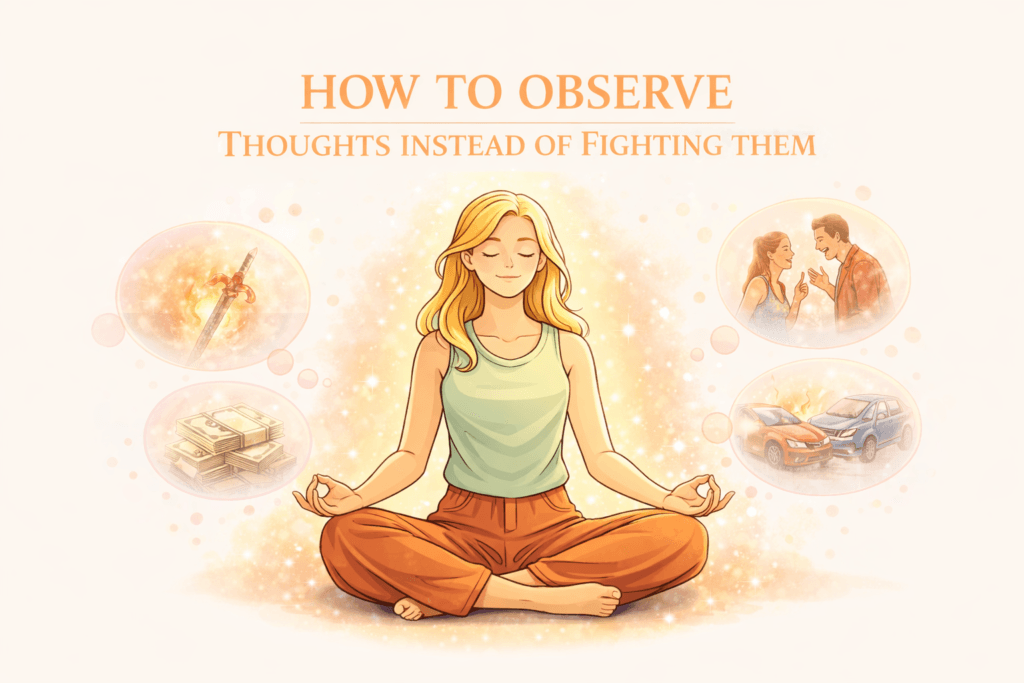
Learn how to observe thoughts instead of fighting them using simple, practical techniques rooted in yogic wisdom and mindful awareness.
The Instinct to Control What Cannot Be Controlled
There is a natural tendency to resist certain thoughts. The moment a thought appears that feels uncomfortable, distracting, or unwanted, the immediate response is to push it away. You try to replace it, suppress it, or distract yourself from it.
For a brief moment, this may seem to work. The thought fades, attention shifts, and there is a sense of control. But this control does not last. The same thought, or a similar one, returns, sometimes stronger, sometimes more persistent.
Over time, this creates a pattern. Thoughts are not just appearing; they are being fought. And in that process, the mind becomes more active, not less.
This is where a deeper understanding becomes necessary.
What the Yogic Perspective Suggests About the Mind
The Yoga Sutras of Patanjali does not describe the mind as something that should be forcefully controlled. Instead, it presents the mind as a field of continuous activity, thoughts, impressions, and fluctuations arising and dissolving.
These fluctuations, often referred to as vrittis, are not problems by themselves. They are natural movements within the mind.
The difficulty begins when there is identification with them or resistance against them.
Trying to eliminate thoughts directly often increases their intensity. This is not a failure of effort, it is the nature of the process.
Why Fighting Thoughts Strengthens Them
When you resist a thought, attention moves toward it. Even if the intention is to remove it, the mind is still engaged with it.
This engagement gives the thought more presence. It becomes more defined, more noticeable.
The more you try not to think something, the more clearly it appears.
This is not accidental. It reflects how attention works.
In Yogic understanding, what is observed without resistance gradually loses its hold. What is resisted tends to persist.
The Shift from Control to Observation
Observation is not the same as passivity. It is a different kind of engagement.
Instead of trying to change the thought, you notice it:
- How it arises
- How it moves
- How it fades
This shift may seem simple, but it changes the entire dynamic.
The thought is no longer something to fight. It becomes something to observe.
What Does It Mean to Observe a Thought?
Observation is not analysis. It is not trying to understand why the thought came or what it means.
It is simply noticing:
“There is a thought.”
You do not follow it. You do not suppress it. You do not expand it.
You remain aware of its presence without becoming involved in it.
This creates a subtle distance between you and the thought.
The Role of Non-Identification
One of the key ideas reflected in the Yoga Sutras of Patanjali is that the observer and the activity of the mind are not the same.
When this distinction is not clear, every thought feels personal and immediate.
When observation develops, a shift happens:
- Thoughts are seen as events
- Not as identity
This does not remove thoughts, but it changes the relationship with them.
Why Observation Feels Difficult at First
At the beginning, observation does not feel natural. The mind quickly gets pulled into thoughts.
You may notice a thought, and within seconds, you are already involved in it.
This is not a mistake. It is the current habit of the mind.
The practice is not about staying detached all the time. It is about noticing when you get pulled in, and returning to observation.
The Support of Breath
The Hatha Yoga Pradipika highlights the close relationship between breath and mind.
When the mind is restless, breath becomes irregular. When breath is steady, the mind begins to settle.
Observing the breath provides an anchor.
When a thought arises:
- You notice it
- You return attention to the breath
This is not suppression. It is redirection without force.
The Role of Moderation and Balance
The Bhagavad Gita emphasizes moderation, not only in action, but also in internal response.
This principle applies here as well.
Extreme control leads to tension. Complete indulgence leads to distraction.
Observation lies between these extremes. It neither suppresses nor follows.
Understanding the Nature of Thoughts
Thoughts are not constant. They arise, stay for a moment, and pass.
When you observe closely, you begin to notice this pattern.
A thought that feels strong at one moment fades in the next.
This shows that thoughts do not sustain themselves. They are sustained by attention.
When attention is withdrawn, their intensity reduces naturally.
The Space Between Thoughts
As observation develops, you begin to notice small gaps between thoughts.
These gaps are often overlooked because attention is usually caught in the content of thinking.
But these gaps are important. They show that the mind is not continuously active, it moves in patterns.
Recognizing this creates a different relationship with thinking.
From Reaction to Awareness
Without observation, thoughts trigger immediate reactions.
- A stressful thought creates tension
- A negative thought creates resistance
- A pleasant thought creates attachment
With observation, this chain begins to slow down.
You see the thought before reacting to it.
This moment of seeing changes everything.
Why This Is Not About Stopping Thoughts
The goal is not to eliminate thinking. That approach leads back to resistance.
The aim is to understand the nature of thoughts.
When understood, their influence reduces.
They continue to arise, but they no longer dominate attention in the same way.
Practicing in Daily Life
This is not limited to formal meditation.
During the day:
- Notice when a thought pulls attention
- Pause for a moment
- Observe without reacting
Even brief moments of observation begin to change the pattern.
The Gradual Nature of Change
This shift does not happen instantly. It develops through repeated observation.
At first, you may notice thoughts occasionally.
Then, more frequently.
Eventually, observation becomes more continuous.
This is not a sudden transformation. It is a gradual refinement.
Trying to fight thoughts often leads to a cycle where the mind becomes more active and resistant. What appears as control is usually temporary, and the same patterns return with greater intensity.
A different approach begins when observation replaces resistance. Instead of pushing thoughts away or getting carried by them, they are seen as movements that arise and pass within the mind. This simple shift creates distance, not by force, but through clarity.
The insights reflected in
- Yoga Sutras of Patanjali
- Bhagavad Gita
- Hatha Yoga Pradipika
point toward a consistent direction, balance, awareness, and steady observation. When this understanding is applied, the relationship with thoughts begins to change. They are no longer something to control or avoid, but something to see clearly.
And in that clarity, the mind gradually becomes less reactive, not because thoughts disappear, but because their hold begins to loosen.