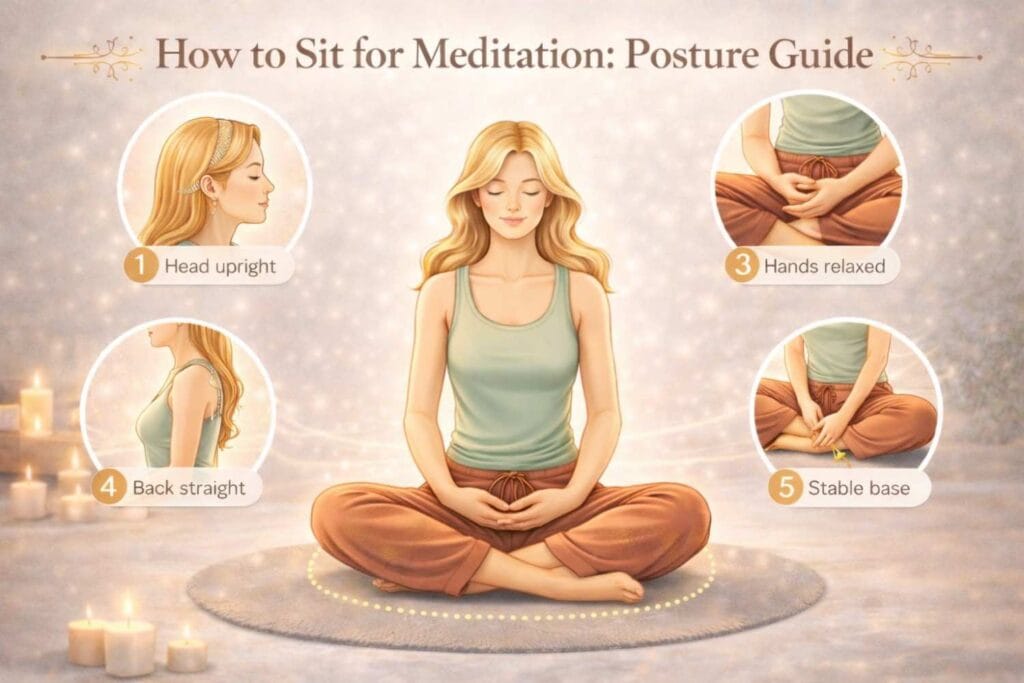
Sitting correctly is essential for meditation. This guide explains how to create a steady and comfortable posture based on classical Yogic texts for better focus and stability.
Why Posture Matters Before Meditation
When most people begin meditation, they focus on the mind. They try to concentrate, observe thoughts, or follow the breath. Very little attention is given to how they are sitting. It is often assumed that posture is secondary, something that can be adjusted later.
However, in the classical understanding found in the Yoga Sutras of Patanjali, posture is not separate from meditation. It is a necessary condition for it. If the body is unstable or uncomfortable, attention is repeatedly pulled back toward physical sensation. This makes continuity of attention difficult.
Meditation does not fail because the method is wrong. It often becomes difficult because the body is not prepared to remain still.
The Classical Requirement: Stability and Ease
The Yoga Sutras defines posture in a very concise way. It describes it as steady and comfortable. This definition applies directly to meditation.
If the posture is not steady, the body keeps shifting. Even small movements break continuity. If the posture is not comfortable, strain builds over time, and the mind becomes occupied with discomfort.
Both conditions interrupt meditation.
This is why posture is not about appearance or correctness in form. It is about creating a condition where the body can remain without disturbance.
The Seat According to the Bhagavad Gita
The Bhagavad Gita provides a very clear description of how one should sit for meditation. It suggests choosing a clean, quiet place and establishing a stable seat. The posture should not be too high or too low, and the body should be held upright.
It also emphasizes alignment. The spine, neck, and head are to be kept in a straight line, without strain.
This is not about rigidity. It is about balance.
If the body collapses, dullness increases. If it is held too tightly, tension increases. The posture must allow alertness without discomfort.
The Role of Asana in Meditation
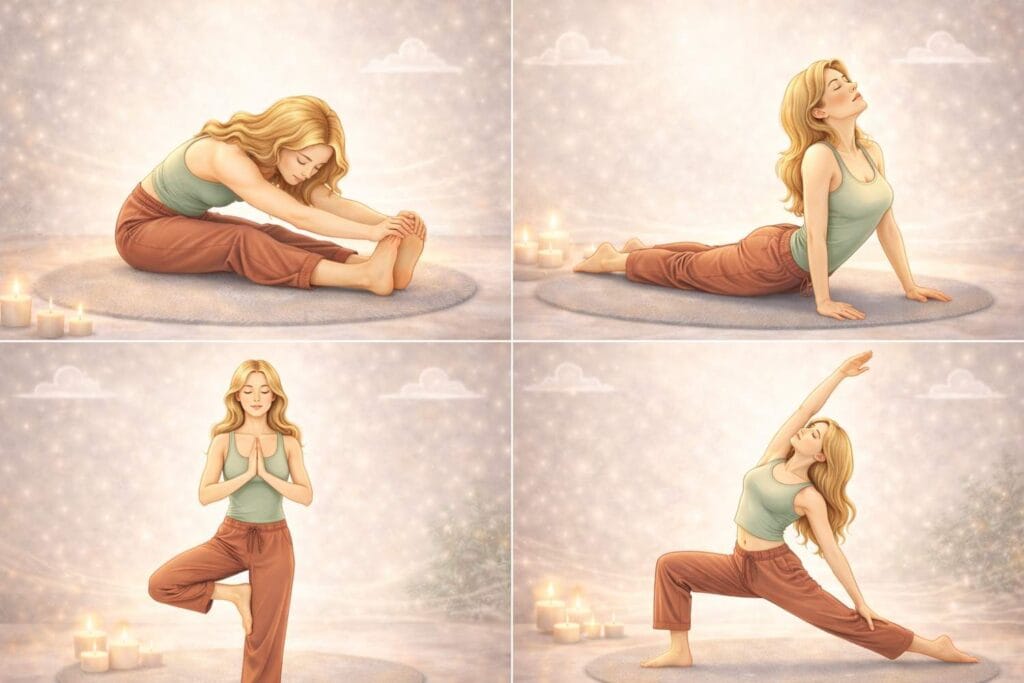
Before meditation, the body must be brought into a condition where it can remain still. This is where asana plays its role.
As explained in the Hatha Yoga Pradipika, postures are practiced to create steadiness and reduce restlessness. The aim is not complexity, but stability.
Certain seated postures are traditionally used for meditation because they provide a stable base. These include simple cross-legged positions or other postures that can be maintained comfortably.
The exact form is less important than the function.
Choosing a Suitable Posture
There is no single posture that works for everyone.
The requirement remains the same: stability and ease.
For some, a cross-legged posture on the floor works well. For others, sitting on a cushion or even a chair may be more appropriate.
What matters is:
- The body can remain still
- The spine can remain upright
- There is no excessive strain
If a posture cannot be maintained for the duration of meditation, it is not suitable, regardless of how traditional it may appear.
The Spine: Central to Stability
One of the most consistent instructions across texts is the alignment of the spine.
An upright spine supports alertness. It allows the breath to move freely and reduces pressure on different parts of the body.
If the spine collapses, breathing becomes restricted, and the mind tends to become dull. If it is held too rigidly, tension builds.
The posture should feel naturally upright, not forced.
This balance develops with practice.
The Position of the Hands
The hands are usually placed in a relaxed position, either on the knees or in the lap.
There is no strict requirement regarding hand gestures. The purpose is simply to avoid unnecessary tension.
If the hands are placed in a way that creates strain, it affects the overall posture.
The principle remains the same: simplicity and ease.
The Role of the Breath
Once the posture is established, the breath becomes more noticeable.
In the Hatha Yoga Pradipika, the connection between breath and mind is emphasized clearly. When the breath is unsteady, the mind tends to be unsteady. When the breath becomes even, the mind begins to settle.
A stable posture allows this regulation to happen naturally.
If the posture is disturbed, the breath becomes irregular, and meditation becomes more difficult.
Stillness Is Gradual
Many beginners expect to sit still immediately.
This is rarely possible.
The body has habits, small movements, adjustments, reactions to discomfort. These do not disappear instantly.
Instead of forcing stillness, it is more useful to allow the body to settle gradually.
Each time you notice movement, reduce it gently.
Over time, the need to move decreases.
Common Mistakes in Meditation Posture
There are a few common patterns that make posture difficult.
One is trying to sit too rigidly. This creates tension and leads to discomfort.
Another is collapsing the body, which leads to dullness.
A third is choosing a posture that cannot be maintained.
All of these create interruption.
The aim is not perfection, but sustainability.
The Role of Environment
The Bhagavad Gita emphasizes the importance of environment. A clean, quiet place supports stability.
External disturbance affects posture indirectly. If the environment is noisy or uncomfortable, the body reacts.
Choosing a consistent place for practice helps the body settle more quickly.
Over time, the association between place and stillness becomes stronger.
Duration and Practical Approach
For beginners, it is better to start with shorter durations.
A posture that can be maintained for ten minutes without strain is more useful than one that creates discomfort after two minutes.
Consistency matters more than duration.
As the body adapts, the duration can increase naturally.
What Begins to Change
With regular practice, posture becomes less of a concern.
The body settles more quickly.
The need for adjustment reduces.
The breath becomes more even.
Attention begins to remain for longer periods.
These changes are gradual, but they indicate that the posture is supporting the process.
A Subtle Shift
At some point, the posture stops feeling like something you are “doing.”
It becomes a condition.
The body remains, but it no longer demands attention.
This is when meditation begins to develop more naturally.
Conclusion
Sitting for meditation is not about achieving a perfect position. It is about creating a posture that is steady, comfortable, and sustainable.
The guidance from the Yoga Sutras, the Bhagavad Gita, and the Hatha Yoga Pradipika all point in the same direction, stability, ease, and balance.
When the body is prepared in this way, it no longer interferes with attention. And when that interference reduces, meditation becomes less of an effort and more of a natural continuation.