
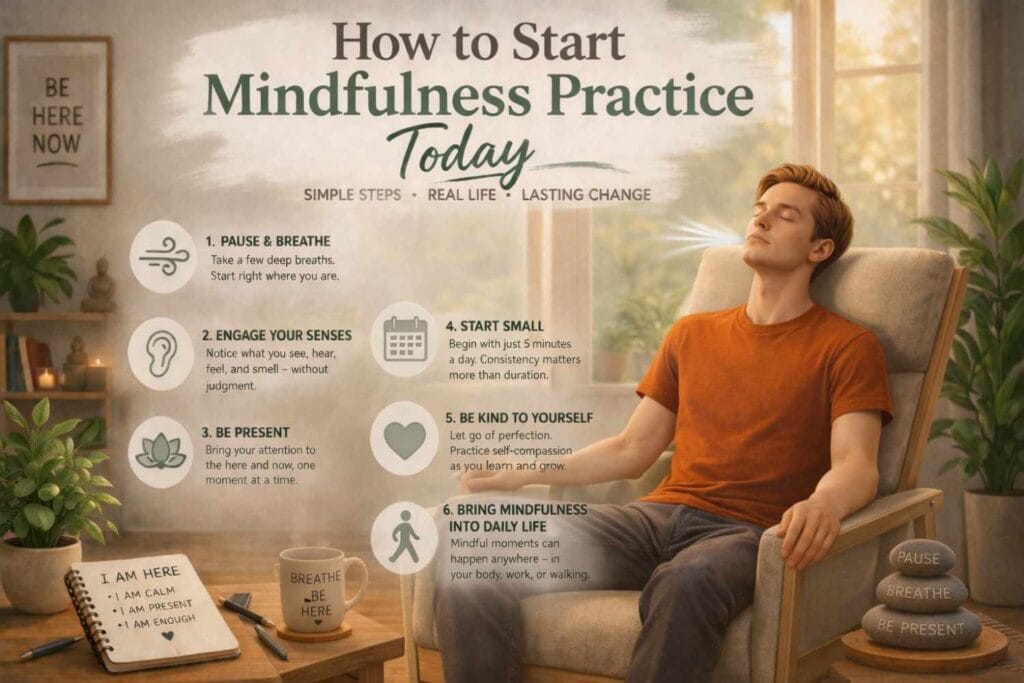
Starting mindfulness can feel confusing at first. This guide explains how to begin simply by observing breath, attention, and daily patterns without overcomplicating the practice.
Beginning Without Turning It Into Another Task
Most people come to mindfulness because something feels off. The mind is constantly active, attention feels scattered, and even rest does not feel complete. The natural response is to look for a method to fix this, something structured, something that can be applied immediately.
That is where confusion begins.
Mindfulness is often presented as a technique to practice, something you “do” for a few minutes each day. But when seen through the lens of the Yoga Sutras of Patanjali, what is being described is not a technique, but a shift in how experience is observed.
This difference is important. Because if mindfulness is treated as just another task, it becomes part of the same pattern it is meant to reveal.
What Mindfulness Actually Refers To
The word “mindfulness” is used widely today, but its meaning often becomes diluted. It is associated with calmness, relaxation, or stress relief.
While these may appear as effects, they are not the definition.
In Yogic understanding, the emphasis is on awareness, seeing what is happening without immediately reacting to it. This is closely related to the observation of mental activity described in the Yoga Sutras.
Thoughts arise, change, and disappear continuously. Most of the time, this happens unnoticed. Mindfulness begins when this activity is seen clearly.
Not controlled. Not suppressed. Observed.
Why It Feels Difficult in the Beginning
When someone tries to be mindful, the first experience is rarely calm. Instead, the mind appears more active than before. Thoughts seem louder, more frequent, more distracting.
This often leads to the conclusion that mindfulness is not working.
In reality, the opposite is happening.
The activity was always present. It is now being noticed.
The Yoga Sutras describes the mind as naturally fluctuating. Mindfulness does not create these fluctuations. It makes them visible.
Understanding this prevents unnecessary frustration.
Starting with Simple Observation
Beginning mindfulness does not require a complex method. It begins with something very simple, observation.
Sit quietly for a few minutes. Bring attention to the breath.
Not to control it, but to notice it.
The mind will move. Thoughts will appear. Attention will shift.
Each time this happens, bring it back gently.
This is not a failure. This is the practice.
The Role of the Body in Mindfulness
The Hatha Yoga Pradipika emphasizes that the body and mind are interconnected. When the body is restless or tense, attention becomes unstable.
For this reason, posture matters.
You do not need a complex sitting position. You need a stable one.
A posture that can be maintained without strain allows the body to become less distracting. This supports observation.
The Influence of Breath
Breath plays a central role in mindfulness, even if it is not always emphasized.
When the breath is uneven, the mind tends to follow. When the breath becomes steady, attention becomes easier to maintain.
This is not something you need to force.
It develops naturally when you observe the breath consistently.
Bringing Mindfulness into Daily Life
Mindfulness is often limited to sitting practice, but its relevance extends beyond that.
The Bhagavad Gita emphasizes awareness in action. It does not separate practice from daily life.
This means mindfulness can be applied while walking, eating, or working.
Not by doing something extra, but by paying attention to what is already happening.
Why Consistency Matters More Than Duration
A common question is how long mindfulness should be practiced.
But duration is not the most important factor.
Consistency is.
A few minutes daily, practiced regularly, is more effective than occasional long sessions.
This aligns with the principle of sustained practice described in the Yoga Sutras.
The Problem of Trying Too Hard
Many beginners approach mindfulness with effort.
They try to control thoughts, maintain perfect focus, or achieve a certain state.
This creates tension.
Mindfulness does not develop through force. It develops through observation.
Trying too hard often creates the very disturbance one is trying to remove.
What Changes Over Time
With consistent practice, subtle changes begin to appear.
Attention stays slightly longer. The need to react to every thought reduces. There is a small space between one thought and the next.
These changes are not dramatic, but they are meaningful.
They indicate that awareness is becoming more stable.
The Role of Discipline
The Bhagavad Gita speaks about balance and discipline.
Mindfulness requires both.
Discipline to practice regularly, and balance to avoid forcing it.
Too much effort creates resistance. Too little effort creates inconsistency.
The middle approach supports continuity.
Mindfulness Is Not About Eliminating Thoughts
A common misconception is that mindfulness means having no thoughts.
This creates unnecessary struggle.
The aim is not to stop thoughts immediately, but to change the relationship with them.
Thoughts may still arise, but they are not followed in the same way.
This reduces their intensity over time.
A Practical Way to Begin Today
Starting mindfulness today does not require preparation.
You can begin with a simple structure.
Sit quietly.
Observe the breath.
Notice when attention moves.
Bring it back gently.
This can be done for a few minutes.
That is enough.
What to Expect and What Not to Expect
It is important to approach mindfulness without unrealistic expectations.
You may not feel calm immediately. The mind may remain active.
This does not mean the practice is ineffective.
The changes are gradual.
Over time, awareness becomes more consistent, and reactivity reduces.
Beyond Formal Practice
As mindfulness develops, it begins to extend beyond sitting.
You notice thoughts more quickly. You react less immediately. There is a slight pause before action.
This pause is significant.
It changes how you respond to situations.
Mindfulness is often approached as a technique to be applied. But when understood through the Yoga Sutras, the Bhagavad Gita, and the Hatha Yoga Pradipika, it becomes something more fundamental.
It is the ability to observe without immediate reaction.
Starting this practice does not require experience or preparation.
It requires beginning with simple observation and continuing consistently.
Over time, this observation becomes more stable.
And in that stability, the relationship with the mind begins to change, not suddenly, but gradually, in a way that does not depend on effort alone.