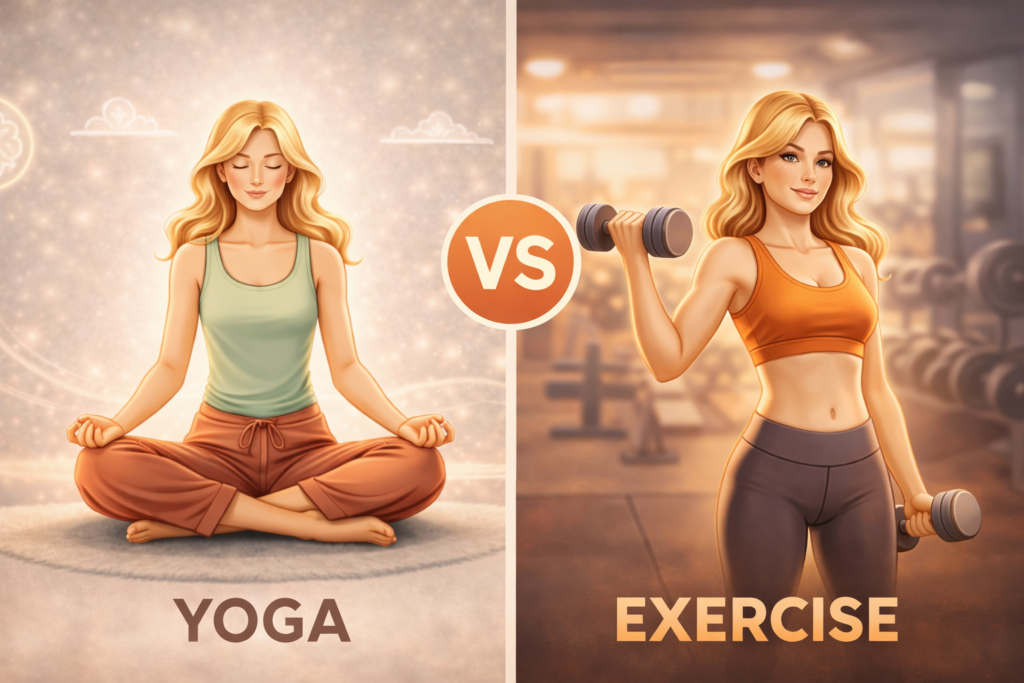
Yoga is often confused with exercise. This guide explains the real difference using Ancient texts.
Yoga vs Exercise: What Is the Real Difference?
At a glance, Yoga and exercise can appear similar. Both involve movement. Both can improve flexibility, strength, and general physical condition. In many contemporary settings, Yoga is even categorized as a form of exercise, placed alongside stretching routines, mobility work, or low-impact fitness practices.
But this similarity is mostly superficial.
If one looks at Yoga through its classical sources, particularly the Yoga Sutras of Patanjali, the Bhagavad Gita, and the Hatha Yoga Pradipika, it becomes clear that Yoga and exercise operate on fundamentally different premises.
The difference is not merely in technique, but in intention, structure, and outcome.
The Purpose of Exercise
To understand the distinction clearly, it is useful to begin with exercise.
Exercise, in its general sense, is designed to improve physical performance and health. It may aim to increase strength, endurance, flexibility, or cardiovascular efficiency. Its outcomes are measurable- weight, muscle tone, stamina, or physical capacity.
The body is both the starting point and the primary focus.
Even when exercise contributes to mental well-being, this is usually understood as a secondary effect, something that follows from physical exertion.
There is nothing inherently limited about this. Exercise serves an important function. But its scope is defined.
The Starting Point of Yoga
Yoga begins from a different place.
In the Yoga Sutras, Yoga is defined not in terms of the body, but in terms of the mind:
“योगश्चित्तवृत्ति निरोधः”
Yoga is the cessation of the fluctuations of the mind.
This definition is precise. It does not describe movement, posture, or physical activity. It identifies Yoga as a process concerned with the regulation of mental activity.
This does not mean that the body is ignored. But it is not the primary focus.
From the outset, Yoga is oriented toward understanding and stabilizing the internal condition of the individual.
A Difference in Orientation
One way to understand the distinction is through orientation.
Exercise is outwardly oriented. It works with visible aspects of the body and produces visible results.
Yoga, while it may involve outward practices, is inwardly oriented. Its primary concern is not how the body appears or performs, but how the mind functions.
This difference in orientation influences every aspect of practice.
In exercise, movement is often driven by repetition and intensity. In Yoga, movement is used to prepare the system for stillness and observation.
The Role of Asana: Often Misunderstood
The confusion between Yoga and exercise arises largely from the practice of Asana.
In modern contexts, Asana is often treated as the entirety of Yoga. It is practiced for flexibility, strength, and alignment, and it can resemble forms of physical training.
However, in classical texts, Asana has a more specific role.
In the Yoga Sutras, Asana is described briefly and functionally, as a posture that is steady and comfortable. It is not elaborated into complex sequences or physical achievements.
In the Hatha Yoga Pradipika, Asana is developed further, but still with a clear purpose: to prepare the body so that it can remain stable for extended periods, allowing deeper practices to take place.
In both cases, Asana is not the goal. It is a means.
When Asana is isolated from this context, it begins to resemble exercise. But within the structure of Yoga, it serves a different function.
The Place of Effort
Another difference lies in how effort is applied.
Exercise often emphasizes exertion. Progress is associated with pushing limits: lifting heavier, running longer, increasing intensity.
In Yoga, effort is approached more carefully.
The aim is not to exhaust the system, but to balance it. Excessive strain is seen as counterproductive because it can disturb the steadiness required for further practice.
This does not mean that Yoga lacks discipline. It requires consistency and attention. But the nature of effort is different. It is directed toward stability rather than intensity.
Breath and Regulation
The role of breath further highlights the distinction.
In exercise, breathing adjusts naturally to support physical demand. It is reactive.
In Yoga, particularly as described in the Hatha Yoga Pradipika, breath is actively regulated through practices such as Pranayama.
This regulation is not for performance enhancement. It is used to influence the state of the mind.
The text makes a clear observation: when the breath is unsteady, the mind is unsteady. When the breath becomes steady, the mind follows.
This introduces a level of subtlety that is not typically present in exercise. The body and breath are used as entry points to influence internal states.
The Dimension of Awareness
Perhaps the most significant difference lies in awareness.
Exercise can be performed with varying levels of attention. It is possible to complete a workout while the mind is occupied elsewhere: thinking, planning, or distracted.
In Yoga, awareness is not optional. It is central.
Every movement, posture, or breath is meant to be observed. The quality of attention matters as much as the action itself.
Without awareness, the practice loses its defining characteristic.
This is where Yoga begins to separate clearly from exercise. It is not just about what is done, but how it is experienced.
The Role of the Bhagavad Gita
The Bhagavad Gita adds another dimension by extending Yoga beyond formal practice.
It describes Yoga as equanimity and as skill in action.
This shifts the focus from isolated sessions to the entirety of life.
In this context, Yoga is not confined to a mat or a routine. It is reflected in how one responds to situations, how one acts under pressure, and how one maintains balance in changing circumstances.
Exercise, by contrast, remains largely confined to specific periods of activity.
Outcomes: External vs Internal
The outcomes of exercise are largely external and measurable.
Strength increases. Endurance improves. The body changes in visible ways.
The outcomes of Yoga are more internal.
Attention becomes more stable. Reactions become less immediate. There is greater clarity in perception.
These changes are not always visible, and they may develop gradually. But they affect how experience is processed.
This difference in outcomes reflects the difference in purpose.
Why the Confusion Persists
The confusion between Yoga and exercise is understandable.
Modern exposure to Yoga is often through physical practice. Classes emphasize sequences, alignment, and physical progress. The deeper aspects are either minimized or presented separately.
Over time, this creates the impression that Yoga is simply a form of exercise with additional benefits.
But when the practice is viewed through its classical sources, it becomes clear that this is only a partial representation.
Can Yoga Include Physical Benefits?
It is important to clarify that Yoga does not exclude physical benefits.
Regular practice can improve flexibility, strength, and overall health. These are natural outcomes.
But they are not the defining purpose.
In Yoga, physical benefits are supportive. They create conditions that make deeper practices possible. They are not the end point.
A Subtle but Important Shift
The real difference between Yoga and exercise can be understood as a shift in emphasis.
In exercise, the body is the primary focus, and the mind follows.
In Yoga, the mind is the primary focus, and the body supports the process.
This shift may appear small, but it changes the entire nature of practice.
Integrating Both Without Confusion
There is no need to reject exercise in order to practice Yoga. Both can coexist.
Exercise can support physical health. Yoga can address internal stability.
The important thing is not to confuse one for the other.
When Yoga is reduced to exercise, its depth is lost. When it is understood in its full context, it becomes something more than a physical routine.
Yoga and exercise may share certain external similarities, but they differ fundamentally in intention, structure, and outcome.
Exercise works primarily with the body, aiming to improve physical capacity. Yoga, as described in classical texts, works with the mind, aiming to bring clarity and stability.
Through the Yoga Sutras, the Bhagavad Gita, and the Hatha Yoga Pradipika, Yoga is presented not as a system of physical training, but as a method of understanding and refining human experience.
When this distinction is understood, practice changes.
Movement becomes more deliberate. Attention becomes more central. The purpose becomes clearer. And Yoga, instead of being another form of exercise, begins to reveal itself as something much more comprehensive.