
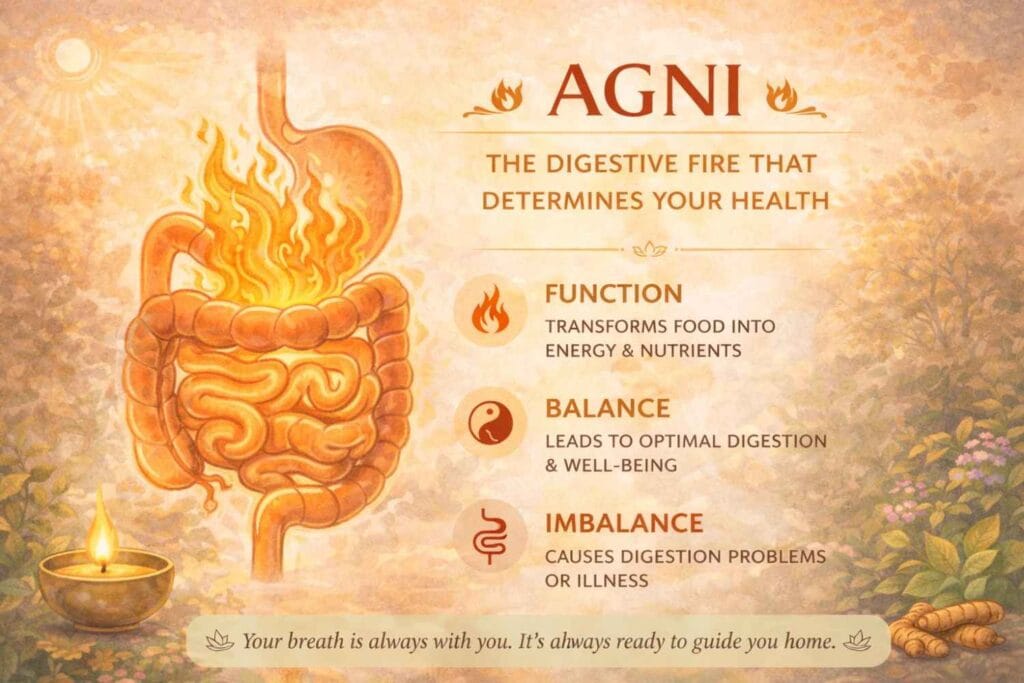
Understand the role of Agni in digestion and why it is central to energy, clarity, and overall well-being.
Health Does Not Begin with Food, It Begins with Digestion
Most discussions about health begin with what to eat, types of food, nutrients, diets, and restrictions. But traditional understanding approaches this differently. It does not begin with food itself, but with the body’s ability to process it.
Two people may eat the same meal, yet experience completely different results. One feels energized and stable, while the other feels heavy, dull, or disturbed. The difference does not lie in the food alone, but in the capacity to digest and assimilate it.
This capacity is described in Ayurveda as Agni, often translated as digestive fire. But Agni is not limited to physical digestion. It represents the entire process through which the body transforms what it receives, food, sensory input, and even experience, into usable energy and clarity.
Understanding Agni Beyond Physical Digestion
Agni is often simplified as stomach digestion, but this is only one aspect of it. In Ayurvedic understanding, Agni functions at multiple levels:
- Breaking down food into nutrients
- Absorbing and distributing energy
- Eliminating what is not needed
If Agni functions well, nourishment is complete. If Agni is disturbed, even the best food cannot be utilized properly.
This shifts the focus from what is eaten to how it is processed.
The Link Between Agni and Balance
The Bhagavad Gita emphasizes moderation and balance in food and lifestyle. It suggests that excess or deficiency, whether in eating, sleeping, or activity, disturbs the system.
This directly relates to Agni.
- Overeating weakens digestion
- Undereating reduces strength
- Irregular eating disturbs rhythm
Agni functions best when there is consistency and moderation.
Types of Agni: Not All Digestion Is the Same
Ayurveda describes different states of Agni, reflecting how digestion behaves:
- Balanced Agni (Sama Agni)
Digestion is steady. Food is processed efficiently. Energy remains stable.
- Weak Agni (Manda Agni)
Digestion is slow. Food remains partially processed, leading to heaviness and dullness.
- Irregular Agni (Vishama Agni)
Digestion fluctuates. Sometimes strong, sometimes weak. This leads to inconsistency.
- Intense Agni (Tikshna Agni)
Digestion is overly strong. Food is processed quickly, but may lead to depletion or imbalance.
These variations show that digestion is not fixed, it changes based on lifestyle, habits, and internal state.
Agni and the Formation of Imbalance
When Agni is disturbed, food is not fully processed. This leads to the formation of Ama, a concept in Ayurveda referring to undigested or improperly processed substances.
Ama does not only affect the body physically. It influences:
- Energy levels
- Mental clarity
- Overall functioning
When accumulation increases, the system becomes burdened.
This shows that health is not only about intake, but about complete processing and elimination.
The Role of Breath and Internal Fire
The Hatha Yoga Pradipika highlights the relationship between breath and internal processes.
Breath influences the movement of energy within the body. When breath is steady, internal functions, including digestion, become more balanced.
Irregular breathing patterns can disturb this balance, indirectly affecting Agni.
This connection shows that digestion is not isolated. It is linked with breath, movement, and internal regulation.
Agni and the State of the Mind
Agni is not only physical. It also reflects how the mind processes information.
- Strong, balanced Agni → clarity and steadiness
- Weak or disturbed Agni → confusion and dullness
The Yoga Sutras of Patanjali emphasizes clarity of mind as essential for understanding.
If the system is burdened, the mind reflects that burden.
This shows that digestion and mental clarity are not separate processes.
Daily Habits That Influence Agni
Agni is influenced by how you live, not just what you eat.
Regular Timing
Eating at consistent times supports rhythm. Irregular timing disturbs digestion.
Quantity
Eating more than required burdens the system. Eating too little weakens it.
Attention
Eating with distraction affects how food is processed. Awareness supports digestion.
Rest and Activity
Both excessive activity and inactivity can disturb balance.
These factors show that Agni is maintained through daily patterns, not isolated actions.
The Importance of Simplicity in Food
Simplicity in food is not restriction, but reducing the burden on digestion. When meals become too complex, the body struggles to process everything efficiently, which weakens Agni and leads to heaviness or inconsistency. Simple meals allow clearer digestion and more complete nourishment, as the body can process food without overlap.
Simplicity also restores rhythm. When food is consistent and uncomplicated, hunger becomes clearer and digestion more stable. As reflected in the Bhagavad Gita, moderation supports balance, not just in quantity, but in approach. This allows Agni to function smoothly, supporting steady energy and clarity.
Signs of Balanced Agni
When Agni is balanced, the body functions with a quiet sense of consistency. Digestion does not draw attention to itself, it works smoothly, without discomfort or irregularity. Hunger arises naturally, energy remains steady, and the body feels light rather than burdened. This balance is not dramatic; it is reflected in how effortlessly the system processes what it receives.
Some clear indications of balanced Agni include:
- Natural and timely hunger without extremes
- A feeling of lightness after meals, not heaviness
- Stable energy levels throughout the day
- Clear digestion without discomfort or irregularity
- A sense of mental clarity and reduced dullness
Along with physical signs, there is also a subtle mental steadiness. Thoughts are less scattered, reactions are less impulsive, and there is a general sense of ease in functioning. Balanced Agni is recognized not by intensity, but by consistency and clarity in both body and mind
Signs of Disturbed Agni
When Agni is disturbed, digestion becomes inconsistent and less efficient. Hunger may fluctuate, sometimes excessive, sometimes absent, and meals often leave a sense of heaviness or discomfort. Energy levels become irregular, and the body no longer processes food with clarity, leading to a gradual feeling of sluggishness.
Some common signs include:
- Irregular or unclear hunger
- Heaviness or bloating after meals
- Fluctuating energy and fatigue
- Incomplete digestion or sluggishness
- Reduced clarity or increased restlessness
This disturbance is not limited to the body; it reflects in the mind as well. Focus becomes uneven, reactions less balanced, and overall stability decreases, showing that Agni influences both physical and mental functioningly.
The Relationship Between Moderation and Agni
Agni functions best in conditions of moderation, where neither excess nor deficiency disturbs its natural rhythm. When food, activity, and lifestyle remain balanced, digestion becomes steady and efficient, allowing the body to process and assimilate nourishment without strain.
Excess, whether in eating, stimulation, or irregular habits, overburdens Agni, while deficiency weakens it, leading to instability in both energy and digestion. As reflected in the Bhagavad Gita, balance is not about strict control but about maintaining a natural equilibrium, where the system functions smoothly without extremes.
Building Agni Gradually
Agni is strengthened through consistency, not force. Sudden changes or extreme habits often disturb digestion rather than improve it. A gradual approach allows the body to adapt and restore balance naturally over time.
This can be supported through simple practices:
- Eating at regular times each day
- Choosing warm, simple, and easily digestible meals
- Avoiding overeating or long gaps between meals
- Maintaining a balanced routine of rest and activity
When these patterns are followed consistently, Agni becomes stable and efficient, supporting better digestion and overall balance without strain.
Why Agni Determines Health
Agni determines how effectively the body can transform what it receives into nourishment. It is not the quality of food alone that defines health, but the body’s ability to digest, absorb, and utilize it. When Agni is strong and balanced, even simple food supports energy, clarity, and stability. When it is weak or disturbed, even well-prepared food can become a burden rather than nourishment.
This can be understood through a few key points:
- Strong Agni → efficient digestion and steady energy
- Weak Agni → incomplete digestion and accumulation
- Balanced Agni → clarity in both body and mind
- Disturbed Agni → heaviness, inconsistency, and imbalance
In this way, Agni becomes central to health, not because of what is consumed, but because of how completely it is processed.
Agni represents the body’s ability to transform what it receives into something usable. It is not limited to digestion in the stomach, but extends to how the entire system processes food, energy, and experience. When this process is balanced, the body remains stable, energy flows steadily, and the mind reflects clarity.
The guidance reflected in
- Bhagavad Gita
- Yoga Sutras of Patanjali
- Hatha Yoga Pradipika
points toward moderation, consistency, and awareness.
When these are applied to eating and daily habits, Agni is supported naturally rather than forced into balance.
Over time, this creates a system that is not dependent on strict control, but functions with stability, where nourishment is not just consumed, but properly received and utilized.




1 thought on “Agni: The Digestive Fire That Determines Your Health”