
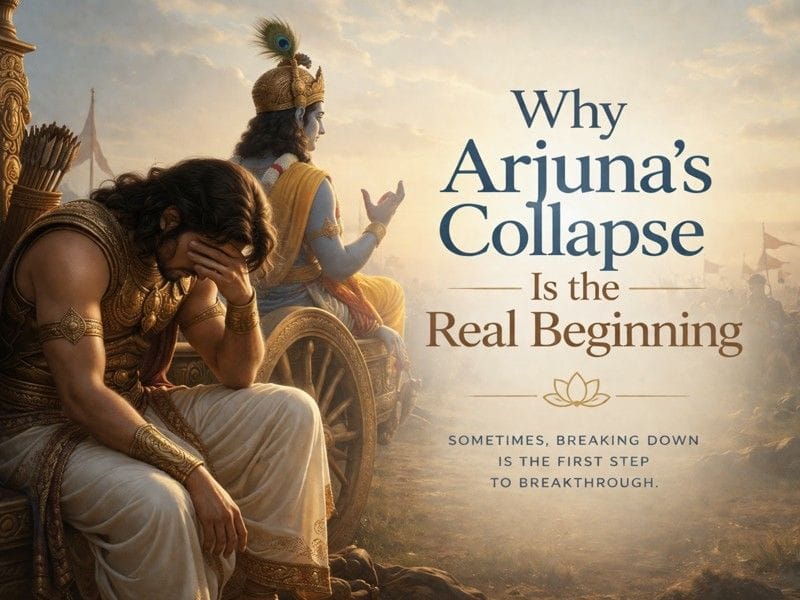
A deeper look at Arjuna’s collapse in the Bhagavad Gita and how it transforms action into inquiry and understanding.
The Moment Before Everything Changes
The scene at Kurukshetra is not a moment of uncertainty, it is the point where everything has already been decided externally. The armies are aligned, the conches have been sounded, and the structure of the conflict is complete. Nothing remains to be negotiated. From the perspective of action, there is only one direction left, to begin.
Arjuna stands in this moment not as someone doubtful, but as someone prepared. His training, his role, and his responsibility all point toward action. There is no visible hesitation in him yet. The situation, as it appears from the outside, is clear and defined.
Yet, just before the first movement toward action, he makes a request to Krishna, to place the chariot between the two armies. This request is simple, but it interrupts the momentum of the moment. It introduces a pause where there would otherwise be immediate action. He does not ask for instruction or reassurance. He asks to see.
The Act of Seeing
When Krishna places the chariot between the armies, nothing in the external situation changes. The same people are present, the same conflict remains, and the same outcome is at stake. But the position from which Arjuna now sees is different.
He is no longer standing at a distance, looking at a collective force. He is placed directly in front of those he must face. This removes abstraction. What was previously understood as “the opposing side” becomes specific and personal.
He sees Bhishma, his grandfather.
He sees Drona, his teacher.
He sees relatives, friends, and companions.
The categories of “enemy” and “ally” no longer hold in the same way. What he sees cannot be reduced to a role or a label. The situation becomes layered, where relationship and duty exist at the same time, without aligning with each other.
The battlefield has not changed, but his way of seeing it has. And that shift is enough to destabilize everything that seemed certain.
The First Signs of Collapse
Arjuna’s response does not begin with reasoning or argument. It begins in the body. His limbs weaken, his mouth dries, his body trembles, and his bow begins to slip from his hand. These are not symbolic expressions, they indicate that the system is no longer able to hold the situation as it was before.
This is important because it shows that the collapse is not a decision. It is not something he chooses. It arises as a direct response to what he now sees. The clarity of his role is no longer sufficient to contain the reality of the situation.
The disturbance moves from perception into the body. What was stable moments ago becomes unstable without any external change. The shift is entirely internal.
When Action Stops
As Arjuna begins to speak, his words do not carry the certainty of someone who knows what to do. Instead, they reflect what he is encountering. He speaks of those standing before him, of the consequences of war, and of the destruction that would follow.
His attention moves away from outcome and toward meaning. The question is no longer “Can I act?” but “What does this action lead to?”
This shift is gradual. There is no single moment where he decides to stop. Rather, the direction of his movement changes step by step. What was previously a movement toward action becomes a movement toward questioning.
Action does not end suddenly, it dissolves as clarity breaks.
The Refusal
Arjuna does not simply hesitate; he begins to question the foundation of the action itself. He asks what remains of victory if it comes at the cost of those he values. He considers not only the immediate act, but its consequences on relationships, order, and continuity.
These are not tactical concerns. They are not about strategy or success. They arise from a deeper conflict that has become visible.
His role as a warrior provided a clear direction earlier. Now, it no longer resolves the situation completely. Something within him recognizes that acting according to role alone may not address the full reality of what is before him.
This is where refusal begins, not as rejection, but as the inability to proceed with incomplete understanding.
The Breaking Point
As this conflict intensifies, Arjuna reaches a point where continuation is no longer possible. The internal tension between what he is expected to do and what he perceives becomes too great to hold together.
He lowers his bow.
He sits down in the chariot.
This is not a conclusion, it is a collapse of movement. He does not arrive at an answer. He arrives at a state where the previous direction can no longer be maintained.
The momentum toward action stops completely. Not because the situation has changed, but because his relationship to it has changed.
And it is in this stopping that something new becomes possible. Not action, but understanding.
Explanation
Why This Collapse Is Not a Failure
At first glance, Arjuna’s state appears as weakness, a warrior unable to act at the moment of action. From a surface perspective, this looks like a failure of resolve. But the Bhagavad Gita does not dismiss this state or correct it immediately. Instead, it allows the collapse to unfold fully, without interruption.
This indicates that something essential is taking place. Arjuna is not losing strength; he is encountering the boundary of what his current understanding can hold. The clarity that supported his action until this point is no longer sufficient for the situation as it now appears.
This kind of collapse is not a breakdown of capacity, it is a breakdown of assumption. What seemed clear before is no longer able to sustain itself when seen more deeply.
The Shift from Role to Reality
Before this moment, Arjuna’s identity as a warrior provides a complete framework. His role defines what he must do, and within that structure, action is straightforward. There is no need to question because the role already contains the answer.
But when he sees those before him, the situation expands beyond the limits of that role. It is no longer only about duty. It includes relationship, consequence, and meaning. These elements do not fit neatly into a single framework.
This shift is critical. The collapse begins not because the role is wrong, but because it is no longer sufficient. Reality has become more complex than the structure used to understand it. When this happens, the previous clarity cannot hold.
Why Seeing Leads to Breakdown
The collapse is not caused by the situation itself, but by seeing it more completely. As long as the battlefield can be understood in simple terms, opposition, strategy, outcome, action remains possible.
But when the same situation is seen through multiple dimensions at once, duty, relationship, consequence, it introduces tension. Each layer carries its own truth, and these truths do not align easily.
This creates a condition where action is no longer clear, even though it remains possible. The breakdown arises because understanding has deepened, but not yet resolved itself.
This shows that clarity is not always immediate. Sometimes, deeper seeing first brings uncertainty before it leads to a more stable form of understanding.
The Emergence of Real Questioning
Before the collapse, there is no need to question. Action is assumed, and the direction is already defined. The absence of questioning is not a sign of clarity, it is a sign that the situation has not yet been examined deeply.
After the collapse, questioning begins. Arjuna no longer assumes that action is self-evident. He begins to ask what it means, what it leads to, and whether it is right.
This is the true turning point. The Gita does not begin with answers imposed from outside. It begins with a question that arises from genuine conflict within. Without this conflict, there would be no depth to the inquiry, and without inquiry, no need for understanding.
The Difference Between Reaction and Inquiry
Arjuna’s state could have remained at the level of reaction. He could have withdrawn from the situation out of emotional disturbance and stopped there.
But instead, his confusion turns into inquiry. He does not only express discomfort, he begins to examine the basis of action itself. He asks what is right, what holds meaning, and what action truly is in a situation like this.
This shift is what gives the collapse its significance. It moves from being a reaction to becoming the beginning of understanding. The disturbance is not avoided, it is used as a point of investigation.
Why Action Had to Stop
As long as Arjuna is able to act without questioning, there is no opening for deeper clarity. Action continues based on existing understanding, even if that understanding is incomplete.
The stopping of action interrupts this continuity. It creates a pause where the usual movement forward is no longer possible.
This pause is not avoidance. It is a necessary condition in which the limitations of current understanding become visible. Only in this condition can something new emerge. Without stopping, there would be no space to see beyond what is already known.
The Role of Surrender
When Arjuna lowers his bow, he is not resolving the conflict. He is acknowledging that he does not know how to proceed. This acknowledgment is not passive, it is a clear recognition of limitation.
This marks a shift from certainty to openness. From acting based on what is assumed to be known, to being willing to understand what is not yet clear.
Surrender here does not mean giving up the situation. It means giving up the assumption that one already knows how to respond to it. This creates the condition in which guidance can be received.
Why the Gita Begins Here
Krishna does not begin speaking until Arjuna reaches this state. This is not incidental. Teaching is not introduced when there is certainty, because certainty leaves no room for it.
It begins when certainty breaks and openness appears. The collapse creates this openness. It removes the confidence that was based on incomplete understanding and replaces it with a willingness to see more clearly.
This is why the teaching begins here. Not because the situation changes, but because Arjuna becomes ready to understand it differently.
The Nature of a Real Beginning
A beginning is often imagined as a point of readiness, clarity, or strength. But in this case, the beginning appears as confusion and inability.
This suggests that a real beginning is not when everything is known, but when it becomes clear that what is known is not enough. It is the moment when previous understanding reaches its limit and something deeper becomes necessary.
This redefines the idea of starting. It is not the start of action, but the start of inquiry.
The Universal Relevance of This Moment
Although this moment occurs on a battlefield, its structure is not limited to that context. It reflects a pattern that appears whenever existing frameworks fail to hold a situation completely.
Moments where roles no longer provide clear answers, where responsibilities conflict, and where action is possible but not clear, these carry the same structure as Arjuna’s collapse.
Such moments are often experienced as setbacks, but they also contain the possibility of deeper understanding, if they are not avoided.
What This Collapse Makes Possible
Without this collapse, action would have continued, but without inquiry. There would have been certainty, but not understanding. Movement would have been present, but clarity would have been limited.
With the collapse, this changes. Inquiry begins. Understanding becomes necessary. A different kind of clarity, one not based on assumption, but on insight, becomes possible.
Final words
Arjuna’s collapse is not the interruption of the Bhagavad Gita, it is the point where the text truly begins to unfold. What appears outwardly as hesitation is, in fact, the moment where action is no longer supported by clear understanding. The certainty that once guided him does not disappear without reason; it breaks because it is no longer sufficient to hold the complexity of what he now sees.
In this pause, something significant shifts. The urgency to act gives way to the need to understand. Action is no longer driven by role or expectation, but held back by the recognition that its foundation is unclear. This is not weakness, it is a deeper form of honesty, where one does not proceed without clarity.
It is from this condition that the teaching of the Gita begins. Not as an instruction imposed from outside, but as a response to a genuine need that has arisen within. The beginning, then, is not marked by readiness or confidence, but by the recognition that what was previously known is no longer enough.
And it is precisely this recognition that opens the way for a deeper and more stable understanding to emerge.
Also read: Chapter 1: Arjuna Vishada Yoga – The Grief of Arjuna