Explore Chapter 1 of the Bhagavad Gita (Arjuna Vishada Yoga) with Sanskrit verses, English translation, and a deep explanation of Arjuna’s grief and dilemma.
Context Before the Teaching Begins
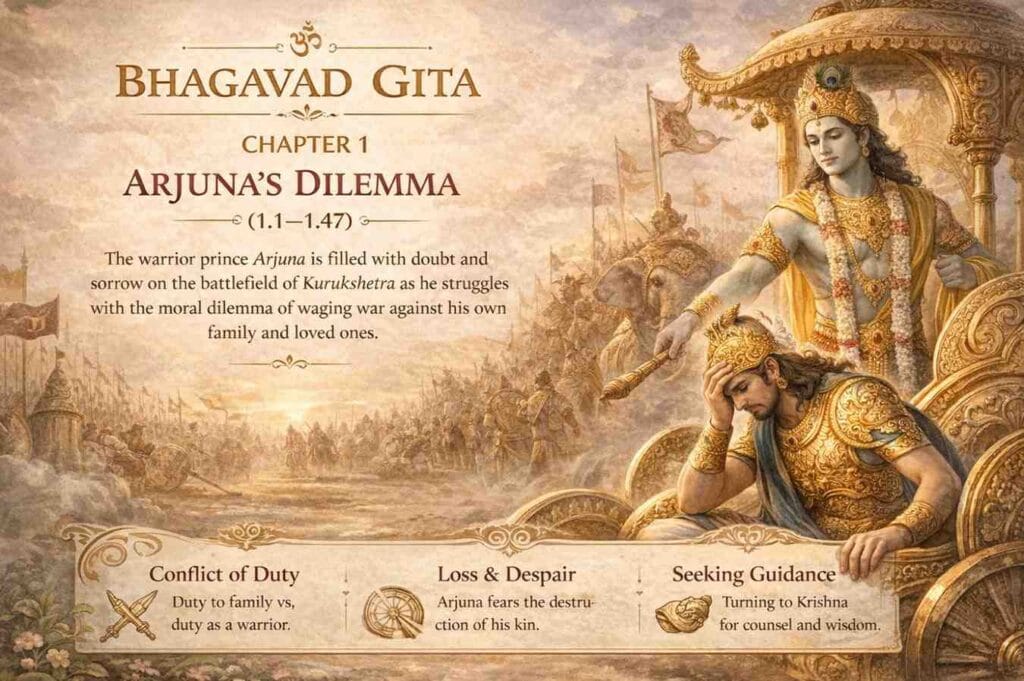
The first chapter of the Bhagavad Gita does not begin with philosophy, but with a situation where philosophy becomes necessary. The setting is the battlefield of Kurukshetra, where two sides stand prepared for war. This is not just a physical conflict, but a moment where action is unavoidable, yet clarity is absent. The dialogue that will unfold later arises from this exact condition, not from calm reflection, but from internal disturbance.
TRANSLATION (VERSES 1.1–1.47)
1.1
Dhritarashtra said: O Sanjaya, after assembling on the holy field of Kurukshetra and desiring to fight, what did my sons and the sons of Pandu do?
1.2–1.3
Sanjaya said: King Duryodhana, seeing the army of the Pandavas arranged in military formation, approached his teacher Drona and spoke these words: Behold, O teacher, this mighty army of the sons of Pandu, expertly arranged by your intelligent disciple.
1.4–1.6
Here are many heroic bowmen equal in fighting to Bhima and Arjuna; there are also great fighters like Yuyudhana, Virata, and Drupada; Dhrishtaketu, Chekitana, the king of Kashi, Purujit, Kuntibhoja, Shaibya; Yudhamanyu, Uttamauja, Abhimanyu, and the sons of Draupadi, all mighty warriors.
1.7–1.11
But for your information, O best of Brahmanas, let me tell you about the distinguished leaders of my army. There are personalities like yourself, Bhishma, Karna, Kripa, Ashvatthama, Vikarna, and others. Our strength is unlimited, protected by Bhishma, while theirs is limited, protected by Bhima. Therefore, all of you must support Bhishma.
1.12–1.19
Then Bhishma, the grandsire, blew his conch loudly, and after him, conches, drums, and horns were sounded. On the other side, Krishna and Arjuna also blew their divine conches, producing a sound that shook the hearts of the sons of Dhritarashtra.
1.20–1.23
Arjuna, seeing the armies ready for battle, took up his bow and said to Krishna: O Krishna, place my chariot between the two armies so that I may see those who have come here to fight.
1.24–1.25
Sanjaya said: Krishna placed the chariot between the two armies and said: Behold, O Arjuna, these assembled Kurus.
1.26–1.28
Arjuna saw fathers, grandfathers, teachers, uncles, brothers, sons, and friends. Seeing them, he was filled with compassion and spoke with sorrow.
1.29–1.30
My limbs are failing, my mouth is drying, my body is trembling, my hair stands on end. My bow slips from my hand, my skin burns, and my mind is confused.
1.31–1.32
I see no good in killing my own people. I do not desire victory, kingdom, or pleasures.
1.33–1.35
What is the use of kingdom or happiness when those for whom we desire them stand here ready to fight? Even if they kill me, I do not wish to kill them.
1.36–1.38
Sin will overcome us if we kill them. Though they are blinded by greed, why should we not refrain?
1.39–1.44
With the destruction of family, traditions are lost. When traditions are lost, unrighteousness prevails, leading to social disorder and decline.
1.45
Better for me if they kill me unarmed than to fight.
1.46–1.47
Sanjaya said: Arjuna, overwhelmed with sorrow, cast aside his bow and sat down in the chariot, his mind distressed.
The Beginning Is Not Peaceful – It Is Disturbed
The first chapter does not open with clarity, but with a subtle disturbance that gradually becomes visible. Dhritarashtra’s question itself carries uncertainty, he does not see the battlefield directly; he depends on Sanjaya to describe what is happening. This creates a sense of distance right from the beginning. The situation is unfolding, but it is not yet understood.
This is important because the Bhagavad Gita does not begin from certainty. It begins from a position where understanding is incomplete. The teaching that follows is not delivered into calmness, but into confusion.
The Battlefield as a Condition of Pressure, Not Just a Place
Kurukshetra is described as a sacred field, yet it is also a battlefield. This dual nature reflects the situation itself. It is not simply a location of conflict; it is a condition where action cannot be avoided. Arjuna is not placed in a position where he can step away and reflect calmly. He is already inside the situation.
This creates pressure. Not external pressure alone, but internal pressure where decision cannot be delayed. The mind is forced to respond, but it does not yet know how.
The Moment of Seeing – Where the Shift Truly Begins
The most significant turning point in the chapter is not when the war begins, but when Arjuna asks to see. This act of seeing changes everything. Until this point, the situation exists as an idea, two sides, a battle, a duty. But when he looks directly, abstraction turns into reality.
He does not see opponents. He sees people.
Fathers, teachers, relatives, companions, figures that belong to his life beyond the battlefield. The categories that once defined the situation dissolve, and something more immediate appears.
This is where the disturbance deepens. Because now, the situation cannot be handled through role alone. It demands a response from the whole being.
The Collapse Happens First in the Body
Before Arjuna begins to reason, his body responds. His limbs weaken, his mouth dries, his skin burns, his bow slips. These are not symbolic exaggerations. They indicate that the conflict has moved beyond thought into the entire system.
This is a crucial observation. The Bhagavad Gita does not present the mind as separate from the body. When clarity is disturbed, the disturbance spreads. The inability to act is not only mental, it becomes physical.
Arjuna does not drop his bow because he decides to. He drops it because he cannot hold it.
Emotion Appears as Compassion, But It Is Not Fully Clear
Arjuna’s first articulated response is compassion. He does not want to harm those who stand before him. This appears as a moral position, but the text allows us to see that it is not stable.
It arises suddenly, under pressure, and is accompanied by confusion, fear, and hesitation. This mixture shows that the compassion is not yet grounded in clarity. It is influenced by the emotional intensity of the moment.
This distinction is subtle but essential. Because action guided by confusion can appear similar to action guided by understanding, yet they are not the same.
The Mind Begins to Justify What It Feels
After the emotional reaction, Arjuna begins to construct arguments. He speaks about the destruction of family, the collapse of traditions, and the spread of disorder. These arguments are thoughtful and far-reaching. They show that he is not reacting blindly.
But they arise after the disturbance has already taken hold.
This suggests that the mind is attempting to organize and justify an internal state that has already formed. The reasoning is not independent, it is shaped by the condition of the mind.
This is not presented as a flaw, but as a natural movement of thought. When clarity is absent, the mind tries to create clarity through reasoning, even if that reasoning is influenced by emotion.
The Conflict of Identities Becomes Visible
Arjuna’s dilemma is not simply about whether to fight or not. It is about conflicting identities that cannot be resolved easily.
As a warrior, his duty is to act.
As a student, he feels reverence for his teachers.
As a relative, he feels attachment and concern.
Each of these identities carries its own logic, its own demand. When they align, action is clear. When they conflict, action becomes uncertain.
This fragmentation is at the heart of his dilemma. He is not lacking knowledge. He is facing multiple valid perspectives that do not point in the same direction.
The Fear Beneath the Surface Is Not of Death
Arjuna does not express fear of dying. In fact, he is willing to be killed.
What he fears is consequence.
The long-term impact of action, the burden of responsibility, the irreversible nature of what is about to happen, these are what disturb him. This kind of fear is more complex than immediate danger. It looks ahead and anticipates outcomes, making the present moment heavier.
This forward-looking awareness increases the difficulty of action, because every possible consequence becomes part of the decision.
The Desire to Withdraw Is a Response to Overwhelm
When the conflict becomes too intense, Arjuna expresses a desire not to act at all. He would rather be killed than participate.
This is not a resolution. It is a release from the pressure of choosing.
When the mind cannot reconcile opposing forces, it moves toward withdrawal. This withdrawal can appear as renunciation, but in this context, it is driven by inability rather than clarity.
The text does not judge this response. It presents it as it is, a natural outcome of unresolved conflict.
The Breakdown Is Not a Failure – It Is Exposure
The first chapter reveals something fundamental. Arjuna’s knowledge, training, and skill are all present, yet they are not enough in this situation.
This does not mean they are useless. It means they are incomplete.
The situation exposes the limits of what he currently understands. What worked before no longer works now.
This exposure is uncomfortable, but it is necessary. Without it, there would be no reason to seek deeper understanding.
Why the Chapter Ends Without Resolution
The chapter concludes with Arjuna sitting down, unable to act. This is not an answer, it is a pause.
The conflict remains unresolved. The tension is still present. Nothing has been solved.
But something has changed.
The certainty that existed before has been broken. The need for understanding has become clear.
This is where the teaching of the Bhagavad Gita begins, not by removing confusion immediately, but by starting from it.
What This Chapter Actually Establishes
The first chapter does not attempt to guide action. It prepares the ground for guidance.
It shows:
- That clarity can break under pressure
- That emotion can influence reasoning
- That identity can become fragmented
- That action becomes difficult when understanding is incomplete
By presenting these without resolution, it creates a space where deeper insight becomes necessary.
Conclusion
The first chapter of the Bhagavad Gita does not resolve Arjuna’s dilemma, it brings it fully into view. What begins as a moment before action gradually becomes a condition where action itself becomes uncertain. The shift does not come from the situation changing, but from the way it is seen, and in that shift, clarity begins to break.
Arjuna’s hesitation is not presented as weakness, but as a point where existing understanding is no longer sufficient. The conflict between duty, emotion, and consequence cannot be resolved through what he already knows.
And it is from this exact point, not from certainty, but from the recognition of confusion, that the deeper inquiry of the Gita begins to unfold.