A detailed guide to how the Mahabharata frames the Bhagavad Gita and shapes its meaning through context and conflict.
Understanding the Context Before the Teaching
The Bhagavad Gita is often read as a standalone philosophical text, but it does not arise independently. It is embedded within the vast narrative of the Mahabharata, which provides the context necessary to understand its depth. Without this background, the dialogue between Krishna and Arjuna can appear abstract. Within the Mahabharata, however, it becomes immediate, situational, and grounded in lived reality.
The Gita does not begin in a peaceful setting or in a space removed from action. It emerges at a moment where action is unavoidable. This is significant because it shows that its teaching is not meant for isolation, but for situations where clarity is required under pressure. The Mahabharata creates this exact condition.
The Mahabharata as More Than a Story
The Mahabharata is often described as an epic, but it functions as more than a narrative. It presents a complex exploration of human life, relationships, responsibilities, conflict, and consequence. The events within it are not isolated incidents; they unfold as interconnected outcomes of choices made over time.
This makes it different from a simple story. It does not move toward a single resolution. Instead, it reveals how actions, intentions, and circumstances interact in ways that are not always predictable. The Gita appears within this unfolding, not as a separate teaching, but as a response to a situation that has developed over generations.
The Build-Up to Kurukshetra
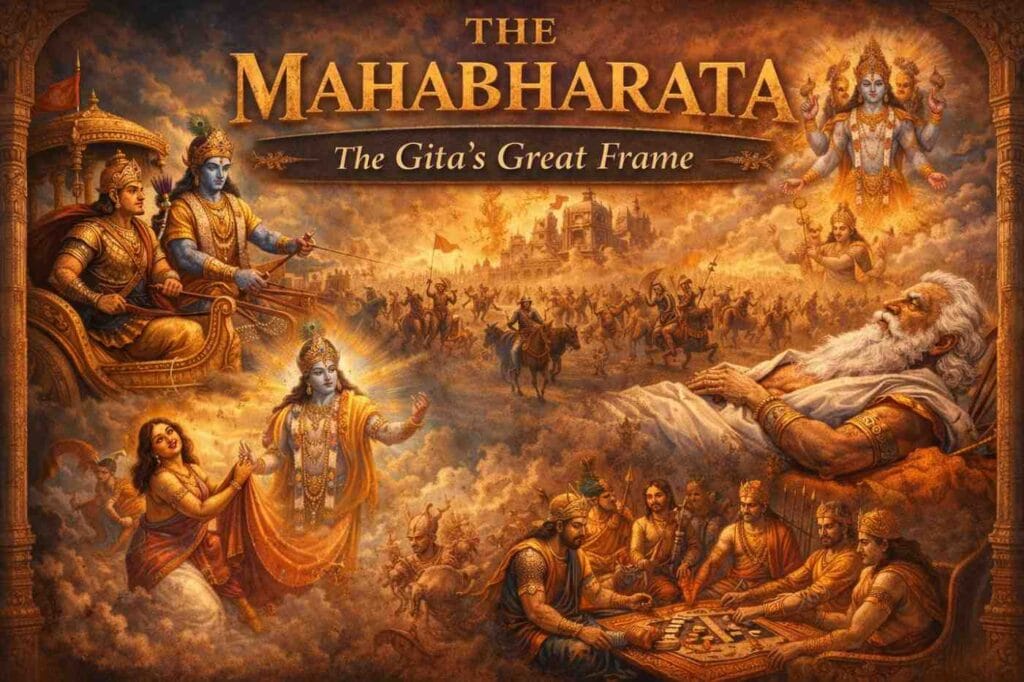
The battlefield of Kurukshetra is not an accidental setting. It is the result of a long sequence of events involving the Kuru dynasty. Disputes over succession, misunderstandings, ambition, and attachment gradually create tension between the Pandavas and the Kauravas.
This tension does not remain contained. It expands over time, involving families, alliances, and kingdoms. By the time the war becomes inevitable, it is not simply a conflict between two groups, it is the culmination of unresolved issues that have accumulated over years.
This background is essential because it shows that the situation Arjuna faces is not sudden. It is the outcome of a process that cannot easily be reversed.
Why the Gita Appears at the Moment of Action
The placement of the Bhagavad Gita within the Mahabharata is precise. It does not occur before the conflict begins, nor after it ends. It appears at the exact moment when action is about to take place.
This timing reflects an important principle. Understanding is most necessary when action cannot be avoided. If the teaching had been given earlier, it might not have carried the same urgency. If given later, it would not influence action.
By placing the dialogue at this moment, the Mahabharata shows that the Gita is not theoretical. It is meant to guide action in real conditions, where uncertainty and consequence are present simultaneously.
Arjuna’s Position Within the Larger Narrative
Arjuna is not an isolated character. He is deeply embedded in the relationships and responsibilities presented in the Mahabharata. He is a warrior, a student, a brother, and a member of a lineage.
When he stands on the battlefield, he is not facing strangers. He is facing people who have shaped his life. This is what creates the intensity of his dilemma. The conflict is not only external, it is deeply personal.
This position is essential for the Gita’s teaching. If Arjuna were detached from the situation, the dialogue would lose its depth. His involvement ensures that the questions he raises are not abstract, but grounded in real human experience.
The Nature of Conflict in the Mahabharata
The Mahabharata does not present conflict as a simple opposition between right and wrong. Instead, it shows that situations often involve multiple perspectives, each with its own justification.
This complexity is reflected in the characters themselves. They are not defined by single traits, but by a combination of qualities and motivations. This makes the conflict more difficult to resolve, because it cannot be reduced to a clear division.
In this context, the Gita does not provide a simplistic answer. It addresses a situation where clarity must emerge despite complexity.
Dharma as a Central Theme
One of the key ideas running through the Mahabharata is dharma, often translated as duty or righteousness. However, within the epic, dharma is not fixed or easily defined. It changes depending on context, role, and situation.
This makes it difficult to apply directly. What appears correct in one situation may not be correct in another. This uncertainty is central to Arjuna’s dilemma. He knows his duty as a warrior, but he also recognizes the consequences of fulfilling it.
The Gita emerges within this uncertainty, not to simplify dharma, but to provide a way of understanding it more deeply.
The Role of Krishna Within the Frame
Krishna’s presence in the Mahabharata is not limited to the Gita, but it is within this dialogue that his role becomes most explicit. He does not intervene by altering the situation. He does not remove the conflict.
Instead, he provides clarity.
This distinction is important. The Mahabharata does not resolve problems by changing external conditions. It shifts understanding within those conditions. Krishna’s role reflects this approach.
The Relationship Between Action and Understanding
The Mahabharata presents a world where action cannot be avoided. Decisions must be made, even when clarity is incomplete. The Gita addresses this directly.
It does not suggest withdrawal from action as the primary solution. Instead, it explores how action can be performed with a different understanding.
This is why the Gita cannot be separated from the Mahabharata. Without the context of unavoidable action, its teaching would lose its relevance.
The Scale of the Epic and the Depth of the Teaching
The Mahabharata is vast, containing numerous stories, dialogues, and perspectives. Within this scale, the Bhagavad Gita appears as a focused moment of clarity.
This contrast is significant. The complexity of the epic reflects the complexity of life, while the Gita offers a way to navigate that complexity.
Together, they create a complete picture, one showing the unfolding of events, and the other offering insight into how to engage with them.
Key Elements That Frame the Gita
To understand how the Mahabharata supports the Gita, a few elements are essential:
- Historical buildup: The conflict develops over time, not suddenly
- Relational depth: The characters are connected through family and duty
- Moral complexity: Situations are not clearly defined as right or wrong
- Inevitable action: The conflict reaches a point where it cannot be avoided
These elements create the exact conditions in which the Gita becomes necessary.
Why the Frame Matters
Reading the Gita without the Mahabharata can lead to an incomplete understanding. The dialogue may appear philosophical, but its depth lies in its connection to the situation in which it is spoken.
The Mahabharata provides:
- The background that leads to the conflict
- The relationships that create emotional intensity
- The circumstances that make action unavoidable
Without this frame, the teaching can seem detached. Within it, the teaching becomes immediate and relevant.
The Mahabharata as a Reflection of Life
The events of the Mahabharata are not limited to a specific time or place. They reflect patterns that continue to appear in different forms.
Situations where:
- Responsibility feels heavy
- Outcomes are uncertain
- Multiple truths exist at once
These conditions are not unique to the epic. They are part of human experience. The Gita addresses these conditions, but it is the Mahabharata that presents them in a complete and detailed form.
The Bhagavad Gita does not stand apart from the Mahabharata, it is shaped by it. The epic provides the circumstances, relationships, and complexity that make the teaching necessary. Without this context, the dialogue between Krishna and Arjuna would lose much of its depth.
The Mahabharata presents the unfolding of life in its complexity, while the Bhagavad Gita offers a way to understand and engage with that complexity. Together, they form a complete structure, one that does not remove conflict, but provides clarity within it.