
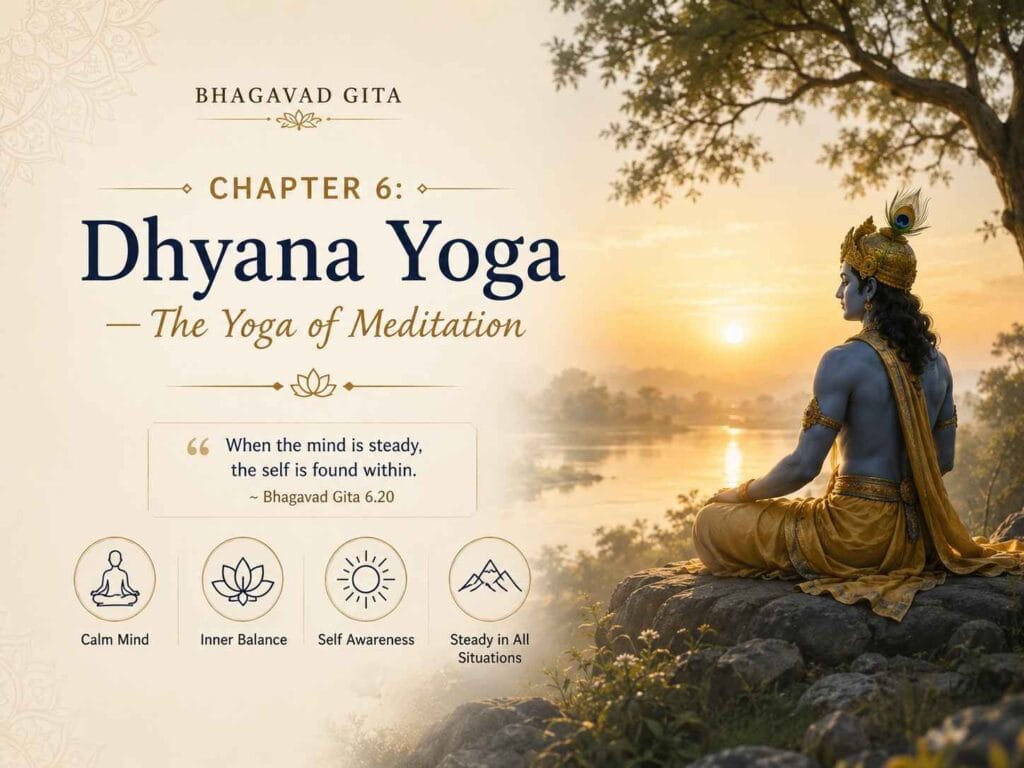
Explore Chapter 6 of the Bhagavad Gita with authentic Sanskrit verses, English translation, and deep analysis of meditation, self-mastery, the restless mind, Dhyāna Yoga, and inner peace through Krishna’s teachings.
Complete English Translation of Chapter 6 of the Bhagavad Gita
Verse 6.1
अनाश्रितः कर्मफलं कार्यं कर्म करोति यः ।
स संन्यासी च योगी च न निरग्निर्न चाक्रियः ॥
“One who performs necessary action without dependence upon its results is a true renunciant and yogi, not one who merely abandons rituals or action.”
Verse 6.2
यं संन्यासमिति प्राहुर्योगं तं विद्धि पाण्डव ।
न ह्यसंन्यस्तसङ्कल्पो योगी भवति कश्चन ॥
“What people call renunciation, know that to be yoga, O Pāṇḍava. One cannot become a yogi without renouncing selfish desire and attachment.”
Verse 6.3
आरुरुक्षोर्मुनेर्योगं कर्म कारणमुच्यते ।
योगारूढस्य तस्यैव शमः कारणमुच्यते ॥
“For one seeking to attain yoga, disciplined action is the means. For one already established in yoga, tranquility becomes the means.”
Verse 6.4
यदा हि नेन्द्रियार्थेषु न कर्मस्वनुषज्जते ।
सर्वसङ्कल्पसंन्यासी योगारूढस्तदोच्यते ॥
“When a person no longer becomes attached to sensory objects or actions and renounces selfish motivations, that person is said to be established in yoga.”
Verse 6.5
उद्धरेदात्मनाऽत्मानं नात्मानमवसादयेत् ।
आत्मैव ह्यात्मनो बन्धुरात्मैव रिपुरात्मनः ॥
“One must elevate oneself through the mind, not degrade oneself. The mind alone is the friend of the self, and the mind alone is the enemy of the self.”
Verse 6.6
बन्धुरात्मात्मनस्तस्य येनात्मैवात्मना जितः ।
अनात्मनस्तु शत्रुत्वे वर्तेतात्मैव शत्रुवत् ॥
“For one who has mastered the mind, the mind is the best friend. But for one who has failed to do so, the mind acts like an enemy.”
Verse 6.7
जितात्मनः प्रशान्तस्य परमात्मा समाहितः ।
शीतोष्णसुखदुःखेषु तथा मानापमानयोः ॥
“One who has mastered the mind remains peaceful amidst heat and cold, pleasure and pain, honor and dishonor, and becomes absorbed in the Supreme.”
Verse 6.8
ज्ञानविज्ञानतृप्तात्मा कूटस्थो विजितेन्द्रियः ।
युक्त इत्युच्यते योगी समलोष्टाश्मकाञ्चनः ॥
“The yogi who is satisfied through wisdom and realization, steady, self-controlled, and equal toward earth, stone, and gold is said to be united in yoga.”
Verse 6.9
सुहृन्मित्रार्युदासीनमध्यस्थद्वेष्यबन्धुषु ।
साधुष्वपि च पापेषु समबुद्धिर्विशिष्यते ॥
“One who remains equal-minded toward friends, enemies, strangers, neutrals, the righteous, and even the sinful excels spiritually.”
Verse 6.10
योगी युञ्जीत सततमात्मानं रहसि स्थितः ।
एकाकी यतचित्तात्मा निराशीरपरिग्रहः ॥
“The yogi should constantly practice meditation in solitude, alone, self-controlled, free from desire and possessiveness.”
Verse 6.11
शुचौ देशे प्रतिष्ठाप्य स्थिरमासनमात्मनः ।
नात्युच्छ्रितं नातिनीचं चैलाजिनकुशोत्तरम् ॥
“One should establish a firm seat in a clean place, neither too high nor too low, covered with cloth, deerskin, and kusa grass.”
Verse 6.12
तत्रैकाग्रं मनः कृत्वा यतचित्तेन्द्रियक्रियः ।
उपविश्यासने युञ्ज्याद्योगमात्मविशुद्धये ॥
“Sitting there with the mind focused and the senses controlled, one should practice yoga for purification of consciousness.”
Verse 6.13
समं कायशिरोग्रीवं धारयन्नचलं स्थिरः ।
सम्प्रेक्ष्य नासिकाग्रं स्वं दिशश्चानवलोकयन् ॥
“Holding the body, head, and neck straight and steady, gazing toward the tip of the nose without looking elsewhere.”
Verse 6.14
प्रशान्तात्मा विगतभीर्ब्रह्मचारिव्रते स्थितः ।
मनः संयम्य मच्चित्तो युक्त आसीत मत्परः ॥
“With a peaceful mind, free from fear, disciplined, and focused on Me, the yogi should remain absorbed in meditation.”
Verse 6.15
युञ्जन्नेवं सदात्मानं योगी नियतमानसः ।
शान्तिं निर्वाणपरमां मत्संस्थामधिगच्छति ॥
“Practicing in this way with disciplined mind, the yogi attains supreme peace and liberation in Me.”
Verse 6.16
नात्यश्नतस्तु योगोऽस्ति न चैकान्तमनश्नतः ।
न चाति स्वप्नशीलस्य जाग्रतो नैव चार्जुन ॥
“Yoga is not for one who overeats, nor for one who excessively fasts, nor for one who oversleeps, nor for one who remains excessively awake.”
Verse 6.17
युक्ताहारविहारस्य युक्तचेष्टस्य कर्मसु ।
युक्तस्वप्नावबोधस्य योगो भवति दुःखहा ॥
“For one who is moderate in food, recreation, effort, sleep, and wakefulness, yoga destroys suffering.”
Verse 6.18
यदा विनियतं चित्तमात्मन्येवावतिष्ठते ।
निःस्पृहः सर्वकामेभ्यो युक्त इत्युच्यते तदा ॥
“When the disciplined mind rests steadily in the Self, free from craving, one is said to be established in yoga.”
Verse 6.19
यथा दीपो निवातस्थो नेङ्गते सोपमा स्मृता ।
योगिनो यतचित्तस्य युञ्जतो योगमात्मनः ॥
“As a lamp in a windless place does not flicker, so is the disciplined mind of the yogi absorbed in meditation.”
Verse 6.20
यत्रोपरमते चित्तं निरुद्धं योगसेवया ।
यत्र चैवात्मनाऽत्मानं पश्यन्नात्मनि तुष्यति ॥
“When the mind becomes still through yoga, one experiences satisfaction within the Self.”
Verse 6.21
सुखमात्यन्तिकं यत्तद्बुद्धिग्राह्यमतीन्द्रियम् ।
वेत्ति यत्र न चैवायं स्थितश्चलति तत्त्वतः ॥
“One experiences supreme joy beyond the senses, grasped through wisdom, and never departs from truth.”
Verse 6.22
यं लब्ध्वा चापरं लाभं मन्यते नाधिकं ततः ।
यस्मिन्स्थितो न दुःखेन गुरुणापि विचाल्यते ॥
“Having attained this state, one considers no greater gain to exist, and remains undisturbed even amidst great sorrow.”
Verse 6.23
तं विद्याद्दुःखसंयोगवियोगं योगसंज्ञितम् ।
स निश्चयेन योक्तव्यो योगोऽनिर्विण्णचेतसा ॥
“Know yoga as the separation from union with suffering. It should be practiced with determination and unwavering mind.”
Verse 6.24
सङ्कल्पप्रभवान्कामांस्त्यक्त्वा सर्वानशेषतः ।
मनसैवेन्द्रियग्रामं विनियम्य समन्ततः ॥
“Abandoning all desires born from imagination and controlling the senses through the mind from every direction.”
Verse 6.25
शनैः शनैरुपरमेद्बुद्ध्या धृतिगृहीतया ।
आत्मसंस्थं मनः कृत्वा न किञ्चिदपि चिन्तयेत् ॥
“Gradually, through patience and disciplined intelligence, one should bring the mind to rest in the Self.”
Verse 6.26
यतो यतो निश्चरति मनश्चञ्चलमस्थिरम् ।
ततस्ततो नियम्यैतदात्मन्येव वशं नयेत् ॥
“Wherever the restless mind wanders, one should gently bring it back under the control of the Self.”
Verse 6.27
प्रशान्तमनसं ह्येनं योगिनं सुखमुत्तमम् ।
उपैति शान्तरजसं ब्रह्मभूतमकल्मषम् ॥
“The peaceful yogi, free from passion and impurity, attains supreme happiness.”
Verse 6.28
युञ्जन्नेवं सदात्मानं योगी विगतकल्मषः ।
सुखेन ब्रह्मसंस्पर्शमत्यन्तं सुखमश्नुते ॥
“Constantly practicing in this way, the purified yogi experiences infinite bliss through union with Brahman.”
Verse 6.29
सर्वभूतस्थमात्मानं सर्वभूतानि चात्मनि ।
ईक्षते योगयुक्तात्मा सर्वत्र समदर्शनः ॥
“The yogi sees the Self in all beings and all beings within the Self.”
Verse 6.30
यो मां पश्यति सर्वत्र सर्वं च मयि पश्यति ।
तस्याहं न प्रणश्यामि स च मे न प्रणश्यति ॥
“One who sees Me everywhere and everything in Me is never separated from Me, nor am I separated from that person.”
Verse 6.31
सर्वभूतस्थितं यो मां भजत्येकत्वमास्थितः ।
सर्वथा वर्तमानोऽपि स योगी मयि वर्तते ॥
“The yogi who worships Me as present in all beings remains united with Me in every condition.”
Verse 6.32
आत्मौपम्येन सर्वत्र समं पश्यति योऽर्जुन ।
सुखं वा यदि वा दुःखं स योगी परमो मतः ॥
“One who sees the happiness and suffering of all beings as similar to one’s own is considered the highest yogi.”
Verse 6.33–34
Arjuna says:
योऽयं योगस्त्वया प्रोक्तः साम्येन मधुसूदन ।
एतस्याहं न पश्यामि चञ्चलत्वात्स्थितिं स्थिराम् ॥
चञ्चलं हि मनः कृष्ण प्रमाथि बलवद्दृढम् ।
तस्याहं निग्रहं मन्ये वायोरिव सुदुष्करम् ॥
“O Krishna, this yoga of equanimity seems difficult because the mind is restless, turbulent, powerful, and difficult to control like the wind.”
Verse 6.35
Krishna replies:
असंशयं महाबाहो मनो दुर्निग्रहं चलम् ।
अभ्यासेन तु कौन्तेय वैराग्येण च गृह्यते ॥
“Without doubt the mind is restless and difficult to control, but through practice and detachment it can be restrained.”
Verse 6.46
तपस्विभ्योऽधिको योगी ज्ञानिभ्योऽपि मतोऽधिकः ।
कर्मिभ्यश्चाधिको योगी तस्माद्योगी भवार्जुन ॥
“The yogi is greater than ascetics, greater than intellectuals, and greater than ritualistic workers. Therefore become a yogi, O Arjuna.”
Verse 6.47
योगिनामपि सर्वेषां मद्गतेनान्तरात्मना ।
श्रद्धावान्भजते यो मां स मे युक्ततमो मतः ॥
“Among all yogis, the one who worships Me with faith and inward devotion is considered by Me the highest yogi.”
The Discipline of the Mind in the Bhagavad Gita
Among all the chapters of the Bhagavad Gita, Chapter 6 – Dhyāna Yoga, stands as one of the deepest explorations of the human mind ever written. After explaining Karma Yoga, detachment, equanimity, and selfless action in the earlier chapters, Krishna now turns directly toward meditation and the discipline required for inner mastery.
This chapter is not merely about sitting quietly with closed eyes. Krishna presents meditation as a profound psychological and spiritual process through which consciousness gradually frees itself from compulsive attachment, emotional turbulence, mental restlessness, and egoic instability.
The Bhagavad Gita recognizes a truth that remains deeply relevant today: the uncontrolled mind becomes the source of suffering.
Human beings may possess knowledge, ambition, wealth, talent, and external success, yet without mastery over the mind, inner peace remains fragile. Fear, anxiety, distraction, craving, comparison, insecurity, emotional reaction, and mental agitation continuously disturb consciousness. Dhyāna Yoga therefore becomes essential because it trains awareness itself.
Krishna explains that true yoga is not escape from life, but mastery within life. Meditation purifies consciousness so that action becomes clearer, calmer, and less driven by unconscious emotional reaction. Chapter 6 therefore becomes the bridge between philosophy and direct inner practice.
The Meaning of Dhyāna Yoga
The Sanskrit word dhyāna means meditation, contemplation, or sustained inward absorption. However, meditation in the Bhagavad Gita is not presented merely as relaxation or temporary stress relief. Krishna describes meditation as a disciplined process through which the mind gradually becomes steady, clear, and inwardly balanced.
This chapter develops naturally from the earlier teachings of Karma Yoga.
In previous chapters, Krishna repeatedly taught Arjuna to perform action without attachment to outcomes. But now an important question emerges: How can the mind remain unattached when it is naturally restless and unstable?
Dhyāna Yoga becomes the answer. Without inner discipline, the mind continuously becomes trapped in craving, fear, distraction, memory, emotional reaction, comparison, fantasy, and anxiety. Even when individuals intellectually understand spiritual teachings, conditioning often continues controlling consciousness unconsciously.
Meditation therefore becomes necessary because understanding alone cannot transform the mind completely. The Bhagavad Gita recognizes that real transformation requires direct training of awareness itself.
True Renunciation and the Inner Meaning of Yoga
Chapter 6 begins by redefining both renunciation and yoga:
अनाश्रितः कर्मफलं कार्यं कर्म करोति यः ।
स संन्यासी च योगी च न निरग्निर्न चाक्रियः ॥ (6.1)
“One who performs necessary action without dependence upon its results is a true renunciant and yogi, not one who merely abandons external activity.”
This verse continues one of the central themes of the Bhagavad Gita: true renunciation is psychological before it is external.
Krishna rejects the simplistic idea that spirituality means abandoning society or withdrawing from responsibility alone. A person may externally renounce worldly life while remaining inwardly consumed by desire, ego, comparison, fear, and attachment. Another person may remain fully engaged in ordinary responsibilities while gradually developing inner steadiness and freedom from compulsive attachment.
According to Krishna, the second person may actually be closer to yoga.
This teaching radically transforms spirituality. Yoga is no longer limited to ritual, isolation, or external appearance. The real question becomes: What is the state of consciousness behind action?
This insight remains profoundly modern because many individuals still believe external change alone will solve inner suffering. People often think:
“If I leave this environment, I will become peaceful.”
“If I escape responsibility, I will feel free.”
“If I withdraw from difficulty, my mind will become calm.”
The Bhagavad Gita points toward something deeper. Without inner transformation, suffering follows the mind everywhere.
The Mind as Friend and Enemy
One of the most psychologically powerful teachings in Chapter 6 appears when Krishna explains the dual nature of the mind:
उद्धरेदात्मनाऽत्मानं नात्मानमवसादयेत् ।
आत्मैव ह्यात्मनो बन्धुरात्मैव रिपुरात्मनः ॥ (6.5)
“One must elevate oneself through the mind, not degrade oneself. The mind alone is the friend of the self, and the mind alone is the enemy of the self.” This verse reveals extraordinary psychological insight.
The Bhagavad Gita does not portray the mind as inherently evil. Instead, Krishna explains that the undisciplined mind becomes destructive because it continuously generates attachment, fear, insecurity, emotional reaction, confusion, and restlessness. An uncontrolled mind creates suffering internally even when external circumstances appear favorable. The disciplined mind, however, becomes a source of clarity and liberation.
This teaching feels remarkably relevant today because modern life continuously overstimulates attention. Social media, entertainment, comparison, information overload, and constant stimulation weaken the mind’s ability to remain steady and inwardly present. Many individuals struggle not because they lack opportunity, but because consciousness remains fragmented and continuously distracted.
Krishna therefore presents self-mastery as essential for freedom. The real battle is not only external. The deeper battle exists within consciousness itself.
The Restless Nature of the Mind
One of the reasons Chapter 6 feels so deeply human is because Arjuna openly admits the difficulty of controlling the mind:
चञ्चलं हि मनः कृष्ण प्रमाथि बलवद्दृढम् ।
तस्याहं निग्रहं मन्ये वायोरिव सुदुष्करम् ॥ (6.34)
“The mind is restless, turbulent, powerful, and obstinate. Controlling it seems as difficult as controlling the wind.”
This is one of the most psychologically honest moments in the Bhagavad Gita. Arjuna recognizes that the mind constantly wanders. Thoughts arise endlessly. Desires pull attention outward. Emotional reactions disturb concentration. Fear, memory, fantasy, and anxiety continuously interrupt inner stillness.
Krishna does not reject Arjuna’s observation.
Instead, he agrees:
असंशयं महाबाहो मनो दुर्निग्रहं चलम् ।
अभ्यासेन तु कौन्तेय वैराग्येण च गृह्यते ॥ (6.35)
“Without doubt, the mind is restless and difficult to control. Yet through practice and detachment it can be restrained.”
This response is profoundly important because the Bhagavad Gita never romanticizes spiritual practice. Krishna does not promise instant enlightenment or immediate mental silence. He acknowledges the difficulty honestly. The mind becomes steady gradually through: practice, discipline, detachment, and repeated return of awareness.
This insight remains deeply relevant because modern culture often expects instant transformation. The Bhagavad Gita presents inner growth as a gradual process requiring patience and continuity.
Meditation as Inner Observation
Krishna describes meditation not as escape from reality, but as deep observation of consciousness itself. The practitioner gradually withdraws attention from compulsive sensory distraction and begins observing the movements of the mind directly. Thoughts, fears, desires, emotional reactions, memories, and cravings become visible within awareness.
Ordinarily, human beings become completely identified with mental activity. A fearful thought appears and identity immediately becomes fear. Anger appears and consciousness becomes trapped inside anger. Desire appears and the mind compulsively pursues gratification.
Meditation changes this relationship. The practitioner slowly develops the ability to witness thoughts without automatically becoming psychologically consumed by them. This creates psychological distance between awareness and mental fluctuation.
Over time, the mind becomes quieter because awareness stops feeding every impulse automatically. Emotional reactivity weakens. Desire loses some of its compulsive intensity. Fear becomes more observable rather than completely overwhelming. Meditation therefore becomes a process of inner purification. Not suppression. Not escape. But increasing clarity of awareness itself.
The Discipline of Meditation
The Bhagavad Gita also provides practical instructions for meditation. Krishna explains that the practitioner should sit in a clean and quiet place with the body, neck, and head aligned steadily:
समं कायशिरोग्रीवं धारयन्नचलं स्थिरः ।
सम्प्रेक्ष्य नासिकाग्रं स्वं दिशश्चानवलोकयन् ॥ (6.13)
“Holding the body, head, and neck straight and steady, gazing toward the tip of the nose without looking elsewhere.” These instructions reveal that meditation in the Bhagavad Gita is deeply disciplined rather than vague or purely symbolic.
Krishna also emphasizes moderation:
नात्यश्नतस्तु योगोऽस्ति न चैकान्तमनश्नतः ।
न चाति स्वप्नशीलस्य जाग्रतो नैव चार्जुन ॥ (6.16)
“Yoga is not for one who overeats, nor for one who excessively fasts, nor for one who oversleeps, nor for one who remains excessively awake.”
This balanced approach is important.
The Bhagavad Gita rejects both indulgence and extreme asceticism. Inner steadiness develops through balance rather than self-punishment. Discipline must support clarity, not create further disturbance.
This moderation reflects the larger philosophy of the Bhagavad Gita itself:
true spirituality avoids both excess and imbalance.
The Experience of Inner Stillness
As meditation deepens, Krishna describes a state of profound inner peace:
यत्रोपरमते चित्तं निरुद्धं योगसेवया ।
यत्र चैवात्मनाऽत्मानं पश्यन्नात्मनि तुष्यति ॥ (6.20)
“When the disciplined mind becomes still through yoga, one experiences inner satisfaction within the Self.”
This inner fulfillment becomes one of the central goals of Dhyāna Yoga.
Ordinarily, human beings seek happiness externally through achievement, stimulation, pleasure, recognition, possession, and emotional gratification. Yet external satisfaction remains temporary because circumstances continuously change.
Meditation gradually shifts the center of stability inward.
The practitioner begins discovering a quieter form of contentment not entirely dependent upon external conditions. This creates freedom from compulsive craving because consciousness becomes less psychologically dependent upon stimulation for peace.
This does not mean rejecting ordinary life. Rather, it means inner stability no longer depends completely upon external fluctuation.
Compassion and Equality of Vision
One of the most beautiful teachings in Chapter 6 concerns universal empathy:
आत्मौपम्येन सर्वत्र समं पश्यति योऽर्जुन ।
सुखं वा यदि वा दुःखं स योगी परमो मतः ॥ (6.32)
“One who sees the happiness and suffering of all beings as similar to one’s own is considered the highest yogi.”
This verse reveals that meditation in the Bhagavad Gita is not selfish withdrawal from humanity. True spiritual growth deepens compassion because awareness becomes less trapped within egoic self-centeredness. As inner clarity increases, rigid separation between self and others begins softening. The practitioner becomes more sensitive to suffering, more compassionate, and less psychologically dominated by selfish attachment.
Meditation therefore transforms not only the inner mind, but also the quality of human relationship.
The Timeless Relevance of Dhyāna Yoga
Chapter 6 feels astonishingly modern because the psychological problems it addresses have intensified dramatically today.
Human attention is continuously fragmented by digital distraction, social comparison, endless stimulation, entertainment, anxiety, and information overload. The nervous system rarely experiences silence. Many individuals struggle with restlessness, inability to focus, emotional instability, and chronic mental exhaustion.
The Bhagavad Gita recognized this restless condition of the mind thousands of years ago.
Krishna’s solution is not escape from responsibility or rejection of ordinary life. Instead, he teaches disciplined awareness, inner observation, meditation, self-mastery, and detachment from compulsive mental reactivity.
These teachings remain profoundly relevant because the modern mind suffers from many of the same patterns Arjuna experienced: restlessness, fear, confusion, attachment, and emotional instability. Dhyāna Yoga therefore remains timeless.
Conclusion
Chapter 6 of the Bhagavad Gita presents meditation not merely as a spiritual technique, but as a profound transformation of consciousness itself.
Krishna teaches that the uncontrolled mind becomes the source of suffering, while the disciplined mind becomes a pathway toward clarity, steadiness, compassion, and liberation. Meditation gradually weakens compulsive attachment, emotional turbulence, and psychological fragmentation by training awareness to remain present and inwardly balanced.
The practitioner continues living fully within the world, yet consciousness becomes less controlled by fear, craving, distraction, and external fluctuation.
This is the essence of Dhyāna Yoga. Not escape from life. Not suppression of thought. But mastery within consciousness itself. The world continues. Action continues. Responsibility continues.
But the relationship between awareness and experience changes completely. And according to Krishna, that transformation is the beginning of true yoga.