Learn the STOP Technique, a powerful one-minute mindfulness practice for stress, anxiety, emotional regulation, and mental clarity inspired by yogic awareness principles.
Introduction
Modern life conditions the mind toward constant movement. Notifications, deadlines, emotional pressure, overstimulation, multitasking, and continuous mental engagement gradually train attention to remain reactive rather than aware.
Most people move from one thought, task, or emotional response to another without ever fully pausing. As a result, stress often becomes automatic. Reaction becomes faster than observation. And the mind begins operating continuously in anticipation, pressure, distraction, or emotional momentum.
The STOP Technique is a simple mindfulness method designed to interrupt this automatic cycle.
Despite taking less than a minute, the practice can create a significant shift in awareness because it introduces something that modern attention rarely experiences consciously: a pause.
Although the acronym “STOP” is modern in presentation, the underlying principles align deeply with teachings found in contemplative traditions such as the Yoga Sutras of Patanjali, the Bhagavad Gita, and classical mindfulness practices centered on observation, self-awareness, and regulation of reactivity.
The technique is not about escaping stress instantly. It is about interrupting unconscious momentum before reaction fully takes over. This distinction is important. Mindfulness does not remove life’s challenges immediately. It changes the relationship with them. And often, that change begins with a single moment of awareness.
What Is the STOP Technique?
The STOP Technique is a brief but highly practical mindfulness method designed to interrupt automatic mental and emotional reactivity before it fully takes control of behavior.
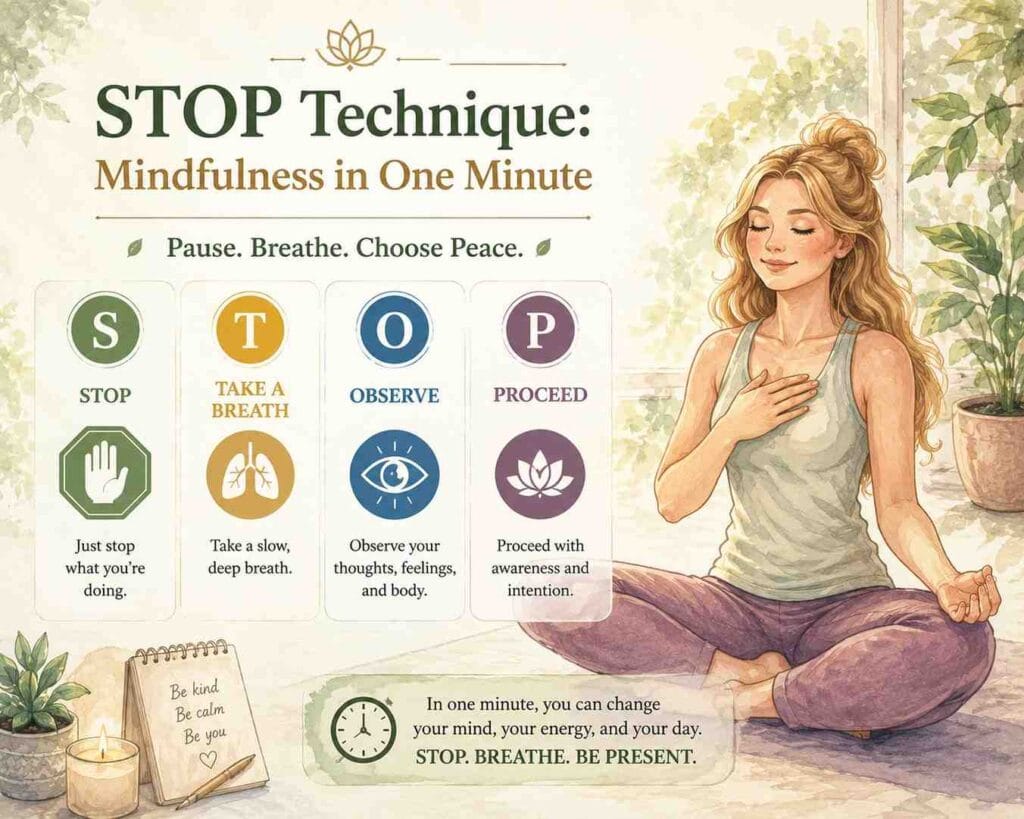
The practice is built around four simple steps:
- S – Stop
- T – Take a Breath
- O – Observe
- P – Proceed
Its structure is intentionally simple. This simplicity is not a weakness of the method, it is one of its greatest strengths.
During moments of stress, emotional overwhelm, anxiety, frustration, or mental overload, the nervous system becomes increasingly reactive. Attention narrows, emotional intensity rises, and the mind loses some of its ability to process complexity clearly.
In these moments, people rarely make decisions from calm awareness. They react from momentum. Speech becomes impulsive. Thought accelerates. Emotion intensifies. Behavior becomes automatic.
The STOP Technique functions as a deliberate interruption in this automatic chain. Instead of continuing unconsciously into reaction, the practitioner briefly pauses and reintroduces awareness into the moment before action continues. This interruption may last only a few seconds.
Yet psychologically, it can be extremely significant. Many harmful reactions occur not because people consciously choose them with clarity, but because awareness disappears beneath emotional momentum. The mind moves faster than observation.
The STOP Technique slows this movement just enough for awareness to re-enter. That small shift changes the entire quality of response. The practice therefore is not about suppressing emotion or eliminating difficulty instantly. It is about restoring conscious participation where unconscious reaction would normally dominate. In this sense, the STOP Technique is less about “stopping life” and more about stopping automaticity.
Why the Practice Works
One of the central insights shared across contemplative traditions is that suffering is often intensified not only by circumstances themselves, but by unconscious reactivity toward those circumstances.
The Bhagavad Gita repeatedly emphasizes steadiness amidst changing conditions rather than compulsive emotional reaction. Krishna consistently redirects attention away from impulsive attachment, fear, and agitation toward clarity and conscious action.
Similarly, the Yoga Sutras of Patanjali defines yoga as the calming of mental fluctuations (vṛttis), allowing perception to become less conditioned by restlessness, projection, and automatic disturbance.
The STOP Technique applies these principles in an immediately practical form.
Ordinarily, psychological reaction unfolds extremely quickly:
- an emotion arises
- thought accelerates around it
- bodily tension increases
- breathing changes
- speech follows impulsively
- behavior becomes reactive
This sequence often happens so rapidly that awareness barely enters before reaction is already complete. The individual becomes absorbed in the emotional movement itself. The STOP Technique interrupts this progression.
It introduces a small but critical space between stimulus and response. And within that space, something important becomes possible: observation.
The practitioner is no longer completely carried by the momentum of reaction. Instead, awareness briefly returns before action continues. This may seem like a minor shift externally. Internally, however, it is transformative. Because once awareness enters the process, reaction is no longer entirely unconscious.
Even a few seconds of conscious interruption can significantly alter:
- emotional intensity
- impulsive speech
- decision-making
- nervous system activation
- and behavioral patterns
This is why a one-minute practice can become deeply powerful when practiced consistently over time. The effectiveness of the STOP Technique lies not in complexity, but in repetition of awareness during real moments of pressure.
Step 1 – Stop
The first step of the practice is deceptively simple:
Stop. Not permanently. Not dramatically. Simply pause.
This pause is far more important than it initially appears because emotional and psychological reactivity depend heavily on uninterrupted momentum.
Stress accelerates thought. Fear accelerates reaction. Anger accelerates speech. Anxiety accelerates mental projection. The mind moves quickly toward continuation. Stopping interrupts that movement. For a brief moment, the practitioner intentionally disengages from automatic continuation and creates space for awareness to return.
This may involve:
- pausing before replying to a difficult message
- becoming still during rising anxiety
- interrupting escalating anger
- stepping away from compulsive overthinking
- pausing before making an impulsive decision
- or simply remaining silent for a few conscious seconds
The action itself may appear extremely small externally. Internally, however, it changes the direction of attention completely. Without pause, reactivity remains unconscious and automatic. With pause, observation becomes possible. This is one of the most important principles in mindfulness practice: awareness often begins with interruption.
The practitioner gradually learns that immediate reaction is not always necessary. And that realization alone begins weakening compulsive behavior patterns.
Step 2 – Take a Breath
After stopping, attention shifts toward breathing. The breath functions as an anchor because it reconnects awareness directly with the body and the present moment.
The instruction is intentionally simple: Take one slow, conscious breath. Or several if needed. There is no need for complicated breathing techniques or forceful control. The purpose is regulation rather than performance.
Stress and emotional reactivity often alter breathing automatically. Anxiety may create shallow chest breathing, muscular tension, rapid respiration, and heightened nervous system activation.
Most people remain unaware of these physiological changes while they are occurring.
Conscious breathing interrupts this pattern.
A slower and more deliberate breath signals safety to the nervous system and reduces the momentum of automatic escalation. This is one reason breath awareness appears repeatedly across yogic and contemplative traditions. The breath occupies a unique position within human experience. It exists at the meeting point between body and mind.
Changes in mental state affect breathing immediately. And changes in breathing often influence mental state in return.
By bringing awareness to the breath, the practitioner begins regulating not only attention, but the physiological stress response itself. This is why even one conscious breath can create noticeable psychological change during moments of overwhelm.
The breath stabilizes attention by bringing awareness back into immediate embodied experience rather than allowing the mind to remain fully absorbed in reactive thought.
Step 3 – Observe
This is the core of the STOP Technique. After pausing and reconnecting through the breath, the practitioner begins observing what is actually happening internally in the present moment.
Without judgment. Without suppression. Without immediate reaction.
Observation may include noticing:
- physical tension in the body
- emotional intensity
- rapid thought patterns
- anxiety or fear
- irritation or anger
- mental pressure
- fatigue
- bodily sensation
- environmental triggers
- or compulsive urges to react
Importantly, the goal is not to instantly “fix” the experience. The goal is awareness first. This distinction is deeply important. Most people attempt to escape discomfort immediately through reaction, distraction, suppression, or emotional discharge. Observation interrupts this automatic escape process.
The practitioner begins recognizing:
“This is what is happening right now.”
That recognition alone changes the relationship with experience. Instead of becoming completely fused with emotion or thought, awareness begins observing it directly. This introduces psychological distance. And distance reduces compulsive identification. The individual is no longer entirely inside the reaction. They are also observing the reaction.
This observational capacity lies at the heart of mindfulness practice and aligns deeply with the teachings of the Yoga Sutras of Patanjali, where awareness gradually becomes distinct from the movements of the mind itself.
Observation weakens automaticity because unconscious reaction depends upon absence of awareness. The moment observation becomes clear, compulsive momentum begins losing some of its power.
Step 4 – Proceed
Only after stopping, breathing, and observing does the practitioner proceed. This final step is extremely important because mindfulness is not withdrawal from life. It is conscious participation within life.
The goal of the STOP Technique is not to remain frozen in observation indefinitely. Rather, the practice helps ensure that action emerges from greater clarity instead of unconscious momentum.
Proceeding may involve:
- speaking more carefully
- responding instead of reacting impulsively
- choosing not to escalate conflict
- returning attention to the present task
- recognizing that immediate action is unnecessary
- or simply continuing with greater steadiness and awareness
Externally, the situation itself may remain unchanged. The conversation may still be difficult. The stress may still exist. The uncertainty may still remain. But internally, the quality of awareness has shifted. Action becomes more deliberate. Less emotionally compulsive. More stable. The practitioner gradually learns that mindfulness does not necessarily remove challenge from life. What it changes is the relationship with challenge.
And often, that shift begins through something remarkably small: one conscious pause before reaction continues.
The Neuroscience of the Pause
Modern neuroscience increasingly supports what contemplative traditions observed intuitively. When stress intensifies, the nervous system often shifts into automatic survival-oriented patterns involving emotional reactivity, impulsive thinking, and narrowed attention. Pausing and consciously breathing can help regulate this process.
Even brief moments of mindful awareness may:
- reduce stress activation
- regulate emotional intensity
- improve attentional control
- and interrupt compulsive behavioral patterns
The STOP Technique works partly because it prevents emotional momentum from fully taking over before awareness returns. This is why such a short practice can still produce meaningful effects.
Why the Technique Can Feel Difficult
Although simple, the STOP Technique is not always easy. In highly reactive moments, the mind often resists pausing. Emotion wants continuation. Anger wants expression. Anxiety wants immediate resolution. Stress wants acceleration. This is why mindfulness requires practice.
The difficulty is not usually the technique itself. The difficulty is remembering to become aware before momentum completely takes control.
Over time, however, repeated practice strengthens the ability to recognize reactivity earlier. Awareness begins appearing sooner. And this gradually changes behavioral patterns.
The Deeper Yogic Principle
At a deeper level, the STOP Technique reflects a core yogic principle: Freedom begins when awareness becomes stronger than compulsion. Most people do not consciously choose many of their reactions.
Thought patterns, emotional conditioning, and nervous system habits operate automatically. Mindfulness interrupts this automaticity. The practitioner begins recognizing that awareness and reaction are not identical. This distinction is foundational within both the Yoga Sutras of Patanjali and the Bhagavad Gita.
The mind may continue producing thought, emotion, and impulse. But awareness gradually learns not to become completely controlled by them. This is the beginning of inner steadiness.
Practical Situations Where STOP Helps
The STOP Technique becomes especially useful during:
- emotional conflict
- anxiety spikes
- overthinking
- workplace stress
- difficult conversations
- decision fatigue
- social overwhelm
- compulsive scrolling
- and moments of mental exhaustion
Because the practice requires very little time, it can be integrated directly into ordinary daily life. This accessibility is part of its strength. Mindfulness no longer becomes something practiced only during formal meditation sessions. It becomes available during real moments of pressure.
Why Simple Practices Spread Powerfully
Part of what makes the STOP Technique resonate so strongly today is its simplicity. Modern attention is overloaded. People often feel overwhelmed not only by stress, but by the complexity of self-improvement advice itself. The STOP Technique offers something immediately usable. No equipment. No long preparation. No special environment. Just awareness inserted into a moment that would otherwise remain unconscious.
Simple practices often spread widely because they are practical under real conditions. And practicality increases consistency.
The STOP Technique is a simple but powerful mindfulness practice designed to interrupt automatic reactivity and restore awareness within moments of stress, distraction, or emotional intensity.
Although modern in presentation, its deeper principles align closely with teachings found in the Yoga Sutras of Patanjali, the Bhagavad Gita, and broader contemplative traditions emphasizing observation, steadiness, and conscious action.
The practice teaches something essential: Between stimulus and reaction, there is a space.
And within that space, awareness can return. Sometimes transformation does not begin through dramatic change. It begins through one conscious pause.