
From distraction to discipline, discover a yogic approach to dopamine detox. Learn how awareness, breath, and sense control help reduce overstimulation and restore focus in modern life.
The Age of Constant Stimulation
We live in a time where attention is no longer a given, it is constantly being competed for. Notifications, scrolling feeds, instant entertainment, and endless information streams keep the mind engaged without pause. What once required effort, focus, patience, discipline, now feels increasingly difficult.
This is not accidental. The modern environment is designed to stimulate the brain’s reward system repeatedly. Each notification, each piece of content, each small “hit” of novelty reinforces a pattern of seeking quick satisfaction.
From a scientific perspective, this relates to dopamine, the neurotransmitter involved in motivation, learning, and habit formation. Continuous exposure to high-reward stimuli can shift behavior from conscious choice to automatic habit, reinforcing cycles of distraction.
But here is where clarity is needed.
The idea of a “dopamine detox” is often misunderstood. It is not about eliminating dopamine, that is neither possible nor desirable. Dopamine is essential for life itself.
What people are actually seeking is something deeper:
Freedom from compulsive stimulation
Restoration of attention
A return to inner balance
And this is precisely where yoga becomes relevant, not as a trend, but as a timeless solution.
The Yogic Diagnosis of Distraction
Long before smartphones and digital overload, the Yoga Sutras of Patanjali described the fundamental problem of the human mind:
The mind is constantly in motion.
These movements, vrittis, are not inherently problematic. But when they are continuous and unobserved, they create restlessness, confusion, and misidentification.
In modern terms, what we call “distraction” is simply an intensified form of these vrittis.
The mind jumps:
- From one thought to another
- From one stimulus to the next
- From one desire to another
And in this constant movement, attention becomes fragmented.
This is not just a productivity issue, it is a state of consciousness.
Yoga identifies the root problem clearly:
Not the world, but the uncontrolled movement of the mind.
Dopamine Detox vs Yogic Discipline
Modern dopamine detox focuses on reducing overstimulation, limiting screen time, avoiding instant gratification, and taking breaks from addictive behaviors.
And to an extent, this is valid.
Research suggests that reducing exposure to high-reward stimuli can:
- Improve focus
- Reduce impulsive behavior
- Restore sensitivity to simpler experiences
However, there is a limitation. If distraction is treated only at the level of behavior, it returns. You may stop using your phone for a day, but the restless mind remains. This is where yoga goes deeper.
It does not begin with external restriction alone. It begins with inner discipline.
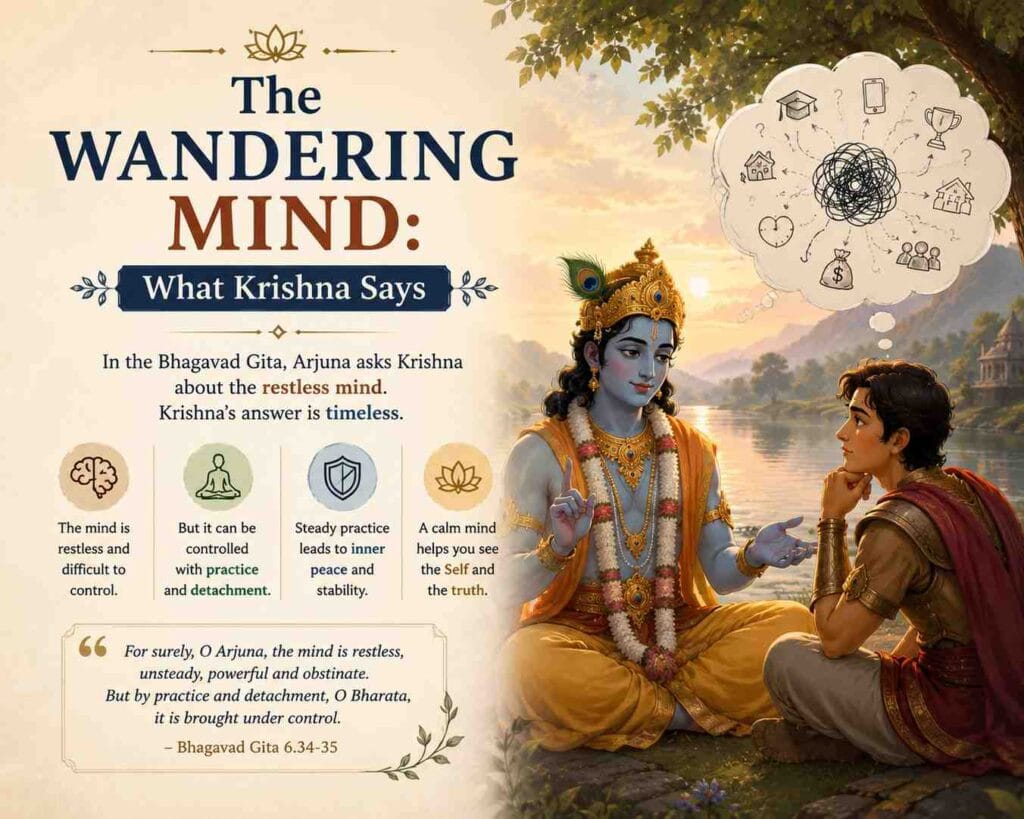
The Bhagavad Gita: Mastery Over the Senses
In the Bhagavad Gita, Krishna explains that the senses naturally move toward their objects. The mind follows the senses, and when the mind follows, attention is lost.
This is exactly the modern condition.
The senses are constantly pulled outward:
- Visual stimulation (screens)
- Auditory stimulation (notifications)
- Emotional stimulation (social validation)
And the mind, following these inputs, becomes restless.
Krishna’s teaching is not suppression, it is mastery.
He emphasizes:
- Regulation of the senses
- Detachment from immediate pleasure
- Stability of attention
This is not very different from what modern science suggests when it speaks of breaking habit loops and reducing impulsive triggers.
But the Gita adds something deeper:
Discipline is not restriction, it is alignment with clarity.
The Hatha Yoga Pradipika: The Body-Mind Connection
While the mind seeks stimulation, the Hatha Yoga Pradipika brings attention to the body and breath.
It teaches a fundamental principle:
When the breath is unsteady, the mind is unsteady.
When the breath is steady, the mind becomes still.
Modern distraction is not only mental, it is physiological.
- Rapid scrolling → restless breath
- Anxiety → shallow breathing
- Overstimulation → constant nervous activation
This creates a feedback loop.
The mind becomes restless, the breath follows, and the cycle continues.
Through breath regulation (pranayama), this cycle can be reversed.
Calm breath → calm nervous system → stable attention.
This is why yogic discipline is not just mental, it is embodied.
The Real Meaning of “Detox”
The phrase “dopamine detox” can be misleading when taken literally. It gives the impression that something within the body must be removed or eliminated. But dopamine itself is not the problem, it is a natural and essential part of how the brain functions, influencing motivation, learning, and engagement with life.
What actually requires attention is not the chemical, but the pattern of dependence that forms around stimulation.
In modern life, the mind becomes accustomed to frequent, high-intensity inputs, constant novelty, instant rewards, and rapid shifts in attention. Over time, this creates a tendency to seek stimulation automatically, even in moments that would otherwise be calm or neutral. The issue, therefore, is not biological imbalance alone, but behavioral conditioning reinforced by repetition.
Scientific understanding supports this view. The aim is not to “reset” dopamine in a literal sense, but to reduce excessive triggers that encourage compulsive engagement. When these triggers are reduced, the system begins to regulate itself more naturally.
Yoga expresses this same principle in a more foundational way.
It does not ask for the rejection of the world or the suppression of experience. Instead, it points toward freedom from unconscious attachment. The problem is not enjoyment, but dependency, the inability to remain steady without constant input.
In this sense, a true “detox” is not an act of removal, but a shift in relationship.
It is the movement from compulsion to awareness, from being driven by impulse to being guided by clarity.
From Stimulation to Sensitivity
When the cycle of constant stimulation is reduced, a subtle but significant change begins to occur, not in the external world, but in perception itself.
Many people notice that simple experiences, which previously felt dull or insufficient, begin to regain depth. Activities such as walking, reading, or even sitting quietly become more engaging. Attention stabilizes, and the need for constant novelty decreases.
This shift is often described as increased sensitivity.
It is not that life becomes more exciting, but that the mind becomes more capable of experiencing what is already present. When the mind is no longer conditioned to seek high levels of stimulation, it becomes receptive to subtler forms of experience.
Yoga has long emphasized this refinement.
When the mind is not continuously chasing external input, attention deepens naturally. Experience is no longer fragmented by distraction. Even ordinary moments begin to carry a sense of completeness.
This is why this process should not be understood as deprivation.
Nothing essential is being removed. Instead, something is being restored, the capacity to experience life without dependency on intensity.
In this way, what appears as “less” stimulation becomes, in reality, greater clarity and richness of experience.
The Role of Awareness
At the core of both modern behavioral science and yogic philosophy lies a shared insight: awareness transforms behavior.
In modern psychology, this is seen in the understanding of habit loops. Behaviors are often triggered automatically by cues and reinforced by rewards. When these patterns operate unconsciously, they repeat without interruption. But when the individual becomes aware of the trigger and the response, a space begins to form.
Within that space, choice becomes possible.
Yoga describes this process in a more direct experiential way. Instead of focusing on external behavior first, it emphasizes observing the movements of the mind, thoughts, impulses, and tendencies (vrittis). By witnessing these movements without immediately reacting, identification with them begins to loosen.
The underlying mechanism is the same.
When a behavior is unconscious, it continues.
When it is observed, its automatic nature weakens.
This is why discipline, in the yogic sense, is not imposed from the outside. It is not a matter of forcing control or suppressing desire. It emerges naturally when awareness is present.
As one begins to see clearly:
- the impulse to seek stimulation
- the discomfort of stillness
- the patterns of distraction
there is a gradual shift. The need to react diminishes. The ability to remain present increases. And in that shift, discipline arises, not as effort, but as a natural alignment with clarity.
Practical Yogic Approach to Dopamine Detox
A yogic approach does not depend on sudden withdrawal or rigid control. It works gradually, reshaping the relationship between the mind, the senses, and attention. The aim is not to fight distraction aggressively, but to understand it and gently redirect it. In this way, change becomes sustainable rather than temporary.
1. Reduce Unnecessary Stimulation
The first step is not elimination, but discernment. In daily life, not all stimulation is harmful, some is necessary, some enriching. The difficulty arises when stimulation becomes excessive and unconscious.
A yogic approach begins by noticing patterns:
- What draws your attention repeatedly without purpose
- What leaves the mind restless even after engagement
- What feels difficult to step away from
This observation creates clarity. From that clarity, small adjustments follow naturally, reducing unnecessary scrolling, limiting constant checking, or creating moments without external input.
The change is not forced. It is guided by understanding.
2. Practice Pratyahara (Withdrawal of the Senses)
In the Yoga Sutras of Patanjali, pratyahara is described as the withdrawal of the senses, not in the sense of shutting them down, but in regaining control over attention.
In modern terms, this means not allowing every external stimulus to capture the mind automatically.
For example:
- Seeing a notification does not immediately require a response
- Hearing a sound does not demand attention
- Feeling boredom does not need to be filled instantly
Pratyahara is the ability to remain centered even when stimuli are present.
It is not withdrawal from the world, but freedom from being constantly pulled by it.
3. Regulate the Breath
The Hatha Yoga Pradipika emphasizes that the breath and mind are closely linked. When one is disturbed, the other follows.
In moments of distraction, the breath often becomes shallow and irregular. This reflects the underlying restlessness of the nervous system.
By simply bringing attention to the breath, without trying to control it forcefully, a subtle shift begins. The breath slows, and with it, the mind begins to settle.
Even a few conscious breaths during the day can:
- Interrupt impulsive behavior
- Reduce mental agitation
- Restore a sense of presence
This makes breath awareness a simple yet powerful anchor in the process of reducing distraction.
4. Observe the Mind Without Reaction
One of the most important aspects of this approach is learning to observe impulses without immediately acting on them.
An urge arises, to check the phone, to switch tasks, to seek stimulation. Instead of following it instantly, one pauses.
This pause is small, but significant.
In that moment, the impulse is seen as a movement in the mind, not as a command that must be obeyed. This aligns with the yogic practice of witnessing vrittis, seeing thoughts and tendencies as they arise.
Over time, this observation weakens the automatic nature of these impulses. The mind begins to recognize that not every urge requires action.
This is where freedom begins, not in suppression, but in non-reaction.
5. Replace Stimulation with Presence
Reducing stimulation alone can sometimes create a sense of emptiness. Yoga addresses this not by adding new distractions, but by cultivating presence.
Simple activities, when done with attention, begin to take on a different quality:
- Walking becomes an experience of movement and breath
- Reading becomes deeper and more focused
- Silence becomes restful rather than uncomfortable
- Conversations become more attentive and meaningful
The shift is not from activity to inactivity, but from distraction to presence.
In this way, life does not become less engaging, it becomes more directly experienced.
These practices are not new techniques designed for modern problems. They are ancient principles that address the same underlying patterns of the mind, now expressed through modern forms of distraction.
The Shift from Distraction to Discipline
Distraction is often seen as a lack of discipline. But from a yogic perspective, it is more accurately understood as a lack of awareness.
When the mind is not observed, it follows its tendencies automatically. It moves toward stimulation, avoids discomfort, and reacts without pause.
Discipline, therefore, is not imposed from the outside. It does not arise from forcing control over behavior. It emerges from seeing clearly.
When one begins to understand:
- what repeatedly pulls attention away
- how constant stimulation affects clarity
- what truly brings stability and focus
then behavior begins to change naturally.
This is not a struggle, it is a realignment.
The transition can be understood simply:
From reacting → to observing
From compulsion → to conscious choice
From distraction → to discipline
In this process, discipline is no longer rigid or restrictive. It becomes a natural expression of understanding.
A Balanced Perspective
It is important to approach this subject with clarity and balance.
Modern scientific understanding indicates that the concept of a “dopamine detox” is often oversimplified. The brain does not undergo a literal reset through short-term abstinence, and extreme restriction can sometimes lead to rebound behaviors or unnecessary strain.
However, research also supports that reducing excessive stimulation, combined with mindful awareness, can improve focus, emotional regulation, and overall well-being.
This aligns closely with the yogic approach.
Yoga does not advocate extremes, neither indulgence nor rigid suppression. Instead, it emphasizes:
- balance over excess
- awareness over compulsion
- consistency over intensity
The goal is not to eliminate pleasure or stimulation, but to remove dependency on it.
In this balanced approach, change becomes sustainable. Attention stabilizes, the mind becomes clearer, and discipline arises without force.
The modern idea of dopamine detox points toward a real problem, but offers only a partial solution.
Yoga offers a deeper perspective.
It does not ask you to escape the world.
It asks you to understand your relationship with it.
Distraction is not outside, it is within.
And so is discipline.
When the mind becomes steady, attention returns.
When attention returns, clarity arises.
And when clarity arises, life itself becomes more meaningful.
In this way, the journey from distraction to discipline is not about removing pleasure, It is about rediscovering awareness.