
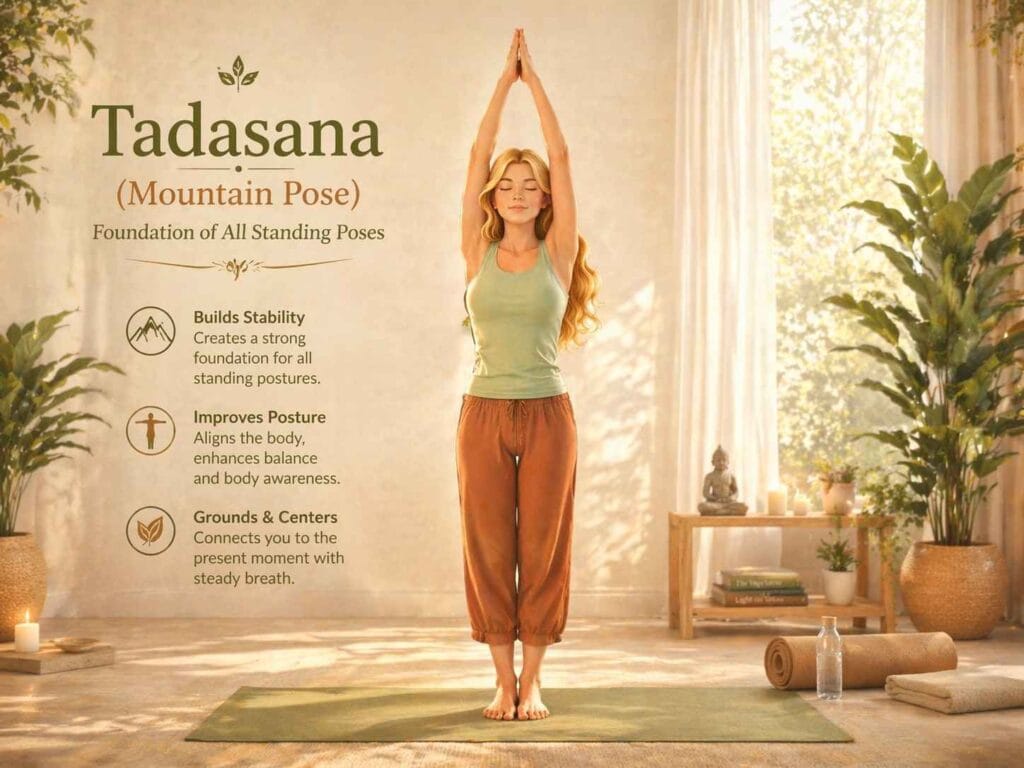
Tadasana (Mountain Pose) is the foundation of all standing yoga poses. Learn its correct alignment, benefits, and deeper meaning to improve posture, balance, and body awareness.
The Stillness That Comes Before Movement
In the practice of yoga, not every posture is defined by movement. Some are defined by stillness.
Tadasana, often translated as Mountain Pose, appears outwardly simple, just standing upright. Yet within this simplicity lies a depth that reflects the very essence of yoga itself.
In the Yoga Sutras of Patanjali, yoga is described as the stilling of the fluctuations of the mind. Before the mind can become steady, the body must learn stability. Tadasana becomes one of the first ways through which this stability is cultivated.
It is not merely a way of standing. It is a way of arriving into the body with awareness.
Why Tadasana is Considered Foundational
Every standing posture in yoga begins from the principles established in Tadasana.
Whether one moves into a forward bend, a balance, or a more complex asana, the essential elements remain the same:
- Grounding through the feet
- Alignment of the spine
- Balance between effort and ease
- Awareness of breath
These are not mechanical instructions, they are principles of integration.
In traditional practice, the body is not trained in isolation. It is trained as a whole system. Tadasana teaches this integration by bringing attention to how the body stands, how it balances, and how it maintains alignment without strain.
In this sense, Tadasana is not just the beginning of standing poses, it is the reference point for all of them.
The Yogic Understanding of Posture
In the Yoga Sutras of Patanjali, asana is defined not by shape, but by quality:
A posture should be steady and comfortable (sthira sukham asanam).
This principle is clearly expressed in Tadasana.
There is steadiness, through grounding and alignment.
There is ease, through relaxation and natural breath.
If either is missing, the posture becomes incomplete.
This teaching shifts the focus away from appearance and toward experience. The goal is not to “hold” the posture rigidly, but to inhabit it with awareness.
How to Practice Tadasana
Begin by standing upright, allowing the feet to rest firmly on the ground. The weight is distributed evenly, not leaning forward or backward, not favoring one side.
The legs remain active, but not tense. There is a subtle lift through the thighs, creating stability without rigidity.
The spine lengthens naturally upward. The chest opens gently, and the shoulders soften downward.
The arms rest by the sides, relaxed but aware.
The head aligns with the spine, and the gaze remains steady.
The breath flows without effort.
From the outside, nothing appears to be happening.
But internally, attention is fully engaged.
The Role of the Breath
The Hatha Yoga Pradipika emphasizes the relationship between breath and mind.
It teaches that when the breath is unsteady, the mind becomes unsteady. When the breath is calm, the mind begins to settle.
In Tadasana, the breath becomes a guide.
Instead of controlling it forcefully, one simply becomes aware of it. This awareness begins to regulate the nervous system naturally.
As the breath steadies, the body relaxes. As the body relaxes, the mind becomes quieter.
In this way, Tadasana becomes more than a physical posture, it becomes a subtle bridge between body and mind.
Alignment as Awareness
Alignment in Tadasana is often described physically, feet grounded, spine upright, shoulders relaxed. But at a deeper level, alignment is not just structural, it is attentional.
To align the body requires awareness.
One must notice:
- where weight is uneven
- where tension is unnecessary
- where posture collapses
This act of noticing is itself a form of practice.
Over time, this awareness extends beyond the posture. One begins to notice alignment in daily life, how one sits, stands, and moves.
In this way, Tadasana becomes not just an exercise, but a training in awareness.
The Inner Stability of the Mountain
The name “Tadasana” carries meaning beyond form.
A mountain stands steady, grounded, and unmoving, yet it is not rigid. It exists in balance with its surroundings.
Similarly, in this posture:
The body is stable, but not stiff.
The mind is quiet, but not suppressed.
This reflects a deeper yogic principle, stability without tension.
In the Bhagavad Gita, Krishna describes a balanced state in which one remains steady amidst changing conditions.
Tadasana becomes a physical expression of this inner steadiness.
Physical Benefits of Tadasana
Though subtle, the physical effects of Tadasana are significant when practiced consistently.
- It helps improve posture by aligning the spine and reducing habitual imbalances.
- It strengthens the legs, ankles, and core, creating stability.
- It enhances body awareness, allowing more efficient movement.
- It supports better breathing by opening the chest and maintaining alignment.
These benefits form the foundation upon which all other physical practices build.
Mental and Energetic Effects
The stillness of Tadasana has a direct impact on the mind.
When the body is steady, the mind begins to follow. Attention becomes less scattered, and awareness becomes more stable.
This can lead to:
- Improved concentration
- Reduced restlessness
- A sense of grounding
In yogic terms, this is the beginning of moving from distraction toward clarity.
Tadasana in Daily Life
The relevance of Tadasana extends beyond the yoga mat.
In modern life, posture is often unconscious, shaped by habits such as prolonged sitting, device usage, and lack of movement awareness.
Tadasana offers a simple way to reconnect.
By standing with awareness, even for a few moments, one can:
- Reset posture
- Reconnect with breath
- Bring attention back to the present
It becomes a small but meaningful pause in the day.
Common Mistakes
Because the posture appears simple, it is often practiced without attention.
Common tendencies include:
- Locking the knees
- Leaning unevenly
- Overarching the lower back
- Holding the breath
These mistakes arise from lack of awareness rather than lack of effort.
Correct practice is not about doing more, it is about doing with attention.
Tadasana as Meditation
At a deeper level, Tadasana can be understood as a form of standing meditation.
The body remains still, and attention is placed on alignment, breath, and presence.
As stillness increases, the movements of the mind become more visible. Thoughts arise, attention drifts, and awareness fluctuates.
By remaining present, one begins to observe these patterns.
This reflects the core teaching of yoga, not to stop the mind forcefully, but to become aware of it.
Tadasana may appear simple, but it contains the essence of yoga.
It teaches how to stand, not only physically, but with awareness.
It brings together:
- stability of the body
- steadiness of breath
- clarity of attention
Before movement, it teaches stillness.
Before complexity, it establishes foundation.
And in that foundation, the entire practice of yoga begins.