
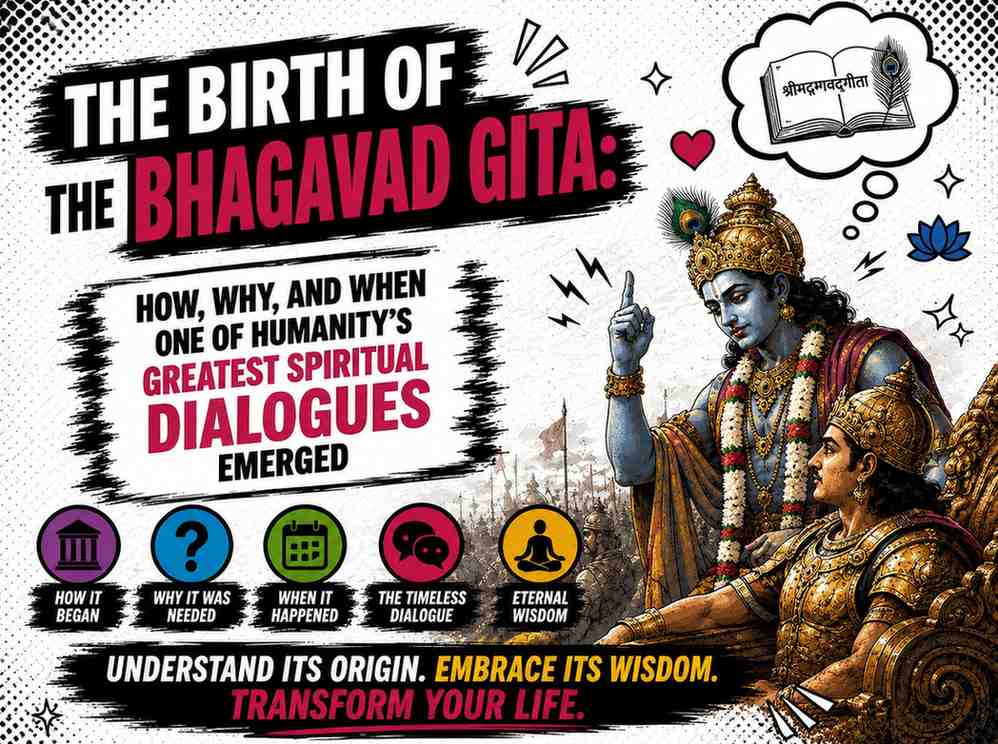
Discover the true origin of the Bhagavad Gita when it was spoken, why it emerged during the Mahabharata war, who heard it first, and why its teachings still guide the modern restless mind today.
The Birth of the Bhagavad Gita
And then there are books that continue following humanity through every age of uncertainty, moral conflict, and inner confusion.
The Bhagavad Gita belongs to the third category.
For more than two millennia, this ancient Sanskrit dialogue has survived the rise and fall of kingdoms, invasions, colonization, industrial revolutions, and the modern technological age. It has been preserved not merely as a religious scripture, but as one of humanity’s most profound explorations of duty, consciousness, suffering, action, and the search for meaning. The Bhagavad Gita has influenced spiritual teachers, philosophers, political leaders, psychologists, scientists, yogis, and ordinary individuals attempting to understand how one should live in moments of fear, uncertainty, and moral complexity.
Unlike many ancient texts that remained confined to their original historical settings, the Bhagavad Gita continuously re-emerged across different eras because its central concerns are deeply human and timeless. Thinkers such as Adi Shankaracharya interpreted it through the lens of Advaita Vedanta, while Ramanujacharya emphasized devotion and surrender. In modern history, Mahatma Gandhi described the Gita as his “spiritual dictionary,” turning to it repeatedly during India’s freedom struggle. Physicist J. Robert Oppenheimer famously recalled a verse from the Bhagavad Gita after witnessing the first successful atomic bomb test in 1945, reflecting the text’s continued philosophical reach even within the modern scientific age. Scholars including Sarvepalli Radhakrishnan, Eknath Easwaran, and Winthrop Sargeant have noted that the enduring power of the Gita lies in its ability to address both philosophical inquiry and practical human struggle simultaneously.
Yet despite its enormous influence, one important question often remains unexplored by modern readers:
How was the Bhagavad Gita actually born?
To understand the birth of the Bhagavad Gita, one must first understand that it did not emerge as an isolated spiritual book written in peace and comfort. The Bhagavad Gita was born within the Mahabharata one of the largest and most philosophically layered epics in human history during a moment of immense political tension, moral conflict, and emotional collapse. According to the traditional narrative preserved in the Mahabharata, the dialogue takes place on the battlefield of Kurukshetra, just before the beginning of a catastrophic war between two branches of the same royal family: the Pandavas and the Kauravas. This setting is not merely historical background; it is central to the philosophical meaning of the text itself.
Ancient Indian tradition attributes the Mahabharata to the sage Vyasa, who is regarded not only as a compiler of sacred knowledge but also as a witness to the civilizational and moral crisis unfolding within the story. Modern scholars generally agree that the Mahabharata evolved over several centuries through oral transmission before reaching its written form, with the Bhagavad Gita likely composed between the 5th century BCE and the 2nd century CE during a period of intense philosophical development in ancient India. During this era, Indian thinkers were deeply engaged with questions concerning:
- duty (dharma),
- karma,
- suffering,
- renunciation,
- meditation,
- consciousness,
- and liberation (moksha).
The Bhagavad Gita emerged as a synthesis of many of these evolving philosophical traditions, including:
- Vedic thought,
- Upanishadic inquiry,
- Samkhya philosophy,
- early Yoga traditions,
- and devotional spirituality. Scholars such as Sarvepalli Radhakrishnan, Jeaneane Fowler, and Klaus Klostermaier have described the Gita as one of the most important integrative texts in Indian intellectual history because it brought these diverse streams of thought into a single human conversation.
Yet the most remarkable aspect of the Bhagavad Gita is not only what it teaches, but where it begins.
Why did this conversation happen on a battlefield?
Most spiritual teachings in the ancient world emerged in forests, hermitages, monasteries, or places associated with withdrawal from ordinary life. The Bhagavad Gita does the exact opposite. It begins in the middle of a battlefield, moments before violence and destruction are about to unfold.
This setting was deeply intentional.
The battlefield of Kurukshetra represents more than a physical war. It symbolizes the inner conflict of human existence itself. The warrior prince Arjuna stands between two armies and suddenly finds himself unable to fight after seeing his own teachers, relatives, elders, and friends standing on both sides of the conflict. The Mahabharata describes Arjuna’s condition with striking psychological realism:
his hands tremble, his body weakens, his mouth dries, and his mind becomes overwhelmed with grief and moral confusion.
At this moment, Arjuna experiences something far deeper than fear.
He experiences a collapse of certainty.
Everything he believed about duty, morality, justice, family, and righteousness suddenly becomes unclear. He no longer knows what the right action is. This crisis becomes the doorway through which the Bhagavad Gita emerges.
This is one of the reasons the text continues to resonate across centuries. The Bhagavad Gita recognizes a profound truth about human life:
wisdom often becomes necessary not during comfort, but during moments of confusion, suffering, and internal conflict.
The Gita was not spoken to someone detached from worldly responsibilities. It was spoken to a human being standing in the middle of unbearable moral complexity.
And perhaps that is exactly why it continues to speak so powerfully to the modern human mind.
Today, people may not stand on the battlefield of Kurukshetra, but they continue facing psychological and existential battles involving:
- anxiety,
- identity,
- ambition,
- grief,
- emotional exhaustion,
- ethical dilemmas,
- attachment,
- and the search for meaning.
Modern civilization has changed externally through technology and progress, but the inner struggles of the human mind remain remarkably similar. The Bhagavad Gita survives because it addresses these timeless dimensions of human experience. It does not offer escape from life; instead, it asks one of the most enduring questions in human history:
How should a person live, act, and remain inwardly stable in a world filled with uncertainty and suffering?
What Is the Bhagavad Gita?
The Bhagavad Gita is one of the most influential spiritual and philosophical texts ever produced in human history. Composed in Sanskrit and preserved within the Indian epic Mahabharata, the Bhagavad Gita takes the form of a dialogue between Prince Arjuna and Lord Krishna on the battlefield of Kurukshetra just before the beginning of a devastating war. The text consists of approximately 700 verses spread across 18 chapters and appears in the Bhishma Parva (Book of Bhishma) of the Mahabharata. Although deeply rooted in the spiritual traditions of ancient India, the Bhagavad Gita has transcended geographical, religious, and historical boundaries because of the universal nature of the questions it explores.
The title itself carries profound meaning.
The word Bhagavad is derived from the Sanskrit term Bhagavan, meaning:
- “the Divine,”
- “the Blessed One,”
or - “the Supreme Lord.”
The word Gita means:
- “song”
or - “sacred dialogue.”
Thus, Bhagavad Gita is traditionally translated as:
“The Song of the Divine.”
However, scholars and spiritual teachers across centuries have emphasized that the Bhagavad Gita is far more than a religious scripture in the conventional sense. It is simultaneously:
- a philosophical inquiry into the nature of reality,
- a psychological exploration of human suffering and moral conflict,
- a guide to ethical action,
- a text on meditation and self-discipline,
- and a profound reflection on consciousness, duty, and liberation.
What makes the Bhagavad Gita historically unique is the way it brings together multiple streams of Indian philosophical thought into a single integrated conversation. The text synthesizes ideas from:
- the Vedas,
- the Upanishads,
- Samkhya philosophy,
- early Yoga traditions,
- and Bhakti (devotional) spirituality.
Scholars such as Sarvepalli Radhakrishnan, Franklin Edgerton, and Jeaneane Fowler have described the Bhagavad Gita as one of the greatest philosophical syntheses in Indian intellectual history because it attempts to reconcile several seemingly opposing paths:
- action and renunciation,
- worldly responsibility and spiritual freedom,
- devotion and knowledge,
- meditation and social duty.
Unlike many spiritual traditions that emphasize withdrawal from ordinary life, the Bhagavad Gita addresses a person who is deeply engaged in the world. Arjuna is not a monk, ascetic, or hermit. He is a warrior, leader, son, student, and human being facing unbearable moral confusion. This context is crucial because the teachings of the Bhagavad Gita emerge not in isolation from life, but directly in the middle of conflict, responsibility, grief, and uncertainty.
For many readers across generations, this is what makes the Bhagavad Gita deeply personal.
The text does not begin with enlightenment.
It begins with breakdown.
When Arjuna sees his own teachers, relatives, friends, and loved ones standing on the battlefield prepared to kill one another, he becomes emotionally overwhelmed. The Mahabharata describes him trembling, losing strength, and questioning the meaning of war, duty, success, and even life itself. At that moment, the Bhagavad Gita begins.
This opening is psychologically extraordinary because it reflects a timeless human experience:
the search for wisdom often begins when certainty collapses.
The Bhagavad Gita does not ignore suffering, confusion, or emotional conflict. Instead, it enters directly into them. Krishna’s teachings to Arjuna address questions that remain relevant even today:
- How should one act in moments of moral complexity?
- What is the nature of the self?
- Why does attachment create suffering?
- Can inner peace exist amidst chaos?
- What does it mean to live consciously and responsibly?
For this reason, the Bhagavad Gita continues to resonate not only as a sacred Hindu text, but also as a universal exploration of the human condition itself.
When Was the Bhagavad Gita Spoken?
The Bhagavad Gita emerges during the Kurukshetra War described in the Mahabharata, one of the oldest and most influential epics of ancient India. According to the traditional narrative, the dialogue between Lord Krishna and Prince Arjuna takes place immediately before the beginning of the great war between the Pandavas and the Kauravas on the battlefield of Kurukshetra. This moment is presented not merely as a historical event, but as a profound moral and civilizational crisis in which questions of justice, duty, power, family, and righteousness collide.
Within traditional Hindu belief, the events of the Mahabharata are often placed thousands of years before the Common Era. Some traditional calculations associate the Kurukshetra war with the transition into Kali Yuga, which according to certain Hindu astronomical and Puranic traditions began around 3102 BCE. Ancient commentators and many spiritual traditions therefore regard the Bhagavad Gita not simply as literature, but as a sacred revelation belonging to a much earlier spiritual age.
However, modern historical and textual scholarship approaches the question differently. Most scholars agree that while the Mahabharata may preserve memories of much older oral traditions and historical conflicts, the text itself evolved gradually over several centuries through oral transmission before reaching its present written form. Based on linguistic analysis, philosophical content, and comparisons with other Indian texts, modern academic estimates generally place the composition of the Bhagavad Gita somewhere between the 2nd century BCE and the 2nd century CE, with many scholars suggesting approximately the 1st or 2nd century BCE as the most likely period of compilation.
This dating is significant because it places the Bhagavad Gita within one of the most intellectually dynamic periods in Indian history.
Ancient India during this era was undergoing profound philosophical transformation. The older Vedic tradition centered around ritual sacrifice and cosmic order was gradually evolving into deeper philosophical inquiry about the nature of existence, consciousness, suffering, and liberation. The Upanishads had already introduced revolutionary ideas concerning:
- Atman (the inner Self),
- Brahman (ultimate reality),
- karma,
- rebirth,
- meditation,
- and moksha (liberation).
At the same time, new philosophical and spiritual movements were actively emerging across the Indian subcontinent. Schools such as:
- Samkhya,
- early Yoga traditions,
- Buddhism,
- Jainism,
- and devotional movements
were all engaging with fundamental human questions concerning suffering, ethics, self-discipline, and spiritual freedom.
Questions surrounding:
- duty (dharma),
- morality,
- violence,
- renunciation,
- social responsibility,
- meditation,
- and consciousness
had become central concerns of Indian intellectual life.
One of the greatest achievements of the Bhagavad Gita was that it did not reject these competing philosophical traditions. Instead, it attempted to bring them together into a unified spiritual vision. Scholars such as Sarvepalli Radhakrishnan and Jeaneane Fowler have noted that the Bhagavad Gita acts as a remarkable synthesis of:
- Vedic spirituality,
- Upanishadic philosophy,
- yogic discipline,
- and devotional theism.
The text integrates:
- Karma Yoga (the path of action),
- Jnana Yoga (the path of knowledge),
- Bhakti Yoga (the path of devotion),
- and Dhyana Yoga (the path of meditation)
into one coherent dialogue about how human beings should live.
But perhaps the most extraordinary aspect of the Bhagavad Gita is not simply when it appeared, but where it placed this philosophical conversation.
The teachings of the Bhagavad Gita do not emerge in a forest hermitage, isolated monastery, or peaceful retreat.
They emerge on a battlefield.
This setting fundamentally changes the meaning of the text.
The Bhagavad Gita recognizes that wisdom is most necessary not when life is calm and predictable, but when human beings are overwhelmed by uncertainty, grief, responsibility, and moral conflict. Arjuna’s crisis becomes symbolic of the human condition itself:
the struggle to act rightly in a world where every decision carries emotional, ethical, and personal consequences.
In this sense, the Bhagavad Gita became far more than a religious scripture tied to one historical period.
It became a timeless exploration of how to remain inwardly stable amidst the confusion of life.
And perhaps that is why it continues speaking across centuries to people living in entirely different worlds from the one in which it was first spoken.
Why Was the Bhagavad Gita Spoken on a Battlefield?
This is perhaps the most important question.
Because the battlefield is not accidental.
The setting itself is symbolic.
Arjuna stands between:
- family and responsibility,
- emotion and duty,
- fear and courage,
- morality and survival,
- action and withdrawal.
He looks at the battlefield and sees:
- teachers,
- cousins,
- elders,
- friends,
- loved ones.
And suddenly he collapses internally.
His hands tremble.
His mouth dries.
His mind spirals into despair.
He no longer wants to fight.
In modern language, Arjuna is experiencing a profound psychological and existential crisis.
And this is where the genius of the Bhagavad Gita begins.
Krishna does not merely tell Arjuna to “be positive.”
He does not dismiss his confusion.
Instead, Krishna transforms the battlefield into a space for philosophical awakening.
This changes the entire meaning of spirituality.
The Gita suggests that wisdom is not only for caves, forests, or monks.
It is for:
- leaders,
- workers,
- parents,
- thinkers,
- creators,
- warriors,
- and ordinary people struggling with difficult choices.
The battlefield represents life itself.
Modern humans may not stand between literal armies.
But internally, many people still stand on their own Kurukshetra every day:
- career confusion,
- emotional exhaustion,
- moral uncertainty,
- overthinking,
- anxiety,
- identity crises,
- digital distraction,
- and fear of failure.
That is why the Gita still feels modern.
Because the battlefield never truly disappeared.
It simply changed form.
Who First Heard the Bhagavad Gita?
The first listener of the Bhagavad Gita was Arjuna.
But interestingly, the text is layered through multiple narrators.
The conversation between Krishna and Arjuna is narrated by Sanjaya to King Dhritarashtra.
According to the Mahabharata, Sanjaya is granted divine vision, allowing him to witness the battlefield remotely.
This narrative structure creates an important philosophical effect.
The Bhagavad Gita is not presented as abstract theory.
It is witnessed in real time during a moment of historical and emotional intensity.
This gives the dialogue urgency.
It feels alive.
Why Did Arjuna Break Down?
Arjuna’s collapse is one of the most psychologically realistic moments in ancient literature.
He is not weak.
He is one of the greatest warriors of his time.
Yet he becomes paralyzed by moral conflict.
Why?
Because human beings are rarely destroyed only by external problems.
More often, they are overwhelmed by inner contradiction.
Arjuna’s crisis comes from competing truths:
- fighting feels violent,
- but avoiding duty feels cowardly,
- protecting justice requires war,
- but war destroys relationships.
This complexity is exactly why the Bhagavad Gita has endured.
It does not offer simplistic answers.
Instead, it explores:
- ethics,
- consciousness,
- detachment,
- purpose,
- discipline,
- devotion,
- and self-understanding.
The Gita understands something deeply human:
confusion often appears before transformation.
Krishna’s Role in the Bhagavad Gita
Krishna appears in the Mahabharata as:
- friend,
- guide,
- charioteer,
- strategist,
- and divine teacher.
But the symbolism is even deeper.
Krishna becomes:
the voice of higher awareness within chaos.
Notice something important.
Krishna does not remove the battlefield.
He transforms Arjuna’s understanding of it.
This distinction matters greatly.
The Bhagavad Gita is not escapist spirituality.
It does not say:
- abandon life,
- reject responsibility,
- withdraw from action.
Instead, Krishna teaches:
how to act without being psychologically consumed by action.
This idea becomes one of the central teachings of Karma Yoga.
The Core Teachings Introduced in the Bhagavad Gita
The Bhagavad Gita introduces several major spiritual and philosophical paths together in one text.
1. Karma Yoga – The Yoga of Action
Krishna teaches Arjuna to act:
- with sincerity,
- discipline,
- and responsibility,
while reducing attachment to outcomes.
This teaching is revolutionary because it spiritualizes ordinary life.
Work itself becomes practice.
2. Jnana Yoga – The Yoga of Knowledge
The Gita explores:
- the nature of the self,
- consciousness,
- reality,
- ego,
- and impermanence.
Krishna repeatedly reminds Arjuna that the deepest self is beyond temporary identity.
3. Bhakti Yoga – The Yoga of Devotion
The Bhagavad Gita also introduces devotion not merely as ritual, but as deep surrender and trust in the divine.
This emotional dimension makes the text profoundly personal for many readers.
4. Dhyana Yoga – The Yoga of Meditation
The Gita discusses:
- mental discipline,
- focus,
- self-control,
- and meditative awareness.
Long before modern mindfulness trends, the text recognized the restless nature of the human mind.
Why the Bhagavad Gita Became Timeless
Many ancient texts remain historically important but emotionally distant.
The Bhagavad Gita survived because it addresses permanent human struggles.
Every generation faces:
- uncertainty,
- grief,
- fear,
- attachment,
- ambition,
- confusion,
- mortality,
- and meaninglessness.
The language changes.
Technology changes.
Civilizations change.
But the structure of human inner conflict remains surprisingly similar.
The Gita speaks directly to that conflict.
The Bhagavad Gita’s Role in Ancient India
In ancient India, the Bhagavad Gita became one of the most influential spiritual texts because it bridged multiple worlds:
- philosophy,
- action,
- devotion,
- meditation,
- ethics,
- and social life.
It did not demand total withdrawal from society.
This made it accessible across many types of people.
Kings studied it.
Yogis studied it.
Householders studied it.
Thinkers debated it.
Its flexibility helped it spread across centuries.
The Bhagavad Gita’s Influence on the Modern World
The Bhagavad Gita eventually reached global audiences through translations and philosophical studies.
It influenced:
- Mahatma Gandhi,
- Aldous Huxley,
- Carl Jung,
- J. Robert Oppenheimer,
- Hermann Hesse,
- and countless spiritual thinkers.
Oppenheimer famously recalled a verse from the Gita after witnessing the atomic bomb test:
“Now I am become Death, the destroyer of worlds.”
The text fascinated modern thinkers because it explored:
- consciousness,
- morality,
- action,
- and human responsibility
at a depth rarely seen in ancient literature.
Why the Bhagavad Gita Feels Relevant Today
Modern life has created extraordinary convenience.
But it has also intensified:
- distraction,
- anxiety,
- overstimulation,
- identity confusion,
- emotional exhaustion,
- and purposelessness.
People today often know:
- how to consume,
- how to scroll,
- how to react,
- how to stay busy,
but not necessarily:
- how to understand themselves.
This is where the Bhagavad Gita still enters the conversation powerfully.
It asks timeless questions:
- What is meaningful action?
- Who are you beyond roles and labels?
- Why does attachment create suffering?
- How should a person act in difficult situations?
- What does inner stability actually mean?
These questions remain deeply modern.
The Bhagavad Gita and the Modern Restless Mind
Perhaps the greatest reason the Bhagavad Gita continues to remain relevant across centuries is because it refuses to simplify the human condition. Unlike many modern interpretations of spirituality that promise instant peace, constant positivity, or escape from emotional difficulty, the Bhagavad Gita begins by acknowledging something far more honest:
human life is often deeply conflicted, uncertain, and psychologically overwhelming.
The text opens not with enlightenment, but with breakdown.
Prince Arjuna, one of the greatest warriors in the Mahabharata, suddenly finds himself emotionally shattered on the battlefield of Kurukshetra. Faced with the reality of war and the possibility of killing his own teachers, relatives, and loved ones, he becomes overwhelmed by grief, fear, confusion, and moral paralysis. The Mahabharata describes him trembling, losing strength in his limbs, and questioning the meaning of duty, success, and even life itself. Modern readers often recognize in Arjuna’s crisis something profoundly familiar:
the experience of mental exhaustion when one’s values, responsibilities, emotions, and fears collide all at once.
This psychological realism is one of the reasons the Bhagavad Gita has endured far beyond its historical setting. The text does not dismiss suffering, nor does it encourage blind optimism. Instead, Krishna gradually guides Arjuna toward:
- clarity,
- self-awareness,
- discipline,
- emotional steadiness,
- and conscious action.
The teachings of the Gita repeatedly emphasize that inner stability is not achieved by escaping life, but by learning how to face life without becoming inwardly consumed by fear, attachment, anger, or despair.
In many ways, the Bhagavad Gita anticipates concerns that dominate the modern world today.
Despite technological advancement and material convenience, modern society continues struggling with:
- anxiety,
- overstimulation,
- distraction,
- burnout,
- emotional isolation,
- identity confusion,
- and a constant sense of psychological restlessness.
People today are more connected digitally than ever before, yet many feel internally fragmented and mentally exhausted. Endless comparison, information overload, social pressure, and the pursuit of external validation have created a culture where attention is constantly scattered and the mind rarely experiences stillness.
The Bhagavad Gita speaks directly to this condition.
Its teachings on:
- detachment,
- disciplined action,
- self-control,
- meditation,
- awareness,
- and mastery over the restless mind
remain remarkably relevant in the modern age. In Chapter 6 of the Bhagavad Gita, Arjuna himself admits that the mind appears “restless, turbulent, powerful, and difficult to control.” Krishna does not deny this difficulty. Instead, he explains that the mind can gradually be steadied through:
- practice (abhyasa)
and - detachment (vairagya).
This insight continues to resonate because it recognizes that mental clarity is not achieved instantly. It requires conscious effort, discipline, and repeated self-awareness.
Importantly, the Bhagavad Gita does not teach passivity or withdrawal from responsibility. Krishna never asks Arjuna to abandon life or escape the world. Rather, the Gita teaches how to remain inwardly balanced while fully participating in life’s challenges. This balance between action and awareness is one of the text’s most enduring contributions to human thought.
For this reason, many modern readers approach the Bhagavad Gita not only as a sacred Hindu scripture, but also as a timeless guide to psychological resilience and ethical living. Thinkers such as Mahatma Gandhi, Swami Vivekananda, Carl Jung, Aldous Huxley, and Eknath Easwaran all observed that the Gita speaks to dimensions of human struggle that remain unchanged across civilizations and historical periods.
In many ways, the Bhagavad Gita is less about religion in a narrow sense and more about learning how to remain conscious in moments that would normally break the human mind.
And perhaps that is why humanity continues returning to it generation after generation.
Because although the world changes constantly, the inner struggle for clarity, meaning, and peace remains timeless.o it.
Final Thoughts
The Bhagavad Gita was born on a battlefield because human transformation rarely begins in comfort. It begins in moments when certainty collapses, when the mind becomes conflicted, and when old ways of understanding life no longer feel sufficient. Arjuna’s crisis on the battlefield of Kurukshetra was not simply a moment of fear before war; it was a profound human breakdown involving grief, moral confusion, responsibility, and the search for meaning. From that moment emerged one of the greatest spiritual and philosophical dialogues in human history.
What makes the Bhagavad Gita timeless is that it does not avoid the realities of human suffering. Instead, it enters directly into them. The text recognizes that life is often complex, uncertain, and emotionally difficult. Rather than offering escape from the world, the Bhagavad Gita teaches how to live within the world with greater awareness, discipline, clarity, and inner balance.
The battlefield of Kurukshetra therefore becomes more than a historical setting. It becomes a symbol of the inner struggles every human being faces:
- fear and courage,
- attachment and detachment,
- confusion and wisdom,
- despair and responsibility.
Even today, modern humanity continues fighting its own internal battles involving anxiety, distraction, ambition, emotional exhaustion, and the search for purpose. This is why the Bhagavad Gita continues to resonate across centuries. Its teachings remain relevant not because they belong only to ancient India, but because they address timeless dimensions of human experience.
The Bhagavad Gita survives because it continues speaking to the restless human mind not as a relic of the past, but as a guide for understanding life, action, consciousness, and the deeper search for meaning that still exists within humanity today.
Also read: