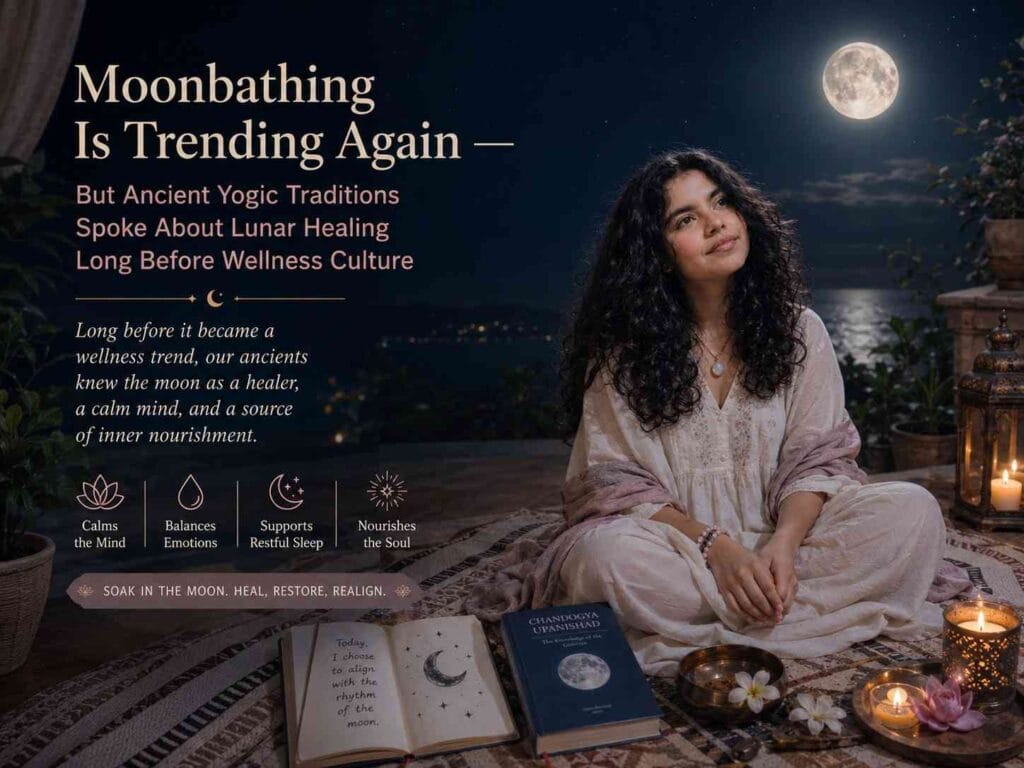
Moonbathing is becoming one of the biggest wellness trends today. Discover its connection to yoga, Ayurveda, lunar symbolism, nervous system regulation, meditation, and ancient Indian wisdom in this deeply researched article.
Why “Moonbathing” Is Suddenly Everywhere
Over the past year, moonbathing has quietly transformed from a niche spiritual practice into one of the most visible trends within modern wellness culture. What once existed mainly within small meditation communities, yogic circles, or traditional lunar rituals is now appearing across mainstream lifestyle spaces worldwide.
Today, full moon gatherings, moon meditation events, moonlight yoga sessions, nighttime breathwork experiences, and lunar wellness retreats are becoming increasingly common across social media platforms, luxury wellness resorts, Ayurveda-inspired communities, and mindfulness-centered lifestyle brands.
The growing popularity of moonbathing reflects a broader cultural shift happening within wellness itself.
For many years, wellness culture largely emphasized productivity, optimization, biohacking, performance enhancement, and constant self-improvement. However, after years of digital overstimulation, chronic stress, emotional burnout, sleep disruption, and continuous psychological pressure, many people are now searching for something very different:
slowness,
restoration,
emotional balance,
nervous system recovery,
and inner quietness.
Moonbathing fits directly into this emerging movement because it symbolically represents the opposite of modern overstimulation.
Instead of bright screens, artificial lighting, endless scrolling, notifications, performance pressure, and constant information exposure, moonbathing encourages silence, darkness, stillness, slower breathing, reduced stimulation, and reconnection with natural rhythms.
For many individuals, simply sitting quietly under moonlight feels psychologically restorative precisely because modern life rarely provides environments that are calm, dark, silent, or undemanding.
This is one reason the practice resonates so deeply emotionally.
Moonbathing itself usually refers to intentionally spending time beneath moonlight , particularly during the full moon , through practices such as: quiet walking, meditation, breath awareness, journaling, silent reflection, moon gazing, or simply resting outdoors in stillness.
Unlike highly stimulating wellness trends focused on intensity or achievement, moonbathing emphasizes receptivity rather than performance.
The goal is not optimization.
The goal is regulation, calmness, and reconnection.
Psychologically, this creates a powerful contrast to the pace of contemporary life.
Modern individuals often spend entire days inside climate-controlled environments under artificial light while remaining continuously connected to digital stimulation. Attention rarely rests completely.
The nervous system remains constantly activated through information exposure, multitasking, comparison culture, emotional reactivity, and continuous cognitive engagement.
As a result, even rest itself often becomes overstimulated.
People may physically stop working while mentally remaining consumed by screens, information, or emotional processing.
Moonbathing symbolically interrupts this cycle.
The practice encourages temporary withdrawal from hyperstimulation and creates space for sensory reduction, quiet observation, and emotional decompression.
This may help explain why moon-related wellness practices have become especially popular among younger generations already experiencing high levels of burnout, anxiety, emotional fatigue, sleep dysregulation, and digital exhaustion.
And interestingly, while moonbathing is now marketed as a modern wellness trend, many of its underlying ideas are not new at all.
Ancient Indian traditions explored the relationship between the moon, emotional balance, consciousness, inner calm, and mental rhythm thousands of years ago through yoga, Ayurveda, tantra, and Vedic philosophy.
The Moon and the Mind in Ancient Indian Traditions
One of the most fascinating aspects of the modern moonbathing trend is that ancient Indian traditions already examined the symbolic and psychological relationship between the moon and the human mind long before contemporary wellness culture existed.
In Sanskrit traditions, the moon is called Chandra, and throughout Vedic and yogic literature it is repeatedly associated with: the mind, emotion, coolness, mental steadiness, receptivity, reflection, cyclical rhythm, and subtle awareness.
Unlike modern mechanistic systems that often separate psychology from nature, ancient Indian traditions frequently viewed human consciousness as deeply interconnected with natural rhythms and cosmic patterns.
The moon therefore became more than a physical celestial object.
It emerged as a symbol of the reflective, emotional, intuitive, and inward dimensions of consciousness itself.
A famous line from the Purusha Sukta states:
“Chandrama Manaso Jatah”
“The Moon was born from the cosmic mind.”
This statement is highly symbolic and philosophically rich.
The moon is presented as emerging from manas, the principle of mind or mental consciousness, suggesting a deep connection between lunar symbolism and psychological life.
Throughout yogic and Ayurvedic traditions, the moon often represents cooling, stabilizing, nourishing, and calming qualities in contrast to the activating and heating symbolism associated with the sun.
This symbolic framework later influenced numerous contemplative and ritual practices connected to lunar cycles.
Ancient traditions did not see human beings as isolated psychological entities disconnected from environment and rhythm.
Instead, they observed subtle relationships between:
breath and emotional state,
sleep and mental clarity,
food and consciousness,
seasonal change and physiology,
attention and suffering,
and lunar cycles and psychological sensitivity.
Whether understood symbolically, spiritually, or experientially, the moon became associated with inwardness, reflection, emotional awareness, and mental quietness.
This is one reason why moon-centered observances became integrated into: meditation practices, fasting rituals, mantra recitation, night vigils, Ayurvedic routines, tantric symbolism, and spiritual observances connected to full moon and new moon cycles.
Even today, many traditional spiritual communities continue observing lunar calendars for meditation, silence, mantra, fasting, and contemplative practices.
Ancient Yogic Texts Already Discussed the Breath-Mind Relationship
One reason moonbathing feels calming for many individuals may not simply be moonlight itself, but the physiological and psychological conditions the practice naturally encourages.
Ancient yogic traditions explored this relationship between breath, attention, and mental steadiness very deeply.
The Hatha Yoga Pradipika explains:
चले वाते चलं चित्तं निश्चले निश्चलं भवेत् ।
योगी स्थाणुत्वमाप्नोति ततो वायुं निरोधयेत् ॥
Transliteration
Chale vāte chalaṁ cittaṁ niścale niścalaṁ bhavet
Yogī sthāṇutvam āpnoti tato vāyuṁ nirodhayet
Meaning
“When the breath is unsteady, the mind is unsteady. When the breath becomes steady, the mind becomes steady.”
This insight is remarkably sophisticated because it recognizes a direct relationship between physiological rhythm and mental state centuries before modern neuroscience and psychology began studying autonomic nervous system regulation scientifically.
Today, modern research increasingly explores how slow breathing practices may influence: stress activation, heart-rate variability, emotional regulation, attention, sleep quality, and parasympathetic nervous system activity.
Interestingly, moonbathing rituals often naturally incorporate many of these same regulatory conditions: slow breathing, silence, mindfulness, stillness, reduced sensory stimulation, darkness, nature exposure, and emotional reflection.
Ancient yogic traditions may not have described these processes using modern neurological terminology, but they clearly recognized through direct contemplative observation that the state of the breath strongly influences the state of the mind.
This is why practices involving calm breathing, silence, reduced stimulation, and inward attention were considered essential for mental steadiness and emotional balance.
In many ways, modern moonbathing culture may be rediscovering ancient principles through contemporary language.
The practice itself is new mainly in branding.
The deeper human need beneath it, the search for calmness, rhythm, nervous system recovery, and inner stillness, is timeless.
Why Moonbathing Is Becoming Popular Now
The rapid rise of moonbathing is not happening randomly or simply because of social media aesthetics. Its growing popularity reflects much deeper conditions within contemporary life and modern psychological experience.
Over the last decade, human attention has become increasingly fragmented through constant digital engagement and continuous exposure to stimulation. Most people today spend large portions of their day moving between screens, notifications, artificial lighting, information streams, social comparison, work pressure, and emotional overstimulation without experiencing genuine mental stillness for extended periods of time.
Modern environments rarely allow the nervous system to rest completely.
Even moments traditionally associated with rest are now often filled with scrolling, entertainment, messaging, multitasking, or continuous cognitive engagement. As a result, many individuals experience chronic mental fatigue while simultaneously remaining overstimulated internally.
This creates a strange psychological condition in which the mind feels exhausted yet unable to slow down completely.
Contemporary wellness culture has increasingly begun responding to this problem.
For many years, mainstream wellness trends focused heavily on optimization, productivity, performance enhancement, aggressive self-improvement, and constant efficiency. However, rising levels of burnout, anxiety, emotional fatigue, sleep disruption, and nervous system dysregulation have gradually shifted attention toward a different kind of wellness centered around restoration, regulation, emotional balance, mindfulness, and recovery.
Moonbathing fits directly into this cultural transition because it represents the opposite of hyperstimulation.
Instead of intensity, it emphasizes softness.
Instead of speed, it encourages slowness.
Instead of constant information exposure, it creates silence and sensory reduction.
Instead of artificial brightness, it invites darkness and natural rhythm.
Psychologically, this contrast itself can feel deeply calming for many people.
Moonbathing rituals often involve: reduced screen exposure, quiet nighttime environments, slow breathing, mindful observation, nature connection, reflection, stillness, and intentional disengagement from overstimulation.
These conditions naturally support nervous system relaxation because they reduce the amount of sensory and cognitive input continuously demanding attention.
In many ways, moonbathing reflects a broader psychological longing emerging within modern culture:
the desire not merely for stimulation, but for recovery from stimulation.
This may be one of the main reasons the trend resonates so strongly, especially among younger generations experiencing increasing levels of digital exhaustion, attentional fragmentation, emotional overload, and chronic stress.
Ayurveda and Lunar Energy
Within Ayurveda, the moon has traditionally been associated with cooling, nourishing, stabilizing, and restorative qualities.
Ayurvedic philosophy views human wellbeing through the lens of balance rather than isolated symptom management alone. Physical health, emotional state, digestion, sleep, environment, seasonal rhythm, sensory experience, and mental condition are all understood as interconnected dimensions of human life.
Within this framework, the moon is symbolically associated with calmness, receptivity, softness, emotional balance, hydration, nourishment, and mental cooling.
This symbolism contrasts with the traditional association of the sun with heat, intensity, outward activity, stimulation, and dynamic energy.
Ayurvedic traditions therefore often connected lunar energy with emotional restoration and nervous system calming practices, especially during periods of excessive heat, agitation, irritability, emotional intensity, or overstimulation.
Ancient systems paid careful attention to cyclical rhythm.
Seasonal change, daily routine, sleep cycles, digestive rhythm, breath patterns, and lunar phases were all considered important influences on psychological and physiological balance.
This is one reason why moon-centered practices became integrated into: full moon meditations, evening contemplation, cooling breathwork, fasting rituals, moon gazing, mantra recitation, and reflective spiritual observances.
The full moon in particular often became associated with heightened emotional sensitivity and introspection within many traditional systems.
Although modern scientific evidence regarding direct lunar influence on human behavior remains debated and complex, the symbolic and psychological importance of lunar rhythm remained deeply significant within yogic and Ayurvedic traditions.
Importantly, ancient traditions did not necessarily separate symbolic, psychological, spiritual, and physiological dimensions as rigidly as modern systems often do.
The moon therefore functioned not only as a celestial object, but also as a symbolic representation of inwardness, reflection, receptivity, and emotional rhythm.
Moonbathing and the Nervous System
One reason moonbathing often feels psychologically calming may have less to do with mystical claims and more to do with the physiological and environmental conditions the practice naturally creates.
Moonbathing usually encourages: silence, slower breathing, darkness, reduced sensory stimulation, mindfulness, nature exposure, emotional reflection, and temporary withdrawal from digital environments.
Modern neuroscience increasingly recognizes that chronic overstimulation strongly affects attention, emotional regulation, stress response, sleep quality, cognitive fatigue, and nervous system balance.
The human nervous system evolved within environments containing periods of darkness, quietness, and reduced stimulation. Contemporary life, however, often exposes individuals to continuous cognitive activation through artificial light, rapid information exchange, constant alertness, and emotional stimulation.
This persistent activation can contribute to stress accumulation and attentional exhaustion over time.
Practices that reduce sensory load therefore often feel restorative because they allow the nervous system to shift away from continuous stimulation.
Moonbathing creates conditions that naturally support this process. Darkness reduces visual intensity. Quietness lowers cognitive demand. Slow breathing may support relaxation. Nature exposure often decreases psychological overload.
Mindful observation interrupts compulsive mental engagement temporarily.
Even the act of intentionally slowing down at night can itself become psychologically regulating within highly accelerated lifestyles.
Ancient yogic traditions recognized many of these principles experientially through contemplative observation long before modern neuroscience existed.
Meditative traditions repeatedly emphasized silence, reduced sensory overload, breath regulation, attentional steadiness, and nervous system calming practices as essential for mental clarity and emotional balance.
Modern research is increasingly exploring many of these same relationships scientifically.
The Moon in Yogic Symbolism
The moon carries profound symbolic importance throughout yogic, tantric, and spiritual traditions.
In many representations of Lord Shiva, the crescent moon appears resting upon Shiva’s head. Symbolically, this often represents mastery over the fluctuating nature of the mind and the capacity to remain steady amidst changing psychological conditions.
Within yogic symbolism, the sun and moon frequently represent complementary forces within human experience.
The sun is often associated with: activity, heat, dynamic outward energy, movement, and vitality.
The moon, by contrast, is associated with: coolness, receptivity, reflection, stillness, calmness, intuition, and inward awareness.
This symbolic polarity appears throughout numerous yogic systems including: Haṭha Yoga, tantric philosophy, Ida and Pingala nāḍī theory, meditative visualization practices, and subtle energy symbolism.
Within traditional yogic physiology, Ida nāḍī is often associated with lunar qualities such as inwardness, cooling energy, receptivity, and mental calmness, while Pingala nāḍī is associated with solar qualities such as activity and dynamism.
These symbolic systems were not merely abstract philosophy.
They reflected careful observation of human psychological and energetic patterns.
Even today, many meditation practitioners intentionally meditate during full moon periods because lunar symbolism psychologically reinforces introspection, stillness, ritual awareness, and contemplative atmosphere.
Whether interpreted spiritually, symbolically, psychologically, or ritually, the moon continues functioning as a powerful archetype of inner quietness within yogic traditions.
Important Clarification: Separating Symbolism From Exaggeration
It is important not to exaggerate claims surrounding moonbathing or present ancient traditions inaccurately.
Modern wellness culture sometimes promotes lunar practices using mystical claims that extend beyond available scientific evidence. Currently, there is no strong scientific consensus proving that moonlight itself possesses supernatural healing powers capable of dramatically curing illness or transforming psychological health independently.
However, acknowledging this does not make moonbathing meaningless.
Many benefits associated with moonbathing may arise indirectly through the conditions and behaviors the practice encourages rather than through mystical properties of moonlight itself.
Practices involving: mindfulness, slower breathing, silence, reduced digital stimulation, darkness, reflection, nature exposure, and intentional rest, can naturally support relaxation and emotional regulation for many individuals.
Similarly, ancient yogic and Ayurvedic systems often approached the moon symbolically, psychologically, ritually, and spiritually rather than through the framework of modern biomedical science.
The value of these traditions does not depend upon forcing ancient scriptures to function as literal neuroscience textbooks.
Their significance lies in the extraordinary depth with which they explored consciousness, rhythm, awareness, mental conditioning, emotional balance, and the human relationship with nature.
This distinction is important because it allows appreciation without exaggeration.
Ancient traditions and modern science use very different methods, yet they sometimes arrive at surprisingly compatible observations regarding the importance of rhythm, attention, rest, environment, and mental steadiness.
Why Moonbathing Resonates So Strongly Today
Perhaps the deeper reason moonbathing resonates so strongly within contemporary culture is because modern life rarely permits genuine stillness.
People now spend much of their lives under artificial light, inside climate-controlled environments, within digital systems designed to continuously capture attention.
Silence has become rare.
Darkness has become rare.
Undistracted attention has become rare.
The nervous system often remains continuously engaged even during supposed periods of rest.
Moonbathing symbolically reverses this entire pattern.
It encourages slowness instead of urgency.
Reflection instead of constant reaction.
Stillness instead of endless stimulation.
Natural rhythm instead of algorithmic rhythm.
Darkness instead of continuous artificial brightness.
In this sense, moonbathing is not only about the moon itself.
It represents a broader human longing to reconnect with calmness, attention, emotional spaciousness, nature, rhythm, and inner quietness within increasingly overstimulated environments.
Its popularity may therefore reveal something important about the current psychological condition of modern culture.
People are not only searching for stimulation anymore.
Increasingly, they are searching for relief from stimulation.
Conclusion
Moonbathing may appear to be a modern wellness trend, yet many of its underlying principles have deep historical roots within yoga, Ayurveda, tantra, and Vedic philosophy.
Ancient Indian traditions long explored the relationship between the moon, the mind, emotional balance, awareness, breath, rhythm, and psychological steadiness through symbolic, contemplative, and experiential frameworks.
Modern wellness culture is now rediscovering many of these same themes within discussions surrounding stress reduction, mindfulness, nervous system regulation, emotional recovery, and attentional restoration.
Although ancient traditions and modern science approach these subjects through very different methods, both increasingly recognize something important:
human wellbeing cannot be separated entirely from rhythm, environment, attention, rest, nervous system balance, and the quality of mental experience itself.
In an age defined by constant stimulation, emotional fatigue, fragmented attention, and digital overload, the growing popularity of moonbathing may reflect something deeper than a passing social media trend.
It may reflect a growing human need for stillness, quietness, regulation, and reconnection with rhythms larger than continuous stimulation itself.
Also read: