
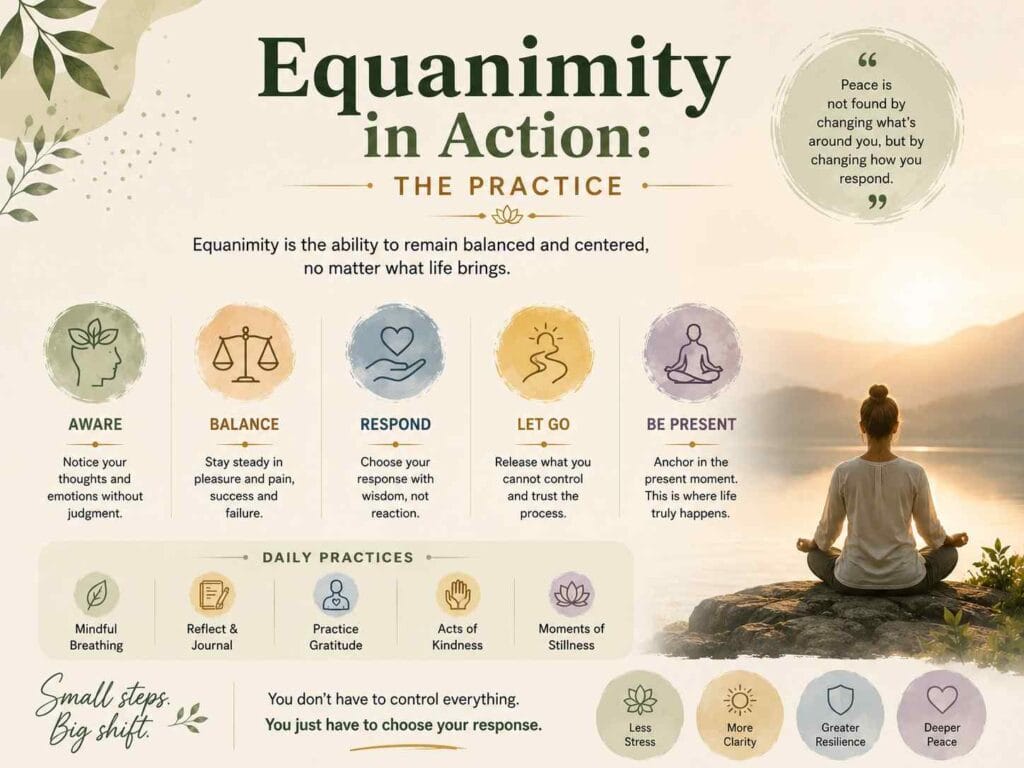
Discover the deeper meaning of equanimity in the Bhagavad Gita. Explore Krishna’s teachings on inner balance, Karma Yoga, meditation, emotional stability, and spiritual strength through authentic philosophy.
The Deeper Meaning of Inner Balance in the Bhagavad Gita
The Bhagavad Gita is not merely a scripture about war, morality, or religious duty. At its deepest level, it is a profound exploration of human consciousness and the challenge of remaining inwardly balanced amidst the instability of life. One of the central teachings Krishna gives to Arjuna is the practice of samatva – equanimity.
Krishna explains that human suffering does not arise only from external circumstances. The deeper problem lies in the way consciousness becomes psychologically attached to constantly changing experiences. Human beings seek lasting security through wealth, achievement, recognition, relationships, success, social identity, and control. Yet all these conditions remain temporary by nature. Because the mind depends upon unstable conditions for stability, inner life also becomes unstable. This creates continuous psychological fluctuation.
Success creates excitement and pride, while failure generates insecurity and self-doubt. Praise strengthens ego, criticism disturbs emotional balance, pleasure creates attachment, and pain creates resistance. The mind continuously moves between attraction and aversion, hope and fear, gain and loss.
Krishna identifies this instability as one of the deepest causes of suffering. The Bhagavad Gita therefore asks a timeless question: Can a human being live fully within the world without becoming psychologically consumed by the instability of the world?
Krishna’s answer is yes – through equanimity. Equanimity in the Bhagavad Gita does not mean emotional suppression, passivity, or indifference. It does not mean withdrawing from responsibility or rejecting ordinary life. Instead, it refers to a disciplined state of inner steadiness in which consciousness remains balanced amidst changing circumstances.
The person established in equanimity still experiences joy and grief, challenge and uncertainty, love and responsibility. However, awareness no longer completely loses itself within every emotional fluctuation. The mind becomes less reactive, less dependent upon outcomes, and less psychologically controlled by fear, craving, and attachment.
Krishna therefore presents equanimity not as escape from life, but as mastery within life. This becomes one of the foundational teachings of yoga itself.
Arjuna’s Inner Collapse on the Battlefield
The teaching of equanimity emerges directly from Arjuna’s psychological crisis at the beginning of the Bhagavad Gita. Standing between two armies on the battlefield of Kurukṣetra, Arjuna suddenly becomes overwhelmed by grief, emotional attachment, fear, moral confusion, and inner collapse.
He sees teachers who once guided him, relatives he loves, elders he respects, and friends with whom he grew up. The reality of war becomes emotionally unbearable. His body trembles, his mouth dries, his famous bow slips from his hands, and his mind becomes clouded by despair.
This moment is deeply symbolic. Arjuna’s battle is not merely external. It represents the inner conflict every human being eventually faces. Fear clashes with responsibility, emotional attachment clashes with wisdom, and the desire to avoid suffering clashes with the necessity of action.
Arjuna therefore symbolizes the instability of ordinary consciousness. Under pressure, the mind becomes reactive. Fear clouds discernment. Emotional attachment weakens clarity. The individual becomes psychologically overwhelmed by uncertainty and consequence.
Krishna recognizes that Arjuna’s deeper problem is not merely the battlefield itself. The real issue is that his consciousness has lost steadiness. This is why Krishna does not simply command Arjuna to fight. Instead, he begins transforming the way Arjuna understands identity, action, suffering, attachment, and awareness itself.
Before right action becomes possible, consciousness must first become clear. This insight gives the Bhagavad Gita extraordinary psychological depth. Human beings do not suffer merely because life is difficult. Suffering intensifies because the mind becomes unconsciously attached and emotionally reactive amidst difficulty. Equanimity therefore becomes essential because without inner balance, wisdom collapses under emotional pressure.
Samatva – Equanimity as Yoga
One of the most important teachings in the Bhagavad Gita appears in Chapter 2:
योगस्थः कुरु कर्माणि सङ्गं त्यक्त्वा धनञ्जय ।
सिद्ध्यसिद्ध्योः समो भूत्वा समत्वं योग उच्यते ॥ (2.48)
“Established in yoga, perform action abandoning attachment, remaining equal in success and failure. This equanimity is called yoga.”
This verse completely transforms the meaning of spirituality. Krishna does not ask Arjuna to abandon action or withdraw from life. Instead, he teaches him how to act without becoming psychologically imprisoned by outcomes.
Ordinarily, the mind becomes deeply dependent upon external conditions. Success creates pride and excitement, while failure creates anxiety and emotional collapse. Praise strengthens ego, criticism creates disturbance, pleasure creates attachment, and pain creates resistance. As a result, consciousness continuously rises and falls according to changing circumstances.
Krishna identifies this instability as one of the root causes of suffering. The problem is not action itself. The deeper problem is attachment within action. Human beings often act through hidden psychological motives such as desire for recognition, fear of failure, emotional insecurity, attachment to success, need for control, and dependence upon validation. Because identity becomes tied to outcomes, emotional balance disappears whenever circumstances change unexpectedly.
Equanimity interrupts this cycle. The practitioner continues acting sincerely, fulfilling responsibilities fully, and participating completely in life, yet awareness no longer becomes shattered by every success and failure. The individual gradually develops the ability to remain inwardly steady amidst external fluctuation. This creates a radically different relationship with life. The person established in samatva still acts wholeheartedly, but inwardly there is greater clarity, steadiness, and freedom from compulsive emotional reaction.
This is why Krishna declares: “समत्वं योग उच्यते” – “Equanimity itself is yoga.”
Yoga is no longer limited to ritual, philosophy, or withdrawal from society. True yoga becomes the ability to maintain inner balance amidst the movement, uncertainty, and complexity of existence itself.
Why Human Beings Lose Inner Balance
The Bhagavad Gita repeatedly explains that emotional suffering intensifies when consciousness becomes psychologically attached to outcomes and external identity. According to Krishna, the human mind rarely remains satisfied with simply acting sincerely. Instead, it becomes emotionally dependent upon what action produces – success, recognition, approval, security, status, control, or validation. This is where inner imbalance begins.
Most individuals unconsciously build their sense of self around unstable external conditions. A person begins believing: “If I achieve this, I will finally feel complete.” “If others recognize me, I will feel worthy.” “If I avoid failure, I will remain secure.”
As a result, emotional stability becomes dependent upon circumstances constantly changing outside one’s control. This creates continuous psychological fluctuation. Success briefly strengthens identity, but fear of losing success soon appears. Praise creates emotional satisfaction, yet criticism suddenly disturbs inner balance. Comparison generates insecurity because the ego constantly measures itself against others. Even achievement often produces anxiety because the mind immediately fears decline, failure, or loss.
Krishna recognized this mechanism thousands of years before modern psychology formally explored emotional attachment, insecurity, and identity formation. The Bhagavad Gita therefore presents suffering not merely as external difficulty, but as psychological dependence upon impermanent conditions.
This insight feels extraordinarily relevant today because modern culture intensifies exactly these patterns continuously. Social media conditions people to seek validation through visibility and approval. Professional culture often ties self-worth entirely to productivity and achievement. Consumer culture convinces individuals that fulfillment lies in accumulation, status, image, and external success.
As a result, many people appear outwardly accomplished while remaining inwardly restless, emotionally exhausted, and psychologically unstable.
The deeper problem is not ambition itself. The deeper problem is attachment to identity through ambition. Krishna therefore offers another possibility: to act sincerely, pursue excellence, fulfill responsibility, and participate fully in life without surrendering inner peace to constantly changing external circumstances. This becomes the foundation of equanimity.
Equanimity Is Not Emotional Numbness
One of the most misunderstood teachings in the Bhagavad Gita is equanimity itself. Many people assume inner balance means emotional coldness, detachment from relationships, or suppression of feeling. Krishna teaches the exact opposite.
Equanimity does not mean becoming emotionally lifeless. It means no longer becoming psychologically enslaved by emotional fluctuation. Krishna never asks Arjuna to stop caring. In fact, Arjuna is repeatedly encouraged to act courageously, responsibly, and wholeheartedly. The transformation occurs not in abandoning emotion, but in changing the relationship between awareness and emotion.
This distinction is extremely important. A person established in equanimity still experiences joy, grief, uncertainty, love, challenge, disappointment, and responsibility. Human emotion does not disappear. What changes is that awareness no longer completely collapses into emotional turbulence every time circumstances shift.
Ordinarily, the mind reacts mechanically. Praise creates excitement, criticism creates hurt, success inflates ego, and failure weakens identity. Emotional reactions immediately take control of consciousness. Equanimity interrupts this automatic identification. The practitioner gradually develops the ability to witness thoughts, emotions, fears, and desires without immediately becoming consumed by them. This creates psychological space within awareness itself.
Instead of reacting impulsively, consciousness becomes calmer and more observant. The individual gains the ability to respond rather than merely react. This is why equanimity represents maturity rather than indifference. The Bhagavad Gita never glorifies emotional suppression because suppressed emotion still controls the mind unconsciously. Real equanimity emerges through awareness, clarity, self-understanding, and inner steadiness. This creates freedom within action rather than escape from action.
Krishna’s Psychology of Attachment and Suffering
One of the most psychologically profound teachings in the Bhagavad Gita appears in Chapter 2, where Krishna explains how emotional suffering develops step by step within the mind:
ध्यायतो विषयान्पुंसः सङ्गस्तेषूपजायते ।
सङ्गात्सञ्जायते कामः कामात्क्रोधोऽभिजायते ॥ (2.62)
“When a person dwells upon objects, attachment develops. From attachment arises desire, and from desire arises anger.”
Krishna then continues describing how anger leads toward confusion, loss of discernment, and eventual psychological downfall. This sequence reveals extraordinary insight into human consciousness. The mind repeatedly focuses upon certain desires, ambitions, fears, fantasies, pleasures, and attachments. Over time, emotional dependence develops around them. The individual begins psychologically needing certain outcomes in order to feel secure, important, successful, or fulfilled. Once identity becomes emotionally invested, disturbance naturally follows whenever reality fails to satisfy expectation.
This creates frustration. Frustration creates anger. Anger clouds discernment. Confused perception then leads toward destructive action and deeper suffering. Krishna’s insight remains deeply relevant because modern life continuously stimulates desire and emotional dependency. Advertising, entertainment, social media, and consumer culture repeatedly encourage people to build identity around acquisition, pleasure, status, and comparison.
The mind therefore rarely experiences stillness. Equanimity interrupts this psychological cycle. The practitioner gradually learns how to observe thoughts, cravings, fears, emotional reactions, and desires without automatically identifying with them. Instead of becoming mechanically controlled by every impulse, awareness becomes clearer and more stable.
This does not eliminate human emotion. It transforms the relationship with emotion. The mind gradually loses some of its compulsive power because awareness becomes less unconsciously attached.
Equanimity and Karma Yoga
One of the most revolutionary teachings in the Bhagavad Gita is that action itself does not need to create bondage.
Ordinarily, human beings assume suffering comes directly from responsibility, work, effort, or worldly involvement. Krishna explains something far deeper: the problem is not action alone, the deeper problem is unconscious attachment operating within action.
A person may perform enormous responsibility while remaining inwardly balanced. Another may avoid responsibility entirely while remaining psychologically restless and emotionally trapped. This is why Krishna introduces Karma Yoga.
Karma Yoga means action performed with awareness, discipline, sincerity, and reduced attachment to results. The practitioner continues acting fully within life, but identity no longer depends entirely upon success, recognition, praise, or outcome. This transforms ordinary action completely.
Work becomes yoga when performed without selfish obsession. Responsibility becomes yoga when performed without egoic dependence upon recognition. Service becomes yoga when performed with sincerity rather than psychological craving for reward. The Bhagavad Gita therefore dissolves the separation between spiritual life and ordinary life. Spiritual growth no longer depends only upon isolation, rituals, or withdrawal from society. Every responsibility becomes an opportunity for awareness, self-mastery, discipline, and inner transformation.
The battlefield itself becomes a place for yoga. This is one of the deepest insights in the Bhagavad Gita: freedom does not necessarily require escaping life. Freedom begins when consciousness learns how to remain inwardly steady while fully participating in life itself.
Meditation and the Practice of Inner Stability
The Bhagavad Gita repeatedly emphasizes meditation, self-observation, discipline of the senses, and regulation of desire because Krishna recognizes a fundamental truth about human consciousness: an uncontrolled mind cannot remain peaceful for long.
Ordinarily, the mind is continuously pulled outward. Thoughts move from one desire to another, attention becomes trapped in comparison, fear creates anxiety about the future, memory recreates pain from the past, and emotional reactions constantly disturb inner balance. The senses continuously seek stimulation, while the ego continuously seeks validation, recognition, control, and security.
As a result, consciousness becomes fragmented and restless. This is why Krishna places such importance upon inner discipline. Without mastery over attention, the mind becomes mechanically controlled by every passing impulse, emotion, distraction, and external circumstance. A person may appear successful outwardly while remaining inwardly unstable because consciousness never learns how to remain steady within itself.
Meditation therefore becomes essential in the Bhagavad Gita, not as escape from life, but as training in inner stability. This distinction is extremely important. Krishna never presents meditation as withdrawal from responsibility or rejection of the world. Instead, meditation purifies consciousness so that action itself becomes clearer, calmer, and less driven by unconscious emotional reactivity.
Through meditation, awareness gradually develops the ability to observe thoughts without immediately becoming trapped inside them. Fear may arise, but awareness no longer completely collapses into fear. Anger may appear, but consciousness gains the ability to witness it before reacting impulsively. Desire may emerge, yet the mind becomes less mechanically controlled by craving. This creates psychological space within awareness itself.
Ordinarily, human beings do not simply experience thoughts and emotions, they unconsciously become them. A fearful thought appears and identity immediately becomes fear. Emotional pain appears and consciousness becomes psychologically consumed by suffering. Meditation slowly changes this relationship. The practitioner begins recognizing that thoughts, emotions, desires, and reactions are experiences appearing within awareness, not the deepest nature of awareness itself. This insight becomes transformative.
Over time, the mind grows quieter, clearer, and less fragmented because consciousness stops feeding every impulse automatically. Mental agitation gradually weakens. Emotional reactions lose some of their compulsive force. Awareness becomes steadier amidst external fluctuation. This inward stability then transforms action itself.
The practitioner continues living fully within the world, fulfilling responsibilities, pursuing work, maintaining relationships, and facing challenges. But consciousness becomes less reactive and less psychologically dependent upon external outcomes for peace. This is why meditation in the Bhagavad Gita is inseparable from Karma Yoga. The goal is not merely peaceful moments during meditation. The deeper goal is transformation of consciousness itself so that everyday life becomes guided by greater clarity, steadiness, and self-mastery.
Krishna later develops these teachings even further in Chapter 6, where he describes meditation as the gradual calming of the restless mind:
यतो यतो निश्चरति मनश्चञ्चलमस्थिरम् ।
ततस्ततो नियम्यैतदात्मन्येव वशं नयेत् ॥ (6.26)
“Wherever the restless and unsteady mind wanders, one should gently bring it back under the control of the Self.”
This verse reveals the compassionate realism of the Bhagavad Gita. Krishna does not pretend the mind becomes steady instantly. The mind naturally wanders because conditioning, attachment, fear, and habit have shaped it for years. Meditation therefore becomes a gradual process of returning awareness inward repeatedly with patience and discipline. Inner stability develops through continuity of practice.
Equanimity as Spiritual Strength
Modern culture often confuses emotional impulsiveness with authenticity and constant activity with strength. The Bhagavad Gita presents a radically different understanding of maturity and power.
Krishna does not describe the wise person as someone without emotion. He describes someone no longer controlled by emotion. This distinction is profound. The person established in equanimity still experiences uncertainty, joy, grief, ambition, love, responsibility, disappointment, and challenge. Human emotion does not disappear. What changes is the relationship between consciousness and emotional reaction.
Ordinarily, fear distorts perception, attachment clouds judgment, anger weakens discernment, and insecurity creates impulsive behavior. A reactive mind struggles to perceive reality clearly because consciousness becomes overwhelmed by emotional turbulence.
Krishna repeatedly explains that wisdom requires steadiness. Without equanimity, the mind loses clarity whenever circumstances become difficult. Emotional attachment creates partial perception because the ego sees reality through fear, craving, and personal investment. A person then reacts mechanically instead of consciously.
Equanimity interrupts this unconscious reactivity. The balanced mind develops the ability to pause, observe, and respond with greater awareness rather than being immediately driven by emotional impulse. This creates a fundamentally different relationship with life.
A calm mind sees more clearly because perception is less distorted by agitation.
A balanced mind acts more consciously because reaction becomes less compulsive.
A steady mind suffers less unnecessarily because identity no longer collapses completely into every external fluctuation.
This is why equanimity is not weakness or emotional suppression. It is spiritual strength. Krishna therefore presents inner balance as a sign of maturity rather than detachment from life. The stronger the awareness becomes inwardly, the less easily consciousness is destabilized by success, failure, praise, criticism, gain, loss, pleasure, or pain. This is one of the deepest meanings of yoga in the Bhagavad Gita.
The Timeless Relevance of Equanimity
One reason the Bhagavad Gita remains timeless is because human psychology has not fundamentally changed. Modern life continuously overstimulates attention through information overload, digital distraction, comparison, social pressure, entertainment, consumerism, and endless external stimulation. The nervous system rarely experiences silence or stillness. Human beings are constantly encouraged to seek fulfillment through productivity, achievement, recognition, and external validation.
As a result, emotional instability increasingly becomes normalized. People struggle with anxiety, comparison, emotional exhaustion, restlessness, insecurity, and inability to remain mentally present. Attention becomes fragmented because consciousness is continuously pulled outward. Krishna’s teachings therefore feel astonishingly modern despite being thousands of years old. The Bhagavad Gita does not ask human beings to abandon responsibility or escape ordinary life. Instead, it teaches how to remain inwardly balanced while fully participating in life itself.
Act sincerely. Participate fully in life. Fulfill responsibilities courageously. But do not surrender your entire inner stability to constantly changing external circumstances. This is the deeper meaning of equanimity.
It is not withdrawal from action. It is freedom within action.
Conclusion
Equanimity in the Bhagavad Gita is not escape from life. It is steadiness within life. Krishna teaches Arjuna that true yoga is not merely external action or external renunciation. Real yoga is transformation of consciousness itself. The wise person continues acting, serving, struggling, leading, loving, and living while remaining inwardly balanced amidst changing circumstances.
This is the essence of samatva. The battlefield remains. Responsibilities remain. Uncertainty remains. But awareness changes.
And when awareness changes, the entire experience of life changes with it.
Also read: Chapter 5 – Karma Sanyasa Yoga