A deeply researched guide to yoga for better sleep covering Balasana, Yoga Nidra, breathwork, restorative yoga, sleep psychology, mental overactivity, and how ancient yoga traditions approached rest and consciousness.
Introduction
Yoga for better sleep refers to a group of practices specifically designed to prepare the body and mind for deep rest rather than stimulation or intense physical activity.
Unlike highly active yoga styles that build heat and energy in the body, sleep-oriented yoga focuses on slowing the entire system down gradually. The purpose is not performance, flexibility, or physical achievement. Instead, the emphasis remains on relaxation, nervous system quietness, breath awareness, and creating the internal conditions that allow sleep to arise more naturally.
This distinction is important because many people misunderstand sleep problems as simply “lack of tiredness.” In reality, modern sleep difficulties are often connected to the inability to mentally disengage after long periods of stimulation.
A person may feel physically exhausted yet remain mentally active for hours.
Thoughts continue moving. The body stays tense. Breathing remains shallow. Attention keeps replaying conversations, responsibilities, unfinished tasks, or emotional stress.
Yoga for sleep attempts to interrupt this state gently rather than forcefully.
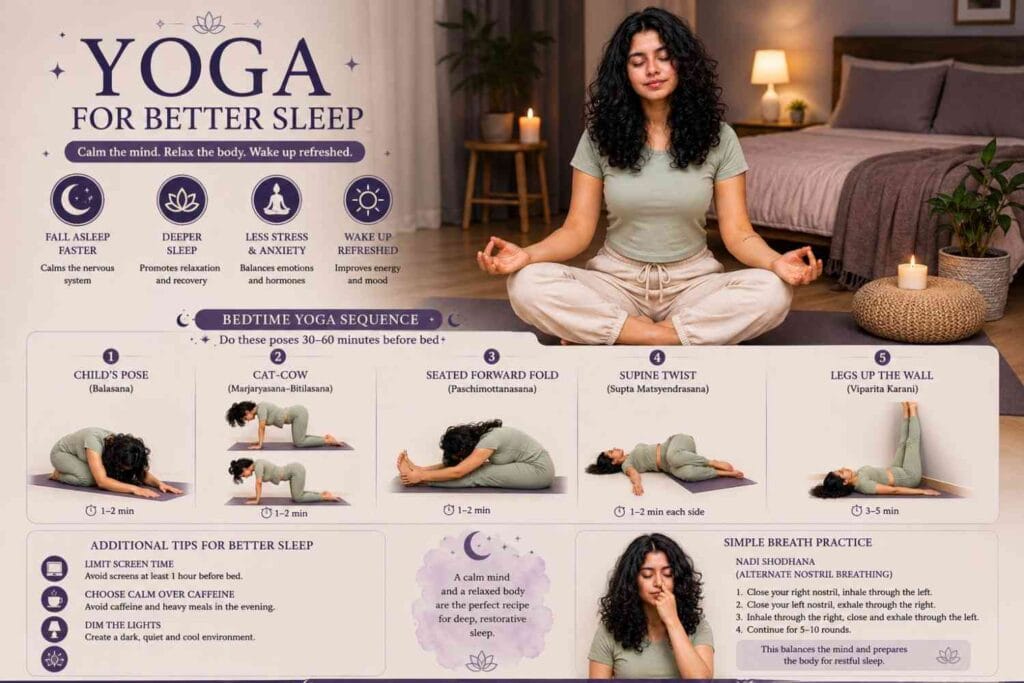
The practices usually include: restorative postures, slow stretching, breathing techniques, guided relaxation, mindfulness, and meditative stillness.
These methods help shift attention away from external stimulation and toward internal quietness.
Importantly, yoga traditions never approached sleep as merely mechanical unconsciousness. Ancient systems viewed rest as deeply connected with the condition of the mind itself.
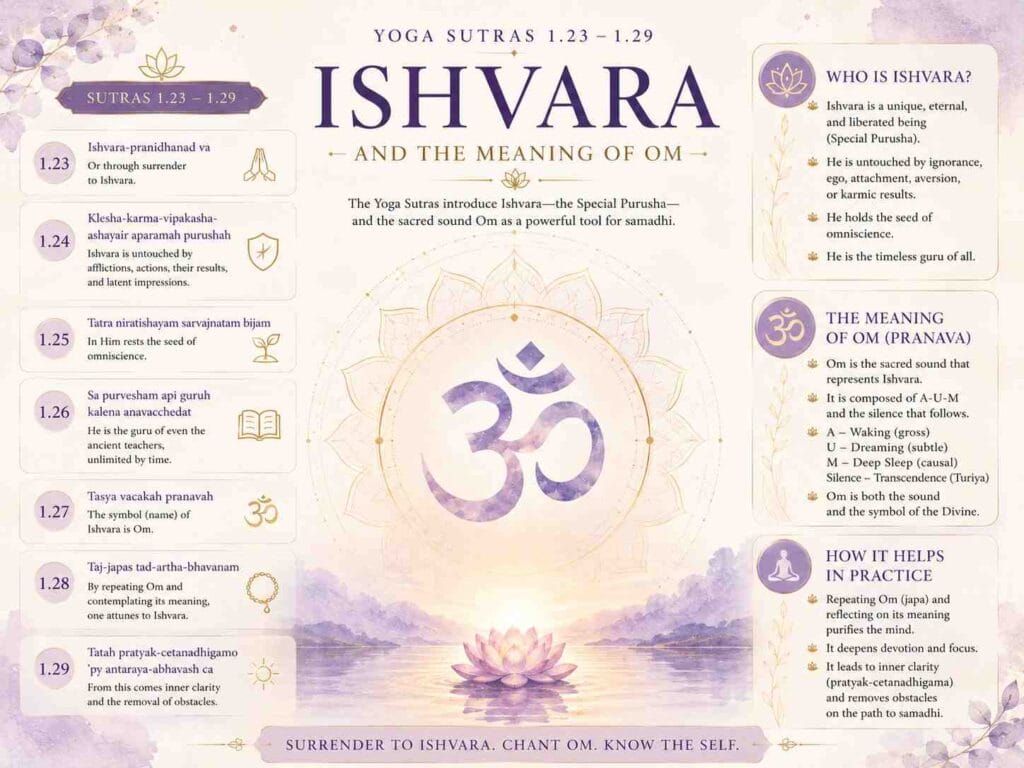
The Yoga Sutras of Patanjali even classifies sleep as a specific mental state:
अभावप्रत्ययालम्बना वृत्तिर्निद्रा ॥
Transliteration
Abhāva-pratyayālambanā vṛttir nidrā
Meaning
“Sleep is the mental modification based upon the cognition of absence.”
This is philosophically profound because it shows that yogic traditions were not only interested in physical rest, but also in how consciousness functions during different states of experience.
Today, modern sleep science also increasingly recognizes that mental state, emotional regulation, stress levels, and physiological activation strongly influence sleep quality.
Although ancient yoga and modern neuroscience approach these subjects differently, both acknowledge an important truth:
the mind cannot remain continuously agitated while expecting deep restorative rest.
Why Sleep Problems Are Increasing Today
One of the biggest reasons sleep difficulties have become so widespread today is because modern life keeps the human mind continuously engaged without giving it enough space to gradually settle into rest.
In earlier periods of human history, daily life followed rhythms that were far more connected to nature. Evening naturally brought darkness, reduced activity, quieter surroundings, and fewer sensory demands. The body and mind slowly received signals that the active part of the day was ending.
Modern environments disrupted this rhythm almost completely.
Today, many people remain surrounded by stimulation until the exact moment they attempt to sleep. Phones, laptops, televisions, artificial lighting, social media feeds, work messages, streaming platforms, and constant digital engagement keep attention active far longer than the nervous system was originally adapted for.
As a result, nighttime no longer feels psychologically different from daytime for many individuals.
The mind continues operating in “processing mode” even while the body attempts to rest.
This creates an important distinction:
many people are physically tired but neurologically overstimulated.
The body may want sleep, yet the mind keeps moving.
Thoughts continue replaying conversations, unfinished responsibilities, future planning, emotional reactions, and information absorbed throughout the day. Even silence becomes difficult because attention has become conditioned to continuous input and stimulation.
Another important factor is the disappearance of genuine transitions between work and rest.
Remote work and digital lifestyles blurred the boundary between professional life and personal life. Many individuals now answer emails late at night, scroll social media in bed, watch multiple forms of content simultaneously, or remain mentally connected to work responsibilities long after the workday technically ends.
The nervous system rarely receives a clear message that it is safe to slow down completely.
This is one reason many people describe feeling “tired but unable to sleep.”
Fatigue alone does not automatically create restfulness.
The mind must also disengage from stimulation gradually.
Modern sleep researchers increasingly discuss how screen exposure, irregular schedules, overstimulation, and stress activation may influence sleep quality and circadian rhythms. However, beyond the scientific explanations, there is also a deeper cultural shift occurring:
modern life rewards constant engagement.
People are encouraged to remain productive, informed, entertained, connected, and mentally active almost all the time.
Stillness itself has become unfamiliar for many individuals.
This is one reason yoga for sleep resonates so strongly today.
It intentionally reintroduces slowness into environments built around speed and stimulation.
Even a short evening yoga practice creates a transition period where the mind no longer chases information continuously.
The body softens. Breathing slows. Attention becomes quieter. And gradually, awareness begins moving away from external activity toward rest.
How Yoga Influences Sleep Quality
Yoga influences sleep quality through a combination of physical, psychological, and physiological changes that help the body transition out of stress-oriented activity and toward relaxation.
One of the first effects many practitioners notice is the release of accumulated physical tension.
Modern stress rarely remains only mental.
The body stores stress physically throughout the day, often without conscious awareness. The shoulders tighten during work, the jaw clenches during emotional pressure, the hips stiffen from prolonged sitting, and the breath becomes restricted during stress or concentration.
By nighttime, many people carry large amounts of unconscious muscular tension even while trying to rest.
Gentle yoga practices help reverse this gradually.
Slow stretching, supported postures, and mindful movement encourage the body to stop holding unnecessary contraction continuously. As muscular tightness softens, many people begin experiencing a deeper sense of physical comfort and ease before sleep.
This matters because the nervous system constantly responds to bodily state.
When the body remains tense and compressed, the brain may continue interpreting the environment as stressful or active. Relaxation signals safety internally.
Breathing also changes significantly during calming yoga practices.
Stress and overstimulation often alter breathing patterns unconsciously. Many individuals begin breathing rapidly, shallowly, or irregularly during mentally demanding days without noticing it.
Sleep-oriented yoga practices intentionally slow the breathing rhythm.
Longer, smoother breaths often create a feeling of steadiness because breathing and nervous system state remain deeply connected physiologically.
This is why many people notice that even a few minutes of conscious breathing before bed creates a feeling of mental quietness that feels different from ordinary resting.
Another important aspect involves attention itself.
Modern life continuously trains attention to move outward toward: screens, conversation, tasks, notifications, and constant information consumption.
The mind becomes habituated to reacting externally almost all the time.
Yoga temporarily reverses this direction.
Instead of chasing stimulation, awareness gradually returns inward again.
Attention shifts toward: breathing, physical sensation, movement, stillness, and present-moment experience.
This inward shift is psychologically important because many sleep difficulties involve excessive mental momentum.
The mind keeps moving because it never truly slows down during the day.
Yoga interrupts this momentum gently rather than forcefully. There is also an emotional dimension to evening yoga practices that many people underestimate.
During the day, emotional tension often remains suppressed beneath activity and distraction. Quiet movement and stillness sometimes allow accumulated emotional pressure to release gradually.
This is one reason many practitioners describe sleep-oriented yoga as emotionally calming even when the movements themselves are extremely simple.
The practice creates an environment where the body, breath, and attention finally stop competing with continuous stimulation.
And for many people living in highly accelerated modern environments, that slowing down itself becomes deeply restorative.
Best Yoga Practices for Better Sleep
Not all yoga practices affect the body and mind in the same way.
Some styles of yoga are energizing, physically demanding, and stimulating, which can feel excellent during the daytime but may not always support relaxation before sleep. Yoga for better sleep focuses on a very different quality of practice.
The emphasis is not intensity.
It is softness, stillness, comfort, slower breathing, and gradual unwinding.
Sleep-supportive yoga practices are usually chosen because they help reduce unnecessary muscular effort, quiet mental activity, and create a feeling of safety and ease within the body before bedtime.
The effectiveness of these practices often comes from simplicity rather than complexity.
Balasana (Child’s Pose)
Balasana is often considered one of the most grounding and emotionally soothing postures within yoga practice because of the shape and psychological quality it creates.
The body folds inward gently while the forehead moves closer to the ground or a support surface. The spine softens, the shoulders relax, and breathing naturally begins slowing without force.
Unlike active postures that require muscular effort and strong engagement, Balasana encourages surrender and release.
This is one reason the posture feels deeply calming for many practitioners after mentally exhausting days.
The position itself symbolically creates withdrawal from overstimulation. Vision decreases, external activity reduces, and awareness naturally turns inward. Many people notice that the posture creates a sense of emotional quietness in addition to physical relaxation.
For individuals carrying tension from long workdays, emotional pressure, or mental overactivity, Balasana often feels less like exercise and more like a pause from constant effort.
The posture may also help release tightness around the lower back, hips, shoulders, and spine, areas where stress commonly accumulates throughout the day.
Importantly, the posture should feel restful rather than intense.
Using cushions, folded blankets, or support beneath the body is completely acceptable within restorative practice.
The purpose is comfort, not performance.
Viparita Karani (Legs-Up-the-Wall Pose)
Viparita Karani is one of the simplest yet most restorative postures commonly used in nighttime yoga routines.
The practice involves lying comfortably on the floor while resting the legs vertically against a wall. The body remains supported with very little muscular effort required.
At first glance, the posture appears almost too simple to be effective. Yet this simplicity is precisely why many practitioners find it deeply calming.
Modern life often keeps the body under constant physical and psychological activity. Even while resting, many individuals remain subtly tense without realizing it. Viparita Karani creates an environment where the body finally stops “doing” continuously.
The posture encourages stillness naturally.
Because the legs remain elevated and supported, many people report a feeling of release around the lower body after long hours of standing, walking, or sitting.
The position is also associated with restorative and cooling qualities within yoga traditions. Unlike physically demanding poses, Viparita Karani reduces effort rather than increasing stimulation.
This is why the posture is frequently included in evening yoga practices, restorative yoga sessions, and relaxation-focused sequences.
Many practitioners remain in the posture quietly for several minutes while focusing softly on breathing or bodily sensation.
The experience often feels deeply restful precisely because nothing dramatic is happening.
Gentle Forward Folds
Forward-folding postures have long been associated within yoga traditions with introspection, quietness, and inward-directed awareness.
Unlike highly activating backbends or fast-moving sequences, gentle forward folds naturally reduce physical intensity and encourage the body to soften gradually.
The shape of forward folds subtly changes psychological orientation as well.
The body curls inward rather than expanding outward aggressively. Breathing often becomes slower and quieter. Attention naturally moves away from external stimulation toward internal sensation and stillness.
This is one reason many practitioners describe forward folds as emotionally calming.
In sleep-oriented yoga practices, forward folds are usually performed softly and without force. The intention is not extreme flexibility or deep stretching.
Instead, the goal is creating a feeling of release and reduced effort within the body.
Supported seated folds, soft standing folds, or gentle resting variations are commonly included in nighttime sequences because they encourage slowing down physically and mentally.
For people carrying excessive stimulation from work, screens, conversation, or emotional pressure, these postures may create a noticeable feeling of withdrawal from the speed of the day.
Supine Twists
Supine twists are gentle reclining spinal twists performed while lying comfortably on the floor or bed.
These postures are especially popular in evening yoga because they combine softness, support, and relaxation simultaneously.
The spine rotates gently while the rest of the body remains grounded and supported. Unlike intense twisting practices, sleep-oriented supine twists remain passive and restorative.
Many people unknowingly accumulate stiffness through the torso, lower back, hips, and ribcage during the day, especially after long periods of sitting or stress-related muscular holding.
Supine twists help introduce gentle movement into these areas without demanding strong effort.
The posture also encourages stillness because the body remains close to the ground with minimal muscular strain.
Many practitioners find reclining twists emotionally settling as well because they create a feeling of unwinding after the stimulation and tension of the day.
Slow breathing is often paired with the movement, making the practice feel more like relaxation than exercise.
Conscious Breathing Practices
One of the most powerful yoga practices for sleep involves no complex posture at all.
It is simply conscious breathing.
Modern stress patterns frequently affect breathing unconsciously. During periods of anxiety, concentration, overstimulation, or emotional pressure, breathing often becomes shallow, rapid, uneven, or restricted.
Many people carry these breathing patterns into the night without realizing it.
Conscious breathing practices help interrupt this state gently.
Instead of allowing the breath to remain automatic and stress-driven, attention intentionally slows and deepens respiration gradually.
Longer exhalations are especially emphasized in many sleep-supportive breathing practices because they often create a feeling of settling and release.
The effectiveness of breathwork comes partly from the fact that breathing functions as both an automatic and consciously influenceable process.
By changing the rhythm of breathing intentionally, many practitioners notice changes in mental speed and emotional state as well.
Even a few minutes of slower breathing before bed may help reduce feelings of restlessness and create a smoother transition toward sleep.
This is one reason breathing practices have become increasingly popular not only within yoga communities, but also within modern discussions surrounding stress management and relaxation.
Yoga Nidra and Deep Rest
Among all modern sleep-supportive yoga practices, Yoga Nidra has become one of the most widely discussed globally.
The practice is often translated as “yogic sleep,” although philosophically it differs from ordinary unconscious sleep.
In Yoga Nidra, the practitioner usually lies down comfortably while following guided instructions that move awareness gradually through different layers of bodily sensation, breathing, attention, and observation.
Externally, the practice appears extremely simple because the body remains still for most of the session.
Internally, however, the experience can feel profoundly restorative.
One reason Yoga Nidra resonates so strongly today is because modern people often struggle not only with physical fatigue, but with the inability to mentally disengage.
The mind continues analyzing, planning, replaying, and reacting continuously even during periods meant for rest.
Yoga Nidra helps interrupt this mental momentum by guiding awareness away from compulsive thinking and toward systematic relaxation.
Practitioners often describe entering a unique state between wakefulness and sleep where the body feels deeply relaxed while awareness remains softly present.
This differs from ordinary distraction because attention becomes calmer and more spacious rather than overstimulated.
Traditionally, Yoga Nidra developed within deeper yogic and meditative traditions. Today, however, it has expanded into wellness culture because many individuals use it as a practical tool for relaxation, emotional quietness, and sleep preparation.
The Psychological Side of Sleep
One of the most important reasons yoga can feel so effective for sleep is because many sleep difficulties are psychological as much as physical.
A large number of people are already exhausted by nighttime.
The problem is not lack of tiredness.
The problem is that the mind continues moving long after the body attempts to rest.
During the day, external stimulation constantly occupies attention. Work, conversation, screens, responsibilities, and activity often distract people from deeper mental and emotional tension temporarily.
At night, however, external stimulation decreases. Silence becomes louder.
Thoughts that remained unnoticed during the day suddenly become more visible.
The mind begins replaying: unfinished conversations, future worries, regret, planning, emotional conflict, or unresolved stress.
Many people therefore struggle not because they “cannot sleep,” but because they cannot disengage from continuous mental activity.
Yoga changes this relationship gradually. The goal is not forcing thoughts to disappear completely.
Instead, attention begins shifting away from total identification with mental activity and back toward breathing, bodily sensation, stillness, and observation.
This creates psychological space. Thoughts may still arise, but awareness becomes less entangled within them continuously.
Over time, this inward quietness may help create the conditions from which sleep naturally emerges rather than being forced mechanically.
Important Clarification
It is important not to exaggerate yoga as a universal cure for every sleep-related problem.
Modern wellness culture sometimes presents relaxation practices as though they can solve all forms of insomnia instantly, but sleep difficulties can involve many different causes beyond stress alone.
Serious sleep disturbances may involve: medical conditions, hormonal imbalance, mental health challenges, neurological disorders, medication effects, sleep apnea, trauma, or other physiological complexities requiring professional treatment.
Yoga should never replace necessary medical care when deeper intervention is needed.
At the same time, many individuals find that consistent calming practices involving movement, breathing, relaxation, and mindfulness help support healthier nighttime routines and improve overall sleep quality gradually.
The benefits usually emerge through repetition and consistency rather than dramatic overnight transformation.
Yoga for sleep works less like a quick fix and more like a gradual retraining of how the body and mind transition into rest.
Final Thoughts
Yoga for better sleep has become increasingly popular because it responds directly to one of the biggest problems of modern life:
the inability to slow down mentally.
Ancient yoga traditions long explored the relationship between mental fluctuation, breath, awareness, and inner stillness, while modern sleep research increasingly recognizes the importance of relaxation and nervous system regulation for restorative rest.
Through gentle movement, conscious breathing, restorative postures, and meditative awareness, yoga offers many people a practical way to transition from mental overactivity toward greater calmness before sleep.
In many ways, the growing popularity of yoga for sleep reflects a deeper cultural shift happening today. People are not only searching for better sleep. Increasingly, they are searching for relief from constant stimulation itself.
Also read: Balasana (Child’s Pose): The Most Underrated Yoga Pose