
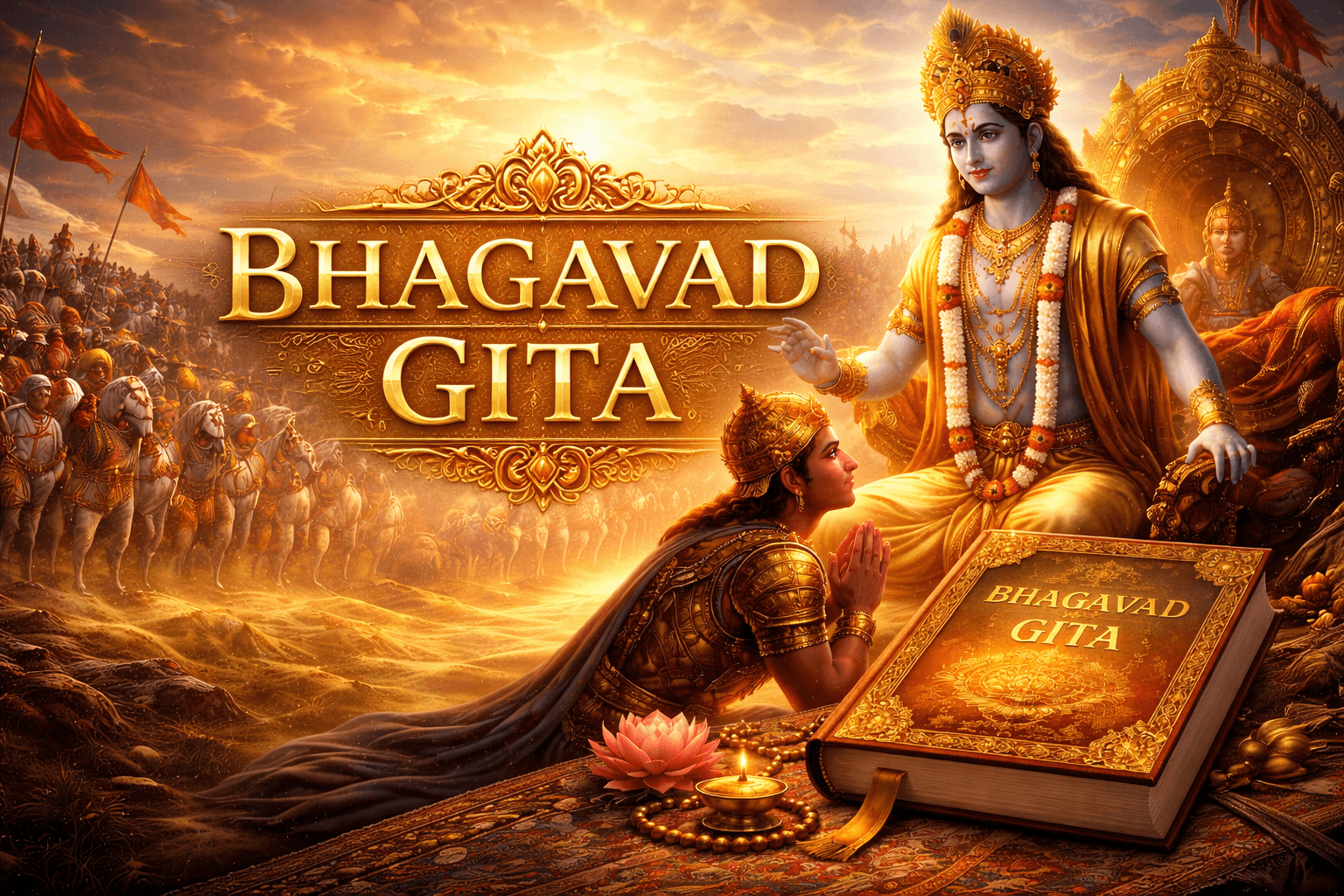
The Bhagavad Gita is not a religious book. It is a guide to how to live.
It was spoken on a battlefield… because life itself is a battlefield.
WHAT IS THE BHAGAVAD GITA?
The Bhagavad Gita is a 700-verse Hindu scripture that is part of the epic Mahabharata (Bhishma Parva, chapters 23–40).
It is presented as a dialogue between Arjuna, a warrior facing a moral and emotional crisis, and Krishna, who serves as his guide.
The conversation takes place on the battlefield of Kurukshetra, just before a war, where Arjuna is confused about his duty and the consequences of his actions.
It explains:
- The nature of the self (Atman)
- The concept of duty (Dharma)
- Different paths of spiritual practice
- The relationship between action and its results (Karma)
- The importance of knowledge, discipline, and devotion
👉 The Bhagavad Gita is not limited to ritual or belief.
👉 It is a philosophical text that addresses ethical dilemmas, decision-making, and the nature of human existence.
At its core, it teaches:
“One should perform their duty (dharma) with focus and discipline, without attachment to the outcomes of their actions.”
VED VYASA: Who Was He and When Did He Live
COMPLETE CHAPTER INDEX (OVERVIEW)
PHASE 1: CONFUSION & AWAKENING (CHAPTERS 1–6)
1.1–1.47 → Arjuna Vishada Yoga– The Grief of Arjuna.
Emotional breakdown, confusion about duty and consequences
2.1–2.72 → Sankhya & Basic Teachings
Nature of the self (Atman), introduction to Karma Yoga
- The Immortal Soul: Krishna’s First Teaching
- Nityasya Uktam: For the Eternal There Is No Death
- Duties of a Warrior: Dharma in Chapter 2
- Sthitaprajna: The Ideal of the Wise Person
- Qualities of the Person of Steady Wisdom
3.1–3.43 → Karma Yoga (Action)
Importance of action without attachment
- Why Action Is Better Than Inaction
- Yajna: Sacrifice as the Cosmic Principle
- Action Without Attachment: The Core Teaching
- The Enemy Within: Kama as Destroyer
4.1–4.42 → Jnana Yoga – The Yoga of Knowledge
Role of knowledge, action vs inaction
- Krishna’s Divine Births: Understanding the Avatara
- What Is Karma? The Complete Teaching
- Jnana as the Boat Across All Sin
5.1–5.29 → Karma Sanyasa Yoga
Balance between action and detachment
6.1–6.47 → Dhyana Yoga – The Yoga of Meditation
Mind control, discipline, and meditation practice
PHASE 2: UNDERSTANDING REALITY (CHAPTERS 7–12)
- 7.1–7.30 → Knowledge of Reality
Understanding the nature of existence and divine - 8.1–8.28 → The Eternal (Brahman)
Life, death, and what lies beyond - 9.1–9.34 → Raja Vidya (Supreme Knowledge)
Highest knowledge and devotion - 10.1–10.42 → Divine Manifestations
How the divine expresses in the world - 11.1–11.55 → Universal Form
Vision of the cosmic form - 12.1–12.20 → Bhakti Yoga (Devotion)
Path of devotion and surrender
PHASE 3: REALIZATION & LIBERATION (CHAPTERS 13–18)
- 13.1–13.35 → Field & Knower (Body & Self)
Distinction between physical body and consciousness - 14.1–14.27 → Three Gunas
Sattva, Rajas, Tamas — qualities of nature - 15.1–15.20 → The Supreme Self
Nature of ultimate reality - 16.1–16.24 → Divine vs Demonic Nature
Human tendencies and behavior - 17.1–17.28 → Faith & Practice
Types of faith and their effects - 18.1–18.78 → Liberation (Moksha)
Final teachings on duty, knowledge, and freedom
👉 This is not just a sequence of chapters.
👉 It is a structured journey from confusion to clarity, and from action to understanding.
BEGIN YOUR JOURNEY
How to Start (Beginner Path)
Understand the Problem
Arjuna’s confusion represents human conflict and doubt
Right Action (Karma Yoga)
Learn to act without attachment to results
Understand Reality
Know the nature of the self, world, and existence
Clarity & Liberation
Act with awareness, without confusion or fear
Real-Life Application
You feel confused about decisions and responsibilities
Confusion arises from attachment and lack of clarity
Perform your duty with focus, without attachment to results
Clarity, stability, and balanced decision-making