In the Bhagavad Gita, Krishna begins with the truth of the immortal soul. Explore how understanding the eternal Self transforms perception, removes fear of death, and brings clarity to life and action.
The Moment Where Everything Changes
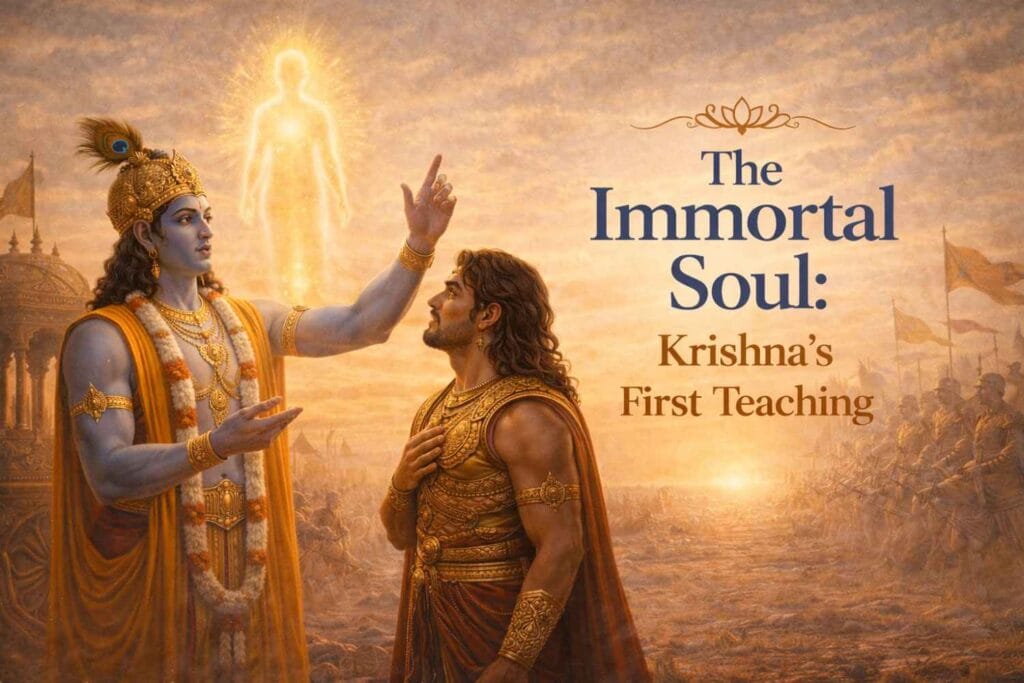
On the battlefield of Kurukshetra, as described in the Bhagavad Gita within the larger narrative of the Mahabharata, Arjuna stands in complete inner collapse. His bow has slipped from his hands, his mind is overwhelmed, and his understanding of right and wrong has dissolved into confusion. He sees before him not an enemy, but his own teachers, elders, and loved ones. His heart resists the very action his role demands.
It is at this exact moment that Krishna begins His teaching, not with strategy, not with motivation, but with truth.
The first teaching Krishna offers is not about war. It is about the nature of the Self.
Because until one understands who they truly are, every decision remains clouded.
The Beginning of Knowledge
Krishna’s opening words cut through Arjuna’s emotional turmoil with striking clarity:
“You grieve for those who should not be grieved for, yet you speak words of wisdom. The wise do not grieve for the living or the dead.” (2.11)
This statement appears almost paradoxical. How can one not grieve? Is Krishna dismissing human emotion?
No. He is correcting misunderstanding.
Grief, as Krishna points out, arises not from reality itself, but from misidentification, from taking the temporary to be permanent, and the perishable to be the Self.
That Which Never Ceases to Be
Krishna then establishes one of the most profound truths in all of spiritual philosophy:
“Never was there a time when I did not exist, nor you, nor all these kings; nor will any of us cease to exist in the future.” (2.12)
Here, Krishna dissolves the idea of existence as something that begins and ends. The Self does not come into being at birth, nor does it vanish at death. It simply is.
This teaching shifts the entire framework through which life is understood. What we usually consider as “life” is only a visible segment of a much larger continuity.
The Changing Body, The Unchanging Self
Krishna makes this even clearer through a simple yet powerful observation:
“Just as the embodied Self passes through childhood, youth, and old age, so it passes into another body; the wise are not deluded by this.” (2.13)
Change is constant at the level of the body. From infancy to old age, the body is never the same. Yet something within remains unchanged, the one who experiences these changes.
That unchanging presence is the Self.
The mistake lies in identifying with what changes, rather than with what remains.
Death as Transition, Not End
One of the deepest fears that binds the human mind is the fear of death. Krishna addresses this directly:
“As a person casts off worn-out garments and puts on new ones, so the Self discards old bodies and takes on new ones.” (2.22)
This metaphor removes the finality associated with death. What we call death is not destruction, it is transition.
The body is like a garment, useful, functional, but not the essence of identity.
When this is understood, the fear of losing oneself begins to dissolve.
The Indestructible Nature of the Self
Krishna continues by describing the Self in a way that leaves no room for doubt:
“Weapons cannot cut it, fire cannot burn it, water cannot wet it, wind cannot dry it. The Self is eternal, all-pervading, unchanging, and immovable.” (2.23–24)
This is not poetic exaggeration, it is a precise description meant to stabilize the mind.
Everything we perceive in the world is subject to change and destruction. The Self alone stands beyond these conditions.
To know this is not merely to believe it, it is to see differently.
Why This Teaching Comes First
Krishna could have begun by explaining duty, righteousness, or action. But He begins with the Self.
Why?
Because without this knowledge, every action is influenced by fear, attachment, and confusion.
Arjuna’s hesitation is not truly about morality, it is about loss. He fears the loss of relationships, identity, and emotional connection. But Krishna shows him that what he fears losing is not ultimately real in the way he thinks it is.
Once the nature of the Self is understood, the foundation of fear begins to weaken.
And only then can right action emerge.
The Shift from Emotion to Understanding
This teaching does not suppress emotion, it refines it.
Arjuna’s grief is real, but it is incomplete. It arises from partial understanding. Sankhya, the path of knowledge, completes this understanding by placing emotion within the larger context of truth.
When knowledge is absent:
- Emotion dominates
- Judgment becomes clouded
- Action becomes uncertain
When knowledge is present:
- Emotion is understood, not suppressed
- Clarity arises
- Action becomes aligned
Krishna is not asking Arjuna to become emotionless. He is asking him to become clear.
What This Means for Us
Though spoken on a battlefield, this teaching is not limited to warriors or ancient times. It addresses a universal human condition.
We all experience:
- Fear of loss
- Attachment to roles and relationships
- Identification with the body and mind
And from this, confusion arises.
Krishna’s first teaching invites us to question this identification.
Who are we, truly?
Are we the body that changes, ages, and eventually perishes?
Or are we the awareness that witnesses all these changes?
Even a slight shift in this understanding begins to transform how we experience life.
Living with This Knowledge
To understand the immortality of the Self is not to withdraw from life, it is to engage with it more freely.
When identity is no longer tied to the temporary:
- Fear begins to loosen
- Attachment softens
- Decisions become clearer
Life continues, responsibilities remain, relationships exist, but the inner dependency on them reduces.
This is not detachment as indifference. It is detachment as clarity.
The Foundation of All That Follows
This teaching is not isolated. It becomes the basis for everything Krishna will later explain, Karma Yoga, Bhakti Yoga, and Dhyana Yoga all rest upon this understanding.
Without knowing the Self:
- Action binds
- Devotion becomes emotional dependence
- Meditation becomes unstable
With this knowledge:
- Action becomes free
- Devotion becomes pure
- Meditation becomes steady
Conclusion
Krishna’s first teaching is simple in expression, yet profound in implication: you are not what you think you are.
You are not merely the body, not merely the mind, not merely the roles you play in the world. You are the unchanging Self that exists beyond birth and death.
Arjuna’s confusion begins to dissolve not because his situation changes, but because his understanding does.
And this remains the essence of the teaching.
When you begin to see yourself clearly, even slightly, the weight of fear reduces, attachment softens, and life begins to move with a different kind of ease.
The battlefield may still be there, but the one standing within it is no longer the same.