Yoga Sutra 1.4, Vritti Sarupyam Itaratra, explains how we become identified with the fluctuations of the mind. Discover its deeper meaning, the nature of the Seer, and how this insight reveals the root of suffering and the path to inner clarity.
Translation
Sanskrit:
वृत्ति सारूप्यमितरत्र ॥१.४॥
Transliteration:
Vritti Sārūpyam Itaratra
Accurate English Translation:
“At other times, the Seer identifies with the fluctuations of the mind.”
The Subtle Continuation of the Previous Sutra
To understand Sutra 1.4 in its true depth, it must be seen not as an isolated statement, but as a natural continuation of the opening vision of the Yoga Sutras of Patanjali. The first four sutras of this text are not separate teachings; they form a precise and deliberate progression that maps the entire structure of human experience.
In Sutra 1.2, Patanjali defines yoga as “chitta vritti nirodhah”: the stilling or cessation of the fluctuations of the mind. This is not merely a practice instruction; it is a definition of the state in which reality can be seen without distortion. The mind, by its nature, is active and constantly shifting. These movements, thoughts, memories, reactions, and perceptions, create a continuous surface of activity. As long as this surface remains disturbed, clarity is compromised.
Sutra 1.3 then presents the immediate consequence of this stillness: “tada drashtuh svarupe avasthanam”: the Seer rests in its own true nature. When the movements of the mind are quieted, awareness is no longer entangled in mental activity. It abides in itself, unmodified, stable, and clear. This is not something newly created; it is the natural condition that becomes evident when interference is removed.
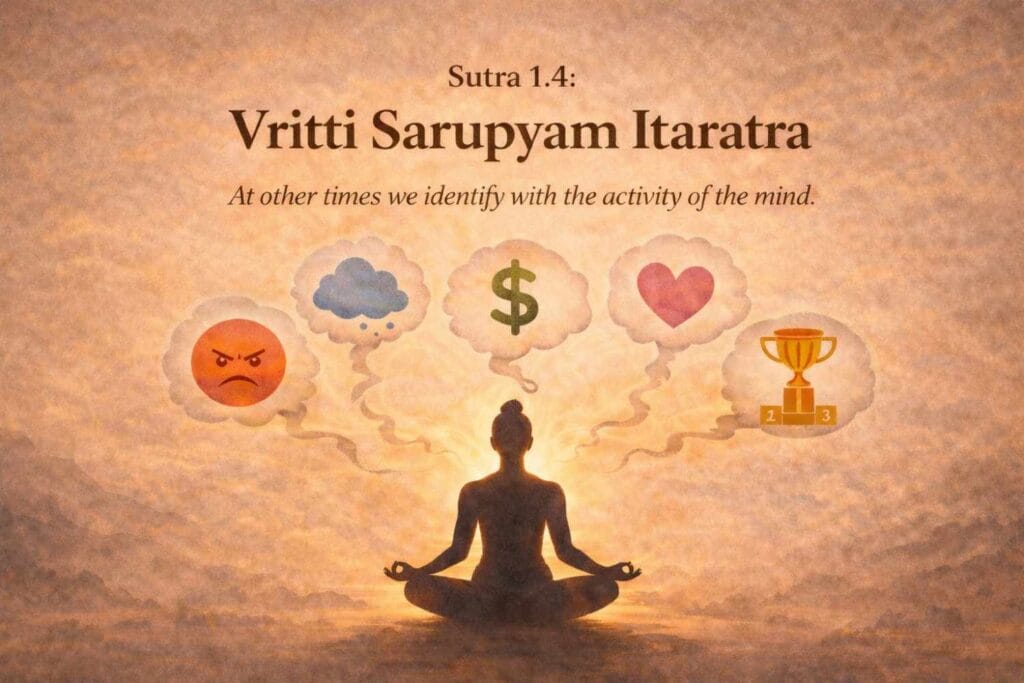
Sutra 1.4 completes this foundational framework by revealing the opposite condition, the state that prevails when the mind is not stilled. It states that, at all other times, the Seer identifies with the fluctuations of the mind. This is the ordinary condition of human life. It is not marked by the absence of awareness, but by its misplacement. Awareness does not disappear; it becomes absorbed in mental activity.
In this state, the distinction between the observer and the observed is lost. Thoughts are no longer seen as passing modifications; they are taken to be the self. Emotions are not experienced as transient states; they define identity. The mind’s activity becomes the lens through which everything is interpreted, and gradually, that lens is mistaken for reality itself.
This is why the sutra is not merely descriptive, it is diagnostic. It identifies the root of human confusion and suffering. The problem is not that the mind moves; movement is inherent to its nature. The problem is that the Seer, instead of remaining established in its own clarity, becomes identified with these movements. From this identification arise instability, misperception, and inner conflict.
Understanding the Words: A Deeper Look
The precision of this sutra lies in its language. Each word is carefully chosen and carries layered meaning, revealing the mechanism of this identification.
- Vritti refers to the fluctuations or modifications of the mind. These are not limited to thoughts alone; they include all forms of mental activity, perception, imagination, memory, and reaction. The mind is not static; it is a field of constant change, and vrittis are the expressions of that change.
- Sarupyam means “taking the same form” or “becoming like.” It indicates not just association, but identification. The Seer does not merely observe the vrittis; it appears to take on their shape. When a particular mental state arises, awareness reflects it so completely that the distinction between observer and state is no longer recognized.
- Itaratra means “at other times”, that is, in all states where the mind has not been stilled through yoga. It refers to the default condition of ordinary experience, where awareness is continuously engaged with mental activity.
When these terms are brought together, the sutra reveals a simple yet profound truth: whenever the mind is active and unobserved, the Seer appears to lose itself in those activities. It does not actually change its nature, but it becomes so closely associated with the movements of the mind that it is no longer recognized as distinct.
In this sense, the Seer does not truly become the mind, it only appears to. This appearance, however, is powerful enough to shape the entire human experience. Identity becomes fluid and unstable, shifting with each thought and emotion. Clarity is replaced by reaction, and awareness is no longer grounded in itself.
Sutra 1.4, therefore, does not introduce a new concept; it reveals the condition that yoga seeks to resolve. It shows that the absence of stillness is not neutral, it leads to identification. And it is this identification that forms the basis of confusion, attachment, and suffering.
To see this clearly is the beginning of understanding.
The Central Problem: Mistaken Identity
At the heart of this sutra lies a subtle but profound error, one that shapes almost every human experience. As expressed in your notes , we do not merely experience thoughts; we begin to identify with them.
When anger arises, it is rarely observed as a passing state. Instead, it becomes personal, “I am angry.” When fear appears, it is not seen as a movement within the mind; it becomes an identity, “I am afraid.” This shift from observation to identification happens so naturally that it often goes unnoticed.
This is what Patanjali refers to as sarupyam, the taking on of form. The Seer, which is pure, unchanging awareness, appears to assume the shape of whatever arises in the mind. It is not that awareness truly transforms; rather, it becomes so closely associated with mental activity that the distinction is lost. In that loss, identity becomes unstable, shaped moment to moment by whatever thought or emotion is dominant.
The Nature of Vritti: Waves in Consciousness
In yogic understanding, the mind is not a fixed or solid entity. It is a field of continuous movement. Thoughts arise, remain briefly, and dissolve, only to be replaced by new ones. These movements are known as vrittis, fluctuations or modifications within consciousness.
A helpful way to understand this is through the image of water. When the surface of a lake is still, it reflects clearly. But when disturbed by ripples, the reflection becomes distorted. Similarly, when the mind is active and unsettled, perception loses clarity. Reality is no longer seen as it is, but as it appears through the distortion of mental movement.
This does not mean that thoughts themselves are the problem. Movement is natural to the mind. The difficulty arises when there is no awareness of this movement, when the fluctuations are not seen, but unconsciously lived. In such a state, one does not simply experience the mind; one becomes entangled in it.
The Seer and the Mind: Two Distinct Realities
Patanjali makes a clear and essential distinction between the Seer and the mind. The Seer, often referred to as Drashta or Purusha: is pure awareness: unchanging, silent, and witnessing. The mind (Chitta), on the other hand, is dynamic, constantly shifting, and filled with vrittis.
In the state described in Sutra 1.3, when the mind is still, the Seer abides in its own nature. There is clarity, stability, and direct awareness. However, in Sutra 1.4, when the mind is active, the Seer appears to become the mind itself.
It is important to understand that this is not an actual transformation. Awareness does not lose its nature. Rather, it becomes identified with the mind, much like a clear crystal placed next to a colored object appears to take on that color. The crystal itself remains unchanged, but the appearance is altered.
In the same way, the Self remains untouched, yet it appears to reflect the qualities of the mind due to proximity and identification.
Everyday Life: Living as the Mind
This teaching is not abstract, it describes the ordinary condition of daily life. From morning to night, the mind is in constant motion: planning, remembering, judging, reacting. Within this continuous flow, identity shifts rapidly.
At one moment, there is confidence. At another, anxiety. Then irritation, then excitement. Each state feels personal and real while it lasts. Yet what is actually changing is not the Self, but the mental state.
Because of identification, however, these shifting states are experienced as changes in “who we are.” This creates a sense of instability. The “I” appears to move with every thought and emotion, even though the underlying awareness remains constant.
This is the illusion that Sutra 1.4 points to, not that the mind changes, but that we mistake those changes for ourselves.
Why This Leads to Suffering
When identity becomes tied to the mind, stability becomes impossible. The mind is influenced by countless factors, past impressions, external situations, sensory input, and emotional patterns. It is inherently variable.
If one’s sense of self is rooted in something so changeable, then peace can never be consistent. It becomes dependent on circumstances. Happiness becomes conditional, clarity becomes occasional, and inner balance becomes fragile.
This is why Patanjali begins with this diagnosis. The source of disturbance is not the external world, but the internal misidentification. The problem is not that thoughts arise, but that they are taken to define the self.
The Loss of the Witness
At the core of this condition is what can be called the loss of the witness. The Seer is always present, it does not disappear. But it is overlooked.
When a thought arises, attention moves toward it and becomes absorbed. Instead of witnessing the thought, one participates in it. Instead of observing an emotion, one becomes immersed in it. This absorption creates reactivity, emotional turbulence, and a lack of clarity.
However, the moment awareness returns, even briefly, a distance is created. The thought is seen, the emotion is recognized, and identification loosens. In that space, a different quality of experience emerges, one that is not driven by reaction, but grounded in observation.
The Mechanism of Identification
This process of identification is subtle and often automatic. A thought appears, attention moves toward it, engagement begins, and identification follows.
Consider a simple example. A thought arises: “I am not good enough.” If this thought is not observed, it is believed. That belief generates an emotional response, which in turn reinforces the thought. A loop forms, and within that loop, identity begins to take shape.
This is vritti sarupyam in operation, the Seer appearing to take on the form of a mental modification.
The Illusion of “I”
One of the deeper implications of this sutra is the nature of the personal “I.” What we commonly refer to as “I” is not constant. It is a shifting collection of thoughts, memories, and reactions. Each moment presents a slightly different version of identity.
And yet, there is a sense of continuity.
This continuity does not belong to the mind, it belongs to the Seer. However, because the Seer is not recognized, that sense of continuity is mistakenly attributed to the mental construct of identity. This creates the illusion of a stable “I,” when in reality, it is continuously changing.
Yoga as De-Identification
If Sutra 1.4 describes the condition of identification, then the path of yoga offers a resolution. Yoga is not about creating a new identity or suppressing the mind. It is about recognizing what has always been present and removing what is mistakenly assumed.
This process can be understood as de-identification. Instead of becoming the mind, one begins to observe it.
“I am angry” gradually shifts to “anger is present.”
“I am anxious” becomes “anxiety is arising.”
This is not a linguistic change, it is a shift in perception. The witness is restored, and with it, a sense of stability that is not dependent on mental states.
The Role of Awareness
Awareness is central to this transformation. Not control, not suppression, but clear observation.
When a thought is observed, it begins to lose its intensity. It is seen as transient, and its ability to define identity weakens. When a thought is believed without awareness, it gains strength and continuity.
This is why meditation holds such importance in the yogic tradition. It is not a practice of forcing the mind into silence, but of seeing its movements clearly. Through this clarity, identification gradually dissolves.
The Connection with Sutra 1.2 and 1.3
These sutras together form a complete framework:
Sutra 1.2 defines the stilling of the mind.
Sutra 1.3 describes the state of resting in one’s true nature.
Sutra 1.4 reveals the condition when this is not established, identification with the mind.
In essence, there are two modes of experience. Either awareness is established in itself, or it is identified with mental activity. Understanding this distinction is the beginning of yoga.
Modern Relevance: The Overactive Mind
In the context of modern life, this sutra becomes even more significant. The mind is continuously stimulated, through information, technology, comparison, and external validation. This constant stimulation increases the number and intensity of vrittis.
As mental activity increases, so does identification. Identity becomes increasingly tied to opinions, reactions, and external feedback. The distance between awareness and thought diminishes, and with it, clarity.
This makes the insight of this sutra not only relevant, but essential.
Practical Understanding in Daily Life
This teaching can be applied in simple, direct ways. When a reaction arises, whether to criticism, failure, or discomfort, it can be observed. Is the reaction being witnessed, or has it become identity?
Each moment presents a choice, though often subtle. One can remain as the observer, or become the mental state.
Even brief moments of observation begin to shift this pattern.
The Beginning of Freedom
Freedom, in this context, is not achieved by controlling external circumstances, but by understanding the internal process. The recognition that thoughts, emotions, and reactions are not the Self creates a space.
Within that space, awareness remains steady. Clarity begins to emerge, and a natural sense of peace arises, not as something created, but as something uncovered.
The Depth of This Sutra
Though concise, this sutra carries immense depth. It identifies the root of suffering, the mechanism of identity, and the direction of transformation. It does not demand external change, but invites a refinement of perception.
Reflection for the Seeker
This sutra encourages a simple yet profound inquiry: am I aware of my thoughts, or am I lost within them? Do I experience emotions, or do they define me? Is my sense of self stable, or does it shift with each mental state?
Even the act of asking these questions begins to restore awareness.
Conclusion
Sutra 1.4 describes the ordinary condition of human experience, not a lack of intelligence, but a lack of clear identification. The Seer remains ever-present, yet it is obscured by the continuous movement of the mind.
When these movements are not recognized, they become identity. And in that identification, the true nature of the Self is forgotten.
But the moment awareness returns, when observation replaces identification, the same mind that once obscured reality begins to reveal it. In this shift, the path of yoga truly begins.
Also read: Patanjali: Who Was He and When Did He Live