Discover the deep and authentic meaning of Yogas Chitta Vritti Nirodhah from Patanjali Yoga Sutras. A detailed, human-centered explanation rooted in true yogic wisdom.
The Original Sutra
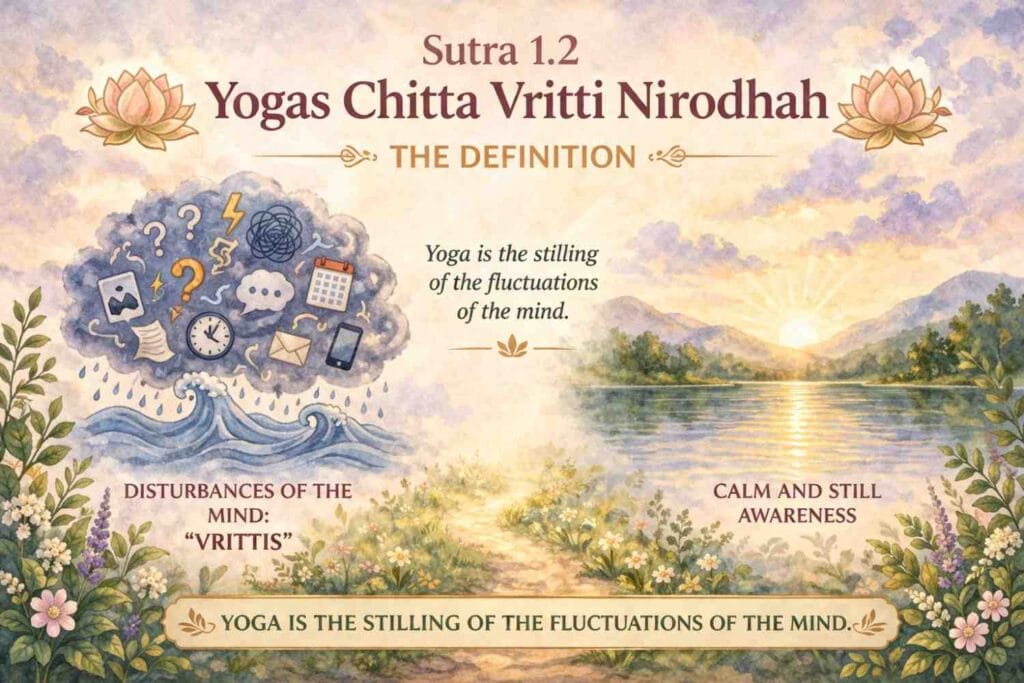
योगश्चित्तवृत्तिनिरोधः
Transliteration: Yogas Chitta Vritti Nirodhah
Exact Translation:
Yoga is the cessation of the fluctuations of the mind-stuff.
Entering the Depth of the Sutra
There are certain lines in spiritual literature that do not merely inform you, they quietly begin to transform you. Sutra 1.2 of the Patanjali Yoga Sutras is one such line. It is deceptively short, almost austere in its expression, yet it holds within it the entire science of yoga.
At Yogazenlife, we approach such sutras not as intellectual concepts to be memorized, but as living truths to be experienced. This sutra is not offering a philosophy, it is revealing a mechanism. A direct insight into how human suffering arises and how it can dissolve.
To understand it, we must slow down, not just mentally, but inwardly.
Yoga: Not What You Do, But What Remains
When most people hear the word yoga, they imagine postures, flexibility, perhaps a sense of calm after a session. But Patanjali does not begin with the body. He begins with the mind.
And more importantly, he does not define yoga as an activity.
He defines it as a state.
This distinction is subtle but transformative.
Yoga is not something you perform for one hour in the morning and then leave behind. It is the condition that arises when the disturbances within you come to rest. It is what remains when the constant inner noise subsides.
In this sense, yoga is less about adding something to yourself, and more about removing what is unnecessary.
Chitta: The Inner Field of Experience
The word chitta is often translated simply as “mind,” but this translation fails to capture its depth. Chitta is better understood as the entire inner field in which experience happens.
It includes your thoughts, yes, but also your emotions, your memories, your sense of identity, your reactions, your unconscious tendencies. It is the subtle space where life is constantly being interpreted.
Every moment, your chitta is active:
- It labels what you see
- It reacts to what you hear
- It compares, judges, remembers, anticipates
You do not just see a person- you interpret them.
You do not just hear a word- you react to it.
This constant activity forms your lived reality.
But here lies the deeper insight of the sutra:
What you experience as “reality” is not reality itself, it is your chitta in motion.
Vritti: The Movements That Shape Your World
The term vritti refers to the movements or modifications within this field of chitta. These are not random, they are patterned, repetitive, and deeply conditioned.
A memory arises- that is a vritti.
A worry about the future- that is a vritti.
A sudden wave of anger- that too is a vritti.
Even imagination, daydreaming, analysis, all are forms of vritti.
To understand this more intuitively, imagine sitting beside a lake.
When the surface of the water is disturbed by wind, you cannot see the bottom clearly. The ripples distort everything. The reflection is fragmented, unstable.
But when the water becomes still, something changes. The surface becomes like a mirror, clear, undistorted, revealing what is truly there.
Your chitta is that lake.
Your vrittis are the ripples.
And your perception of life depends entirely on whether that lake is disturbed or still.
Nirodhah: The Subtle Art of Stilling
Now we come to the most delicate word in the sutra: nirodhah.
It is often misunderstood as suppression, as if yoga demands that you forcefully stop your thoughts. But suppression creates tension. It divides you against yourself.
Patanjali is not advocating violence toward the mind.
Nirodhah is not force, it is mastery through understanding.
It is the natural settling of the mind that happens when:
- You stop feeding unnecessary thoughts
- You stop identifying with every mental movement
- You learn to observe without interference
Think of it like a spinning wheel.
If you try to stop it abruptly, it resists. But if you simply stop pushing it, over time, it slows down on its own.
Similarly, the mind does not need to be controlled aggressively. It needs to be understood and gently guided toward stillness.
The Core Insight: You Are Not the Mind
This sutra carries within it a radical realization, one that can quietly shift your entire sense of self.
- You are not your thoughts.
- You are not your emotions.
- You are not even your patterns.
All of these are vrittis, movements within the field of chitta. But there is something in you that is aware of these movements. That silent witness, that observing presence, that is your true nature.
However, because the mind is constantly active, this deeper reality remains hidden. You become so absorbed in the movements that you forget the stillness behind them.
Yoga, as defined by this sutra, is the process of returning to that stillness.
Why the Mind Keeps Moving
If stillness is so natural, why is the mind so restless?
The answer lies in conditioning.
From childhood, the mind is trained to:
- Seek stimulation
- Avoid discomfort
- Constantly engage
Every experience leaves an impression. These impressions accumulate and create tendencies. These tendencies generate more thoughts, more reactions, more vrittis.
It becomes a cycle.
The mind is not restless because something is wrong with it. It is restless because it has been conditioned to move continuously.
Yoga does not fight this conditioning, it slowly dissolves it.
The Shift from Reaction to Awareness
One of the most practical ways to understand this sutra is through observation in daily life.
Imagine someone says something unpleasant to you.
Instantly, a reaction arises, anger, hurt, defensiveness. This reaction feels personal, immediate, almost automatic. But if you look closely, you will notice something:
The reaction arises within you.
It is not you, it is happening to you.
This is the beginning of yoga.
The moment you see the difference between:
- “I am angry”
and - “Anger is arising”
you create a space. And in that space, the vritti loses its power.
This is nirodhah in action, not suppression, but disidentification.
The Gradual Path to Stillness
The stilling of the mind is not an overnight event. It is a gradual unfolding.
At first, the mind resists. It seeks distraction. It pulls you into old patterns. But with consistent practice, what Patanjali later calls abhyasa, something begins to change.
Moments of stillness appear.
Gaps between thoughts become visible.
Reactions lose their intensity.
And slowly, the mind begins to trust stillness.
This is important.
Stillness is not imposed, it is discovered.
The Role of Detachment
Alongside practice comes vairagya– detachment.
Detachment does not mean withdrawal from life. It means freedom from compulsive involvement.
You still experience everything:
- Joy
- Pain
- Success
- Failure
But you are no longer entangled in them. The mind becomes like the sky, allowing clouds to pass without being disturbed. This combination of practice and detachment naturally leads to chitta vritti nirodhah.
A Mirror Without Distortion
When the vrittis settle, something profound happens, not something new, but something that was always there becomes visible.
Your awareness becomes clear, like a polished mirror.
You begin to see:
- Situations without bias
- People without projection
- Yourself without distortion
This clarity is not intellectual. It is direct, immediate, undeniable.
And from this clarity arises:
- Peace that is not dependent on circumstances
- Stability that is not shaken by events
- Joy that does not require a reason
The Relevance in Today’s World
In the modern world, the mind is constantly stimulated. Notifications, information, comparison, endless content, these keep the chitta in continuous motion.
The result is:
- Restlessness even in silence
- Anxiety without clear cause
- Difficulty being present
Sutra 1.2 becomes even more relevant in such a context.
It does not ask you to escape the world. It teaches you how to remain inwardly still within the world.
Living the Sutra: A Perspective
This sutra is not just a teaching, it is a daily practice.
It is present when:
- You pause before reacting
- You breathe consciously in a stressful moment
- You observe your thoughts without immediately believing them
It is present when you realize that peace is not something to be achieved later, but something that is revealed when the mind quiets down.
Yoga, then, is not confined to the mat.
It is in how you listen.
It is in how you speak.
It is in how you experience each moment.
Conclusion: Returning to What You Already Are
Yogas Chitta Vritti Nirodhah is not asking you to become something extraordinary.
It is inviting you to return to what is already true.
Beneath the layers of thought, beneath the constant movement of the mind, there is a stillness that is untouched by time, unaffected by circumstance.
That stillness is not separate from you.
It is you.
Yoga is simply the process of removing what hides it.
And once even a glimpse of that stillness is experienced, the journey is no longer a search, it becomes a remembrance.