Explore the authentic teachings of meditation in the Bhagavad Gita through Krishna’s wisdom on Dhyāna Yoga, self-mastery, the restless mind, detachment, inner peace, and spiritual transformation.
Inner Discipline, Self-Mastery, and the Stillness of Consciousness in the Bhagavad Gita
Meditation occupies a central place in the Bhagavad Gita, yet the text approaches meditation in a way that is far deeper than modern ideas of relaxation or temporary stress relief. The Gita presents meditation as a disciplined transformation of consciousness itself. It is not merely a technique for calming the mind, but a path toward self-mastery, inner clarity, emotional balance, and spiritual freedom.
Krishna introduces meditation most systematically in Chapter 6, traditionally known as Dhyāna Yoga – the Yoga of Meditation. However, the principles of meditation are woven throughout the entire Bhagavad Gita. Again and again, Krishna teaches Arjuna about attention, self-observation, emotional discipline, detachment, concentration, and mastery over the restless mind.
The Bhagavad Gita recognizes a truth that remains profoundly relevant today: an uncontrolled mind becomes a source of suffering.
Human beings may achieve external success, recognition, wealth, or power, yet without inner stability the mind remains vulnerable to fear, anxiety, distraction, comparison, emotional turbulence, craving, and psychological exhaustion. External achievement alone cannot create lasting peace because the deeper disturbance exists within consciousness itself.
Meditation therefore becomes essential not as escape from life, but as preparation for living wisely within life.
Krishna does not teach meditation as withdrawal from responsibility. In fact, one of the most revolutionary insights of the Bhagavad Gita is that meditation and action are not opposites. Meditation purifies awareness so that action itself becomes clearer, steadier, and less driven by egoic reaction.
This is why meditation in the Bhagavad Gita is inseparable from Karma Yoga, self-discipline, and inner transformation.
Why the Mind Becomes Restless
One of the deepest psychological insights in the Bhagavad Gita is its understanding of the restless nature of the human mind. Long before modern psychology began studying attention, emotional conditioning, compulsive thinking, and mental instability, the Bhagavad Gita explored why consciousness becomes disturbed and fragmented internally.
Krishna repeatedly explains that the mind becomes restless because awareness remains continuously attached to desire, fear, memory, emotional reaction, sensory stimulation, and egoic identification. Human consciousness rarely remains fully present. Instead, the mind constantly moves outward toward objects, experiences, expectations, worries, fantasies, comparisons, and emotional projections.
The senses continuously seek stimulation, pleasure, excitement, novelty, recognition, and distraction. At the same time, the ego seeks validation, certainty, importance, control, emotional security, and psychological permanence. Thoughts endlessly oscillate between past and future, between memory and anticipation, regret and expectation, craving and anxiety.
As a result, the mind rarely experiences genuine stillness.
The Bhagavad Gita recognizes that the human mind becomes unstable because it continuously depends upon changing external conditions for emotional satisfaction and identity. The more consciousness becomes psychologically attached to temporary experiences, the more vulnerable it becomes to emotional fluctuation. This creates inner turbulence.
When desire is fulfilled, attachment strengthens.
When desire is obstructed, frustration develops.
When expectations collapse, suffering emerges.
When identity feels threatened, fear intensifies.
The mind therefore becomes trapped within continuous reaction.
Krishna analyzes this mechanism elsewhere in the Bhagavad Gita with remarkable psychological precision:
ध्यायतो विषयान्पुंसः सङ्गस्तेषूपजायते ।
सङ्गात्सञ्जायते कामः कामात्क्रोधोऽभिजायते ॥ (2.62)
“When a person continuously dwells upon objects, attachment develops. From attachment arises desire, and from desire arises anger.”
Krishna then continues explaining how anger creates confusion, confusion weakens discernment, and the mind gradually loses inner clarity altogether. This sequence reveals profound insight into how mental suffering develops.
The mind repeatedly focuses upon particular desires, fears, ambitions, resentments, and emotional narratives until psychological dependence forms around them. Once identity becomes emotionally invested in certain outcomes, the mind loses its stability because peace now depends upon whether reality satisfies expectation. The Bhagavad Gita therefore identifies attachment as one of the central causes of mental restlessness.
This teaching feels extraordinarily relevant today because modern life intensifies exactly these conditions. Digital technology, social media, entertainment culture, productivity pressure, endless comparison, information overload, and constant stimulation continuously fragment human attention. The nervous system rarely experiences silence or inward stillness.
Modern individuals are constantly pulled outward: toward notifications, toward visibility, toward performance, toward validation, toward consumption, and toward endless mental stimulation. As a result, many people experience chronic anxiety, distraction, emotional fatigue, inability to concentrate, and psychological exhaustion. The Bhagavad Gita recognized this restless condition of consciousness thousands of years ago.
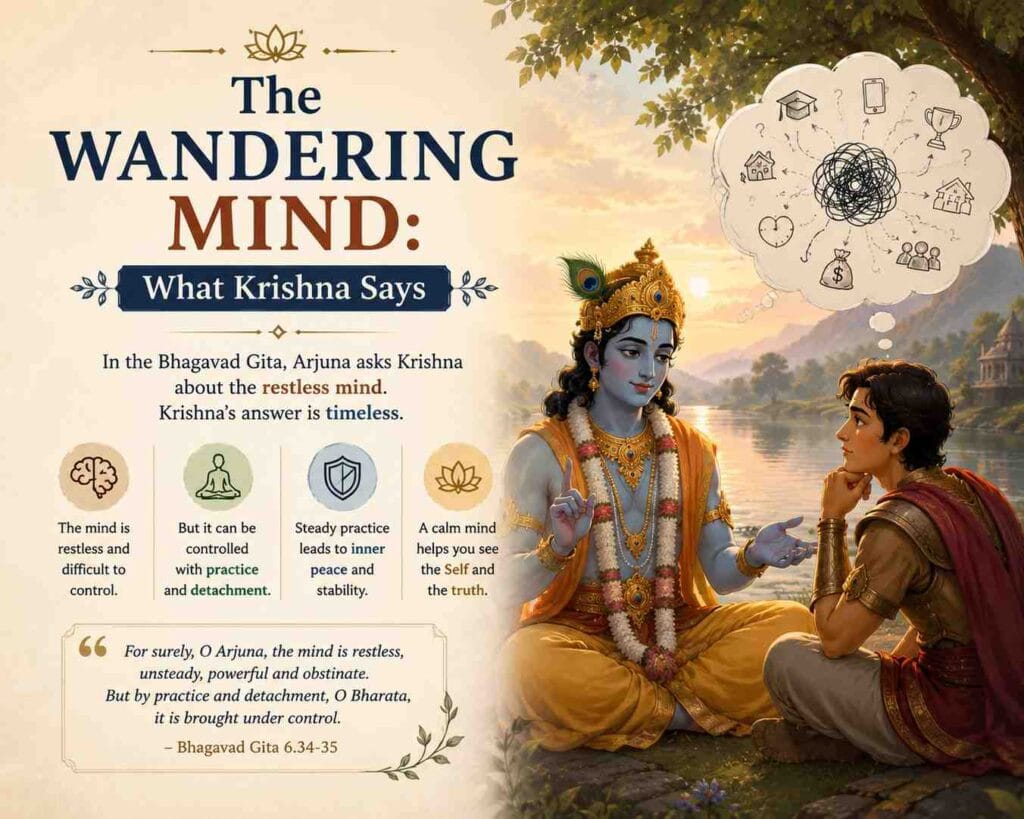
This is why Arjuna openly admits his struggle before Krishna :
चञ्चलं हि मनः कृष्ण प्रमाथि बलवद्दृढम् ।
तस्याहं निग्रहं मन्ये वायोरिव सुदुष्करम् ॥ (6.34)
“The mind is restless, turbulent, powerful, and obstinate. Controlling it seems as difficult as controlling the wind.”
This is one of the most psychologically honest moments in the Bhagavad Gita because Arjuna expresses the exact difficulty human beings still experience during meditation and self-observation:
wandering thoughts, emotional turbulence, compulsive thinking, distraction, mental agitation, and inability to remain inwardly steady.
The comparison with the wind is especially profound. Just as wind constantly moves and shifts direction unpredictably, the ordinary mind continuously jumps between thought, memory, fear, desire, imagination, and reaction.
Krishna does not dismiss this struggle. He responds with realism and compassion:
असंशयं महाबाहो मनो दुर्निग्रहं चलम् ।
अभ्यासेन तु कौन्तेय वैराग्येण च गृह्यते ॥ (6.35)
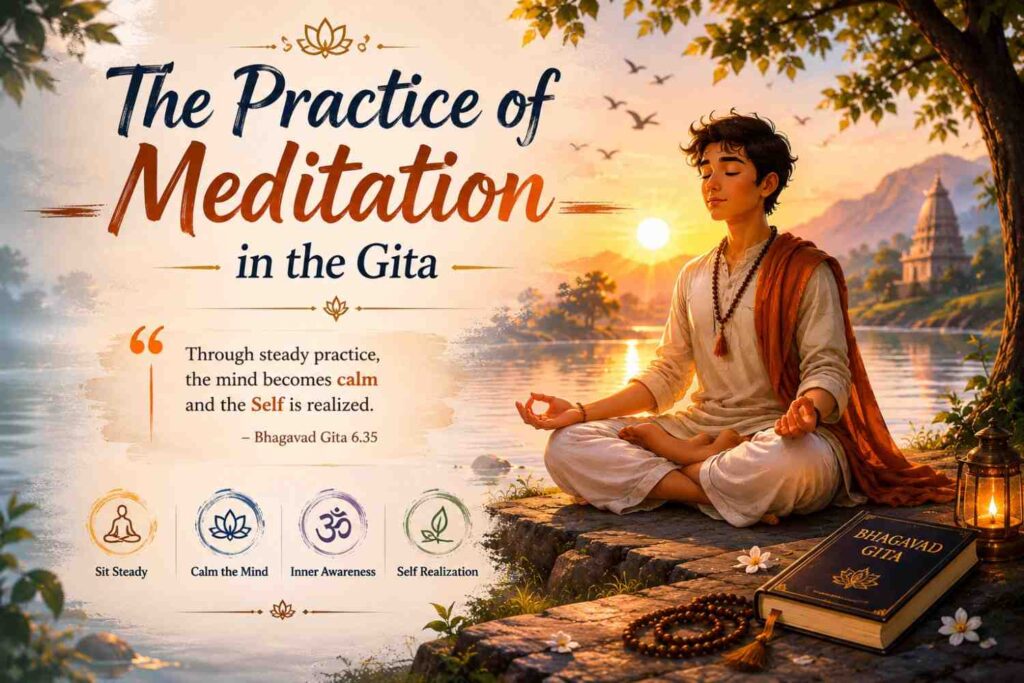
“Without doubt, the mind is restless and difficult to control, but through practice and detachment it can be restrained.”
This verse forms the foundation of meditation in the Bhagavad Gita. Krishna does not promise instant stillness or sudden perfection. Inner mastery develops gradually through disciplined practice and detachment. The mind becomes steadier not through forceful suppression, but through repeated training of awareness.
This distinction is extremely important. Many people approach meditation expecting immediate silence or total absence of thought. When thoughts continue arising, frustration develops. The Bhagavad Gita approaches meditation differently. Krishna recognizes that mental conditioning has developed through years of habit, emotional reaction, attachment, and distraction. Naturally, stabilizing consciousness also requires patience, continuity, and sustained effort.
Meditation therefore becomes a lifelong refinement of awareness.
The term अभ्यास (abhyāsa) refers to consistent practice, repeatedly returning attention inward despite distraction. The practitioner learns to gently bring awareness back whenever the mind wanders.
The term वैराग्य (vairāgya) refers to detachment, freedom from compulsive emotional dependence upon thoughts, desires, and sensory stimulation. Without detachment, the mind continuously becomes pulled outward by craving and fear.
Together, practice and detachment gradually create inner steadiness.
The Bhagavad Gita therefore presents meditation not as escape from life, but as training in self-mastery. The restless mind becomes calmer not because the external world disappears, but because consciousness gradually stops reacting compulsively to every impulse and emotional fluctuation.
Meditation as Inner Observation
The Bhagavad Gita presents meditation not merely as concentration, but as direct observation of consciousness itself.
Ordinarily, people do not simply experience thoughts and emotions, they become psychologically identified with them. A fearful thought appears and identity immediately becomes fear. Anger appears and awareness becomes absorbed within anger. Desire appears and consciousness compulsively pursues gratification. Emotional pain appears and the mind becomes trapped within suffering. Human beings therefore live in continuous identification with mental activity.
This is one of the central problems meditation addresses. The Bhagavad Gita explains that the ordinary mind remains so deeply entangled with thoughts, reactions, desires, memories, and emotional movement that awareness forgets its own deeper stability beneath mental fluctuation.
Meditation slowly changes this relationship. The practitioner begins observing thoughts, emotions, desires, fears, memories, impulses, and reactions without immediately becoming psychologically consumed by them. Awareness gradually develops the ability to witness the movements of the mind directly.
This creates psychological distance between awareness and mental fluctuation.
The significance of this insight is profound because unconscious patterns gain power through identification. The more automatically consciousness merges with fear, craving, jealousy, insecurity, anger, or emotional reaction, the stronger those patterns become internally. The moment awareness becomes capable of observing these movements clearly, their unconscious grip begins weakening.
Meditation therefore becomes a process of increasing clarity rather than suppression. Krishna never teaches violent control of the mind. He does not advocate repression of emotion or destruction of thought. Instead, he teaches disciplined awareness.
This distinction is essential because suppression often strengthens inner conflict rather than resolving it. A person may temporarily repress anger, fear, or desire outwardly while the disturbance continues internally beneath awareness.
The Bhagavad Gita points toward something deeper: conscious observation. When awareness begins observing emotional movement directly, the practitioner gradually becomes less mechanically controlled by impulse and reaction. Thoughts still arise, emotions still arise, desires still arise, but consciousness develops greater steadiness amidst them.
Over time, emotional reactivity weakens because awareness stops feeding every impulse automatically. The practitioner becomes less psychologically dominated by: desire, fear, comparison, anger, insecurity, emotional turbulence, and external stimulation. This transformation happens gradually.
The Bhagavad Gita never romanticizes instant enlightenment. Krishna repeatedly emphasizes discipline, patience, continuity, and repeated practice. The mind has developed conditioning over years of repetition and attachment, so meditation becomes a gradual purification of consciousness itself.
As awareness deepens, the mind slowly becomes quieter, steadier, clearer, and more transparent. This inner clarity transforms not only meditation, but life itself. The individual continues acting within the world, yet consciousness becomes less reactive, less fragmented, and less psychologically imprisoned by every passing thought and emotion. According to Krishna, this growing inner steadiness is the beginning of true yoga.
The Discipline of Meditation
The Bhagavad Gita approaches meditation with extraordinary seriousness, precision, and psychological depth. Krishna does not present meditation as a vague spiritual mood or occasional relaxation technique. Instead, meditation is described as a disciplined process of transforming consciousness itself.
One of the most important aspects of the Bhagavad Gita’s teaching is that inner stillness does not arise accidentally. The restless mind must be trained gradually through discipline, self-regulation, awareness, moderation, and repeated practice. Krishna therefore gives practical instructions regarding environment, posture, lifestyle, concentration, and mental balance.
He explains:
शुचौ देशे प्रतिष्ठाप्य स्थिरमासनमात्मनः ।
नात्युच्छ्रितं नातिनीचं चैलाजिनकुशोत्तरम् ॥ (6.11)
“One should establish a steady seat in a clean place, neither too high nor too low.”
This verse may appear simple outwardly, yet it reflects profound psychological understanding.
The environment influences consciousness deeply. External disorder often increases internal distraction. A noisy, chaotic, overstimulating atmosphere continuously pulls attention outward and weakens concentration. Krishna therefore emphasizes simplicity, cleanliness, steadiness, and balance because meditation requires an environment supportive of inward awareness.
The “steady seat” symbolizes more than physical sitting. It reflects stability itself.
Ordinarily, the human mind continuously moves toward stimulation and distraction. Thoughts shift rapidly between desire, fear, memory, planning, comparison, and emotional reaction. The practitioner therefore begins meditation by establishing external steadiness as a foundation for inner steadiness.
The body becomes still so awareness can gradually become still.
Krishna then explains:
समं कायशिरोग्रीवं धारयन्नचलं स्थिरः ।
सम्प्रेक्ष्य नासिकाग्रं स्वं दिशश्चानवलोकयन् ॥ (6.13)
“Holding the body, head, and neck straight and steady, gazing toward the tip of the nose without looking elsewhere.”
The posture itself becomes symbolic of psychological balance.
Physical restlessness often reflects mental restlessness. When the body constantly shifts impulsively, attention also becomes scattered outward continuously. Steady posture therefore supports concentration because the practitioner gradually learns how to withdraw awareness from compulsive sensory distraction.
This does not mean rigid force or physical tension. Rather, posture reflects alert relaxation, stable yet calm. The instruction regarding the gaze is equally important. Human attention normally becomes pulled outward endlessly through sensory stimulation. The eyes move constantly toward objects, activity, excitement, entertainment, and distraction. By softening external engagement, the practitioner slowly directs awareness inward.
Meditation in the Bhagavad Gita therefore becomes training in attention itself.
The practitioner learns how to remain present without compulsively reacting to every external impulse and internal thought. This inward discipline gradually strengthens clarity, steadiness, and self-mastery.
The Bhagavad Gita also emphasizes moderation as an essential foundation for meditation:
नात्यश्नतस्तु योगोऽस्ति न चैकान्तमनश्नतः ।
न चाति स्वप्नशीलस्य जाग्रतो नैव चार्जुन ॥ (6.16)
“Yoga is not for one who overeats, nor for one who excessively fasts, nor for one who oversleeps, nor for one who remains excessively awake.”
This balanced approach is one of the most sophisticated aspects of the Bhagavad Gita. Krishna rejects both indulgence and extreme asceticism. Spiritual discipline is not self-punishment. Meditation does not require violent suppression of the body or rejection of all human needs. At the same time, excessive indulgence weakens clarity because the mind becomes increasingly attached to stimulation and comfort.
Inner balance develops through moderation rather than excess. This teaching reflects one of the broader principles of the Bhagavad Gita: spiritual maturity grows through harmony, discipline, and self-regulation rather than extremism and imbalance.
Modern culture often swings between overstimulation and burnout. Some individuals pursue endless sensory gratification, while others approach spirituality through harsh self-denial. Krishna rejects both extremes. The nervous system functions best through steadiness and balance.
Meditation therefore requires an integrated life. Food, sleep, work, emotional habits, sensory input, and lifestyle all influence consciousness. The Bhagavad Gita recognizes that meditation cannot be separated from the overall quality of life itself. The practitioner gradually learns to live with greater awareness and balance because every aspect of life influences the mind.
Meditation and Detachment
One of the deepest aspects of meditation in the Bhagavad Gita is detachment.
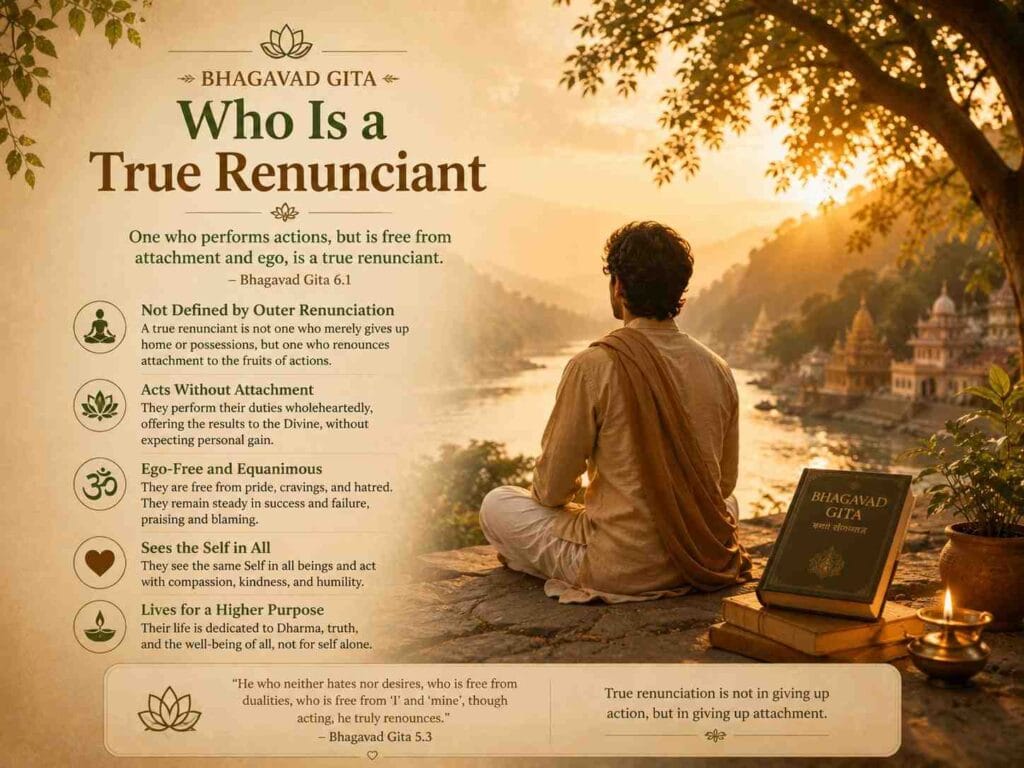
Detachment is often misunderstood as emotional coldness, indifference, or rejection of life. Krishna teaches something very different. Detachment means freedom from compulsive psychological dependence upon thoughts, emotions, desires, and external outcomes.
Ordinarily, the mind continuously seeks pleasure while resisting discomfort. Human beings become emotionally attached to success, recognition, relationships, control, validation, stimulation, and emotional security. Because these conditions constantly change, consciousness also remains unstable. This creates continuous mental agitation.
The mind fears losing what it desires. It resists what it dislikes. It becomes attached to praise and disturbed by criticism. It seeks certainty within an uncertain world. As a result, emotional suffering intensifies because peace depends entirely upon changing external conditions. Meditation gradually weakens this compulsive dependence.
The practitioner learns how to observe thoughts, emotions, desires, fears, and reactions without immediately becoming psychologically trapped within them. Awareness slowly develops the ability to remain steadier amidst emotional fluctuation.
This is the deeper meaning of detachment. Detachment does not mean the absence of feeling. It means freedom from unconscious enslavement to feeling. The individual still experiences love, challenge, uncertainty, grief, joy, responsibility, and emotional movement, but consciousness becomes less mechanically reactive.
Krishna repeatedly teaches that awareness must learn how to remain steady amidst pleasure and pain, gain and loss, praise and criticism. This inner balance becomes possible only when the mind is no longer completely dependent upon emotional fluctuation for identity and security. Meditation therefore supports equanimity. The practitioner continues participating fully in life while becoming less psychologically controlled by changing circumstances. Emotional experiences continue naturally, yet awareness becomes steadier amidst those experiences. This creates profound inner freedom. The Bhagavad Gita therefore presents meditation not merely as concentration, but as liberation from compulsive emotional bondage.
The Experience of Inner Stillness
As meditation deepens, the Bhagavad Gita describes a state of profound inner peace and inward fulfillment.
Krishna explains:
यत्रोपरमते चित्तं निरुद्धं योगसेवया ।
यत्र चैवात्मनाऽत्मानं पश्यन्नात्मनि तुष्यति ॥ (6.20)
“When the mind becomes still through yoga, one experiences satisfaction within the Self.”
This verse describes one of the deepest goals of meditation in the Bhagavad Gita.
Ordinarily, human beings search for fulfillment externally through achievement, pleasure, recognition, stimulation, possession, emotional gratification, and sensory experience. Yet all external experiences remain temporary. Satisfaction appears briefly and then fades, causing the mind to seek new stimulation repeatedly. This creates endless psychological restlessness. The Bhagavad Gita recognizes that external pleasure alone cannot create lasting peace because the mind remains dependent upon unstable conditions. Meditation gradually shifts the center of fulfillment inward.
As awareness becomes quieter and less fragmented, the practitioner begins discovering a subtler form of peace independent of constant external stimulation. Consciousness experiences moments of inward stillness where the mind temporarily stops compulsively chasing and resisting experience.
This inward satisfaction is profoundly different from ordinary pleasure. Pleasure depends upon external conditions. Inner stillness emerges from clarity of consciousness itself.
The Bhagavad Gita therefore presents meditation as a path toward psychological freedom because awareness gradually stops depending entirely upon external experience for emotional stability.
This does not mean rejecting the world. The practitioner still participates fully in life. What changes is the source of inner stability. Peace slowly moves inward. This is why Krishna describes meditation as a path toward liberation rather than mere relaxation.
Meditation and Compassion
One of the most beautiful dimensions of meditation in the Bhagavad Gita is its relationship with compassion and unity.
Krishna explains:
आत्मौपम्येन सर्वत्र समं पश्यति योऽर्जुन ।
सुखं वा यदि वा दुःखं स योगी परमो मतः ॥ (6.32)
“One who sees the happiness and suffering of all beings as similar to one’s own is considered the highest yogi.”
This teaching reveals that meditation is not selfish withdrawal from humanity.
Ordinarily, the ego remains trapped within self-centered concern. The mind continuously revolves around personal desire, personal fear, personal insecurity, personal ambition, and personal identity. As long as consciousness remains psychologically imprisoned within egoic identification, genuine compassion remains limited. Meditation gradually weakens this rigid self-centeredness.
As awareness becomes quieter and less reactive, the practitioner begins perceiving others with greater sensitivity and understanding. Emotional defensiveness weakens. Compassion naturally deepens because consciousness becomes less dominated by egoic craving and fear.
The practitioner slowly recognizes the shared vulnerability of human existence: everyone experiences suffering, everyone seeks happiness, everyone struggles with fear, attachment, insecurity, and emotional pain. This recognition softens separation. The highest yogi therefore becomes inwardly transformed, not merely mentally concentrated.
Meditation purifies not only attention, but also the quality of relationship with the world itself. The individual becomes more patient, more compassionate, more balanced, and less psychologically aggressive toward life and others.
This is why the Bhagavad Gita never separates meditation from ethical and emotional transformation. Real meditation changes consciousness itself. According to Krishna, the highest spiritual maturity is revealed not only through inward stillness, but through expanded awareness, compassion, and unity with all beings.
The Timeless Relevance of Meditation in the Gita
The teachings of meditation in the Bhagavad Gita remain extraordinarily relevant because the psychological condition described by Krishna has become even more intense in modern life. Human beings today possess more external stimulation, information, convenience, and technological connection than any previous civilization, yet inner stillness has become increasingly rare. Modern consciousness is continuously fragmented.
Attention is constantly pulled outward through notifications, entertainment, social media, advertising, comparison, productivity pressure, endless information, emotional stimulation, and digital distraction. The mind rarely remains fully present because awareness continuously jumps from one impulse to another.
As a result, many individuals struggle with: constant distraction, mental exhaustion, anxiety, comparison, emotional instability, restlessness, overthinking, and inability to remain inwardly calm. The nervous system rarely experiences silence.
Many people now live in a state of continuous psychological stimulation. Even moments of rest are often filled with screens, noise, scrolling, emotional reaction, or mental activity. Human beings have become conditioned to constant engagement, making inward stillness increasingly difficult.
The Bhagavad Gita recognized this restless condition of consciousness thousands of years ago. Krishna understood that the mind naturally becomes unstable when it remains attached to craving, fear, emotional dependence, sensory stimulation, and egoic identity. The more consciousness seeks fulfillment externally without inner discipline, the more fragmented and reactive the mind becomes.
This insight feels astonishingly modern because contemporary culture intensifies exactly these patterns.
Social media amplifies comparison continuously. Professional life often conditions people to define self-worth through productivity and achievement. Consumer culture constantly stimulates desire by convincing individuals that happiness lies in acquiring more experiences, recognition, possessions, and validation.
As a result, many people become emotionally dependent upon external feedback for identity and security.
The mind then loses its natural steadiness. Krishna’s response to this condition remains timeless: discipline awareness, observe the mind, practice detachment, cultivate inner steadiness, and gradually free consciousness from compulsive emotional reactivity. This is why meditation in the Bhagavad Gita is not merely a spiritual ritual. It becomes a profound psychological practice.
Meditation trains the mind to stop reacting mechanically to every thought, desire, fear, impulse, and emotional fluctuation. The practitioner gradually develops the ability to remain present without becoming completely absorbed within mental turbulence.
This is deeply important because modern suffering is often intensified by unconscious mental reactivity itself.
A fearful thought appears and anxiety expands automatically. Comparison appears and insecurity deepens. Criticism appears and identity collapses emotionally. Desire appears and the mind compulsively seeks gratification. The Bhagavad Gita teaches that awareness does not need to remain enslaved by every mental movement.
Meditation therefore becomes training in inner freedom. The practitioner learns how to observe thoughts without immediately identifying with them. Emotional experiences continue naturally, but consciousness becomes steadier amidst those experiences. Over time, the mind develops greater clarity, patience, balance, and resilience. This transformation affects every dimension of life.
Relationships become healthier because emotional reactivity weakens. Work becomes clearer because attention strengthens. Decisions become wiser because fear and impulsiveness lose some of their control. The individual develops greater capacity for focus, empathy, patience, and self-awareness. Meditation therefore supports not only spirituality, but emotional intelligence and psychological stability itself.
The Bhagavad Gita also remains timeless because it rejects extremes. Krishna neither advocates indulgence nor harsh repression. He teaches balance, moderation, self-regulation, and disciplined awareness. This balanced philosophy is especially important today because modern individuals often swing between overstimulation and burnout.
Some people attempt escaping stress through endless distraction. Others pursue rigid self-control through unhealthy perfectionism.
Krishna teaches another path: steady awareness, balanced discipline, and inward clarity. This approach remains profoundly relevant because the fundamental structure of human psychology has not changed. Human beings still struggle with attachment, fear, distraction, insecurity, craving, emotional instability, and restless thinking.
And therefore the solution Krishna offers remains timeless. Meditation becomes a process of returning consciousness to itself. Not through force. Not through suppression. But through patient observation, disciplined awareness, and gradual inner transformation.
Conclusion
The Bhagavad Gita presents meditation as a profound transformation of consciousness rather than merely a relaxation technique.
Krishna teaches that the uncontrolled mind becomes one of the primary sources of suffering, while disciplined awareness becomes the path toward clarity, equanimity, self-mastery, compassion, and inner freedom. Meditation gradually weakens compulsive attachment, emotional turbulence, egoic reaction, and psychological fragmentation by training awareness to remain steady amidst the changing conditions of life.
This teaching is deeply important because the Bhagavad Gita does not separate meditation from ordinary existence. The practitioner continues living fully within the world while gradually becoming less psychologically controlled by fear, craving, distraction, emotional instability, and external uncertainty.
Action continues. Responsibility continues. Relationships continue. Life continues. But consciousness changes. This is the deeper meaning of meditation in the Bhagavad Gita. Meditation is not escape from life. It is transformation within life. It is not suppression of thought or rejection of emotion. Rather, it is the gradual cultivation of awareness capable of observing thought and emotion without becoming unconsciously imprisoned by them. As inner steadiness deepens, consciousness becomes clearer, calmer, less reactive, and more inwardly free. The individual no longer depends entirely upon external stimulation and unstable circumstances for emotional balance.
This creates a fundamentally different relationship with existence itself. The Bhagavad Gita therefore presents meditation not merely as spiritual practice, but as mastery within consciousness.
The world remains uncertain. Pleasure and pain continue. Success and failure continue. Praise and criticism continue. But awareness becomes steadier amidst them. And according to Krishna, that inner transformation is the beginning of true yoga.