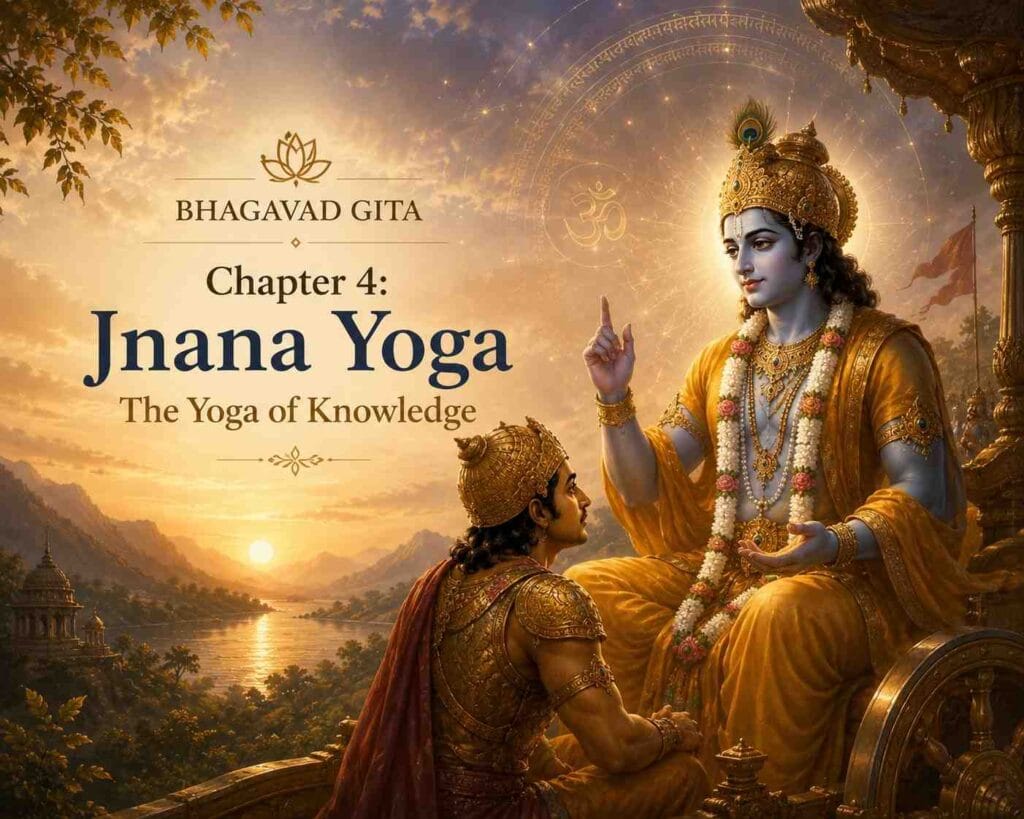
Explore Chapter 4 of the Bhagavad Gita in depth. Understand Jnana Yoga, the Yoga of Knowledge, divine manifestation, yajña, karma, and the liberating power of wisdom.
Introduction to Chapter 4
Chapter 4 of the Bhagavad Gita marks a significant transition in the dialogue between Krishna and Arjuna. In the earlier chapters, Krishna establishes the foundations of Karma Yoga, the discipline of action without attachment. Here, the teaching deepens further into the nature of knowledge, action, and spiritual understanding.
This chapter is traditionally known as Jñāna Yoga, the Yoga of Knowledge.
However, the knowledge discussed here is not merely intellectual information or philosophical theory. Krishna speaks of a transformative understanding that changes how reality, action, and the self are perceived.
The chapter explores:
- the origin and transmission of spiritual knowledge
- the relationship between knowledge and action
- the nature of divine incarnation
- the meaning of sacrifice (yajña)
- the role of discipline and inquiry
- the power of knowledge to dissolve confusion
It is one of the most philosophically rich chapters in the Bhagavad Gita because it connects action with wisdom rather than separating them.
Verse 4.1
The Blessed Lord said:
“I taught this imperishable yoga to Vivasvan (the sun-god); Vivasvan taught it to Manu; Manu taught it to Ikshvaku.”
Verse 4.2
“Thus received through disciplic succession, the royal sages understood this knowledge. But over time, this yoga was lost in this world.”
Verse 4.3
“That same ancient yoga I have spoken to you today because you are My devotee and friend. This is the supreme secret.”
Verse 4.4
Arjuna said:
“Your birth is recent, while the birth of Vivasvan was in ancient times. How am I to understand that You taught this in the beginning?”
Verse 4.5
The Blessed Lord said:
“Many births have passed for both you and Me, O Arjuna. I know them all, but you do not.”
Verse 4.6
“Though unborn and imperishable, and the Lord of all beings, I manifest Myself through My own power, controlling My material nature.”
Verse 4.7
“Whenever righteousness declines and unrighteousness rises, I manifest Myself.”
Verse 4.8
“For the protection of the virtuous, the destruction of wrongdoing, and the establishment of dharma, I appear age after age.”
Verse 4.9
“One who truly understands My divine birth and actions is not reborn after leaving the body, but attains Me.”
Verse 4.10
“Freed from attachment, fear, and anger, absorbed in Me and purified by knowledge, many have attained My being.”
Verse 4.11
“As people approach Me, I reciprocate accordingly. All paths ultimately lead to Me.”
Verse 4.12
“Those desiring success in action worship the gods, for success in worldly action comes quickly.”
Verse 4.13
“The fourfold order was created by Me according to qualities and actions. Though I am its creator, know Me as non-doer and eternal.”
Verse 4.14
“Actions do not bind Me, nor do I desire their results. One who understands this truth is also not bound by action.”
Verse 4.15
“Knowing this, seekers of liberation in ancient times also performed action. Therefore, you too should act as the ancients did.”
Verse 4.16
“What is action? What is inaction? Even the wise are confused about this. I shall explain it to you.”
Verse 4.17
“One must understand action, wrong action, and inaction. The nature of action is difficult to understand.”
Verse 4.18
“One who sees inaction in action and action in inaction is wise among people. Such a person is truly integrated and accomplished in action.”
Verse 4.19
“One whose actions are free from desire and selfish intention, whose actions are burned by the fire of knowledge, is considered wise.”
Verse 4.20
“Abandoning attachment to results, always content and independent, such a person acts yet is not truly bound by action.”
Verse 4.21
“Without expectation, self-controlled, and free from possessiveness, performing only bodily action, one does not incur fault.”
Verse 4.22
“Satisfied with what comes naturally, beyond dualities, free from envy, balanced in success and failure, one is not bound by action.”
Verse 4.23
“For one free from attachment, liberated, established in knowledge, and acting for sacrifice alone, action dissolves completely.”
Verse 4.24
“The offering is Brahman, the oblation is Brahman, offered by Brahman into the fire of Brahman. One who sees Brahman in action attains Brahman.”
Verse 4.25
“Some yogis perform sacrifice to the gods, while others offer the self itself into the fire of Brahman.”
Verse 4.26
“Some offer hearing and other senses into the fire of restraint, while others offer sound and sense objects into the fire of the senses.”
Verse 4.27
“Others offer all actions of the senses and life-force into the fire of self-control, illuminated by knowledge.”
Verse 4.28
“Some perform sacrifice through wealth, austerity, yoga, study, and knowledge.”
Verse 4.29
“Others regulate the movement of breath, offering inhalation into exhalation and exhalation into inhalation.”
Verse 4.30
“All these understand sacrifice, and through sacrifice their impurities are destroyed.”
Verse 4.31
“Those who partake of the nectar remaining from sacrifice attain the eternal Brahman. Without sacrifice, even this world cannot be attained.”
Verse 4.32
“Thus many forms of sacrifice are described in the Vedas. Know them all to arise from action. Understanding this, you shall be liberated.”
Verse 4.33
“The sacrifice of knowledge is superior to material sacrifice, O Arjuna. All action culminates in knowledge.”
Verse 4.34
“Approach those who possess knowledge with humility, inquiry, and service. The wise who perceive truth will instruct you in knowledge.”
Verse 4.35
“Having attained this knowledge, you will never again fall into confusion. Through it, you will see all beings within the Self and within Me.”
Verse 4.36
“Even if you are the greatest sinner among all sinners, you shall cross beyond all wrongdoing through the boat of knowledge.”
Verse 4.37
“As blazing fire reduces wood to ashes, so does the fire of knowledge reduce all actions to ashes.”
Verse 4.38
“In this world, there is nothing as purifying as knowledge. One perfected in yoga realizes this within oneself over time.”
Verse 4.39
“One who has faith, dedication, and mastery over the senses attains knowledge. Having attained knowledge, one quickly reaches supreme peace.”
Verse 4.40
“But the ignorant, faithless, and doubting self is ruined. Neither this world, nor the next, nor happiness belongs to one filled with doubt.”
Verse 4.41
“One whose doubts are destroyed by knowledge, whose actions are surrendered through yoga, is not bound by action.”
Verse 4.42
“Therefore, cut this doubt born of ignorance with the sword of knowledge within your heart. Established in yoga, arise, O Arjuna.”
Explanation: Chapter 4 – Jñāna Yoga (The Yoga of Knowledge)
Introduction: A Shift from Action to Understanding
In Chapter 3 of the Bhagavad Gita, Krishna explains how action can be performed without attachment. The emphasis there is on Karma Yoga, the discipline of right action.
Chapter 4 deepens the teaching. The focus now shifts from action itself to the understanding behind action.
Krishna begins to reveal that the quality of action depends entirely on the state of knowledge from which it arises. Two individuals may perform the same external action, yet inwardly they may exist in completely different conditions. One acts from attachment, fear, ego, or desire. Another acts from clarity, steadiness, and understanding.
This chapter therefore explores a central question: What transforms action from bondage into freedom?
Krishna’s answer is knowledge. But the knowledge described here is not merely intellectual information. It is not accumulation of concepts, scripture, or theory. It is transformative insight.
Knowledge, in the context of Jñāna Yoga, changes how the individual perceives:
- the self
- action
- reality
- responsibility
- and the relationship between all of them
This is why Chapter 4 is considered one of the most philosophically profound sections of the Bhagavad Gita.
The Ancient Transmission of Knowledge
At the beginning of Chapter 4 of the Bhagavad Gita, Krishna introduces the teaching of yoga not as a new philosophy created for a specific historical moment, but as an ancient and enduring wisdom transmitted across generations. He explains that this knowledge was first taught to Vivasvan, the sun deity, then passed to Manu, and later to Ikshvaku through a lineage of understanding.
This opening is highly significant because it establishes the universality and continuity of the teaching.
Krishna is emphasizing that yoga is not dependent upon a particular culture, period, or intellectual trend. It is presented as timeless because the fundamental structure of human experience remains consistent across history.
Civilizations evolve. Social systems change. Technologies advance. Yet the essential psychological struggles of human beings continue to reappear in every era.
People still experience:
- confusion in moments of decision
- attachment to outcomes and identities
- fear of uncertainty and loss
- conflict between desire and understanding
- emotional instability caused by expectation and dependence
The Bhagavad Gita addresses these recurring inner conditions rather than temporary social circumstances alone. This is why the teaching remains relevant beyond its historical context.
Krishna also explains that this wisdom becomes obscured over time. Importantly, he does not say that truth disappears completely. Instead, it becomes covered or forgotten beneath layers of distraction, ritualism without understanding, egoic interpretation, or mechanical repetition. This insight remains deeply relevant even in modern contexts.
Wisdom rarely disappears because truth itself ceases to exist. More often, clarity becomes clouded by excess complexity, emotional conditioning, superficial interpretation, or loss of direct understanding. The role of authentic teaching, therefore, is restorative rather than merely informative. It restores perception where confusion has accumulated. It reconnects the individual with principles that were always present but no longer clearly seen. This restoration is one of the central purposes of Jñāna Yoga.
The Meaning of Divine Manifestation
One of the most widely recognized teachings in Chapter 4 appears in Krishna’s declaration:
“Whenever dharma declines and adharma rises, I manifest Myself.”
Traditionally, this verse is understood in relation to divine incarnation during periods of moral and social disorder. While this historical and theological interpretation is important, the verse also carries a profound philosophical and psychological meaning within the larger context of the Bhagavad Gita.
Dharma, in this chapter, represents more than moral conduct alone. It refers to alignment with truth, balance, order, clarity, and right understanding.
Adharma, by contrast, represents fragmentation, confusion, imbalance, and loss of alignment with reality.
Krishna’s manifestation therefore symbolizes the restoration of clarity whenever consciousness becomes dominated by disorder and misunderstanding.
This restoration can be understood at multiple levels:
- within society when ethical confusion becomes widespread
- within individuals when attachment and ignorance cloud discernment
- within consciousness itself when awareness loses alignment with truth
At a deeper level, Krishna’s teaching suggests that truth is never permanently absent from existence. Even when obscured, it retains the capacity to re-emerge. This is a crucial insight.
The Bhagavad Gita does not present the divine as distant, passive, or disconnected from human life. Instead, the divine principle is portrayed as continuously involved in restoring balance whenever disorder overwhelms understanding.
Psychologically, this also reflects an important principle of yoga: clarity may become concealed, but it is never completely destroyed.
Even when the mind becomes dominated by fear, attachment, or confusion, the possibility of insight remains present beneath the disturbance. The process of yoga is therefore not the creation of truth, but the removal of what obscures it. This is why Krishna’s manifestation can also be understood symbolically as the re-emergence of clarity within the human mind whenever consciousness becomes overwhelmed by ignorance.
Knowledge and Action Are Not Opposed
One of Arjuna’s central misunderstandings throughout the earlier chapters of the Bhagavad Gita is the assumption that spiritual knowledge and worldly action belong to separate and opposing paths.
He repeatedly assumes that if knowledge leads toward inner freedom, then withdrawal from action must naturally follow. In his mind, action appears associated with conflict, responsibility, and attachment, while knowledge appears associated with renunciation and disengagement.
Krishna gradually dismantles this division throughout Chapter 4.
He explains that true knowledge does not necessarily eliminate action. Instead, it transforms the inner basis from which action arises. This distinction is fundamental to Jñāna Yoga. The problem is not action itself. The problem is ignorance within action. When action arises from egoic attachment, compulsive desire, fear, or psychological dependence, it creates bondage and disturbance. However, when action arises from clarity and understanding, the same external activity no longer produces the same inner conflict.
This is why Krishna introduces one of the most paradoxical statements in the chapter:
“One who sees inaction in action and action in inaction is wise.”
This verse directs attention away from external appearances and toward inner consciousness.
A person may appear extremely active outwardly, engaged in responsibilities, work, and decision-making, while inwardly remaining free from agitation, egoic compulsion, and attachment to outcomes.
At the same time, another individual may appear externally inactive while inwardly remaining deeply entangled in fantasy, fear, desire, regret, or mental restlessness. The distinction therefore is not behavioral alone. It is psychological and existential.
Krishna is teaching Arjuna to observe not merely what action looks like externally, but the state of awareness from which the action emerges. This is one of the defining insights of Chapter 4.
Freedom is not necessarily found through absence of activity. It is found through transformation of consciousness within activity itself. This understanding dissolves the false division between knowledge and action. Action continues, but attachment weakens. Responsibility remains, but psychological dependence reduces. And through this shift, action itself becomes integrated with understanding rather than opposed to it.
The Expansion of Yajña (Sacrifice)
In the earlier chapters of the Bhagavad Gita, yajña is primarily introduced as action performed without selfish attachment. The emphasis is placed on participation in life without egoic ownership of results. However, in Chapter 4, Krishna significantly expands the meaning of yajña and transforms it from a ritualistic idea into a universal principle of inner refinement and spiritual transformation.
This expansion is one of the most important philosophical developments in the chapter.
Traditionally, yajña referred to sacrificial rituals performed through offerings into sacred fire. Krishna does not reject this understanding, but he broadens it considerably. Sacrifice is no longer limited to external ceremony. It becomes a process through which the individual consciously refines the mind, disciplines the senses, and moves toward clarity.
Krishna describes multiple forms of sacrifice:
- sacrifice through disciplined living
- sacrifice through regulation of breath
- sacrifice through restraint of the senses
- sacrifice through study and contemplation
- sacrifice through self-control
- sacrifice through knowledge
This diversity is significant because it reveals that spiritual practice is not confined to one external form. Different individuals may approach refinement through different methods, yet the underlying principle remains the same: something limited is relinquished in order to move toward greater clarity and integration.
The focus therefore shifts away from ritual performance alone and toward transformation of consciousness itself.
Among all forms of sacrifice, Krishna places the highest value on knowledge. He states that the sacrifice of ignorance through understanding is superior to material offerings. Why is knowledge considered the highest sacrifice? Because ignorance is identified as the root of bondage.
According to the Bhagavad Gita, human suffering is not caused merely by external circumstances. It arises because reality is misunderstood. The individual falsely identifies with transient conditions, becomes attached to outcomes, and seeks permanent stability in what is inherently unstable.
From this misunderstanding arise:
- attachment
- fear
- compulsive desire
- anxiety regarding loss
- psychological conflict
Knowledge becomes liberating because it corrects this distorted perception.
Krishna repeatedly compares knowledge to fire because fire transforms whatever it touches. In the same way, genuine understanding burns through confusion and dissolves false identification. Knowledge is therefore not passive information stored in memory. It is transformative insight capable of altering the entire structure of perception.
This is why Chapter 4 places such strong emphasis on Jñāna Yoga. The purpose of knowledge is not intellectual superiority. It is inner freedom through clarity.
The Importance of Inquiry and Humility
Another major teaching in Chapter 4 concerns the manner in which knowledge is approached and received. Krishna instructs Arjuna to approach those who possess understanding with:
- humility
- sincere inquiry
- willingness to learn
This teaching is deeply significant because it defines the attitude necessary for authentic learning within the yogic tradition.
Jñāna Yoga is not based on blind belief, passive acceptance, or mechanical repetition of doctrine. At the same time, it is equally opposed to intellectual arrogance and argumentative skepticism rooted purely in ego. True inquiry requires openness. A mind that assumes complete certainty before investigation becomes incapable of genuine understanding because it is no longer receptive. Humility, in this context, does not mean inferiority or blind submission. It means recognition of the limitations of one’s current understanding.
This recognition creates the psychological space necessary for learning.
Krishna therefore encourages questioning, but not questioning driven solely by the need to defend identity or display intellectual superiority. Inquiry must arise from a sincere desire to understand reality more clearly.
This balance is essential. Without inquiry, knowledge becomes dogmatic. Without humility, inquiry becomes egoic and fragmented. The yogic tradition therefore values disciplined questioning guided by openness and discernment. Krishna’s instruction also highlights the importance of direct experience and guidance from those who possess lived understanding rather than theoretical knowledge alone. Wisdom is not treated merely as conceptual information; it is something embodied and realized.
This is why the relationship between teacher and student in the Bhagavad Gita is not authoritarian in nature. It is rooted in transmission of understanding through dialogue, inquiry, reflection, and disciplined practice.
Knowledge as Purification
Krishna declares in Chapter 4:
“There is nothing as purifying as knowledge.”
This statement is profound because the purification described here is not external or ritualistic. It is the purification of perception itself. Ignorance, in the context of the Bhagavad Gita, does not merely refer to lack of information or education. It refers to fundamental misunderstanding regarding:
- the nature of the self
- the nature of action
- the nature of reality
- and the source of lasting stability
Because of this misunderstanding, the individual becomes psychologically entangled in attachment, fear, and compulsive desire. The mind begins seeking permanent fulfillment in impermanent conditions, creating continuous instability and conflict.
Knowledge purifies because it reveals what was previously misperceived. It restores accurate seeing. This transformation does not occur through external force or suppression. It occurs internally through insight. As understanding becomes clearer, many forms of disturbance begin to weaken naturally because the mind no longer relates to reality in the same conditioned way.
This is why Krishna repeatedly associates knowledge with freedom.
Once confusion begins to dissolve:
- attachment loses some of its intensity
- fear weakens
- compulsive reactions reduce
- action becomes less psychologically burdened
The transformation therefore is organic rather than imposed. Knowledge changes the quality of consciousness itself.
Doubt and Inner Division
Chapter 4 also offers an important analysis of doubt and its effect on the mind. Krishna distinguishes carefully between healthy inquiry and destructive uncertainty. Healthy inquiry is necessary for understanding. It motivates investigation, reflection, and deeper perception. However, chronic doubt creates fragmentation within consciousness.
A person consumed by unresolved inner contradiction cannot act steadily because attention remains divided between competing possibilities, fears, and uncertainties. The mind becomes unable to commit fully to action or understanding. This division weakens clarity.
Krishna therefore states that the doubting mind finds neither peace nor stability. Such a person remains psychologically suspended, unable to move with confidence in either action or understanding. This teaching is highly psychological. The problem is not questioning itself. The problem is becoming trapped in endless mental contradiction without resolution.
Knowledge resolves this fragmentation by bringing clarity to what was previously confused. When understanding becomes stable, the mind no longer remains internally divided in the same way. Action then becomes more direct and integrated because consciousness is no longer fragmented by constant uncertainty.
The Relationship Between Knowledge and Freedom
A central theme running throughout Chapter 4 is that bondage is fundamentally psychological before it becomes external. People are not bound merely because they act. They become bound because action is performed from ignorance, attachment, fear, compulsive desire, and false identification. This is why Krishna repeatedly connects knowledge with liberation.
Knowledge changes the relationship between consciousness and these patterns. It reveals that many forms of suffering are sustained not by reality itself, but by misunderstanding and unconscious identification.
When understanding becomes clearer:
- attachment weakens
- egoic dependence reduces
- compulsive reaction loses strength
- action becomes less burdened by psychological conflict
Importantly, Krishna does not teach that liberation requires complete withdrawal from life. External activity may continue. Responsibilities may continue. Action itself does not necessarily disappear.
What changes is the inner condition from which action arises. The individual becomes less psychologically entangled in action because understanding has become clearer. Freedom, therefore, is not primarily absence of activity. It is freedom from unconscious bondage within activity itself.
Conclusion
Chapter 4 of the Bhagavad Gita deepens the teaching of Karma Yoga by introducing the transformative role of knowledge. Krishna reveals that genuine knowledge is not mere intellectual accumulation or philosophical abstraction. It is insight that fundamentally changes how reality, identity, and action are perceived.
The chapter explores:
- the timeless transmission of wisdom
- the restoration of dharma
- the relationship between knowledge and action
- the expansion of sacrifice into inner refinement
- the importance of inquiry and humility
- and the purifying power of understanding
At its core, Chapter 4 teaches that bondage originates in ignorance because perception becomes clouded by attachment, fear, and false identification. Knowledge clears this clouding.
And when clarity emerges, action becomes steadier, freer, and less psychologically burdened. Jñāna Yoga, therefore, is not escape from life. It is transformation in how life itself is understood and lived.