Discover why the Hatha Yoga Pradipika describes only 15 āsanas. Explore the original purpose of posture in classical Haṭha Yoga and how modern yoga evolved differently.
Introduction
Modern yoga is frequently identified with variety, expansion, and physical innovation. Across contemporary studios, teacher trainings, books, and digital platforms, practitioners encounter hundreds of postures and countless variations designed to develop flexibility, strength, endurance, balance, and coordination. In many modern systems, progression is often measured by the ability to perform increasingly advanced or visually demanding positions.
As a result, yoga is commonly perceived primarily as a physical discipline centered around movement and postural diversity. Against this background, one detail within the Hatha Yoga Pradipika becomes particularly striking.
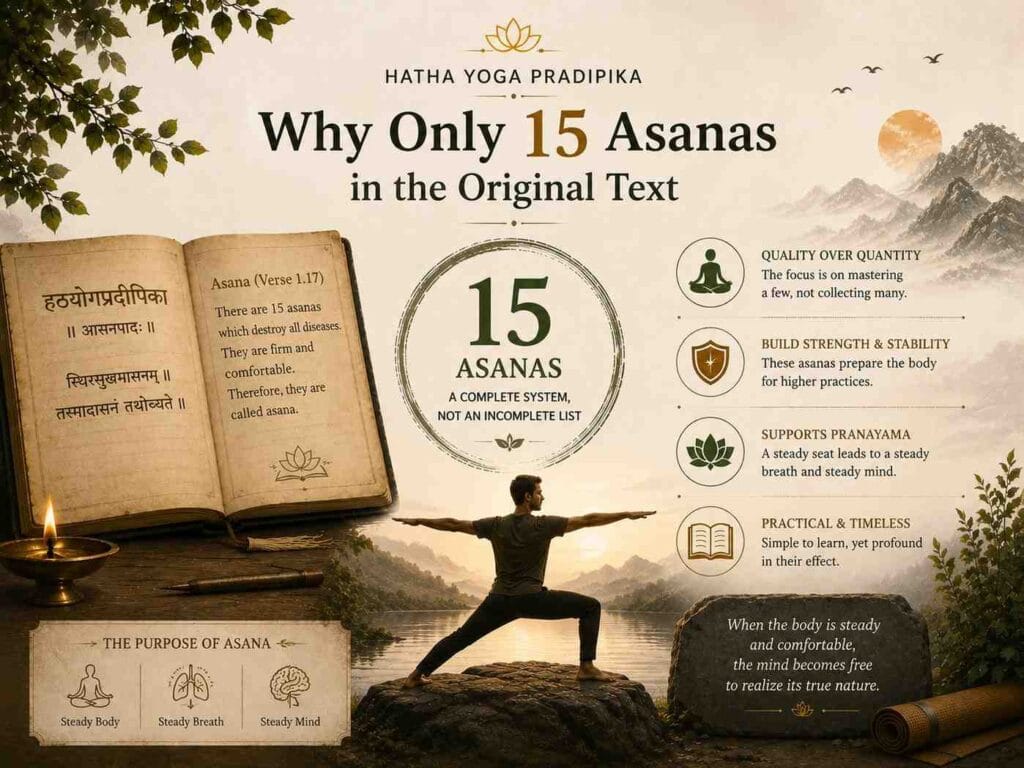
Swami Swatmarama, the compiler of one of the most influential texts in the Haṭha Yoga tradition, describes only fifteen āsanas in detail. For many contemporary practitioners, this immediately raises an important question: Why would a foundational yoga text contain so few postures if yoga was already a developed spiritual and practical system? The answer reveals something essential about the original orientation of classical Haṭha Yoga.
The purpose of the text was not to create an ever-expanding catalogue of physical techniques. Nor was it attempting to maximize physical complexity for its own sake. Instead, the Hatha Yoga Pradipika approaches the body as part of a larger yogic process aimed at preparing the practitioner for higher states of internal stability, regulation of prāṇa, and meditative absorption. This distinction is fundamental.
In the classical tradition, physical practice was important, but it was never isolated from the broader goals of yoga. Āsana functioned as preparation rather than culmination. Understanding why only fifteen āsanas were emphasized therefore provides insight not only into the structure of the Hatha Yoga Pradipika itself, but also into the philosophical priorities of early Haṭha Yoga as a whole.
It reveals a tradition far more concerned with steadiness, energetic balance, and inner transformation than with endless physical variation. At the same time, it highlights how significantly many modern interpretations of yoga have shifted from the original emphasis of the classical texts.
The Purpose of Āsana in Classical Haṭha Yoga
To understand why the Hatha Yoga Pradipika includes only a limited number of postures, it is first necessary to understand what the term āsana originally meant within the context of classical Haṭha Yoga.
In modern yoga culture, āsana is often treated as the central feature of practice. Considerable emphasis is placed on physical achievement, flexibility, muscular strength, advanced sequencing, and external form. The posture itself frequently becomes the primary objective.
In classical Haṭha Yoga, however, the role of āsana was more restrained, functional, and preparatory. The posture was not an end in itself. Its purpose was to create a stable and balanced condition within the body so that subtler yogic practices could become possible.
Swatmarama explicitly explains that āsana is practiced for:
- steadiness
- health
- lightness of body
These objectives reflect a very different understanding of physical practice.
The body was not approached primarily as something to perfect aesthetically or continuously challenge through increasing complexity. It was regarded as an instrument that required sufficient balance, stability, and regulation so that the practitioner could sit comfortably, regulate the breath effectively, and sustain meditative awareness without excessive disturbance.
This reflects a broader principle found throughout classical yoga traditions: the body supports practice, but it is not the final aim of practice. Within this framework, the value of an āsana was determined less by how impressive it appeared externally and more by the condition it produced internally.
A useful posture was one that:
- stabilized the nervous system
- supported energetic balance
- reduced physical restlessness
- facilitated comfortable sitting
- and prepared the body for prāṇāyāma and meditation
From this perspective, the question naturally changes.
The goal was not:
“How many postures can be accumulated or mastered?”
The goal was:
“What forms of posture are necessary to prepare the system effectively?”
Once posture fulfilled this preparatory function, excessive multiplication of techniques became unnecessary.
This is one of the clearest differences between the classical and many modern approaches to yoga. In the Hatha Yoga Pradipika, depth of practice was valued more highly than endless variety. Consistency, refinement, and internal stability were considered more important than continuous physical expansion.
The Symbolic Number of 84 Āsanas
The Hatha Yoga Pradipika acknowledges the traditional yogic idea that there are eighty-four lakh (8.4 million) āsanas originating from Shiva, of which eighty-four are considered especially significant. Yet despite this enormous symbolic number, Swatmarama chooses to describe only fifteen postures in detail.
This choice is highly significant. It suggests intentional selection rather than limitation through lack of knowledge or incomplete tradition.
The number eighty-four in yogic literature is often understood symbolically rather than literally. In many Indian spiritual traditions, symbolic numbers are used to represent completeness, totality, or the vast range of possibilities contained within existence. The reference to eighty-four lakh āsanas points toward the immense diversity of embodied experience and potential forms of practice. However, the Hatha Yoga Pradipika is not attempting to catalogue every possible posture. Its purpose is practical rather than encyclopedic.
Swatmarama selects postures that directly support the aims of Haṭha Yoga itself. This indicates that the text prioritizes effectiveness and purpose over accumulation of techniques. The emphasis therefore remains on quality rather than quantity. This reflects a fundamental principle of classical yoga:
Transformation was believed to arise through depth, consistency, and refinement, not through endless variation alone. A smaller number of postures practiced regularly, attentively, and with proper understanding was considered more valuable than constant experimentation without inner development.
This principle also aligns with the broader structure of the Hatha Yoga Pradipika. The text moves relatively quickly from āsana toward prāṇāyāma, mudrā, bandha, and meditative absorption, indicating that posture was understood as foundational preparation rather than the final destination of practice.
The limited number of āsanas therefore reveals something profound about the priorities of classical Haṭha Yoga: the objective was not physical accumulation. It was inner stabilization.
Why These Specific Fifteen Were Chosen
The Hatha Yoga Pradipika does not present its fifteen āsanas randomly. Their inclusion reflects a deliberate and carefully structured understanding of what the body required for the purposes of classical Haṭha Yoga.
The postures described include:
- Svastikāsana
- Gomukhāsana
- Vīrāsana
- Kūrmasana
- Kukkutāsana
- Dhanurāsana
- Matsyendrāsana
- Paścimottānāsana
- Mayūrāsana
- Śavāsana
- Siddhāsana
- Padmāsana
- Siṁhāsana
- Bhadrāsana
What becomes immediately noticeable to a modern practitioner is that many of these postures are not visually spectacular according to contemporary standards of yoga performance. They do not emphasize dramatic flexibility, complex transitions, or externally impressive shapes in the way many modern postural systems often do. Instead, the selected postures serve highly specific functional and energetic purposes.
Some are primarily meditative seats designed for prolonged stillness and stability. Others influence abdominal pressure, digestion, and energetic regulation. Certain postures support spinal alignment and nervous system steadiness, while others assist in preparing the body for prāṇāyāma, mudrā, and internal concentration. This reveals something essential about the selection criteria behind the text.
The postures were not chosen primarily for athletic challenge or physical display. They were selected for their effect on the internal condition of the practitioner.
Swatmarama’s emphasis appears to rest upon how an āsana influences:
- the nervous system
- the movement of prāṇa (vital energy)
- digestive function
- physical steadiness
- breath regulation
- energetic balance
- and meditative preparation
This reflects a fundamentally different orientation from many contemporary approaches to yoga.
In modern contexts, posture is often analyzed largely through biomechanics, muscular engagement, flexibility, strength, or alignment principles derived from anatomy and movement science.
In classical Haṭha Yoga, however, the body was approached not only mechanically, but energetically and meditatively.
The concern was not simply whether a posture strengthened or stretched the body. The deeper question was: “What condition does this posture create within the system?”
Does it stabilize attention?
Does it reduce restlessness?
Does it regulate internal energy?
Does it support prolonged sitting?
Does it prepare the practitioner for subtler yogic practices?
These considerations shaped the structure of the Hatha Yoga Pradipika far more than aesthetic complexity or physical variation. This is why many of the selected postures appear deceptively simple externally while carrying substantial importance within the tradition. Their value was measured by internal effect rather than external appearance.
Siddhāsana: The Central Seat
One of the clearest examples of this classical orientation is the exceptional importance given to Siddhāsana within the Hatha Yoga Pradipika.
Swami Swatmarama repeatedly elevates Siddhāsana above many other postures and describes it as especially suitable for serious yogic practice. This preference is highly revealing.
Siddhāsana is not emphasized because it appears physically advanced or visually impressive. In fact, by modern standards, it may appear relatively simple compared to many contemporary postures associated with advanced yoga practice.
Its significance lies elsewhere.
Siddhāsana supports:
- prolonged stillness
- upright spinal alignment
- minimal unnecessary muscular effort
- steadiness of breath
- energetic balance within the body
- and reduced physical distraction during meditation
These qualities made it exceptionally valuable within classical Haṭha Yoga because the larger aim of practice was not external performance, but internal stabilization. This reveals an important principle that shaped much of the classical yogic understanding of āsana: The highest posture was often the one that interfered least with meditation.
An ideal meditative seat was not required to demonstrate complexity. It needed to create a condition in which awareness could remain steady without excessive physical disturbance. This is why seated postures receive such importance in traditional yogic literature.
The body was expected to become sufficiently stable that attention could gradually withdraw from physical discomfort and become available for subtler practices involving breath, concentration, and meditation. From this perspective, simplicity was not viewed as limitation. It was viewed as efficiency. The posture succeeded precisely because it allowed the practitioner to forget the body rather than remain preoccupied with it.
This principle differs significantly from many modern interpretations where increasing physical complexity is often associated with progression. In classical Haṭha Yoga, progression was measured more by steadiness, internal balance, and capacity for sustained awareness than by external difficulty alone.
The Shift from Preparation to Performance
Over time, the role of āsana underwent significant transformation, particularly during the nineteenth and twentieth centuries. Historical developments such as physical culture movements, gymnastic systems, modern anatomical approaches to exercise, and the global popularization of yoga contributed to a substantial expansion in the number and style of postures being taught and practiced.
Modern yoga gradually evolved into systems containing:
- standing sequences
- balancing postures
- inversions
- flowing transitions
- strength-based practices
- dynamic vinyasa systems
- and increasingly complex physical variations
These developments brought genuine physical benefits and introduced yoga to millions of practitioners worldwide. Improved mobility, strength, body awareness, stress reduction, and physical conditioning are all meaningful outcomes associated with many contemporary forms of yoga practice.
However, these systems often differ considerably from the original orientation of the Hatha Yoga Pradipika.
In the classical model: āsana functioned primarily as preparation for deeper yogic practices. In many modern systems: āsana itself gradually became the central focus of practice. This shift is important to recognize historically and philosophically.
The Hatha Yoga Pradipika moves relatively quickly from posture toward:
- prāṇāyāma
- mudrā
- bandha
- sensory withdrawal
- concentration
- and meditative absorption
The body is refined so that attention can eventually move beyond constant bodily disturbance. In many contemporary settings, however, meditation and energetic practices sometimes become secondary to the physical dimension of yoga itself. This observation is not necessarily a criticism of modern yoga. Contemporary systems serve different purposes and often address modern physical and psychological needs effectively.
But understanding the distinction helps prevent confusion when comparing classical Haṭha Yoga texts directly with modern postural yoga systems. The intentions behind them are frequently different.
Classical Haṭha Yoga was primarily oriented toward internal transformation and meditative preparation. Many modern systems emphasize physical development, wellness, stress reduction, movement exploration, or therapeutic benefit. Both approaches may contain value.
But the Hatha Yoga Pradipika reminds us that the original role of āsana was never merely physical performance. It was preparation for deeper states of awareness.
Simplicity Was Intentional
Another important reason the Hatha Yoga Pradipika emphasizes only a limited number of āsanas is that the classical yogic tradition consistently values depth of practice over accumulation of techniques. This principle appears repeatedly throughout traditional yoga literature.
The emphasis is placed on:
- regularity of practice
- discipline and restraint
- steadiness of body and mind
- gradual refinement over time
Within this framework, spiritual development is not viewed as the result of constant novelty or endless expansion of methods. Instead, transformation is understood as something that develops slowly through repetition, consistency, observation, and increasing subtlety of awareness. Too many techniques, according to this perspective, can fragment attention rather than deepen it.
The practitioner may begin moving continuously from one method to another in search of stimulation, complexity, or rapid progress without remaining with any practice long enough for genuine internal refinement to occur. This tendency remains highly recognizable even in contemporary practice.
Modern yoga culture often encourages continuous variation:
- new styles
- advanced transitions
- increasingly complex postures
- constant external progression
While variety can have practical value, it can also create a subtle form of restlessness in which the mind continually seeks novelty rather than stability. Swami Swatmarama’s approach in the Hatha Yoga Pradipika is notably different. It is restrained, methodical, and intentional.
The text appears to operate on the assumption that a smaller number of practices, deeply understood and consistently performed with awareness, can transform the practitioner more effectively than endless accumulation of techniques without inner integration. This reflects a broader principle within yoga:
Transformation does not necessarily come through doing more. It comes through going deeper into what is already being practiced. In this sense, simplicity within the Hatha Yoga Pradipika should not be interpreted as limitation. It reflects precision.
The selected practices were intended to be sufficient for preparing the body, regulating energy, stabilizing attention, and supporting higher states of practice. The emphasis therefore remains on refinement rather than expansion.
The Body Was Never the Final Goal
Perhaps the most important reason only fifteen āsanas were included in the Hatha Yoga Pradipika is that the body itself was never considered the final objective of Haṭha Yoga.
This point is essential for understanding the original orientation of the text.
The body certainly mattered within the classical tradition. Swatmarama does not dismiss physical health or bodily preparation. On the contrary, the body is treated as an important instrument that requires purification, steadiness, balance, strength, and regulation.
However, these conditions were viewed as preparatory rather than ultimate.
The larger aims of Haṭha Yoga remained:
- regulation of prāṇa (vital energy)
- stabilization of the mind
- refinement of awareness
- preparation for meditation
- and ultimately, samādhi (deep meditative absorption)
This explains the structure of the text itself.
The Hatha Yoga Pradipika does not remain focused exclusively on physical posture. After establishing the foundational role of āsana, the text moves relatively quickly toward:
- prāṇāyāma
- mudrā
- bandha
- energetic regulation
- sensory withdrawal
- and meditative absorption
This progression reveals the intended hierarchy of practice.
Āsana was foundational because the body needed sufficient stability for deeper practices to become possible. Physical discomfort, instability, lethargy, or energetic imbalance could interfere with concentration and meditation. But posture itself was not regarded as the culmination of yoga.
The body was prepared so that awareness could gradually move beyond constant bodily disturbance. This is one of the major differences between classical Haṭha Yoga and many modern interpretations where the physical dimension of yoga often becomes the primary focus. In the traditional understanding, bodily refinement served a larger spiritual and meditative process. The purpose of āsana was not endless physical development. It was creation of the internal conditions necessary for deeper awareness.
Relevance Today
The question “Why only fifteen āsanas?” remains highly relevant within contemporary yoga culture because modern practitioners are often exposed to an environment of constant complexity and comparison.
Today, yoga is frequently associated with:
- advanced physical postures
- continuous variation
- performance-oriented practice
- visual achievement
- and social comparison through images and demonstrations
In such an environment, it becomes easy to assume that progress in yoga is measured primarily by external complexity or physical capability. The Hatha Yoga Pradipika offers a profoundly different perspective.
The text suggests that the value of yoga may not depend on how many postures a practitioner can perform, but on whether practice genuinely cultivates:
- steadiness
- clarity
- balance
- awareness
- and internal stability
This shift in emphasis is important because it redirects attention away from external achievement toward the quality of consciousness developed through practice. A practitioner may know hundreds of postures while remaining internally restless and distracted.
Another practitioner may work with only a few foundational practices yet gradually develop profound steadiness, discipline, and clarity. From the classical perspective, the second condition would be considered closer to the true aim of yoga. This does not mean modern physical yoga is without value. Many contemporary approaches provide legitimate physical, psychological, and therapeutic benefits.
However, the Hatha Yoga Pradipika reminds practitioners that yoga was not originally intended to become an endless pursuit of physical novelty or aesthetic accomplishment alone.
Its deeper purpose was transformation of the human system from within.
Conclusion
The Hatha Yoga Pradipika includes only fifteen āsanas not because the tradition lacked creativity, sophistication, or physical understanding, but because the purpose of classical Haṭha Yoga differed fundamentally from many modern interpretations of yoga practice.
Āsana was intended primarily as preparation.
The body needed sufficient steadiness, balance, and energetic regulation so that deeper practices involving breath, concentration, meditation, and awareness could become possible.
For this reason, the emphasis within the text remained on:
- stability rather than performance
- consistency rather than endless variation
- refinement rather than accumulation
- and awareness rather than external complexity
Swami Swatmarama selected postures that supported meditative preparation, energetic balance, and internal steadiness because these qualities were considered essential for the larger aims of yoga.
The text therefore offers an important reminder that remains deeply relevant today: The depth of yoga practice is not determined by the number of postures performed. It is determined by the quality of awareness, steadiness, and understanding brought into practice itself.
Also read: Chapter 1 Overview: Asanas in the hatha yoga Pradipika