
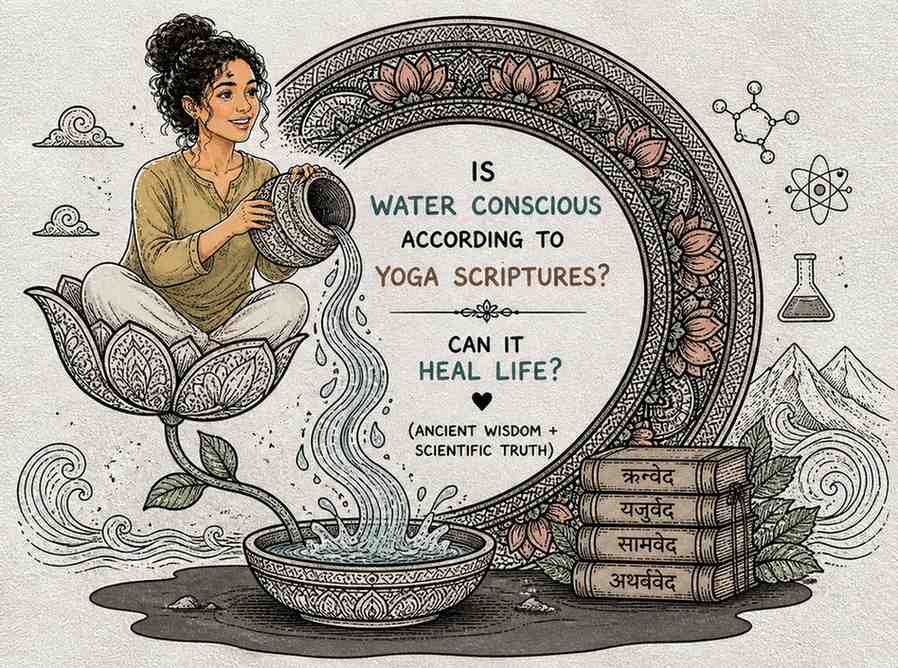
Is water conscious or just a myth? Explore ancient yogic scriptures like the Bhagavad Gita and Yoga Sutras of Patanjali along with modern science to understand water, consciousness, and how it impacts your life.,
Introduction: A Question That Blurs the Line Between Science and Spirituality
You drink water every single day but have you ever stopped to question what it really is?
Not just a liquid.
Not just hydration.
But something deeper.
What if the water inside your body is constantly reflecting your state of mind?
What if your stress, your emotions, and your awareness are silently shaping your internal world?
For years, people have claimed that water can “store memory” or “respond to energy.” Others call it complete nonsense.
So what’s the truth?
Ancient yogic texts like the Hatha Yoga Pradipika, Yoga Sutras of Patanjali, and Bhagavad Gita never made exaggerated claims but they did reveal something far more powerful.
Not that water is conscious but that you are, and your internal state shapes everything within you.
This article will challenge common myths, uncover what ancient wisdom actually says, connect it with modern science, and show how a simple element like water can become a doorway to deeper awareness and a more balanced life.
The History of Water in Ancient Yogic Thought
In ancient yogic philosophy, water was never seen as just a physical substance. It was understood as a fundamental element of existence, essential not only for survival but for maintaining balance within the body and the universe.
This understanding comes from the concept of the Pancha Mahabhuta (Five Great Elements), a foundational principle described across Indian philosophical systems and reflected in texts like the Bhagavad Gita.
The Five Elements (Pancha Mahabhuta)
According to this framework, all of creation including the human body is composed of five primary elements:
- Prithvi (Earth) → structure, stability, and physical form
- Jala (Water) → fluidity, cohesion, and nourishment
- Agni (Fire) → transformation, digestion, and energy
- Vayu (Air) → movement and circulation
- Akasha (Space) → expansion and connection
These elements are not just symbolic ideas but represent observable qualities in both nature and the human body.
Water (Jala) represents:
- Flow
- Adaptability
- Emotion
- Life sustenance
According to yogic teachings:
The human body itself is a composition of these elements.
Water (Jala) as a Principle of Life
Within this system, water (Jala) holds a central role because it enables life to exist and function.
Ancient yogic and Ayurvedic teachings associate water with:
- Fluidity → allowing movement within bodily systems
- Cohesion → binding cells and tissues together
- Adaptability → responding to internal and external changes
- Emotional association → often linked symbolically to the fluid nature of human emotions
However, it is important to understand that these associations are functional and observational, not claims of consciousness.
This is where ancient insight and modern science meet.
The Human Body as a Reflection of Nature
A key principle in yogic philosophy is that the human body is a microcosm of the universe.
This means:
– The same five elements that exist in nature also exist within us.
From a modern scientific perspective:
- The human body is approximately 70% water in adults
- Water is essential for circulation, cellular function, and temperature regulation
While ancient texts did not express this in numerical terms, they clearly recognized that:
Life is sustained through a dynamic balance of internal elements, with water playing a vital role.
Important Clarification
Ancient yogic scriptures:
- Do not describe water as conscious
- Do not claim that water has thoughts or awareness
Instead, they present water as a supportive, life-sustaining element that responds to the overall state of the system it exists in.
The true significance of water in yogic philosophy lies not in mystical claims, but in this simple understanding:
Life depends on balance, flow, and adaptability and water is central to all three.
What Is Consciousness? (Before Talking About Water)
Let’s define this clearly.
Consciousness means:
- Awareness → the fundamental ability to know that you exist
- Ability to observe → noticing thoughts, sensations, and surroundings without being them
- Ability to experience → directly perceiving life through senses and inner states
In both yogic philosophy and modern discussions, consciousness is not considered a physical object. It is not something you can see, touch, or measure directly it is the subject that experiences everything.
According to Yoga Sutras of Patanjali:
A foundational idea expressed in the text is:
The true self is the drashta (the seer or observer), while the mind and world are what is observed.
This means:
- You are not your thoughts
- You are not your emotions
- You are not even your body
You are the awareness that observes all of these
What Yoga Teaches About Mind and Awareness
Yoga clearly distinguishes between:
1. The Mind (Chitta)
- Constantly changing
- Filled with thoughts, emotions, memories, and reactions
- Influenced by external and internal experiences
2. Consciousness (Purusha or the Seer)
- Unchanging
- Silent observer
- Not affected by fluctuations
This idea is central to yoga philosophy:
Thoughts arise, change, and disappear but the awareness observing them remains constant.
Why Water Is Used as a Metaphor in Yoga
This is where most people get confused.
In yoga, water is often used symbolically not to suggest that it is conscious, but to help explain the nature of the mind and awareness in a simple, observable way.
In yoga, water is often used symbolically.
Example from yogic teaching:
A common analogy used in yogic philosophy is:
- Mind = water (like a lake or river)
- Thoughts = waves or ripples on the surface
This comparison is widely used in interpretations of the Yoga Sutras of Patanjali, especially when explaining the concept of chitta vritti (fluctuations of the mind).
Understanding the Analogy
When water is:
- Disturbed → the surface becomes unstable, constantly moving
- Reflection appears broken or unclear
- Objects cannot be seen accurately
- Still → the surface becomes calm and steady
- Reflection becomes clear and undistorted
- Reality can be seen as it is
This idea is deeply explained in yogic philosophy and commentary traditions.
As described using the lake metaphor:
Only when the water becomes still can truth be seen clearly
Philosophical Meaning
In yogic philosophy, this analogy represents the state of the mind:
- A disturbed mind (filled with thoughts, distractions, emotions)
→ cannot perceive reality clearly - A calm and steady mind
→ allows true perception and deeper awareness
This directly relates to the core teaching of yoga:
When the fluctuations of the mind are stilled, the observer rests in its true nature.
Important Clarification
The purpose of this metaphor is not to claim that water has consciousness.
Instead, it is used because:
- Water naturally demonstrates movement and stillness
- It visibly reflects changes in state
- It provides a simple way to understand an otherwise abstract concept
Scientific Understanding of Water and the Human Body
Let’s move to real science.
1. Water as a Biological Medium
Modern biology clearly establishes that water is not just important it is fundamental to life at every level.
Research shows that:
- Water is essential for cellular function
Every cell in the body relies on water to maintain its structure, shape, and internal balance. It acts as the medium in which cellular components interact and function. - It influences metabolism and nutrient transport
Water dissolves nutrients, minerals, and gases, allowing them to be transported through blood and intracellular fluids. It is directly involved in metabolic reactions, including energy production. - It forms the environment where biological processes occur
Most biochemical reactions in the body happen in aqueous (water-based) environments. Without water, processes like enzyme activity, protein folding, and cellular communication cannot function properly. - It helps regulate temperature and maintain homeostasis
Through sweating and circulation, water plays a key role in stabilizing body temperature and maintaining internal balance.
Advanced Understanding
Recent scientific research in cell biology suggests that:
- Water near cellular structures (such as proteins and membranes) behaves differently from bulk water
- It can form organized layers that influence biochemical interactions
This does not mean water has consciousness, but it highlights that water is a dynamic and responsive medium within biological systems
2. Mind–Body Interaction (Proven Science)
Modern science strongly supports the connection between mental states and physical health.
Research in neuroscience and physiology shows:
- Stress increases cortisol and disrupts hormonal balance
This can affect digestion, immunity, hydration, and overall cellular function - Chronic stress can alter fluid balance and bodily regulation
It impacts circulation, electrolyte balance, and even cellular hydration levels - Calmness and relaxation improve regulation
When the nervous system shifts into a relaxed state, the body functions more efficiently improving digestion, circulation, and internal stability
Connecting This to Water
Since the human body is largely composed of water:
Changes in mental and emotional states influence the internal environment, including fluid systems like blood, lymph, and intracellular water
This means:
- Water itself is not “responding consciously”
- But the system it exists in is being regulated by your state of mind
3. The Truth About “Water Memory”
You may have heard popular claims such as:
- Water can remember emotions
- Water changes structure based on thoughts or words
- Water can store information beyond physical interaction
Scientific Reality
They are widely considered controversial or unverified within the scientific community
There is no strong, reproducible scientific evidence supporting these claims
Many such experiments lack proper controls and cannot be consistently replicated
Science does not support the idea that water has memory or consciousness.
But it clearly shows that:
Water is a critical, responsive medium within a living system and that system is influenced by your mental and physiological state.
What Ancient Scriptures DO Say About Water
Ancient yogic and philosophical texts do speak about water but in a very specific and grounded way. They do not describe it as a conscious entity, but they do recognize its essential role in life, balance, and inner experience.
Key references include:
Water as a Fundamental Element of Life
Across yogic and Vedic traditions, water (Jala) is considered one of the Pancha Mahabhuta (five elements) that form all creation.
It is understood as:
- A life-sustaining element → essential for maintaining the body and supporting all biological processes
- A principle of cohesion → helping bind and hold structures together within the body
- A medium of nourishment → enabling the transport of nutrients and maintaining vitality
While these texts do not use modern biological language, they clearly recognize that:
Without balance in internal elements especially without water life cannot be sustained.
Water as a Symbol of Purification
In many traditional practices, water is associated with cleansing and purification.
This is not only physical but also symbolic:
- Washing the body → physical cleansing
- Ritual use of water → mental and emotional reset
- Association with purity → removal of disturbances or impurities
In yogic philosophy, purification (shuddhi) is a key step toward clarity and awareness. Water becomes a tool and symbol for this process, not a mystical force acting on its own.
Water as Flow and Adaptability
Water is often used to represent qualities that are essential for balanced living:
- Flow → the ability to move without resistance
- Adaptability → adjusting to circumstances without breaking
- Continuity → sustaining life through constant movement and renewal
These qualities are not attributed as consciousness, but as observed characteristics of nature that humans are encouraged to embody.
Connection with Emotions (Svadhisthana Chakra)
In yogic and tantric systems, water is associated with the Svadhisthana chakra the energy center linked to:
- Emotions
- Creativity
- Sensitivity
- Relationships
This association reflects an important observation:
Emotions, like water, are fluid and constantly changing
However, this does not mean water itself “contains” emotions.
It means:
The nature of emotions can be understood through the qualities of water.
What Ancient Scriptures DO NOT Say
This is where clarity becomes essential because most confusion around water and consciousness does not come from ancient wisdom, but from how it is misunderstood today.
When you carefully look into texts like the Hatha Yoga Pradipika, the Yoga Sutras of Patanjali, and the Bhagavad Gita, you begin to notice something very important: they are incredibly precise in what they say and equally precise in what they do not say.
- They do not describe water as a conscious entity.
- They do not suggest that water can think, feel, or respond with awareness.
- They do not claim that water stores emotions or memories like a human mind.
And this matters.
Because in today’s world, it is easy to be drawn toward ideas that feel mystical or comforting the thought that even something as simple as water might “understand” us, respond to us, or carry our emotions. But ancient yogic knowledge was never built on comfort; it was built on clarity and direct observation.
In these teachings, consciousness is always associated with the seer the one who is aware, who observes thoughts, emotions, and experiences. Water, like all physical elements, belongs to the observed world. It supports life, it sustains the body, it reflects balance but it does not possess awareness of its own.
The idea that water holds memory or responds to human intention is a modern interpretation, not a classical teaching. While such ideas may inspire curiosity, they can also blur the line between genuine understanding and assumption if not approached carefully.
What ancient wisdom offers instead is something far more empowering.
It tells you that the power does not lie in the element, it lies in your awareness of it.
Water does not need to be conscious to be meaningful. Its role is already profound it sustains your body, supports every function, and reflects the state of the system it exists in. But the responsibility of transformation, of healing, of clarity that has always belonged to you.
And perhaps that truth is less magical, but far more real.
Because once you understand this distinction, you stop searching for power outside and begin to recognize it within.
So Can Water Heal Life?
Not directly – and it is important to be honest about this from the beginning. Water does not heal your life in a magical or conscious way. Neither ancient yogic scriptures nor modern scientific consensus support the idea that water independently thinks, feels, or heals through intention. However, stopping at that conclusion would miss a deeper and far more meaningful truth. Water may not heal you on its own, but it plays an absolutely essential role in the system that allows healing to happen.
From a scientific perspective, water is fundamental to human physiology. It maintains internal balance (homeostasis), regulates body temperature, supports detoxification through kidneys and sweat, and acts as the medium for almost every biochemical reaction in the body. Without adequate hydration, cells cannot function properly, nutrients cannot be transported efficiently, and waste cannot be eliminated effectively. In simple terms, water does not “heal” you but without it, your body loses its ability to heal itself.
Over the years, several scientists and researchers have explored deeper properties of water, sometimes leading to controversial or misunderstood conclusions. For example, Masaru Emoto proposed that water could respond to words, music, and human intention by forming different crystal structures. While visually compelling, his work has been widely criticized for lacking controlled, reproducible scientific methods. Similarly, Luc Montagnier conducted experiments suggesting that water might retain electromagnetic signals of biological molecules, but these findings remain controversial and are not accepted as established science. On the other hand, Gerald Pollack introduced the concept of “structured water” (also called the fourth phase of water), showing that water near cellular surfaces behaves in an organized way that can influence biological activity. While this does not imply consciousness, it does highlight that water is more dynamic than previously assumed.
What all of this points toward is not that water is conscious, but that it is a highly responsive and essential medium within a living system. And that system of your body is deeply influenced by your mental and emotional state. Modern science strongly supports the mind-body connection: stress increases cortisol, disrupts hormonal balance, and negatively impacts digestion, immunity, and cellular function. Calmness, on the other hand, improves regulation, recovery, and overall physiological stability. Since the human body is largely composed of water, these changes naturally affect the internal environment in which water exists.
So the real answer is not that water heals life, but that water supports the body that heals itself. And the efficiency of that healing system depends greatly on your awareness, your habits, and your internal state. In this way, both science and ancient wisdom subtly align and not in claiming that water is conscious, but in showing that your consciousness influences the system sustained by water.
The Real Connection: Consciousness → Body → Water
To understand the real relationship between consciousness and water, we need to move away from mystical assumptions and look at a clear, cause-and-effect chain that both ancient wisdom and modern science support. Your thoughts are not just abstract ideas; they have measurable effects on your body. When you experience stress, anxiety, or overthinking, your brain activates the nervous system specifically the sympathetic nervous system, often called the “fight or flight” response. This activation triggers the release of stress hormones like cortisol and adrenaline. These hormones then begin to influence multiple systems in the body, including heart rate, digestion, immune response, and even fluid balance. On the other hand, when you are calm, aware, and mentally stable, the parasympathetic nervous system (the “rest and digest” state) becomes active, promoting recovery, balance, and efficient functioning.
Now, this is where water comes into the picture. The human body is largely composed of water, and all these physiological processes circulation, cellular communication, nutrient transport, and waste removal take place in fluid environments. Hormonal changes directly impact these fluid systems. For example, stress can lead to dehydration patterns, reduced digestion efficiency, and imbalanced electrolyte levels, while a calm state supports proper hydration, smoother circulation, and better cellular function. So while water itself is not conscious and does not independently respond to your thoughts, it exists within a biological system that is constantly being shaped by your mental and emotional state.
In simple terms, your awareness influences your thoughts, your thoughts influence your nervous system, your nervous system regulates hormones, and those hormones affect the internal environment of your body including its water systems. This creates a subtle but powerful chain of influence. Ancient yogic teachings emphasized this connection through the idea that inner balance leads to outer harmony, while modern science explains it through neurobiology and physiology. Both point toward the same truth: the quality of your internal state determines how efficiently your body functions.
So the real connection is not mystical, but deeply practical. Water does not change because it is conscious; it reflects the condition of the system it supports. And that system is directly influenced by how aware, calm, and balanced you are.
Daily Practices (Real, Not Myth-Based)
If water is not conscious, then the real question becomes: what should you actually do to experience balance and improvement in your life? The answer lies not in changing water, but in changing the way you engage with your body and mind. Ancient yogic wisdom and modern science both point toward simple, consistent practices that influence your internal system in a meaningful way.
One of the most overlooked habits is mindful hydration. Most people drink water unconsciously while scrolling, rushing, or multitasking. Instead, try slowing down. Drink water with awareness, noticing the act itself. This small shift activates the parasympathetic nervous system (the body’s relaxation response), allowing better absorption and internal balance. It is not that water changes but your body becomes more receptive.
Another powerful yet simple practice is to pause and breathe before drinking water. Taking two or three slow, deep breaths helps transition your body from a stressed state to a calm one. Scientifically, this reduces cortisol levels and stabilizes your nervous system. When your body is relaxed, processes like digestion, hydration, and circulation function more efficiently.
Beyond physical habits, there is also a deeper lesson to take from water: flow. Water naturally adapts, moves, and adjusts without resistance. Applying this principle to life means learning to let go of unnecessary tension whether in emotions, decisions, or daily routines. Instead of resisting situations, you begin to respond with flexibility. This reduces mental friction and supports overall well-being.
At the core of all yogic practices lies one essential principle calming the mind. As taught in the Yoga Sutras of Patanjali, when mental fluctuations settle, awareness becomes clear. This is not just a philosophical idea; it has practical implications. A calm mind leads to a regulated nervous system, balanced hormones, and improved bodily function. This is where real transformation begins not from external elements, but from internal clarity.
Finally, aligning with natural rhythms plays a crucial role. Simple habits like drinking water in the morning, maintaining consistent hydration throughout the day, and staying connected with natural cycles such as sunlight and rest help stabilize the body’s internal systems. These practices may seem basic, but their impact is cumulative and profound.
In essence, these daily actions are not about controlling water or expecting it to change your life. They are about creating the right internal conditions for your body and mind to function optimally. When practiced consistently, they bring a sense of balance, clarity, and ease grounded not in myth, but in awareness and experience.
– Mindful Hydration
Instead of:
- Drinking randomly
Try:
- Drinking slowly
- Being present
– Breath Before Water
Take 3 deep breaths before drinking water
This shifts body into relaxation mode
– Build Flow in Life
Water teaches:
- Adaptability
- Letting go
- Movement
Apply this in:
- emotions
- decisions
- daily habits
– Calm the Mind (Core Practice)
From Yoga Sutras of Patanjali:
When mental fluctuations stop, awareness becomes clear
This is the real transformation
– Align with Natural Rhythms
- Drink water in the morning
- Maintain proper hydration
- Stay connected with nature
Common Myths You Should Avoid
- Water is conscious
- Water remembers your thoughts
- Water alone can transform your life
Truth:
- Water is essential
- Water is responsive
- But transformation comes from your awareness
Final Understanding (The Real Answer)
To bring everything together with clarity, the answer is simpler than it first appears. Water is not conscious neither modern science nor authentic yogic philosophy suggests that it has awareness, thoughts, or the ability to feel. In teachings like the Yoga Sutras of Patanjali, consciousness is always described as the observer the one who experiences while physical elements like water belong to the observed world. Similarly, water does not heal life in a direct or magical way. It does not carry intention, intelligence, or independent healing power. However, this does not make it insignificant. In fact, its importance lies in something much deeper and more practical.
Water is the foundation of the biological system you live in. Every function of your body circulation, digestion, cellular activity, temperature regulation, and detoxification depends on it. It creates the environment in which life processes occur. But what truly shapes how well this system functions is not the water itself it is your internal state. Your thoughts influence your nervous system, your nervous system regulates hormones, and those hormones affect how your body operates, including its fluid balance. In this way, water becomes a medium that reflects the condition of the system it supports.
So the real insight is not about water being conscious, but about recognizing that you are. Your awareness, your habits, your mental state all of these influence the body that water sustains. When you are stressed, your system becomes imbalanced; when you are calm and aware, your body functions more efficiently. Water does not change your life on its own but it supports the system through which your life changes. And that system is you.
Water reflects the system it exists in and you are that system.
Final Line
Water is not conscious but it reflects everything and since your body is mostly water, your life becomes a reflection of your inner state.