Understand Yoga Sutra 1.7 in depth. Learn pratyaksha, anumana, and agama as valid knowledge and how they shape clarity in meditation and daily life.
The Sutra (Original)
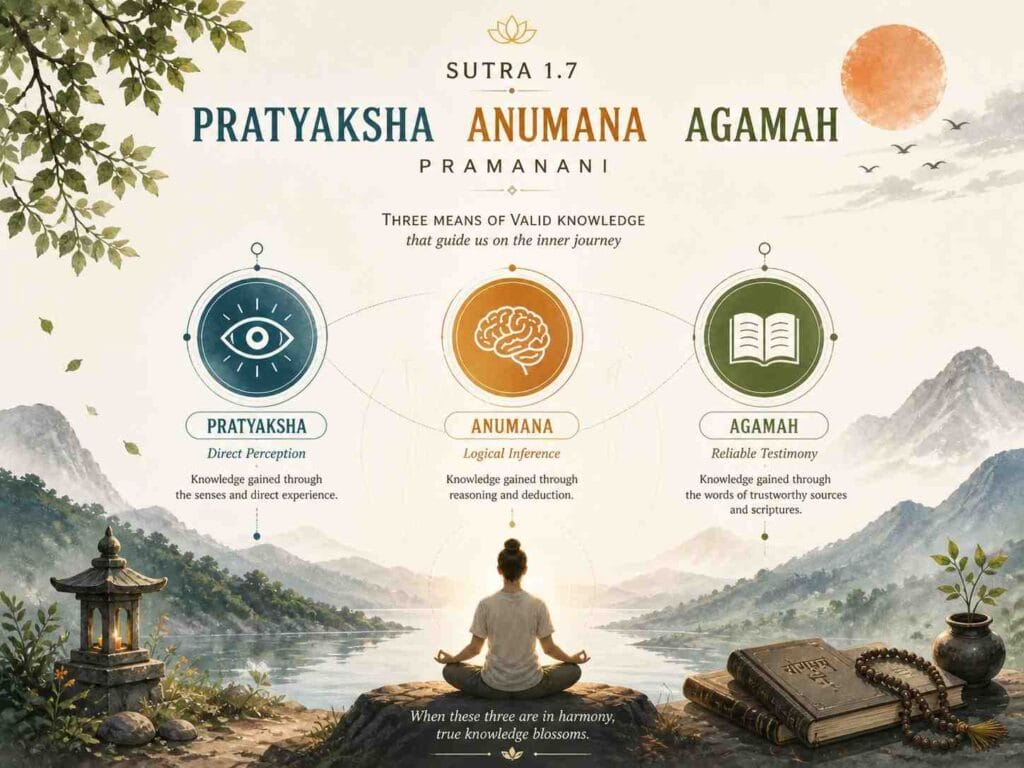
प्रत्यक्षानुमानागमाः प्रमाणानि
Translation
“Valid means of knowledge (pramāṇa) are direct perception (pratyakṣa), inference (anumāna), and authoritative testimony (āgama).”
Introduction
In the Yoga Sutras of Patanjali, Sutra 1.7 follows a precise progression. In Sutra 1.6, Patañjali identifies the five categories of mental modifications (vṛttis). With that classification established, he now moves into detail, beginning with one specific type: pramāṇa, or valid cognition. This shift is important. The text is no longer speaking in general terms about the mind. It is beginning to differentiate the quality of mental activity.
At first glance, this may appear philosophical, as though it belongs to abstract theory. But within the structure of the Yoga Sutras, it serves a practical function. Yoga is defined as the stilling of mental fluctuations. But before stillness is possible, the nature of those fluctuations must be understood. Without this understanding, all thoughts appear similar.
There is no distinction between: what is accurate? what is distorted? what is imagined? This lack of distinction creates confusion. Sutra 1.7 addresses this directly. It clarifies that not all mental activity is problematic in the same way. Some thoughts reflect reality accurately. These are not errors, they are functional and necessary.
However, even these accurate movements are still movements. They belong to the activity of the mind. This is the key point. The sutra does not reject knowledge. It places it in context.
What Is Pramāṇa?
Pramāṇa refers to valid cognition, knowledge that corresponds to what is actually present. It is the aspect of the mind that allows correct understanding. In everyday life, this function is essential. It enables: recognition of objects as they are, understanding of cause and effect, decision-making based on observation and reasoning. Without pramāṇa, even basic functioning would become unreliable. One would not be able to distinguish between accurate perception and error.
In this sense, pramāṇa is stabilizing. It brings order to experience. However, within the framework of yoga, pramāṇa is still categorized as a vṛtti. This means it is still a modification of the mind. Even when knowledge is correct, it is still a movement, an activity that arises, operates, and subsides. This introduces an important distinction.
There is a difference between:
- using knowledge for practical functioning
- identifying with knowledge as the self
Pramāṇa is necessary for the first. But yoga ultimately moves beyond the second. The goal is not to eliminate knowledge in daily life, but to recognize that even accurate knowledge is not the final state of awareness. It is functional, but not foundational. It serves clarity, but it is not the source of it.
The Three Sources of Valid Knowledge
In Sutra 1.7 of the Yoga Sutras of Patanjali, Patañjali does not leave pramāṇa undefined. He specifies three distinct ways through which valid knowledge arises. This distinction is subtle, but essential. It shows that knowing is not a single process. It occurs through different pathways, and each has its own strengths and limitations.
Understanding these pathways brings precision to observation.
1. Pratyakṣa – Direct Perception
Pratyakṣa refers to immediate knowledge through direct contact. It is the most direct form of knowing, when the senses meet an object and a clear perception arises.
Examples include:
- seeing a shape or color
- hearing a sound
- feeling temperature or texture
Because it is immediate, pratyakṣa appears the most reliable. However, it is not infallible.
Perception depends on several factors:
- the clarity of the senses
- the condition of attention
- the absence of distortion or interference
If the senses are limited, or the mind is distracted or conditioned, perception can become inaccurate.
For example:
- dim light may distort what is seen
- prior expectation may influence interpretation
- emotional states may alter perception
This shows that even direct perception is not purely objective. It is influenced by the condition of the observer. Therefore, pratyakṣa becomes reliable only when supported by awareness. It is direct, but it must still be seen clearly.
2. Anumāna – Inference
Anumāna refers to knowledge derived through reasoning. It extends beyond what is immediately perceived. The mind observes something and connects it to prior understanding.
For example:
- seeing smoke and concluding there is fire
- observing repeated patterns and forming conclusions
Inference allows the mind to operate beyond the limits of direct perception. It is essential for understanding relationships, patterns, and causation. However, its validity depends on the accuracy of its foundation. If the initial observation is incomplete, or the reasoning is flawed, the conclusion becomes unreliable.
For instance:
- misinterpreting a sign leads to incorrect conclusions
- assumptions taken as facts distort reasoning
Anumāna, therefore, is powerful but conditional.
It is valid only when:
- observation is accurate
- reasoning is consistent
- conclusions follow logically
Without these, inference easily turns into assumption.
3. Āgama – Authoritative Testimony
Āgama refers to knowledge received from a reliable source.
This includes:
- teachings from those with direct understanding
- scriptural knowledge
- transmitted wisdom within a tradition
In the context of yoga, this often refers to knowledge that cannot be directly perceived or logically inferred by the practitioner at their current stage.
For example:
- deeper states of meditation
- subtler aspects of mind and consciousness
Āgama provides direction where direct experience is not yet available. However, not all received knowledge qualifies as pramāṇa.
For testimony to be valid, the source must be:
- reliable
- consistent
- grounded in direct realization, not speculation
If the source lacks these qualities, the knowledge becomes uncertain. Therefore, āgama is not blind acceptance. It is informed trust, supported by consistency and verified over time through experience.
Why This Sutra Matters
Sutra 1.7 is not merely a classification of knowledge. It refines how the mind is observed. In daily experience, thoughts arise continuously. Some reflect reality accurately. Others are distorted, imagined, or influenced by memory. Without clarity, all of these appear similar.
There is no distinction between:
- direct perception
- inference
- imagination
- memory
This creates confusion. A thought is taken as fact simply because it appears. By understanding pramāṇa, a shift occurs.
One begins to recognize:
- what is directly perceived
- what is concluded through reasoning
- what is received from others
This recognition introduces discrimination. The mind is no longer experienced as a single stream, but as a set of identifiable movements. This reduces misinterpretation.
It prevents:
- confusing assumption with perception
- treating imagination as reality
- relying on unreliable sources
Over time, this clarity changes the relationship with thought. Instead of reacting automatically, one begins to observe with precision. And in that precision, the mind becomes less confused, and more available for stillness.
The Role in Practice
In the context of meditation and self-observation, Sutra 1.7 of the Yoga Sutras of Patanjali moves from theory into direct application. The teaching is not meant to remain conceptual. It is meant to be used. During practice, thoughts continue to arise. The aim is not to stop them immediately, but to understand their nature as they appear. At this point, the classification of pramāṇa becomes a practical tool.
When a thought arises, attention can shift from the content of the thought to its source:
- Is this something directly perceived?
- Is this a conclusion drawn from observation?
- Is this based on something previously learned or accepted?
This shift changes the way thought is experienced. Instead of being absorbed in the thought, one begins to observe it. Instead of reacting, one begins to recognize. This recognition introduces a subtle but important separation. The thought is seen. It is no longer automatically followed. This creates distance. And where there is distance, identification weakens. The mind may continue to produce movement, but it is no longer completely compelling. This is the beginning of clarity in practice.
A Deeper Insight
An important refinement introduced by this sutra is that even pramāṇa, valid knowledge, is still a vṛtti. It is still movement. This has significant implications. In ordinary understanding, the aim might appear to be replacing incorrect thoughts with correct ones. But the definition of yoga given earlier is more fundamental:
Yoga is the stilling of all mental modifications. Not only the inaccurate ones. This means that even correct knowledge is not the final state. It is necessary for functioning. It brings clarity. But it is still part of the activity of the mind. In practice, this leads to a different orientation. Knowledge is used where needed. But it is not held onto unnecessarily. There is no attempt to build identity around it. There is no dependence on it for stability.
Over time, even accurate knowledge is seen as something that arises and subsides. What remains is not the content of knowledge, but the awareness in which it appears.
Connection to Daily Life
The three forms of pramāṇa are not limited to formal practice. They operate continuously in daily experience.
At any moment:
- something is perceived directly
- something is interpreted through reasoning
- something is understood based on prior knowledge
These processes are constant. However, confusion arises when they are not distinguished.
For example:
- a conclusion (inference) may be taken as direct perception
- a learned belief may be treated as immediate reality
- imagination may be mistaken for fact
When these are mixed, the mind loses clarity. Reactions become based on assumptions rather than observation. This leads to unnecessary mental activity. Understanding this sutra introduces discrimination into everyday experience.
One begins to pause and recognize:
- what is actually seen
- what is being assumed
- what is being recalled or accepted
This reduces confusion. It also reduces reactivity. Because when the source of a thought is understood, its influence changes.
Conclusion
Sutra 1.7 of the Yoga Sutras of Patanjali defines three sources of valid knowledge:
- direct perception (pratyakṣa)
- inference (anumāna)
- authoritative testimony (āgama)
This classification is not abstract. It serves as a practical framework for observing the mind. By recognizing how knowledge arises, the practitioner begins to see thought more clearly: not as a single, continuous stream, but as distinct processes. This clarity reduces confusion. It weakens automatic identification.
And as identification reduces, the mind becomes less occupied. From this, stillness does not need to be forced. It begins to emerge naturally, supported by understanding.