Learn how to prepare your body for Padmasana safely. Discover proper steps, alignment, benefits, and mistakes to achieve a stable Lotus Pose
Introduction
Padmāsana, or Lotus Pose, is often seen as a defining image of yoga: calm, centered, and effortless. Yet in classical sources like the Hatha Yoga Pradipika, its purpose is not aesthetic or performative. It is functional. The posture is described as a seat for stillness. This distinction matters.
In modern practice, there is often an emphasis on achieving the final shape of a posture. In the classical approach, the emphasis is on whether the posture can be maintained without disturbance. Padmāsana appears simple when observed externally. The legs are crossed, the spine is upright, and the body seems relaxed. But this simplicity is the result of preparation, not the starting point.
Without preparation:
- the hips resist rotation
- the knees absorb unwanted pressure
- the spine struggles to remain upright
This creates strain rather than stability.
With preparation:
- the hips open gradually
- the knees remain safe and neutral
- the spine aligns naturally
The posture then becomes sustainable. This is why Padmāsana is not approached as something to “achieve” quickly. It is approached as something the body grows into. The transition is gradual. The effort reduces over time. And eventually, the posture becomes less of an effort and more of a condition.
Meaning and Significance
The term Padmāsana combines two elements:
- Padma – lotus
- Āsana – posture
The lotus holds a specific place in yogic symbolism. It grows in water, often in conditions that are unstable or unclear, yet it remains unaffected by them. This reflects a quality that is central to yoga: stability amidst change. The posture mirrors this principle. Externally, the body is placed in a fixed and balanced position. Internally, the aim is to develop a similar steadiness, where changing thoughts, sensations, or external conditions do not immediately disturb the mind.
However, this is not achieved through symbolism alone. The structure of the posture supports this outcome.
When the body is stable:
- unnecessary movement reduces
- physical distraction decreases
- attention becomes less fragmented
This creates the possibility for the mind to settle. Padmāsana, therefore, is not symbolic in isolation. It is practical. It establishes the physical conditions required for mental steadiness.
Understanding the Structure of the Pose
Padmāsana is fundamentally a hip-driven posture. This is one of the most important aspects to understand, especially for safe practice. The placement of the feet on the thighs requires external rotation at the hip joint. This rotation must occur at the hip, not at the knee. The knees are designed primarily for flexion and extension, not for rotation.
When the hips are not sufficiently open, the body compensates by forcing rotation at the knees. This creates stress and increases the risk of injury. This is why the posture cannot be approached by forcing the legs into position.
The structure involves several coordinated elements:
- External rotation of the hips – allows the thighs to open outward
- Controlled flexion of the knees – occurs without twisting or strain
- Neutral positioning of the pelvis – supports the spine
- Upright alignment of the spine – reduces muscular effort
- Relaxed but stable shoulders – prevent upper-body tension
Each of these contributes to overall stability. If one element is missing, the posture becomes unstable.
For example:
- tight hips → strain shifts to knees
- unstable pelvis → spine collapses
- tense shoulders → breathing becomes restricted
This is why preparation focuses primarily on the hips. The hips determine whether the posture can be entered safely.
When the hips are adequately prepared:
- the knees follow naturally
- the pelvis stabilizes
- the spine aligns with less effort
The posture then becomes integrated rather than forced.
In this way, understanding the structure changes the approach. Instead of trying to “place the legs,” the focus shifts to preparing the system that allows the posture to arise correctly.
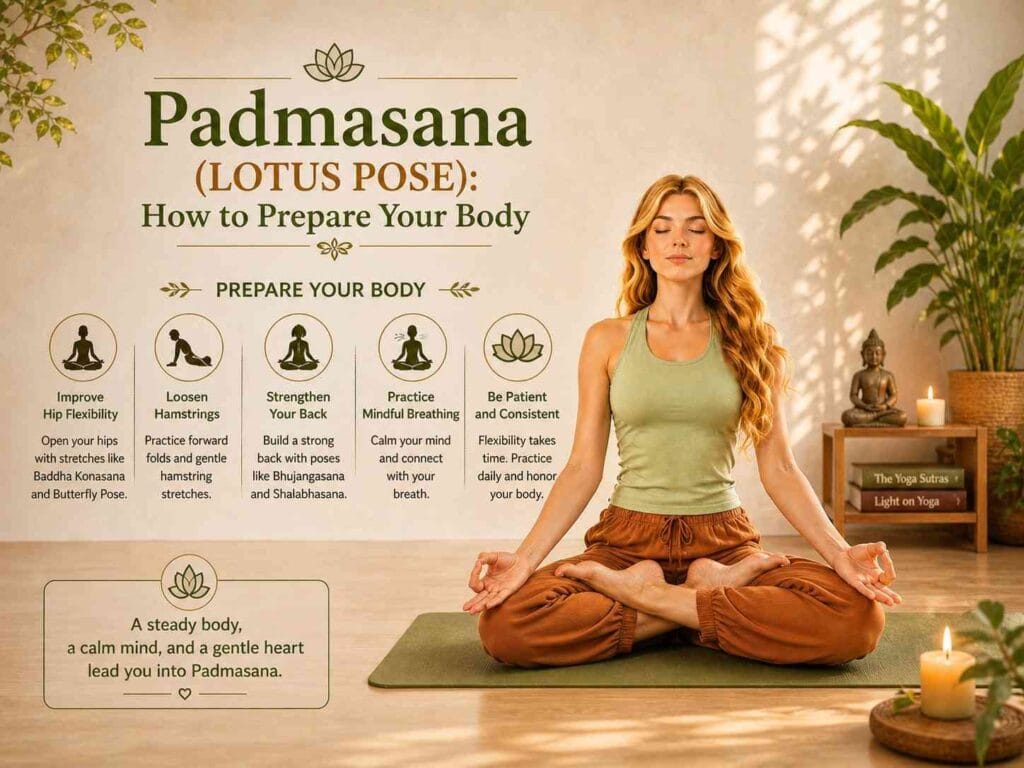
How to Prepare the Body for Padmāsana
Preparation for Padmāsana is not a separate stage, it is the practice. In the approach reflected in the Hatha Yoga Pradipika, the body is gradually conditioned so the posture arises without strain, not forced into position.
The focus is simple: develop what the posture actually requires.
- Hip mobility → allows safe external rotation
- Pelvic stability → supports the spine
- Ease in the knees → prevents compensation
- Spinal alignment → reduces effort while sitting
When these are present, Padmāsana becomes natural rather than imposed.
Key Areas to Prepare
Hip External Rotation
The posture begins at the hips. When the hips open gradually, the knees remain protected and the legs settle into place without force.
Hamstring Flexibility
Tight hamstrings tilt the pelvis backward and collapse the spine. Gentle lengthening helps the body sit upright with less effort.
Ankle Mobility
Flexible ankles reduce pressure when the feet rest on the thighs, making the posture more comfortable.
Pelvic Stability
A stable pelvis creates the base for the entire posture. When this is steady, the spine aligns more easily.
Preparatory Postures
These are not alternatives, they are stages that build readiness:
- Sukhasana → develops basic sitting stability
- Ardha Padmāsana → introduces the structure gradually
- Baddha Koṇāsana → opens the hips
- Janu Śīrṣāsana → improves flexibility and alignment
Each contributes a specific element required for Padmāsana.
Method: How to Perform Padmāsana
1. Begin in a seated position
Sit on the floor with legs extended. Ensure the spine is upright.
2. Bend the right leg
Bring the right foot toward the left thigh. Place it gently on the thigh, sole facing upward.
3. Bend the left leg
Bring the left foot toward the right thigh and place it on top.
4. Adjust the posture
Both knees should move toward the ground without force. The spine remains upright.
5. Position the hands
Place the hands on the knees in a comfortable mudra or relaxed position.
6. Maintain the posture
Keep the body steady and the breath natural.
Important Alignment Points
Alignment in Padmāsana is not about achieving a visual ideal, it is about ensuring that the posture is structurally sound and sustainable. Each point protects the body while supporting stability.
Movement should come from the hips, not the knees
The defining movement of Padmāsana is external rotation at the hips. When this rotation is insufficient, the body compensates by twisting at the knees, which are not designed for that movement. This creates strain. Proper alignment ensures that the hips initiate and absorb the movement, allowing the knees to remain safe.
The spine should remain upright without stiffness
An upright spine allows the body to balance naturally. However, this uprightness should not be forced. Excess effort creates rigidity, which restricts breathing and increases fatigue. The aim is a spine that is aligned but relaxed, supported by the pelvis rather than held by tension.
The shoulders should stay relaxed
Tension in the shoulders often reflects unnecessary effort elsewhere. When the shoulders lift or tighten, it affects breathing and creates upper-body strain. Relaxed shoulders indicate that the posture is being supported efficiently from the base.
The posture should not create pain
Discomfort is a signal, not something to ignore. Pain, especially in the knees or hips, indicates that the body is being forced beyond its current capacity. In such cases, the posture is not yet appropriate and should be modified.
Benefits of Padmāsana
When practiced correctly and with preparation, Padmāsana supports both physical and mental stability.
Physical Stability
The crossed-leg structure creates a firm base, reducing unnecessary movement. This stability is essential for practices that require stillness.
Improved Posture
By encouraging an upright spine, the posture reduces strain during prolonged sitting and supports balanced alignment.
Enhanced Breathing
An open chest and aligned spine allow the breath to move more freely. This supports deeper, more natural breathing patterns.
Support for Meditation
Padmāsana minimizes physical distraction. When the body is steady, attention is less frequently interrupted, making it easier to remain focused.
Joint Awareness
The posture requires careful placement of the legs and hips, encouraging mindful movement and awareness of joint alignment.
Common Mistakes
Forcing the Knees
Pressing the knees downward to “complete” the posture is one of the most common errors. This shifts strain to the joints and increases risk of injury.
Ignoring Hip Limitation
Attempting Padmāsana without adequate hip mobility leads to compensation in the knees. The posture should adapt to the body, not the other way around.
Rounding the Spine
A collapsed spine reduces stability and restricts breathing. It also increases effort over time.
Holding Tension
Trying to “hold” the posture rigidly creates fatigue. The posture should be steady, but not tight.
Skipping Preparation
Entering Padmāsana without preparatory work often leads to discomfort and instability. Preparation is not optional, it is essential.
Precautions
Padmāsana should be approached with care in certain conditions.
Avoid or modify if there is:
- knee injury or sensitivity
- hip pain or restriction
- ankle discomfort
In such cases, postures like Half Lotus or simpler seated positions provide a safer alternative while still supporting stability.
Subtle Aspect of Practice
Padmāsana reflects a deeper principle of yoga: stability without force. The posture is not created by pushing the body into position. It develops as the body becomes ready. This shift, from forcing to allowing, is central.
When effort is excessive, tension increases.
When preparation is consistent, effort reduces.
The posture then becomes natural rather than imposed. This is not limited to the body. It reflects a broader approach to practice, where progress comes through understanding and consistency, not force.
Conclusion
Padmāsana is not simply a posture to achieve. It is a condition that develops over time. Its value lies not in appearance, but in function, how effectively it supports stability.
With proper preparation, the posture becomes:
- comfortable
- steady
- sustainable
And when the body is steady, the mind is given the possibility to settle. In this way, Padmāsana fulfills its purpose, not as a physical accomplishment, but as a foundation for deeper practice.