
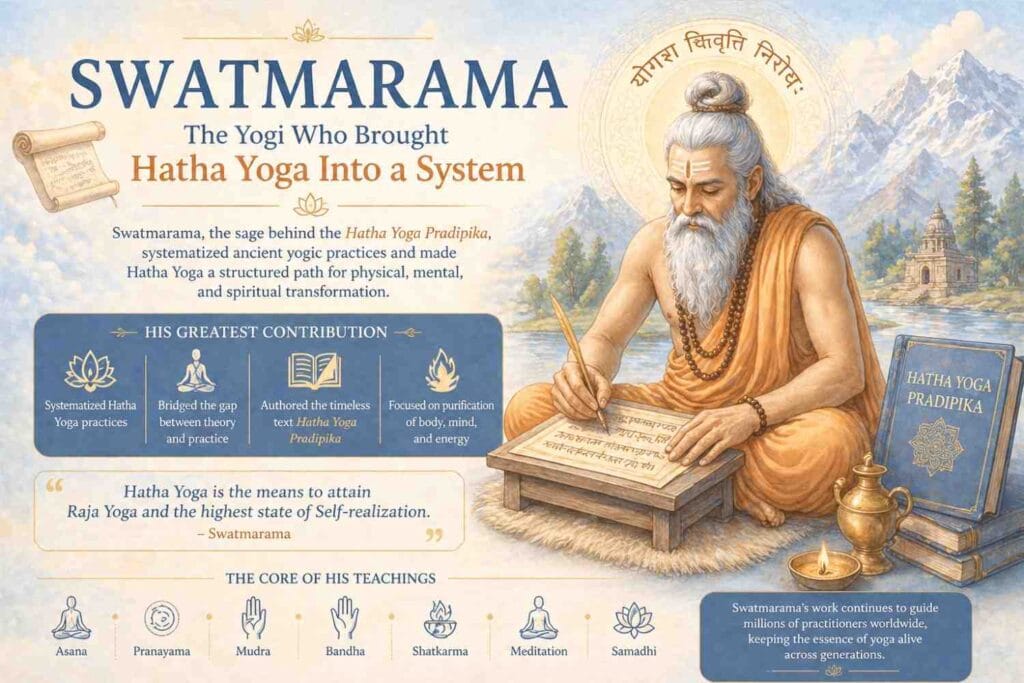
the life and teachings of Swatmarama, the author of the Hatha Yoga Pradipika, and understand how his work shaped the foundation of Hatha Yoga through body, breath, and energy practices.
Introduction
In the history of yoga, some names are widely recognized and frequently discussed, while others work quietly in the background, shaping entire traditions without ever becoming widely known.
Swatmarama belongs to the latter.
He is not a name that appears often in modern conversations around yoga. His story is not commonly told, and his identity remains relatively understated compared to more prominent figures. Yet, his contribution is foundational. Much of what is practiced and understood today as Hatha Yoga can be traced back to the system he presented.
To understand his importance, it is necessary to look at the context in which he lived.
Before Swatmarama, yogic knowledge did not exist as a single, organized system. It was spread across different traditions, passed down through lineages, and often transmitted orally from teacher to student. Practices related to posture, breath, and internal energy existed, but they were not always structured in a way that could be easily followed or understood by a wider audience.
Different schools emphasized different methods. Some focused on discipline of the body, others on control of breath, and others on meditative absorption. These teachings were powerful, but they were also fragmented.
This fragmentation created a gap.
There was no single text that brought together these practices into a clear and progressive path something that could guide a practitioner step by step from preparation to deeper states of awareness.
This is where Swatmarama’s contribution becomes significant.
Through the Hatha Yoga Pradipika, he brought together these scattered teachings and organized them into a coherent structure. His work did not aim to introduce something entirely new. Instead, it clarified what already existed, refined it, and presented it in a way that could be practiced systematically.
The title itself reflects this intention.
The word Pradipika means “to illuminate” or “to bring light.” It suggests that the purpose of the text is not to create, but to reveal to make visible what was already present but not clearly understood.
Swatmarama positioned Hatha Yoga not as a collection of isolated techniques, but as a complete process. A process that begins with the body, moves through the regulation of breath, works with internal energy, and ultimately leads toward stillness of the mind.
This approach brought clarity to a field that had previously been dispersed across traditions.
In doing so, Swatmarama did more than write a text.
He created a bridge.
A bridge between earlier yogic traditions and future practitioners.
A bridge between scattered knowledge and structured practice.
A bridge between physical discipline and inner transformation.
Today, when yoga is often reduced to movement or physical exercise, returning to the work of Swatmarama offers a different perspective.
It reminds us that yoga was never intended to be limited to the body.
It was designed as a systematic path one that uses the body and breath as tools, but ultimately aims at stability of the mind and clarity of awareness.
Understanding Swatmarama is not just about understanding a historical figure.
It is about understanding the foundation of a practice that continues to influence how yoga is approached even today.
The Historical Context: When Did Swatmarama Live?
Swatmarama is generally placed around the 15th century CE, during a time when Indian spiritual and yogic traditions had already developed over many centuries.
By this period:
- The Upanishads had established the idea of the Atman (inner self) and emphasized self-inquiry
- The Yoga Sutras of Patanjali had provided a structured understanding of the mind and its fluctuations
- Tantric and Nath traditions had developed practical methods involving the body, breath, and internal energy
This means that the knowledge of yoga already existed in depth.
However, it was not presented in a single, unified system.
The teachings were:
- Distributed across different traditions
- Often transmitted orally from teacher to student
- Focused on specific aspects rather than a complete path
Because of this, there was no clear, structured guide that connected:
- Physical practices
- Breath regulation
- Energy control
- Meditative states
into one progressive system.
This is the gap Swatmarama addressed.
Through the Hatha Yoga Pradipika, he brought together these existing teachings and organized them into a coherent and practical framework.
He did not introduce a new philosophy.
Instead, he compiled, structured, and clarified earlier Hatha Yoga practices, making them more accessible and systematic for practitioners.
His contribution lies in integration and organization,
turning scattered knowledge into a clear path that could be followed.
This is why his work remains important and it provides a bridge between earlier yogic traditions and a structured approach to practice.
The Nath Tradition: His Lineage
Swatmarama was part of the Nath yogic tradition, a lineage deeply rooted in experiential practice rather than theoretical philosophy.
This tradition traces back to yogis such as:
- Matsyendranath
- Gorakshanath
The Nath yogis focused on:
- Direct experience over intellectual debate
- Transformation of the body and energy system
- Awakening inner potential through disciplined practice
Swatmarama acknowledges this lineage in his work, making it clear that his teachings are not isolated, but part of a continuous transmission.
Not an Inventor, But a Compiler
One of the most important aspects of Swatmarama’s work is his role as a compiler and systematizer.
He did not claim originality in the modern sense.
Instead, he openly presented his work as a collection of teachings from earlier masters, refined and organized into a coherent structure.
This is significant.
Because it shows that Hatha Yoga was not created in a single moment and it evolved over time, and Swatmarama became the one who brought it into clarity.
The Meaning of “Hatha”
To understand Swatmarama’s work, it is important to understand the meaning of Hatha.
The word is often misunderstood as “forceful.”
But traditionally:
- “Ha” represents the sun (active energy)
- “Tha” represents the moon (passive energy)
Hatha Yoga, therefore, is about balancing these energies within the body.
This balance is not physical alone but it is energetic and mental.
The Creation of Hatha Yoga Pradipika
Swatmarama’s most important contribution is the Hatha Yoga Pradipika, a Sanskrit text that translates roughly to:
“The Light on Hatha Yoga.”
The intention of the text is clear:
To illuminate the path for practitioners.
The text is divided into four chapters, each representing a stage in practice:
1. Asana – Stability of the Body
Swatmarama does not present asana as a performance.
Instead, the focus is on:
- Stability
- Comfort
- Preparation for meditation
The body is seen as a foundation, not the goal.
2. Pranayama – Regulation of Breath
Breath becomes the central tool for transformation.
Swatmarama explains:
- Techniques of breath control
- The importance of purification
- The connection between breath and mind
The underlying principle:
When breath is steady, the mind becomes steady.
3. Mudras and Bandhas – Control of Energy
This is where Hatha Yoga becomes deeper.
The focus shifts to:
- Directing internal energy (prana)
- Awakening latent potential
- Preventing energy dissipation
These practices are subtle, powerful, and require discipline.
4. Samadhi – The State of Absorption
The final goal is not physical mastery.
It is stillness.
A state where:
- Mental fluctuations reduce
- Awareness becomes steady
- The practitioner experiences inner absorption
Hatha Yoga as a Preparation for Raja Yoga
Swatmarama clearly states that Hatha Yoga is not the final destination.
It is a preparatory path for higher states of meditation, often referred to as Raja Yoga.
This is a critical insight.
It means:
- Asana is not the goal
- Breath control is not the goal
- Even energy practices are not the goal
They are all steps leading to mental clarity and stillness.
What Makes Swatmarama’s Work Unique
To fully understand what makes Swatmarama’s work unique, it is important to step back and look at the condition of yogic knowledge before his time. By the period in which Swatmarama is believed to have lived around the 15th century CE when yoga was not a new concept. It had already evolved through centuries of philosophical inquiry, spiritual experimentation, and practical discipline.
The Upanishads had long established the idea of the inner self (Atman) and emphasized introspection as a means of understanding reality. The Yoga Sutras of Patanjali had provided a precise and systematic framework for understanding the mind, its fluctuations, and the process of achieving mental stillness. At the same time, various Tantric and Nath traditions had developed a wide range of practical techniques involving the body, breath, and internal energy.
This means that the essential components of what we now associate with Hatha Yoga already existed.
However, these components were not unified.
They were distributed across different traditions, often preserved within specific lineages, and transmitted through direct teacher–student relationships. Many of these teachings were not written in a way that made them easily accessible or systematically organized. Each tradition emphasized certain aspects some focused on breath, others on energy, others on meditative states but there was no single, coherent framework that brought these elements together into a progressive path.
This is where Swatmarama’s contribution becomes significant.
Rather than creating an entirely new system, Swatmarama undertook the task of integration. In the Hatha Yoga Pradipika, he gathers teachings from earlier sources and organizes them into a structured and sequential approach to practice. This act of integration is what distinguishes his work.
He does not present isolated techniques.
He presents a connected process.
The structure of the text itself reflects this. Swatmarama organizes the teachings into four chapters, each corresponding to a stage in the practitioner’s development. The progression begins with Asana, moves into Pranayama, continues through Mudras and Bandhas, and culminates in Samadhi.
This sequence is not arbitrary.
It reflects a deep understanding of how different aspects of practice interact with each other.
The body is first stabilized through posture.
The breath is then regulated to influence the nervous system and mental state.
Energy is directed and conserved through specific techniques.
Finally, the practitioner is prepared to enter states of deep meditative absorption.
What Swatmarama does here is subtle but powerful.
He transforms a collection of practices into a methodology.
Before this, a practitioner might have encountered these techniques separately, without a clear understanding of how they relate to each other. After Swatmarama, these practices are presented as parts of a single, interconnected system.
Another important aspect of his work is that it bridges the gap between practice and philosophy.
While earlier texts like the Yoga Sutras focus on the nature of the mind and the process of achieving stillness, they do not provide detailed instructions on how to prepare the body and energy system for that process. On the other hand, many Tantric and Nath teachings offer practical techniques but do not always present them within a broader philosophical structure.
Swatmarama brings these dimensions together.
He makes it clear that Hatha Yoga is not an end in itself. Instead, it is a preparatory path that leads toward higher states of meditation, often referred to as Raja Yoga. This integration ensures that physical and energetic practices are not misunderstood as goals, but are recognized as tools.
This clarification is critical, especially in the modern context, where yoga is often reduced to physical exercise.
Swatmarama’s work reminds us that:
The body is a foundation, not the destination.
The breath is a bridge, not the final objective.
Energy practices are methods, not outcomes.
The true aim lies in stability of the mind and clarity of awareness.
Another distinguishing feature of Swatmarama’s work is its emphasis on practical application.
The Hatha Yoga Pradipika is not written as an abstract philosophical text. It is a manual for practitioners. It provides specific instructions, techniques, and guidelines that can be followed and tested through direct experience.
This practical orientation makes the text accessible in a way that purely philosophical works are not.
It also contributes to its longevity.
Because it is not tied to a particular theoretical framework alone, but grounded in practice, it continues to be relevant across different contexts and time periods.
From a scholarly perspective, modern researchers have also recognized the integrative nature of Swatmarama’s work. Studies of early Hatha Yoga texts, such as the Amṛtasiddhi (c. 11th century) and the Goraksha Shataka, show that many of the techniques described in the Hatha Yoga Pradipika have earlier origins. However, these earlier sources often present the material in a fragmented or specialized manner.
Scholars such as James Mallinson and Mark Singleton have pointed out that Swatmarama’s text plays a key role in synthesizing these earlier teachings into a more unified and influential form.
This synthesis is what allowed Hatha Yoga to move beyond isolated traditions and become a more widely recognized and practiced system.
In this sense, Swatmarama’s uniqueness lies not in innovation in the modern sense, but in clarification, organization, and transmission.
He takes what already exists and presents it in a way that is:
- Structured
- Sequential
- Coherent
- Practically applicable
This transformation has long-term implications.
By organizing these teachings into a system, Swatmarama made it possible for future generations to access, understand, and practice Hatha Yoga without being limited to a specific lineage or teacher.
His work becomes a bridge.
A bridge between:
- Earlier, scattered traditions and later, structured practice
- Philosophical understanding and practical application
- Individual techniques and integrated systems
This is why his contribution remains significant.
Without such organization, knowledge can remain inaccessible, fragmented, or even lost over time.
With structure, it can be preserved, transmitted, and adapted.
In conclusion, what makes Swatmarama’s work unique is not that he introduced entirely new concepts, but that he brought clarity to complexity.
He transformed a dispersed body of knowledge into a system that could be followed.
A system that connects body, breath, energy, and mind.
And in doing so, he ensured that Hatha Yoga would not remain a collection of isolated practices, but would continue as a coherent and enduring path toward inner stability and awareness.
Relevance in the Modern World
Today, yoga is often reduced to physical exercise.
Flexibility, strength, and aesthetics dominate the conversation.
But Swatmarama’s teachings remind us:
- The body is a starting point
- The breath is a bridge
- The mind is the destination
Without understanding this progression, the practice remains incomplete.
A Deeper Insight
While Patanjali provides a detailed framework for understanding the nature and behavior of the mind, Swatmarama focuses on preparing the body, breath, and internal system to work with it effectively.
Patanjali explains what needs to be understood.
Swatmarama explains how to prepare for that understanding.
In this sense, one offers the philosophical foundation,
while the other provides the practical method to experience it.
Conclusion
Swatmarama may not be widely recognized outside traditional yogic circles, yet his contribution remains foundational to the way Hatha Yoga is understood today.
He did not claim to invent yoga, nor did he present his work as something entirely new. The practices he described the involving posture, breath, and energy had already existed within earlier traditions. What makes his contribution significant is that he brought clarity to what was previously dispersed.
At a time when yogic knowledge was spread across different lineages, often transmitted orally and preserved in fragmented forms, Swatmarama organized these teachings into a coherent and structured system. Through the Hatha Yoga Pradipika, he connected individual practices into a progressive path, showing how each stage supports the next from physical discipline to breath regulation, from energy control to meditative stillness.
This act of organization was not merely intellectual. It made the teachings practical and accessible. It allowed practitioners to understand not just individual techniques, but the relationship between them. It provided a framework that could be followed, tested, and refined through experience.
In doing so, Swatmarama ensured that Hatha Yoga would not remain confined to isolated traditions or risk being lost over time. Instead, it became a preserved and transmissible system, capable of guiding practitioners across generations.
His work also clarifies an important aspect of yoga that is often overlooked in modern interpretations. The practices described in the Hatha Yoga Pradipika are not ends in themselves. They are preparatory. They create the conditions necessary for deeper states of awareness and meditative absorption.
Through this perspective, Swatmarama positions Hatha Yoga not as a separate path, but as a supporting foundation for inner transformation.
Ultimately, his contribution lies in this transformation of understanding:
From scattered knowledge → to structured practice
From isolated techniques → to an integrated system
From external discipline → to inner stability
Through the Hatha Yoga Pradipika, Swatmarama did not simply document practices.
He preserved a pathway.
A pathway that continues to guide seekers from discipline, to balance, and to stillness.