
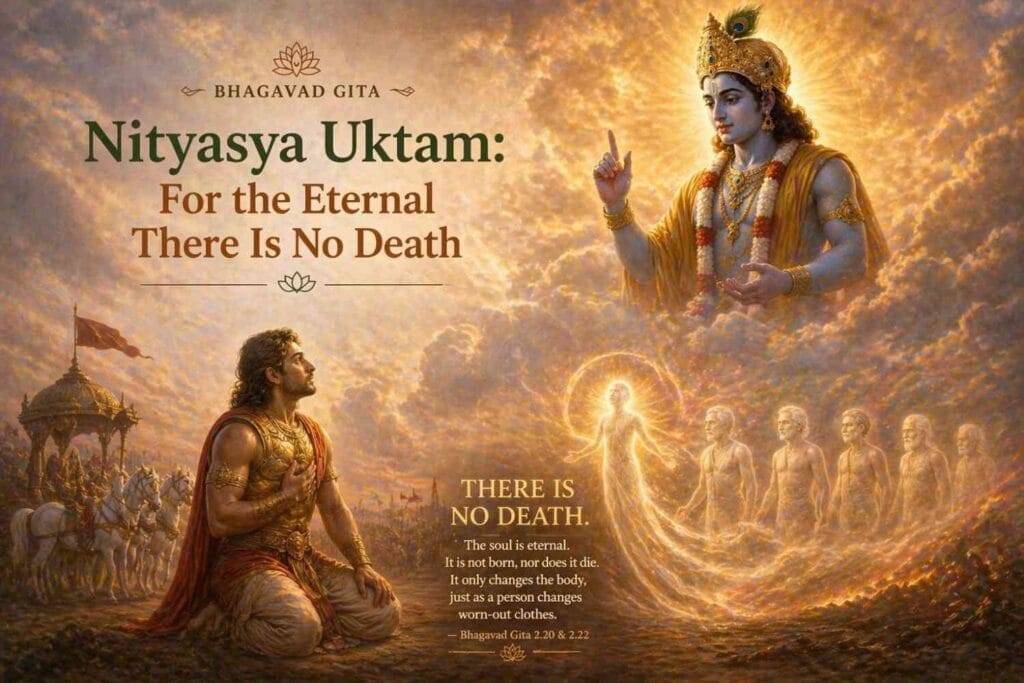
“For the eternal there is no death” is a core teaching of the Bhagavad Gita. Discover how Krishna explains the eternal Self, removes fear of death, and reveals the truth beyond the body and change.
The Context of This Teaching
This teaching emerges at a moment of complete inner conflict within the Bhagavad Gita. Arjuna is not confused about what is happening externally, he clearly sees the battlefield, the opposing sides, and the consequences of war. His conflict arises from within.
He is faced with a situation where action and emotion are in direct opposition. On one side is his role, his duty, and the necessity of action. On the other side are his relationships, those he has loved, respected, and identified with throughout his life.
This creates a deep psychological collapse.
Arjuna’s understanding of life is based on form: on people as bodies, as roles, as relationships. When he sees the possibility of their destruction, he interprets it as total loss. For him, death is not change, it is ending. Krishna does not attempt to remove Arjuna from the battlefield, nor does he offer immediate comfort.
Instead, he addresses the foundation of Arjuna’s confusion. He reveals that the problem is not the situation itself, but the way it is being perceived. What Arjuna calls death, Krishna identifies as a misunderstanding of reality. The teaching begins not by changing external conditions, but by correcting internal vision.
The Verse and Its Meaning
The statement “For the eternal, there is no death” reflects a central principle presented in Chapter 2 of the Bhagavad Gita.
Krishna introduces a clear distinction between two aspects of existence:
That which is subject to change
and that which is not
Everything that is born, formed, or composed of parts is temporary. It arises, exists for a period, and eventually dissolves. This includes the body, external objects, and all visible forms. However, Krishna points to something beyond this cycle.
The Self (Ātman) is described as nitya, eternal. It does not come into existence at a particular moment, nor does it cease to exist. It is not affected by the changes that occur at the level of the body. The confusion arises when these two are not distinguished. Arjuna sees the body and assumes that it represents the entirety of the individual. Krishna redirects his attention toward that which remains unchanged, even as the body undergoes transformation.
This teaching does not deny change, it places it in context.
The Meaning of “Nitya” (The Eternal)
The term nitya carries a depth that goes beyond the idea of duration. Something that lasts for a long time can still come to an end. The eternal, however, is not extended time, it is beyond time altogether.
That which is eternal:
- does not begin
- does not evolve
- does not end
It is not produced by any cause, and therefore it is not subject to any effect.
In the Bhagavad Gita, the Self is described in this way, not as something that can be observed as an object, but as the underlying reality that makes all observation possible. This shifts the entire perspective. Instead of focusing on what appears and disappears, attention moves toward that which remains constant in all experience.
It is not something that can be grasped through thought alone. It is recognized through insight, by seeing what does not change amidst constant change.
The Misidentification with the Body
The central source of fear, according to this teaching, is misidentification. When the body is taken to be the Self, all change appears threatening. Aging, loss, and death are interpreted as personal endings. This is the state Arjuna is experiencing. Krishna addresses this by pointing out a simple but profound observation: the body is constantly changing. From childhood to youth to old age, its form is never stable. Yet, throughout these changes, there is a continuity of awareness. The one who observes these changes remains present.
This reveals an important distinction:
Change is observed.
The observer is not changing in the same way.
The error lies not in perceiving change, but in identifying with what changes. When identity is placed in the body, fear becomes inevitable. When identity shifts toward awareness, the nature of change is understood differently.
Death as Transition, Not End
Krishna further clarifies this understanding by reframing death. Death is not presented as the end of existence, but as a transition within a larger process. The well-known analogy of changing garments illustrates this point: just as worn-out clothes are replaced with new ones, the embodied Self moves from one form to another. This analogy is not merely illustrative, it serves a philosophical purpose. It separates what is temporary from what is continuous.
Forms arise and dissolve.
The underlying reality does not.
From this perspective, death is no longer an absolute event. It is part of a sequence of change occurring at the level of form. This understanding does not deny the experience of loss, but it places it within a broader context. What appears as an ending at one level is not an ending at another. As this becomes clear, the finality associated with death begins to dissolve. It is no longer seen as annihilation, but as movement, within a reality that itself does not end.
The Psychological Impact of This Understanding
Within the Bhagavad Gita, the teaching of the eternal Self is not presented as an abstract philosophy. It directly addresses the structure of human fear. Fear of death is not limited to the moment of dying. It operates continuously in subtle forms, fear of loss, fear of change, fear of insecurity, fear of the unknown. These fears influence choices, relationships, and emotional stability.
When identity is rooted in what is temporary: the body, roles, possessions, relationships, uncertainty becomes unavoidable. Everything that is depended upon is subject to change. As a result, the mind attempts to secure what cannot be secured. This creates a constant underlying tension.
Krishna’s teaching addresses this at its foundation. By revealing that the Self is not subject to birth and death, he shifts identity away from the changing toward the unchanging. This does not remove emotional experience, but it alters its basis.
Loss may still be felt, but it is no longer interpreted as absolute destruction. Change may still occur, but it is not experienced as a threat to existence itself.
Clarity begins to replace fear.
Action Without Fear
Arjuna’s inability to act does not come from lack of knowledge, it comes from emotional disturbance. His perception is clouded by attachment and fear, and as a result, his capacity to act becomes compromised.
Krishna does not advise withdrawal from action. Instead, he restores clarity.
When the eternal nature of the Self is understood, action is no longer driven by insecurity. The need to preserve identity through external outcomes begins to reduce.
From this understanding:
- action becomes more precise, because it is not clouded by fear
- attachment to results decreases, because identity is no longer tied to them
- emotional reactivity diminishes, allowing steadiness in decision-making
This is not indifference or detachment in the sense of withdrawal. It is engagement without confusion. One continues to act fully, but the action is no longer driven by anxiety about gain or loss.
The Difference Between Intellectual and Direct Understanding
A critical distinction in this teaching is between conceptual knowledge and direct realization. It is possible to understand, at an intellectual level, that the Self is eternal. However, this understanding often remains superficial. In moments of difficulty, fear and attachment continue to arise. This indicates that the knowledge has not yet become experiential.
Krishna’s teaching is not intended to remain at the level of belief or philosophy. It is meant to be seen directly. Direct understanding occurs when the distinction between the changing and the unchanging is observed within one’s own experience. One begins to notice that thoughts, emotions, and bodily states are constantly shifting, while the awareness that observes them remains present.
This recognition is not theoretical, it is immediate. Only when this is seen clearly does the teaching begin to transform perception.
The Role of Discernment
Discernment (viveka) is the capacity to distinguish between what is temporary and what is unchanging.
Without discernment, the mind continues to identify with form. Every experience is taken personally, and every change is interpreted as significant.
With discernment, perception becomes more precise.
One begins to recognize:
- that the body is subject to time
- that thoughts and emotions arise and pass
- that awareness remains constant amidst these changes
This clarity does not remove experience, it places it in perspective. Life is no longer viewed only in terms of gain and loss, success and failure. It is understood in terms of appearance and reality. Discernment becomes the basis for stability.
Relevance in Daily Life
Although this teaching is presented in the context of a battlefield, its application extends to everyday life. Change is constant. Relationships evolve, circumstances shift, and the body undergoes continuous transformation. Without clarity, these changes create disturbance. The mind reacts with resistance, attachment, or fear. With understanding, the same changes are perceived differently.
They are recognized as movements within experience, rather than threats to existence. This does not eliminate practical concerns, but it reduces the psychological burden associated with them. One responds to situations with greater steadiness, because identity is no longer entirely dependent on external conditions.
The Subtle Shift in Identity
As this understanding deepens, a fundamental shift begins to occur. Identity gradually moves away from what is observed toward that which observes.
Instead of experiencing:
“I am this body”
there is a recognition that:
“The body is part of experience”
Instead of:
“I will be lost”
there is clarity that:
“What I am is not subject to loss”
This shift is not achieved through repetition of statements. It emerges through observation and insight. As identification loosens, the intensity of fear reduces. Experience continues, but without the same degree of psychological involvement.
CONCLUSION
The statement “For the eternal, there is no death,” as presented in the Bhagavad Gita, is not intended as consolation. It is a correction of perception. It establishes a clear distinction between what changes and what does not.
The body exists within time. It undergoes transformation and eventually dissolves.
The Self is not within this process. It is not created, and therefore it is not destroyed.
Understanding this does not remove the challenges of life. Situations continue to arise, and actions continue to be required. What changes is the way they are experienced. Fear begins to reduce, because it is no longer rooted in misunderstanding. Clarity increases, because perception is no longer limited to form.
Krishna does not remove death from the world. He removes the illusion that death defines existence.
Also read: The Immortal Soul: Krishna’s First Teaching