
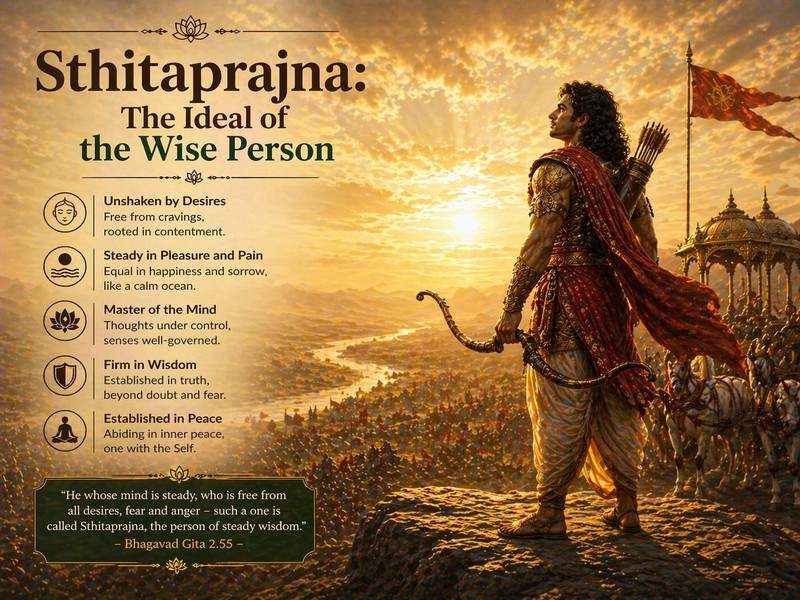
Discover the meaning of Sthitaprajna in the Bhagavad Gita. Learn how Krishna describes the wise person, free from desire, steady in all situations, and established in inner clarity.
The Question That Arises After Clarity
In Chapter 2 of the Bhagavad Gita, Arjuna’s inquiry undergoes a subtle but important refinement. Initially, his concern is immediate and situational, whether he should act or withdraw. His questions are shaped by conflict, emotion, and uncertainty about consequences. Krishna responds by introducing foundational teachings: the nature of the Self, the inevitability of change, and the principle of dharma.
As these teachings begin to settle, Arjuna’s confusion does not disappear instantly, but it changes in quality. He moves from asking about action to asking about understanding itself. This shift is significant. It indicates that Arjuna is no longer looking for instructions alone. He is seeking to understand the state from which right action naturally arises.
In verse 2.54, he asks:
What is the mark of one whose wisdom is steady?
How does such a person live, speak, and act?
These questions are not superficial. Arjuna is not asking for outward behavior to imitate. He is asking how inner clarity expresses itself in life. This marks a transition in the dialogue.
The focus moves:
- from what should be done
- to what one becomes when understanding is established
It shifts from philosophy as explanation to philosophy as embodiment. Arjuna recognizes that correct action cannot be sustained through instruction alone. It requires a stable foundation, an understanding that does not fluctuate with changing situations.
What Does “Sthitaprajna” Mean?
The term sthita-prajña describes precisely this condition.
It is composed of two parts:
- sthita – that which is firmly established, steady, not easily disturbed
- prajña – insight, higher knowledge, direct understanding
Together, they refer to a state in which understanding is no longer temporary or dependent on conditions. This distinction is essential. Ordinary understanding tends to fluctuate. It may be clear in moments of reflection, but it weakens in moments of pressure. Under emotional strain or uncertainty, clarity is often replaced by reaction.
Sthitaprajna is not subject to this fluctuation. It is not knowledge that appears occasionally, it is stability of knowing. This does not mean that the person withdraws from life or avoids difficulty. On the contrary, it means that understanding remains present even within complexity.
Such a person:
- does not lose clarity when circumstances change
- does not depend on favorable conditions to remain steady
- does not revert to confusion when challenged
This is why the teaching emphasizes that sthitaprajna is not intellectual. Intellectual knowledge can be acquired, repeated, and even explained, but it does not necessarily transform perception. Sthitaprajna refers to a deeper integration. Understanding becomes continuous. It is not something that needs to be recalled, it is already present.
In this state, action does not require constant deliberation. It arises naturally from clarity.
Freedom from Desire
In Chapter 2 of the Bhagavad Gita, Krishna begins describing the sthita-prajña by addressing the nature of desire. Here, desire is not merely a natural inclination toward action or preference. It refers to a deeper psychological movement, a sense of incompleteness that seeks fulfillment outside itself.
When the mind is driven by desire, it operates on the assumption:
“I will be complete when I attain this.”
This creates dependence. The object of desire: whether material, relational, or psychological, becomes a condition for inner stability. Until it is attained, there is restlessness. Even when it is attained, the satisfaction is temporary, leading to further seeking.
Krishna points toward a different state. The sthita-prajña is not without activity or engagement, but is free from compulsive wanting. Desire does not dictate the movement of the mind. This is because fulfillment is no longer sought externally.
The person is described as:
- inwardly content
- not dependent on circumstances for a sense of completeness
This does not result in passivity. Action continues, but it is no longer driven by lack.
The shift is subtle but fundamental:
From seeking fulfillment
to recognizing that fulfillment is not absent
Stability in Pleasure and Pain
Krishna then describes the wise person as one who remains steady in both pleasure and pain. Ordinarily, the mind is conditioned to move toward what is pleasant and away from what is unpleasant.
Pleasure leads to attachment- the desire to repeat or prolong the experience.
Pain leads to resistance- the attempt to avoid or escape it.
This creates constant fluctuation. The individual becomes dependent on external conditions for inner balance. When conditions are favorable, there is ease. When they change, disturbance arises. The sthita-prajña is not free from experience, but from reactivity to experience.
Pleasure is recognized, but it does not lead to attachment.
Pain is perceived, but it does not create inner resistance.
This is not indifference or numbness. It is clarity. Experience is allowed to arise and pass without being grasped or rejected. The underlying stability remains unaffected. In this way, the person is not carried by circumstances, but remains steady within them.
Freedom from Attachment, Fear, and Anger
Krishna identifies three key disturbances that arise when the mind is bound to outcomes:
- attachment (rāga)
- fear (bhaya)
- anger (krodha)
These are interconnected. Attachment develops when the mind identifies something as necessary for its well-being. From attachment arises fear, the concern that what is valued may be lost. When expectation is obstructed, anger emerges.
This sequence reveals how emotional disturbance is structured. It is not random, it arises from dependence. The sthita-prajña is free from these disturbances, not through suppression, but because the underlying cause, dependence on external conditions, is no longer present.
When identity is not tied to outcomes:
- attachment does not form in the same way
- fear loses its basis
- anger does not arise as a reaction to unmet expectation
This does not eliminate all emotional response, but it removes the compulsive patterns that disturb clarity.
Withdrawal of the Senses
Krishna uses the analogy of a tortoise withdrawing its limbs to describe the relationship of the wise person with the senses. This analogy is precise. The tortoise does not lose its limbs, nor does it reject them. It withdraws them when necessary. Similarly, the sthita-prajña does not reject the world or sensory experience. The senses continue to function, but they do not dominate attention. Ordinarily, the senses pull the mind outward. Attention is captured automatically by objects, leading to continuous engagement.
In the wise person, this movement is no longer compulsive.
There is the ability to:
- engage when appropriate
- withdraw when necessary
This introduces choice. Attention is no longer controlled by external stimuli. It remains guided by awareness. This does not result in isolation from the world. It allows participation without loss of clarity. The senses become instruments, not drivers.
The Persistence of Impressions
Krishna acknowledges an important reality in the Bhagavad Gita. Even when one withdraws from objects, the subtle impression (rasa) may still remain. This means that external restraint alone is not sufficient. One may step away from an object, yet the inner pull toward it can continue. The mind may appear controlled, but the tendency is still present. Only when there is direct understanding of the Self do these impressions begin to dissolve completely. This is what separates control from transformation.
Control restricts expression.
Understanding removes the cause.
The Chain of Disturbance
Krishna outlines a precise psychological sequence:
Attention on objects → attachment → desire → anger → confusion → loss of memory → destruction of discrimination → downfall.
This sequence shows that disturbance does not arise suddenly. It develops step by step.
Attention, when repeatedly placed on an object, creates attachment.
Attachment strengthens into desire.
When desire is obstructed, it turns into anger.
From there, clarity begins to break down. Confusion arises. Memory of what is right weakens. Discrimination fades. And eventually, the ability to act clearly is lost. The sthita-prajña is free from this chain not because thoughts never arise, but because the process is seen early. Awareness interrupts the sequence before it completes itself.
The State of Inner Satisfaction
The wise person is described as one who is content within. This does not mean withdrawal from life or lack of engagement. It means that fulfillment is not dependent on external acquisition. When there is a constant sense of lack, the mind keeps seeking. When that sense reduces, the need to seek also reduces. Action continues, but not from incompleteness. There is participation, but without dependency.
The Ocean Analogy
Krishna compares the sthita-prajña to an ocean: Rivers flow into it, yet it remains full and undisturbed. This analogy is not about resisting experience. It is about capacity. The ocean does not reject the rivers, nor does it become overwhelmed by them. Similarly, experiences continue to arise, pleasant or unpleasant, but they do not disturb the inner stability. The mind does not need to control every experience. It remains steady within them.
The State of Brahmi Sthiti
At the conclusion of Chapter 2, Krishna describes this state as Brahmi sthiti, being established in ultimate reality. One who is established in this is not shaken by confusion. Understanding is no longer temporary. It does not come and go. Even at the moment of death, this clarity remains. This shows that it is not dependent on circumstances or conditions. It is not a passing state.
It is the culmination of understanding, where knowledge is no longer conceptual, but fully lived.
The Difference Between Practice and Realization
In Chapter 2 of the Bhagavad Gita, a clear distinction must be understood. There is a difference between trying to behave like a sthita-prajña and actually being established in that state.
At the level of practice, one may attempt to control reactions:
- restrain speech
- suppress emotional expression
- maintain outward composure
This can create temporary steadiness. But this steadiness depends on effort. It holds as long as conditions are manageable, and often breaks under pressure. This is imitation. It operates at the surface. Realization is different. It does not begin with controlling behavior. It begins with understanding. When the origin of reaction is seen clearly, when attachment, expectation, and identification are understood, the intensity of reaction naturally reduces. There is no need to suppress. Stability arises on its own.
This is why the teaching is not about becoming rigid or emotionless. It is about seeing clearly enough that the mind no longer moves compulsively. From that clarity, steadiness is not maintained, it is present.
Relevance in Daily Life
The description of a sthita-prajña is not meant to remain as an ideal separate from life. It reflects qualities that can be observed and gradually developed in everyday situations.
For example:
Reduced reactivity
Instead of responding immediately to every situation, there is a pause. Reaction slows down, allowing space for clarity.
Clarity in decision-making
Decisions are not driven solely by impulse or pressure. They arise from a more stable understanding.
Independence from constant external validation
The need for approval, recognition, or reassurance begins to reduce. Action is less dependent on how it is perceived.
Steadiness in changing situations
When circumstances shift, the mind does not fluctuate as intensely. There is a continuity of awareness.
These are not abstract qualities. They are practical outcomes of understanding. They appear gradually, not through force, but through consistent observation and clarity.
The Shift from Reaction to Awareness
At the center of this teaching is a fundamental shift. Ordinarily, life is experienced through reaction.
A situation arises → the mind responds immediately → action follows.
There is little space between experience and response. This creates habitual patterns. Krishna’s teaching introduces awareness into this process. With awareness, a space begins to appear:
Situation → awareness → response
This space, though subtle, changes everything.
It allows:
- observation before reaction
- clarity before action
- choice instead of compulsion
Life does not become simpler. Situations remain complex. But the way they are experienced changes. Instead of being carried by every reaction, one begins to respond with steadiness.
Conclusion
The sthita-prajña, as described in Chapter 2 of the Bhagavad Gita, represents the ideal of steady wisdom. This steadiness is not defined by outward behavior alone, but by inner clarity.
Such a person:
- is not driven by desire
- is not disturbed by changing circumstances
- is not bound by habitual reactions
This state is not achieved through force, discipline alone, or imitation.
It emerges through understanding. As perception becomes clear, the need for control reduces. Action becomes aligned. Stability becomes natural. Krishna does not present this as something distant or unattainable. He presents it as the natural outcome of seeing things as they are.