Explore dharma in Chapter 2 of the Bhagavad Gita and understand how Krishna guides Arjuna to act with clarity, responsibility, and detachment beyond fear, emotion, and confusion.
The Turning Point in Arjuna’s Dilemma
In Chapter 2 of the Bhagavad Gita, a decisive shift takes place. Arjuna’s condition moves from emotional overwhelm to a deeper, more fundamental inquiry. His grief does not disappear, but it begins to transform into questioning. He is no longer only affected by what he feels, he is now uncertain about how to act.
This distinction is important. Arjuna clearly understands the situation in front of him. He knows who stands on each side of the battlefield. His confusion does not arise from lack of information, but from the inability to reconcile action with his moral perception.
To fight appears as violence.
To withdraw appears as abandonment of duty.
Both options seem flawed. This creates a state of paralysis, not because there are no choices, but because each choice appears to violate something essential. Krishna does not resolve this by offering a simple solution. He does not say “fight” or “do not fight” without explanation. Instead, he shifts the basis on which Arjuna is evaluating the situation. He introduces dharma, a principle that does not depend on emotion, preference, or immediate comfort. This marks the beginning of clarity.
What Is Dharma in This Context?
The word dharma is often reduced to “duty,” but within the Bhagavad Gita, it carries a more precise and comprehensive meaning.
Dharma refers to the principle that sustains order. It operates at multiple levels:
- within the individual
- within society
- within the larger structure of life
It is not something that is chosen arbitrarily. It arises from the nature of a situation and the role one occupies within it.
For Arjuna, dharma is not a philosophical idea, it is directly connected to his identity as a kṣatriya, a warrior. His role is not defined by personal preference, but by responsibility. His hesitation emerges because he is viewing the situation through personal relationships rather than through the structure of dharma.
He sees:
- his teacher, not a representative of a position
- his relatives, not participants in a larger conflict
This personal perspective narrows his understanding. Krishna expands it. He shifts Arjuna’s focus from individual relationships to the larger context of responsibility and order.
The Conflict Between Emotion and Responsibility
Arjuna’s resistance is rooted in genuine emotion. His response is not superficial, it arises from attachment, respect, and compassion. Krishna does not deny the validity of these emotions. However, he reveals their limitation when they become the sole basis for action.
When action is guided only by personal attachment:
- decisions become selective
- consistency is lost
- clarity is obscured
One may act correctly in one situation and avoid action in another, based purely on personal comfort or discomfort. This creates instability. Dharma introduces a different standard. It requires action to be aligned with what is necessary, not what is emotionally comfortable. This does not eliminate emotion, but it prevents emotion from becoming the sole determinant of action. In this way, responsibility is restored to its proper place.
The Nature of a Warrior’s Duty
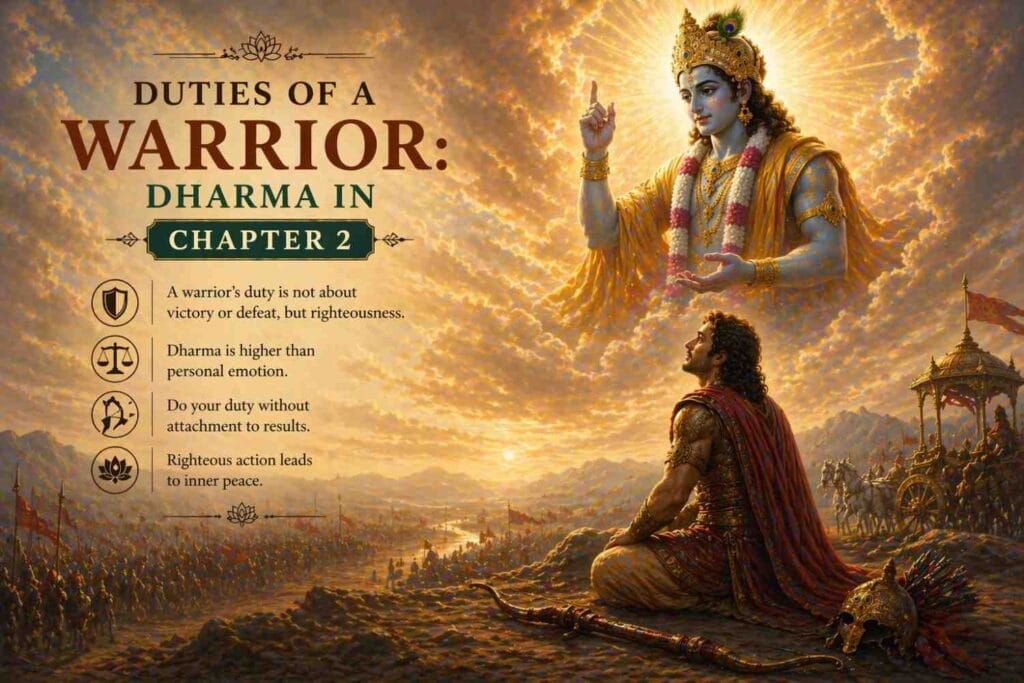
Krishna clarifies that for a warrior, the responsibility is not optional, it is inherent in the role. To stand in the presence of injustice and withdraw is not neutrality. It is a form of imbalance. This teaching is often misunderstood. Krishna is not glorifying conflict. He is not encouraging violence for its own sake. He is emphasizing that when a situation demands action to restore order, avoidance is not a solution.
For Arjuna:
- action is required by circumstance
- inaction is not a neutral alternative
To abandon his role due to confusion or fear would create both internal and external disorder.
Internally, it would lead to conflict and loss of integrity.
Externally, it would allow imbalance to persist.
Thus, a warrior’s duty is not defined by aggression, but by alignment with responsibility.
Action Without Attachment
One of the most important principles introduced in this chapter is the idea of acting without attachment to outcomes. This does not imply indifference. It does not mean that results are irrelevant. Rather, it means that action is not governed by the desire for a particular outcome. Krishna advises Arjuna to act according to his dharma, without becoming attached to success or failure. This changes the structure of action.
When action is tied to outcome, it becomes unstable:
- fear of failure creates hesitation
- desire for success creates pressure
- concern for judgment creates anxiety
The mind becomes divided. When action is aligned with dharma, these influences reduce. The focus shifts from “What will I gain or lose?” to “What is the correct action in this situation?” This brings steadiness. Action is no longer driven by insecurity, but by clarity. This is not detachment from life, it is detachment from confusion.
The Psychological Paralysis of Inaction
In Chapter 2 of the Bhagavad Gita, Arjuna’s condition is not one of weakness, but of inner conflict taken to its limit. He possesses the ability, the skill, and the knowledge to act. What is absent is clarity.
This absence creates paralysis. Paralysis, in this sense, is not inactivity, it is the inability to act decisively despite the presence of action. The mind becomes divided. One part inclines toward responsibility, while another resists due to emotional attachment and anticipated consequences.
Three primary factors sustain this state:
Over-identification with outcomes
Arjuna is not only concerned with the action itself, but with what it will lead to, loss, suffering, destruction of relationships. The mind projects forward, and these projections become more powerful than the present necessity.
Emotional conflict
His emotions are not superficial, they are deeply rooted in attachment. These attachments create hesitation. The mind attempts to protect what it values, even when doing so conflicts with responsibility.
Fear of consequences
Fear is not limited to physical harm. It includes moral fear, fear of making the wrong decision, fear of regret, fear of responsibility for outcomes.
These factors do not remove the need for action, but they make action unclear. Krishna addresses this not by simplifying the situation, but by changing the foundation on which Arjuna is operating. When the Self is understood as not subject to harm, the intensity of fear reduces. When dharma is understood as independent of personal preference, the basis of decision-making shifts. Action is no longer evaluated solely through emotional consequence.
It is aligned with clarity. In that alignment, paralysis dissolves, not because the situation changes, but because perception does.
Honor and Responsibility
Krishna introduces the idea of honor, but not in the conventional sense. Honor is not reputation. It is not how one is perceived by others. It is alignment with one’s responsibility. For a warrior, this alignment is central. To act in accordance with dharma is to remain integrated internally. To avoid action, despite knowing what is required, creates division within.
This division manifests as:
- internal conflict
- loss of steadiness
- erosion of clarity
Krishna does not present these as moral punishments, but as natural consequences. When action is avoided despite clarity of role, the mind does not find peace. It continues to revisit the avoided responsibility. Doubt persists. Regret may arise. Externally, avoidance may allow imbalance to continue. Internally, it disrupts coherence. Thus, responsibility is not imposed, it is inherent. To act in alignment with it maintains order within the individual. To withdraw from it creates disturbance.
Dharma Beyond the Battlefield
Although the teaching is situated within the battlefield of the Bhagavad Gita, its application is not confined to that context. Dharma is not limited to a warrior’s role. It is present in every situation where action is required. In daily life, the forms may differ, but the structure remains the same.
There is always:
- a context
- a role
- a responsibility
The challenge is not identifying action, but acting with clarity.
Often, modern situations reflect similar patterns to Arjuna’s dilemma:
- knowing what is necessary, but hesitating due to discomfort
- avoiding decisions because of potential consequences
- allowing emotional preference to override clarity
Dharma, in this broader sense, becomes the principle of responding to what is required, rather than what is convenient.
It may involve:
- making decisions that are difficult but necessary
- standing by what is correct even when it is not supported
- fulfilling responsibilities without constant reliance on external validation
The outer situations change, but the inner process remains consistent. The teaching, therefore, is not bound to time or place. It remains applicable wherever there is action, uncertainty, and the need for clarity.
The Shift from Personal to Universal
A central transformation in Chapter 2 of the Bhagavad Gita is the movement from a personal lens to a universal understanding.
At the beginning, Arjuna’s perception is shaped by relationship and identity. He sees:
- his teacher
- his relatives
- those he has emotional bonds with
Because of this, his response is also personal. Action is evaluated in terms of my people, my loss, my consequences. This narrows perception.
Krishna does not dismiss these relationships. Instead, he expands Arjuna’s field of understanding.
He introduces:
- the nature of the Self as beyond form
- the inevitability of change at the level of the body
- the necessity of action within the structure of life
With this expansion, the situation is no longer seen only through personal attachment. It is placed within a broader framework.
This shift reduces distortion.
When perception is limited to personal preference, it becomes selective. One may act in one situation and withdraw in another, based on emotional comfort. But when perception becomes universal, action aligns with what sustains order rather than what protects personal attachment.
In this way, Arjuna’s understanding moves from:
“what do I feel about this?”
to
“what is required in this situation?”
This is not the removal of emotion, but the repositioning of it within a larger clarity.
Discipline of the Mind in Action
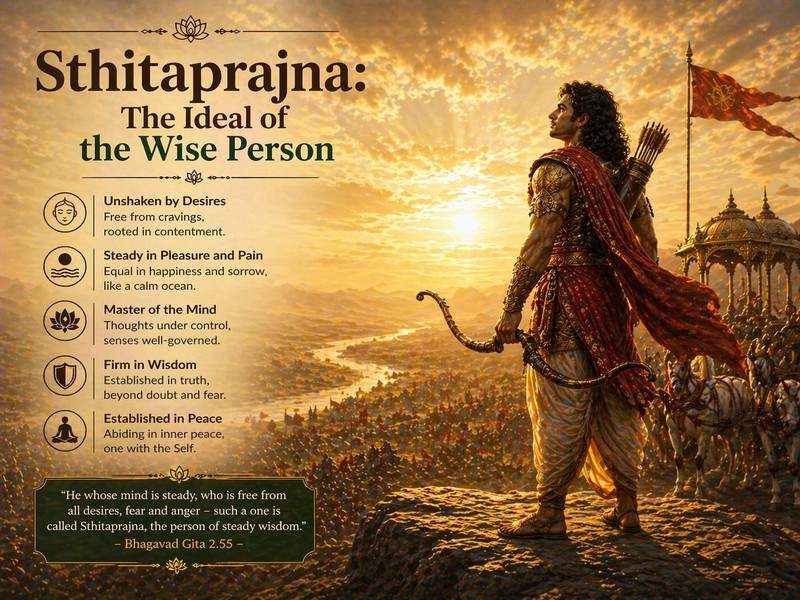
Krishna emphasizes that right action is not possible without a stable mind. A fluctuating mind produces fluctuating action.
When the mind is unstable:
- decisions change frequently
- emotions override clarity
- actions become inconsistent
Even when one knows what is correct, the inability to remain steady leads to hesitation or reversal. A disciplined mind, on the other hand, allows action to remain aligned. Discipline here does not mean suppression. It refers to steadiness, the capacity to remain clear despite internal or external disturbance.
This is where yoga and dharma intersect.
Yoga works at the level of the mind:
- it reduces fluctuation
- it stabilizes attention
- it creates inner clarity
Dharma works at the level of action:
- it directs what is to be done
- it provides orientation within a situation
Without yoga, dharma cannot be followed consistently, because the mind lacks stability.
Without dharma, yoga lacks direction in action.
Together, they create alignment between inner clarity and outer response.
The Courage to Act Clearly
Clarity alone is not sufficient. It must be supported by the willingness to act. This is where courage becomes essential. The courage described in the Bhagavad Gita is not merely physical bravery. It is the capacity to act in accordance with understanding, even when there is inner resistance.
This resistance may take many forms:
- discomfort in facing consequences
- hesitation due to emotional attachment
- fear of making a difficult decision
To act clearly requires the ability to remain aligned despite these pressures.
This includes:
- facing situations that are not comfortable
- accepting outcomes that are uncertain
- maintaining clarity even when challenged internally
For Arjuna, this courage does not come from external reassurance. It arises from understanding. He does not become fearless because danger disappears. The battlefield remains the same. What changes is his perception. When reality is seen more clearly, the weight of fear reduces. Action becomes possible, not because the situation is easy, but because it is understood.
Conclusion
In Chapter 2 of the Bhagavad Gita, the concept of dharma fundamentally transforms the understanding of action. Action is no longer driven by immediate emotional response. It becomes grounded in clarity and responsibility. Krishna does not attempt to control Arjuna’s emotions. He does not instruct him on what to feel.
He clarifies how to see. From this clarity, right action emerges naturally. A warrior’s duty, in this context, is not defined by conflict itself, but by alignment with what is necessary.
When action arises from dharma:
- it remains steady, even in difficulty
- it is clear, because it is not clouded by confusion
- it is free from inner division
This teaching extends beyond the battlefield.
It becomes a framework for living in situations where complexity, uncertainty, and responsibility coexist. In such situations, clarity is not found by avoiding action, but by understanding it. And through that understanding, action becomes aligned.