
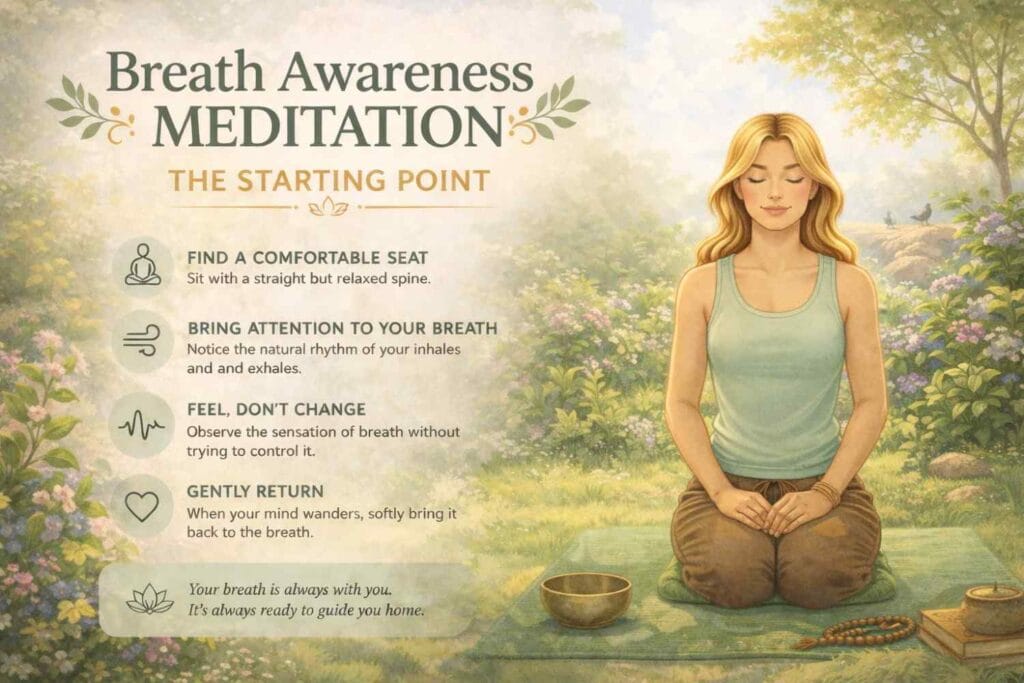
A simple guide to breath awareness meditation for beginners. Learn how observing your breath improves focus and reduces mental restlessness.
Where Practice Actually Begins
Meditation is often imagined as something advanced, something that requires stillness, control, or the absence of thought. Many people approach it with the expectation that the mind should become quiet quickly, and when that does not happen, they assume they are doing something wrong. But the beginning of meditation is not about achieving silence. It is about learning how to observe without interference, and the most accessible point for that observation is the breath.
Breath is always present. It does not need to be created, controlled, or imagined. It is already happening, whether attention is on it or not. This makes it different from most other objects of focus. You do not have to bring it into awareness, it is already there, waiting to be noticed.
This is why breath awareness is not just a technique. It is a starting point that requires nothing external, only a shift in attention.
The Connection Between Breath and Mind
The Hatha Yoga Pradipika presents a clear relationship between breath and the internal state of the mind. When breath is disturbed, the mind reflects that disturbance. When breath becomes steady, the mind begins to settle.
This relationship is not theoretical. It can be observed directly. When you are anxious or restless, breathing becomes shallow or irregular. When you are calm, breathing becomes slower and more even.
By observing the breath, you are not controlling the mind directly. You are approaching it through a pathway that is already connected to it.
Why Breath Awareness Comes Before Other Practices
Before the mind can be directed toward more subtle objects, it needs a point of stability. Without this, attention moves continuously from one thought to another.
The Yoga Sutras of Patanjali describes how the mind takes different forms based on what it engages with. If it is constantly shifting, clarity does not develop.
Breath provides a simple, consistent reference point. It does not demand effort. It does not create additional stimulation. It simply exists as a rhythm that can be observed.
This makes it suitable for the beginning, where the primary challenge is not depth, but stability of attention.
What It Means to Observe the Breath
Breath awareness is often misunderstood as controlling or modifying the breath. But observation is different from control.
To observe the breath means:
- Noticing the inhale as it happens
- Noticing the exhale as it happens
- Being aware of the natural rhythm without changing it
There is no need to make the breath deeper or slower. In fact, trying to change it introduces effort and tension.
The practice begins when you allow the breath to remain as it is and simply place attention on it.
The First Difficulty: The Mind Does Not Stay
At the beginning, attention does not remain on the breath for long. Within seconds, the mind moves, toward thoughts, memories, or distractions.
This is not a problem. It is the nature of the mind.
The practice is not about preventing this movement. It is about noticing when it happens and returning to the breath.
This return is the actual practice. Not the duration of focus, but the act of coming back.
The Role of Repetition in Stabilizing Attention
Each time attention returns to the breath, a small shift occurs.
It may not feel significant, but over time, these repeated returns begin to create stability. The mind becomes slightly less reactive, slightly less scattered.
The Yoga Sutras of Patanjali emphasizes practice as something that develops through consistency over time. Breath awareness reflects this directly.
It is not a single moment of focus that creates change, but repeated moments of returning.
Breath as a Neutral Anchor
One of the reasons breath works effectively is that it is neutral.
It is not emotionally charged. It does not create attachment or aversion. It simply moves in and out.
This neutrality allows the mind to settle without being pulled in different directions.
Other objects of focus may carry associations or meanings. Breath does not.
This simplicity is what makes it powerful.
The Gradual Shift in Experience
At first, observing the breath feels like effort. You have to remind yourself to return, to notice, to stay.
But gradually, something changes.
The breath becomes more noticeable without effort. Attention stays for slightly longer periods. The gaps between thoughts become more visible.
This shift is not dramatic, but it is consistent.
It reflects the mind moving from constant activity toward occasional stillness.
The Relationship with Thoughts During Breath Awareness
Thoughts do not stop when you observe the breath. They continue to arise.
But the relationship with them changes.
Instead of being carried by each thought, you begin to notice it and return to the breath.
This creates distance, not by pushing thoughts away, but by not following them.
Over time, this reduces the intensity of mental activity.
The Influence of Posture and Stillness
While breath awareness is simple, the way you sit affects the experience.
A stable posture allows the body to remain still without strain. When the body is restless, attention is divided.
You do not need complex positions. A comfortable, upright posture is sufficient.
The purpose is not perfection, but reducing physical disturbance so that attention can remain steady.
The Duration of Practice
For beginners, breath awareness does not require long sessions.
Even 5–10 minutes of attentive observation is enough to begin.
What matters is not how long you sit, but how present you are during that time.
As the practice becomes familiar, duration can increase naturally.
The Role of Consistency
Breath awareness develops through repetition. Practicing occasionally does not create the same effect as practicing regularly.
Daily practice, even if short, creates continuity.
This continuity allows the mind to become familiar with stillness.
The Subtle Effects Beyond Practice
Over time, breath awareness extends beyond formal meditation.
You begin to notice your breath during the day, while walking, sitting, or reacting to situations.
This awareness creates a small pause between stimulus and response.
In that pause, reactions become less immediate.
This is how meditation begins to influence daily life, not through effort, but through increased awareness.
Why Breath Remains Central Even in Advanced Practice
Even as practice deepens, breath does not lose its relevance.
It continues to serve as a reference point, a way to return when attention becomes scattered.
This is why it is considered a foundation, not just a beginning.
Breath awareness is not a complex method or an advanced technique. It is a simple entry into meditation where attention is gently brought back to something that is already present. Through this process, the mind is not forced into stillness but gradually becomes less restless as observation develops.
The guidance reflected in
- Yoga Sutras of Patanjali
- Hatha Yoga Pradipika
- Bhagavad Gita
points toward steadiness, awareness, and consistency rather than force. When applied to breath awareness, this creates a practice that is simple in form but gradual in its effect.
What begins as noticing the inhale and exhale slowly becomes a way of observing the mind itself.
And through this observation, the practice moves forward, not by adding more, but by seeing more clearly what is already present.