Wondering how long a beginner yoga session should be? Learn the ideal duration, how to start, and how to build a consistent practice.
The Question That Looks Simple but Isn’t
When someone begins Yoga, one of the first practical questions that arises is about duration. How long should the session be? Fifteen minutes, Thirty minutes, an hour?
At first, it seems like a matter of scheduling. Something that can be answered with a fixed number. But the more you look into it, the more it becomes clear that Yoga does not function in fixed units of time in the way modern exercise routines do.
In a gym setting, duration often determines effectiveness. Longer sessions are assumed to be more beneficial. But Yoga operates differently. It is not based on how long you practice, but how you engage while practicing.
This shift changes the question itself.
Duration vs Quality of Attention
In the Yoga Sutras of Patanjali, practice is described through consistency and steadiness, not duration alone. The emphasis is on how regularly and attentively something is done.
This suggests that a shorter session with full attention may be more effective than a longer session performed mechanically.
For a beginner, this becomes especially important. Because at the beginning, the challenge is not extending duration, it is maintaining awareness.
Why Beginners Often Choose the Wrong Duration
Many beginners approach Yoga with expectations shaped by other forms of exercise.
They assume:
- Longer sessions are better
- More effort leads to faster results
- Intensity equals effectiveness
This leads to sessions that are too long or too demanding in the beginning.
The result is not progress, but fatigue. And with fatigue comes inconsistency.
Yoga does not build through exhaustion. It builds through continuity.
The Role of the Body in Determining Duration
A beginner’s body is not yet adapted to the movements, postures, or stillness required in Yoga.
- Muscles are unfamiliar with the positions
- Breathing patterns are inconsistent
- Attention shifts frequently
If the session is too long, the body begins to resist. Postures become unstable, breathing becomes forced, and attention drops.
This is where duration begins to work against the practice instead of supporting it.
The Minimum Effective Duration
A beginner does not need a long session to begin.
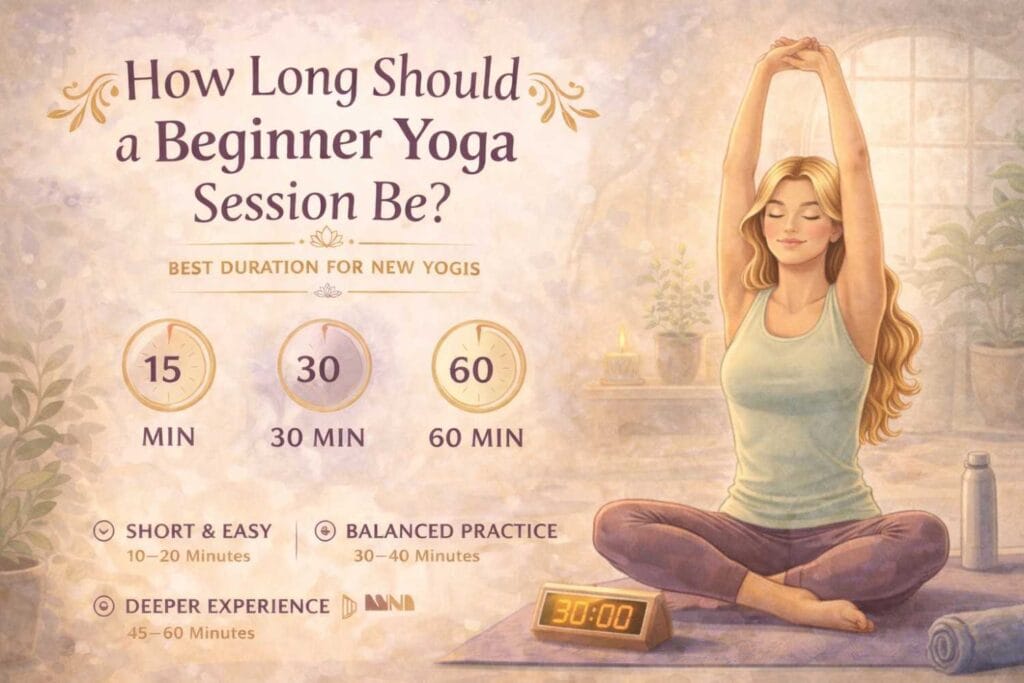
Even 15–20 minutes of attentive practice can be sufficient in the early stages.
This may include:
- Simple movement
- Basic postures
- A few minutes of stillness
The key is not what is included, but how it is done.
A short, consistent practice creates a stronger foundation than occasional long sessions.
Why Consistency Matters More Than Length
The Bhagavad Gita emphasizes moderation and balance in daily life. This applies directly to practice.
Practicing a little every day creates rhythm.
Practicing for long durations occasionally creates fluctuation.
The body and mind respond better to regularity than to intensity.
This is why a beginner benefits more from:
- Daily 20-minute sessions
than - Irregular 60-minute sessions
The Natural Expansion of Duration
As the body becomes familiar and attention becomes steadier, duration increases naturally.
This increase does not need to be forced.
When practice feels stable, extending the session becomes effortless.
This may move from:
- 20 minutes → 30 minutes
- 30 minutes → 45 minutes
But this progression should follow comfort and stability, not ambition.
The Role of Breath in Determining Duration
The Hatha Yoga Pradipika highlights the connection between breath and internal balance.
Breath becomes an indicator of how long the practice should continue.
If breathing becomes strained or irregular, it is a sign that the session has exceeded its natural limit.
If breathing remains steady, the practice is still within a supportive range.
Signs That the Session Is Too Long
A beginner may not always recognize when the duration is excessive.
Some indicators include:
- Loss of focus
- Physical strain
- Forced breathing
- Desire to finish quickly
When these appear, the quality of practice reduces.
Continuing beyond this point does not add benefit.
Signs That the Duration Is Appropriate
When the session length is suitable:
- Movement feels steady
- Breath remains natural
- Attention stays present
- The body does not resist
The session ends with a sense of completion, not exhaustion.
The Importance of Ending at the Right Time
Ending the session at the right point is as important as starting it.
If the practice ends when the body and mind are still balanced, it leaves a positive impression.
This encourages continuity.
If it ends in fatigue, the next session feels like a burden.
Morning vs Evening Duration
The time of day also influences how long a session should be.
In the morning, the body is relatively fresh, and slightly longer sessions may feel natural.
In the evening, energy levels may vary, and shorter sessions may be more suitable.
The duration should adapt to the condition of the body, not follow a fixed rule.
Yoga Is Not Measured in Minutes
One of the key shifts for a beginner is understanding that Yoga is not measured the way other activities are.
It is not about completing a certain number of minutes.
It is about:
- Stability
- Awareness
- Continuity
When these are present, even a short session becomes meaningful.
Practical Starting Structure
A beginner session can be simple:
- 5 minutes of gentle movement
- 10–15 minutes of postures
- 5 minutes of stillness or breath observation
This creates a balanced session without overwhelming the body.
The Role of Discipline Without Rigidity
Discipline is necessary, but it should not become rigid.
Fixing a time for practice helps build consistency.
But forcing duration beyond capacity creates resistance.
Balance lies between structure and flexibility.
When to Increase Duration
Duration can be increased when:
- The current session feels stable
- Breath remains steady
- There is no fatigue
The increase should be gradual, not sudden.
The Mistake of Comparing with Others
Beginners often compare their practice with others.
They see longer sessions and assume that they should match them.
But Yoga is not comparative.
Each body, each mind, each stage of practice is different.
Duration should be based on personal capacity, not external reference.
The Deeper Meaning of Duration
Over time, the question of duration changes.
It is no longer about how long you practice, but how continuously awareness is maintained.
Even outside formal sessions, this awareness begins to extend into daily activity.
At that point, practice is no longer limited to a specific time frame.
The length of a beginner Yoga session is not defined by a fixed number of minutes, but by how well the body, breath, and attention remain aligned during practice. Starting with a shorter, manageable duration allows the system to adapt gradually, creating a foundation that supports consistency rather than strain.
The guidance reflected in ancient texts consistently points toward balance, steadiness, and moderation. When applied to practice, this means choosing a duration that can be sustained regularly, without forcing the body or losing attention.
With time, as familiarity grows and stability develops, duration naturally expands. But in the beginning, it is not the length of the session that shapes the practice, it is the quality of presence within it.