
Explore Chapter 2 of the Bhagavad Gita – Sankhya Yoga, the Yoga of Knowledge. Understand the eternal Self (Atman), detached action, and the path to inner stability through authentic teachings and deep explanation.
The Beginning of True Teaching
As the battlefield of Kurukshetra stands silent between two armies, Sanjaya describes Arjuna – his eyes filled with tears, his mind shaken, his body refusing to act. At that moment, Krishna finally begins to speak.
Translation (2.1–2.3):
Sanjaya said: Seeing Arjuna overwhelmed with pity and sorrow, Krishna spoke these words:
“O Arjuna, from where has this weakness come upon you in this hour of crisis? It is not worthy of you. It does not lead to honor, but to disgrace. Do not yield to this weakness. Rise, O destroyer of enemies.”
Krishna does not console Arjuna. He does not validate his emotions. Instead, He challenges him. This is the first shift in Sankhya Yoga, truth is not always gentle. Sometimes, it cuts through illusion.
Arjuna is not weak because he feels grief. He is weak because he is confused about dharma.
Arjuna Surrenders
Arjuna, still conflicted, responds not with argument, but surrender.
Translation (2.4–2.7):
“How can I fight against Bhishma and Drona, who are worthy of worship? My nature is overcome by weakness. I am confused about my duty. I ask You, tell me what is right. I am Your disciple.”
This is the turning point. In the first chapter, Arjuna speaks as a warrior. Here, he speaks as a seeker.
Sankhya Yoga begins not with knowledge, but with accepting that you do not know.
The First Teaching: The Wise Do Not Grieve
Krishna begins with a statement that appears almost harsh.
Translation (2.11):
“You grieve for those who should not be grieved for, yet you speak words of wisdom. The wise do not grieve for the living or the dead.”
This is not a denial of emotion, it is a correction of perception.
Grief arises when we mistake the temporary for the permanent.
The Eternal Nature of the Self
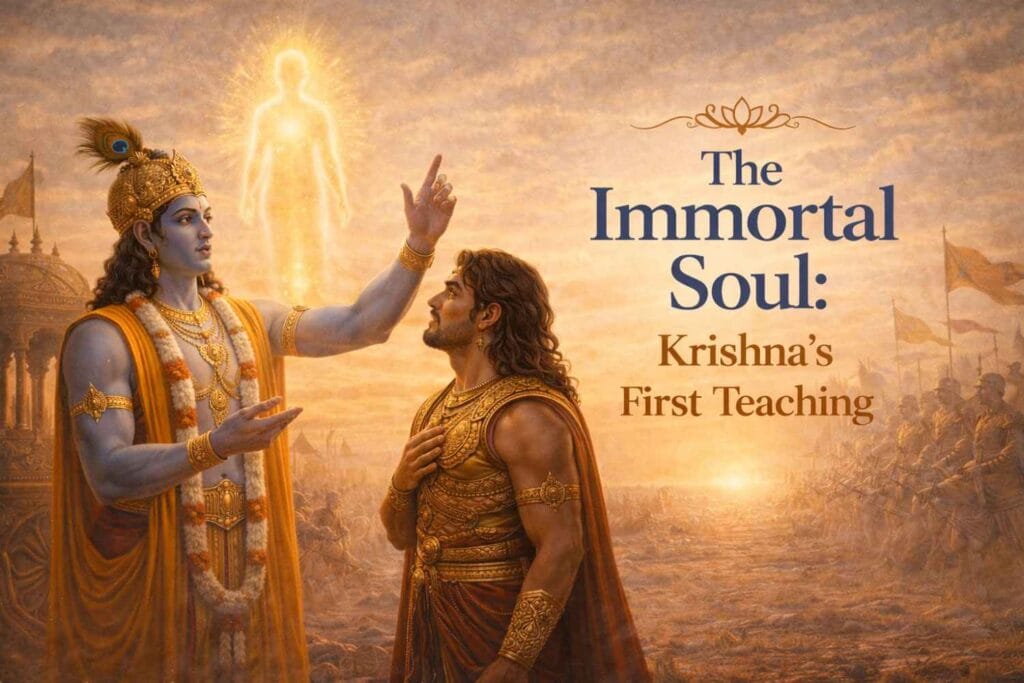
Krishna now reveals the foundation of Sankhya, knowledge of the Self.
Translation (2.12–2.13):
“Never was there a time when I did not exist, nor you, nor all these kings. Nor will any of us cease to exist in the future. Just as the body passes through childhood, youth, and old age, the soul passes into another body.”
Here, Krishna removes the fear of death, not by comforting Arjuna, but by revealing truth.
The Self (Atman) does not begin. It does not end.
The body changes, but the one who witnesses the change remains.
Death is Only a Transition
Krishna deepens this understanding with a powerful analogy.
Translation (2.22):
“As a person casts off worn-out garments and puts on new ones, so the soul discards old bodies and takes on new ones.”
This single idea shifts the entire perspective of life.
Death is not destruction. It is continuity in another form.
What Arjuna fears is not real loss, but change.
The Indestructible Atman
Krishna continues, removing every possible doubt.
Translation (2.23–2.24):
“The soul cannot be cut by weapons, burned by fire, wetted by water, or dried by wind. It is eternal, unchanging, and indestructible.”
This is not philosophy for debate. It is meant to stabilize the mind.
If the Self cannot be destroyed, then fear loses its foundation.
Duty Beyond Emotion
Now Krishna brings Arjuna back to the battlefield, not emotionally, but logically.
Translation (2.31–2.33):
“For a warrior, nothing is higher than a righteous battle. If you do not fight this dharma-yuddha, you will incur sin and lose your honor.”
This is where Sankhya Yoga becomes practical.
Knowledge is not meant to escape life, it is meant to guide action within it.
Arjuna’s role is not random. It is part of a larger order.
The Balance of Opposites
Krishna introduces a crucial discipline of the mind.
Translation (2.14–2.15):
“Pleasure and pain, heat and cold, they come and go. Endure them. One who remains steady in these is fit for immortality.”
Life moves in dualities.
- Gain and loss
- Victory and defeat
- Joy and sorrow
Sankhya Yoga does not remove these, it teaches you to stand steady within them.
Karma Without Attachment
Now comes one of the most defining teachings of the Gita.
Translation (2.47):
“You have a right to action alone, never to its fruits. Do not be motivated by results, nor attached to inaction.”
This is the beginning of Karma Yoga, but rooted in Sankhya.
Action is necessary. Attachment is optional.
When action is tied to result:
- Fear arises
- Anxiety increases
- Clarity disappears
When action is done with understanding:
- The mind becomes free
The Steady Mind (Sthitaprajna)
Arjuna now asks a deeper question.
What does a realized person look like?
Krishna answers not with appearance, but with inner state.
Translation (2.55–2.57):
“When a person gives up all desires and is satisfied within the Self, he is steady in wisdom. He is not disturbed by sorrow, nor attached to pleasure, free from fear and anger.”
This is not suppression.
This is independence from emotional fluctuation.
The Chain of Downfall
Krishna explains the psychology of suffering.
Translation (2.62–2.63):
“Thinking of sense objects leads to attachment. From attachment comes desire, from desire anger, from anger delusion, from delusion loss of memory, from loss of memory destruction of intelligence, and from that one falls.”
This is one of the most practical teachings in the entire Gita.
Every disturbance begins subtly, with attention.
Where attention goes, attachment follows.
Mastery Over the Senses
Krishna gives a simple but powerful image.
Translation (2.58):
“As a tortoise withdraws its limbs, one who withdraws the senses from objects is established in wisdom.”
Control is not forced repression.
It is the ability to withdraw when needed.
The State of Inner Stability
Krishna describes the final state of one established in knowledge.
Translation (2.70):
“As rivers flow into the ocean, yet the ocean remains undisturbed, so is the one into whom desires enter, yet he remains steady.”
Desires may arise.
But they do not disturb.
That is freedom.
The Final Realization
Krishna concludes this teaching with a profound statement.
Translation (2.72):
“This is the state of Brahman. Attaining this, one is never deluded. Established in this even at death, one attains liberation.”
Sankhya Yoga is not just knowledge.
It is clarity that liberates.
Deeper Explanation: What This Chapter Really Does
Chapter 2 of the Bhagavad Gita does not simply continue the narrative of the Mahabharata: it transforms it. The first chapter leaves us in the turbulence of Arjuna’s inner collapse, where perception is shaped entirely by emotion. He looks at the battlefield and does not see a field of duty; he sees teachers, elders, relatives, and loved ones. His vision is personal, relational, and deeply conditioned by attachment. Every thought he expresses arises from this emotional lens, and therefore every conclusion he reaches is clouded, however noble it may appear on the surface.
With the beginning of Sankhya Yoga, Krishna does not alter the external situation; the battlefield remains the same, the warriors stand where they stood, and the inevitability of conflict has not changed. What Krishna changes is Arjuna’s way of seeing. This is the real turning point. The problem was never the war alone, it was the framework through which Arjuna was interpreting it. Where Arjuna sees loss, Krishna introduces continuity. Where Arjuna sees destruction, Krishna reveals transformation. Where Arjuna sees moral paralysis, Krishna establishes clarity rooted in dharma.
At the heart of Arjuna’s confusion lies a fundamental misidentification. He takes the temporary to be permanent and the perishable to be the essence of existence. By identifying the Self with the body, relationships, and roles, he experiences fear, grief, and hesitation. This is not merely Arjuna’s condition; it reflects a universal human tendency. When identity is tied to what changes, instability becomes inevitable. Emotions rise and fall with circumstances, and judgment becomes dependent on personal attachment rather than truth.
Krishna’s response is not motivational or emotional, it is ontological. He reorients Arjuna by establishing a deeper understanding of reality itself. First, He separates the Self from the body, making it clear that what is truly “you” is not subject to birth or death. The body undergoes change, decay, and eventual dissolution, but the witnessing consciousness, the Atman, remains untouched. This distinction alone begins to dissolve the intensity of fear, because what Arjuna believes he is about to lose is no longer seen as ultimately real.
Second, Krishna establishes the eternal nature of the Self. Existence is not fragmented into beginnings and endings as the mind perceives it; rather, it is continuous. What appears as death is simply transition, a change in form rather than a cessation of being. This insight does not remove the gravity of action, but it removes the illusion that action results in absolute annihilation. It shifts the axis of understanding from the visible to the essential.
Finally, Krishna brings Arjuna back to action, but now grounded in clarity rather than confusion. Action, He explains, must arise from dharma, not from fluctuating emotional states. Emotion, while real, is not a reliable guide for right action because it is influenced by attachment and fear. Dharma, on the other hand, is rooted in order, responsibility, and truth beyond personal preference. When action aligns with dharma, it becomes steady, purposeful, and free from inner conflict.
What Chapter 2 ultimately accomplishes is a reconfiguration of consciousness. It moves Arjuna from a reactive state to a reflective one, from emotional entanglement to discriminative understanding. The battlefield does not disappear, nor does the necessity of action, but the inner chaos that once made action impossible begins to dissolve. In its place arises a clarity that is not dependent on outcome, approval, or personal comfort.
Once these truths are even partially understood, everything begins to shift. Fear loosens its grip because it is no longer rooted in absolute loss. Attachment softens because identity is no longer confined to transient forms. Action becomes possible again, not as compulsion, but as conscious participation in a larger order. Sankhya Yoga, therefore, is not merely philosophical instruction; it is the restoration of right vision, without which no path, whether of action, devotion, or meditation, can truly begin.
The Real Meaning of Sankhya Yoga
Within Chapter 2 of the Bhagavad Gita, Sankhya Yoga is often misunderstood as mere philosophical analysis or intellectual categorization of reality. However, in its true sense, Sankhya is not about accumulating concepts, it is about refining perception. It is the shift from thinking about truth to directly seeing it. Krishna does not intend to make Arjuna a philosopher; He intends to make him clear.
This clarity is not abstract. It is deeply practical and transformative. Sankhya Yoga teaches the discipline of discrimination, the ability to distinguish between what is changing and what is constant, what is assumed and what is real. Without this discrimination, the mind becomes entangled in appearances; with it, the same world is seen in an entirely different light.
At its core, Sankhya is clear seeing, and this clarity unfolds through a few fundamental recognitions:
- The difference between the body and the Self: The body is subject to time, change, and decay, while the Self remains constant, witnessing all changes without being altered by them. Confusion begins when these two are taken to be the same.
- The difference between duty (dharma) and desire: Desire arises from personal inclination, attachment, and expectation, whereas dharma arises from alignment with a larger order. Acting from desire binds; acting from dharma liberates.
- The difference between action and attachment: Action is unavoidable and necessary, but attachment to the results of action creates inner disturbance. Sankhya does not deny action, it purifies the intention behind it.
When this level of clarity begins to arise, its effects are not theoretical, they are immediately experiential.
- Fear begins to reduce, because it is largely rooted in misidentification with what is temporary.
- Confusion starts to dissolve, as perception is no longer clouded by emotional bias and attachment.
- Action becomes natural and unforced, because it flows from understanding rather than compulsion or hesitation.
In this way, Sankhya Yoga becomes the foundation upon which all other paths in the Gita rest. Without clear seeing, action becomes restless, devotion becomes emotional dependence, and meditation becomes unstable. But when clarity is established, every path gains direction and depth.
Sankhya, therefore, is not an escape from life, it is the ability to see life as it truly is, and to act within it with steadiness, intelligence, and inner freedom.
Reflection for the Reader
Sankhya Yoga, as revealed in the Bhagavad Gita, does not begin by changing the outer conditions of life. The battlefield remains, responsibilities remain, and challenges do not disappear. What it transforms is something far more fundamental, the lens through which life is perceived. Most human struggle does not arise solely from circumstances, but from the way those circumstances are interpreted. When perception is shaped by attachment, fear, and misidentification, even ordinary situations become sources of inner conflict.
Sankhya Yoga invites a quiet but profound shift. It asks the reader to look inward and examine: What am I truly identifying with? Is it the changing roles, relationships, and outcomes, or something deeper that remains constant through all experiences? When this inquiry becomes sincere, a subtle distance begins to form between the observer and the observed. Thoughts, emotions, and reactions are no longer absolute, they are seen, understood, and gradually mastered.
This shift does not make life passive or indifferent. Instead, it brings a sense of steadiness. One begins to act not out of compulsion or emotional turbulence, but out of clarity. The same life continues, but the inner experience of it becomes lighter, more grounded, and more intentional. In this way, Sankhya Yoga does not remove life’s complexity, it enables one to move through it with understanding.
Conclusion
Chapter 2 of the Bhagavad Gita stands as the philosophical and spiritual foundation of the entire teaching. Within this single chapter, Krishna establishes the essential principles upon which all later paths, whether of action, devotion, or meditation, are built.
It introduces, with remarkable precision, the core dimensions of spiritual understanding:
- The immortality of the Self, which removes the fundamental fear of loss and death
- The discipline of the mind, which brings stability amidst the fluctuations of life
- The path of detached action, which allows one to act fully without inner bondage
- The state of steady wisdom (Sthitaprajna), which represents the culmination of inner balance
Every subsequent teaching in the Gita is, in many ways, an expansion or deepening of these insights. Without this foundation, the rest cannot be fully grasped.
Arjuna, at the beginning of this chapter, stands in complete inner disarray, confused, overwhelmed, and unable to act. Krishna does not change the external situation, nor does He offer temporary consolation. Instead, He restores something far more essential, right vision. By revealing the nature of the Self, the structure of reality, and the role of dharma, He reorients Arjuna’s entire understanding.
And this is the lasting message of Sankhya Yoga: when vision becomes clear, action no longer needs to be forced. It arises naturally, aligned with truth rather than driven by confusion. The outer world may remain the same, but the one who moves within it is no longer the same.
Also read: Chapter 1: Arjuna Vishada Yoga – The Grief of Arjuna