
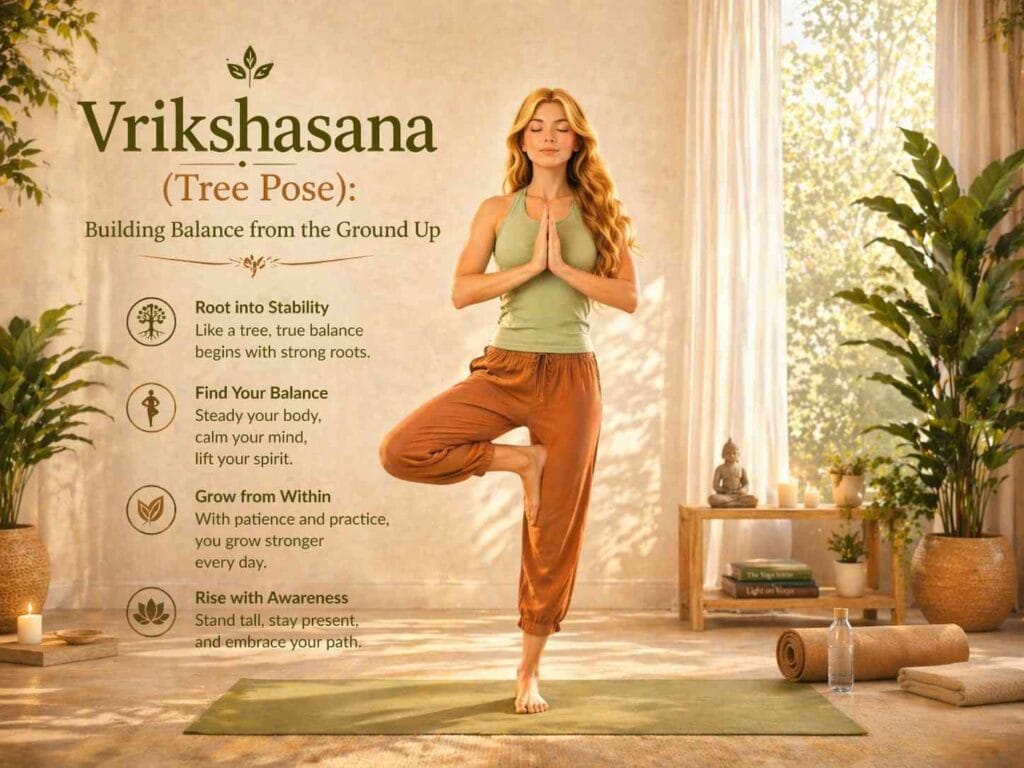
Learn Vrikshasana (Tree Pose) with step-by-step guidance, benefits, and deeper yogic meaning. Discover how this posture builds balance, focus, and inner stability.
The Deeper Meaning of Balance
In modern practice, balance is often understood as a physical ability, the capacity to remain steady without falling. But within the broader framework of yoga, balance is not limited to the body. It reflects the condition of the mind.
In the Yoga Sutras of Patanjali, instability of the mind is described through constant fluctuations (vrittis). These fluctuations do not remain confined to thought, they express themselves through the body.
Restlessness in the mind becomes instability in posture.
Distraction in attention becomes imbalance in movement.
Vrikshasana, or Tree Pose, is not simply a posture, it is a direct encounter with this relationship. The body becomes a mirror of the mind.
Why Tree Pose Is Foundational
Vrikshasana appears simple, yet it reveals fundamental aspects of practice. Standing on one leg removes the natural stability that is usually taken for granted. What remains is a need for alignment, attention, and subtle adjustment. The pose does not allow distraction. Even a slight shift in attention can disturb balance. This immediacy makes Vrikshasana a powerful tool for developing awareness.
Unlike complex postures that rely on strength or flexibility, Tree Pose depends primarily on stability of attention. This aligns closely with the principles described in the Yoga Sutras of Patanjali, where steadiness (sthira) and ease (sukha) define the quality of posture.
How to Practice Vrikshasana (Tree Pose)
Begin in a steady standing position with weight evenly distributed. Shift your weight onto one leg and gently place the opposite foot on the inner calf or thigh (avoid the knee). Let the standing leg remain firm but not rigid.
Bring the palms together at the chest and fix your gaze on a single point to stabilize attention. Keep the spine tall, shoulders relaxed, and breath natural.
Hold the posture with ease, making small adjustments rather than forcing stillness. If balance is lost, return without frustration and begin again.
Lower the foot slowly, pause, and repeat on the other side.
The focus is not on how long you hold the pose, but how steadily you remain aware within it.
The Grounding: Where Balance Begins
Balance does not begin in the lifted leg, it begins in the standing one. The foot connects to the ground. This connection is not passive. It requires active engagement. The weight is distributed evenly. The toes are relaxed yet responsive. The ankle stabilizes, and the leg supports without rigidity. This grounding establishes the foundation. Without it, the upper body cannot remain steady.
There is a parallel here. Just as physical balance begins from the ground, mental stability begins from awareness. Without a stable base, attention fluctuates. The pose teaches that stability is built from below, not imposed from above.
The Role of Alignment
Once the base is established, alignment becomes essential. The pelvis must remain neutral. The spine lengthens naturally. The head stays aligned above the body. There is no force.
Balance is not achieved by tightening the body, but by aligning it. Excess tension disrupts equilibrium. Insufficient engagement leads to collapse. The body finds a middle point.
This reflects a deeper principle in yoga, the balance between effort and ease.
Too much effort creates strain.
Too little effort creates instability.
True steadiness lies between these extremes.
The Lifted Leg: Stability Without Strain
The lifted foot is placed against the standing leg, either at the calf or thigh. This placement is not about height. It is about stability. The pressure between the foot and the leg creates a point of support. Both sides engage equally.
There is a subtle lesson here. Support is not one-sided. Balance emerges through mutual engagement.
The body is not held rigidly. It is responsive.
The Role of Drishti (Focused Gaze)
One of the most important aspects of Vrikshasana is the gaze. Fixing the eyes on a single point stabilizes attention. This is known as drishti. When the gaze is steady, the mind follows.
If the eyes wander, the mind becomes distracted, and the body reflects this through instability.
This demonstrates a direct connection:
Attention influences posture.
In the Yoga Sutras of Patanjali, concentration (dharana) is described as the ability to hold attention steadily. Vrikshasana becomes a practical expression of this principle.
The Mind in Balance
While holding the posture, the movements of the mind become visible.
Thoughts arise:
- anticipation of losing balance
- frustration when instability appears
- distraction from external stimuli
These are not separate from the pose, they are part of it. The instruction is not to eliminate these movements, but to observe them. As attention returns to the present moment, the body stabilizes. Balance is not achieved by controlling every movement. It emerges when attention becomes steady.
Falling and Returning
In Vrikshasana, losing balance is common. This is not failure, it is feedback. Each time balance is lost, it reveals a moment of distraction or misalignment.
Returning to the pose becomes part of the practice. This repetition builds awareness.
Over time, the duration of steadiness increases, not because the body becomes rigid, but because attention becomes more consistent.
Breath and Stability
Breath plays a quiet but important role. When the breath is irregular, the body becomes tense. When it is steady, the posture becomes more stable.
There is no need to control the breath forcefully. Simply observing it allows it to settle. As the breath stabilizes, the nervous system relaxes. This supports balance.
From Physical Balance to Inner Stability
The value of Vrikshasana extends beyond the posture.
It trains:
- attention
- patience
- awareness of subtle shifts
These qualities are not limited to practice, they influence daily life. Situations that require steadiness, clarity, and balance benefit from the same principles. The posture becomes a training ground.
The Principle of Sthira and Sukha
In the Yoga Sutras of Patanjali, posture is defined as steady and comfortable (sthira sukham asanam).
Vrikshasana embodies this.
Steadiness without tension.
Ease without collapse.
This balance is not achieved instantly. It develops through practice.
Common Misunderstandings
Tree Pose is often approached as a challenge of endurance or strength.
But forcing the body to remain still does not create true balance.
Balance arises from:
- alignment
- attention
- relaxation within effort
Trying to “hold” the pose often leads to instability.
Allowing the pose to stabilize through awareness leads to steadiness.
Application in Daily Life
The principles learned in Vrikshasana extend naturally.
Balance in life requires:
- grounding
- clarity
- steady attention
Just as in the posture, external conditions may not always be stable.
Inner steadiness becomes essential.
Vrikshasana is more than a physical posture. It is a study of balance, both in the body and in the mind.
Through grounding, alignment, and attention, it reveals the connection between physical stability and mental clarity. Balance is not forced.It is developed.
And as it develops, it extends beyond the mat into everyday life.