Explore the Hatha Yoga Pradipika, its meaning, structure, and role in classical yoga. Understand how body, breath, and mind are prepared for deeper awareness.
Introduction
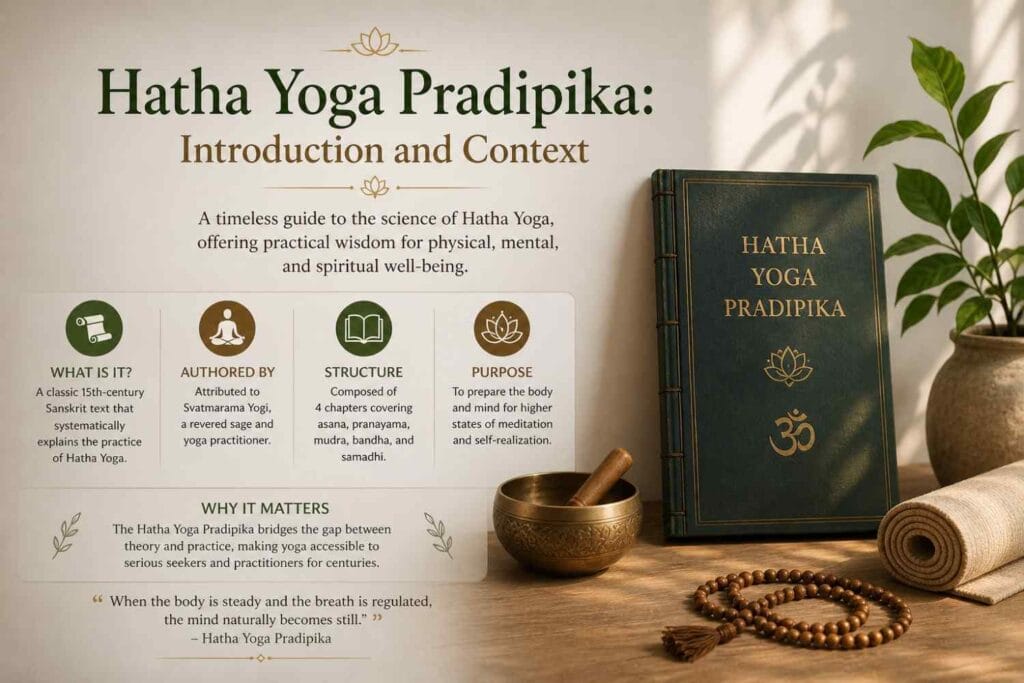
The Hatha Yoga Pradipika holds a central place in the development of Haṭha Yoga as a structured discipline. Compiled by Swami Swatmarama, the text does not merely present isolated practices, it organizes them into a coherent system. This distinction is important.
Many approaches to yoga today present techniques independently, postures, breathing exercises, or meditation methods practiced without a clear progression. The Hatha Yoga Pradipika takes a different approach. It presents these elements as interconnected stages, each preparing the ground for the next.
Āsana prepares the body for stability.
Prāṇāyāma refines the movement of breath and energy.
Mudrā directs and stabilizes internal processes.
Samādhi represents the culmination in meditative absorption.
This sequence reflects a deliberate methodology.
The purpose of the text is not limited to improving physical condition. Physical practices are included, but they are not the final objective. They function as preparatory steps that support a deeper transformation.
The underlying aim is inner stability.
Without this stability, higher practices remain inconsistent. With it, the transition from physical practice to meditative clarity becomes more natural.
The Place of Haṭha Yoga in the Yogic Tradition
To understand the role of Haṭha Yoga, it is necessary to place it within the broader framework of classical yoga.
In the Yoga Sutras of Patanjali, yoga is defined as the stilling of mental fluctuations. The focus is on the mind, its movements, its patterns, and its eventual stabilization. However, the Yoga Sutras primarily describe the goal and the internal process.
The Hatha Yoga Pradipika addresses a different question:
What prepares the practitioner for that goal?
Haṭha Yoga recognizes that the mind does not function independently of the body and breath. Physical tension, irregular breathing, and instability in the nervous system directly affect mental clarity. Attempting to stabilize the mind without addressing these factors often leads to inconsistency.
For this reason, Haṭha Yoga emphasizes preparation. It works through the body and breath to create conditions in which the mind can settle more naturally. It does not replace the goal described in the Yoga Sutras, it supports it.
In this sense, Haṭha Yoga functions as a foundation. It aligns the physical and energetic aspects of the system so that deeper states of meditation are not only possible, but sustainable.
Meaning of “Haṭha Yoga”
The term Haṭha Yoga is frequently interpreted as forceful or effort-driven practice. This interpretation arises from a superficial reading of the word.
In classical understanding, the meaning is more nuanced.
- Ha represents the sun – associated with activity, heat, and outward movement
- Tha represents the moon – associated with calmness, cooling, and inward movement
Haṭha Yoga is the process of bringing these two into balance. This balance is not symbolic in an abstract sense. It reflects observable tendencies within the body and mind. There are periods of activity and rest, effort and ease, stimulation and stillness. When these remain unbalanced, the system becomes either agitated or dull. The practices described in the Hatha Yoga Pradipika are designed to regulate these fluctuations.
Through posture, breath, and internal techniques, the practitioner begins to experience a more balanced state. This balance supports both physical health and mental clarity. Importantly, Haṭha Yoga does not rely on force to achieve this balance. It relies on method. Effort is applied, but it is measured and guided. The aim is not to dominate the body or mind, but to align them.
When this alignment is established, stability arises, not as a result of suppression, but as a natural outcome of balance.
Structure of the Hatha Yoga Pradipika
The Hatha Yoga Pradipika is organized into four chapters, each representing a stage in the refinement of the practitioner. This structure is deliberate and reflects a progression from the more tangible aspects of practice toward increasingly subtle states.
Āsana (Posture) forms the starting point. The emphasis here is not on variety or complexity, but on stability. The postures are intended to prepare the body, reducing restlessness, improving endurance, and creating a foundation for sitting steadily over time. The aim is not performance, but readiness.
Prāṇāyāma (Breath Regulation) follows once the body is prepared. At this stage, attention shifts from the physical structure to the movement of breath. The practices described are systematic and require gradual development. Their purpose is to regulate prāṇa and reduce internal fluctuations that affect the mind.
Mudrā and Bandha (Energy Practices) introduce a more refined level of work. These techniques are designed to influence internal processes that are not immediately visible. They direct and stabilize the flow of energy within the system, supporting deeper levels of stillness.
Samādhi (Absorption) represents the culmination of the process. It is not presented as something separate from the earlier stages, but as their natural outcome. When the body is stable, the breath regulated, and the internal system balanced, the mind becomes capable of sustained stillness.
This progression, from physical to subtle, is central to the text. Practices are not presented randomly. Each stage supports the next. The practitioner is guided step by step, moving from external preparation toward internal stability.
The Role of the Body in Haṭha Yoga
A defining aspect of Haṭha Yoga is its recognition of the body as an essential part of the practice. The body is not treated as something to be overcome or ignored. It is understood as an instrument through which stability can be developed. If the body is tense, restless, or fatigued, the mind reflects these conditions. Physical discomfort leads to distraction, and irregularity in posture affects the ability to remain steady.
For this reason, the text begins with āsana. Through posture, the body is gradually conditioned to remain stable without strain. This stability is not rigid, it is relaxed and sustainable.
Once the body is prepared, prāṇāyāma refines the breath. Together, these two create a supportive condition in which the mind can settle more naturally. Rather than forcing mental stillness directly, Haṭha Yoga approaches it indirectly, by addressing the factors that influence it.
The Central Role of Prāṇa
One of the distinguishing features of Haṭha Yoga is its emphasis on prāṇa, the vital force underlying all physiological and mental activity.
The text establishes a direct relationship:
When prāṇa is unsteady, the mind is unsteady.
When prāṇa is steady, the mind becomes steady.
This relationship explains the central role of prāṇāyāma. Breath is the most accessible expression of prāṇa. By regulating the breath, the practitioner influences the movement of this vital force.
Prāṇāyāma is therefore not limited to respiratory exercise. It is a method of altering the internal condition of the system. As the breath becomes more even and controlled, fluctuations in the mind begin to reduce. This creates a more stable foundation for deeper practices.
Discipline and Method
The Hatha Yoga Pradipika places strong emphasis on discipline. Progress is not described as immediate or spontaneous. It is presented as the result of consistent, structured effort.
The text highlights several essential conditions:
- moderation in lifestyle
- regularity in practice
- appropriate guidance
These are not optional additions. They are integral to the method. Irregular practice leads to inconsistent results. Excessive effort leads to imbalance. Lack of guidance can result in misunderstanding or misuse of techniques. The text therefore presents practice as a sustained process, one that develops gradually through repetition and attention.
Common Misunderstandings
In modern contexts, Haṭha Yoga is often reduced to physical postures. This interpretation captures only a portion of the system. While āsana is an important entry point, it is not the entirety of the practice. The text gives equal, if not greater, importance to prāṇāyāma, mudrā, and the development of meditative stability.
Another common misunderstanding is viewing Haṭha Yoga as separate from other yogic paths. In classical understanding, it is preparatory. It provides the necessary stability for the mind, making it possible to engage in deeper practices described in texts such as the Yoga Sutras of Patanjali.
Seen in this way, Haṭha Yoga is not an independent system with a separate goal. It is a structured approach that supports the broader aim of yoga, clarity, steadiness, and inner stillness.
The Relationship Between Effort and Ease
In the Hatha Yoga Pradipika, practice is presented as disciplined, but not forceful. This distinction is essential. Effort is required, but it is not applied indiscriminately. It is measured, progressive, and guided by awareness. Each practice, whether posture, breath, or internal technique, is approached according to capacity, not ambition.
When effort is excessive or unregulated, it leads to tension. The body becomes strained, the breath becomes irregular, and the mind becomes agitated. In such a condition, the purpose of practice is compromised. At the same time, the absence of effort leads to stagnation. Without engagement, there is no development. The system remains unchanged, and stability does not deepen.
This establishes a necessary balance:
Effort provides direction.
Awareness provides regulation.
When effort is guided by awareness, practice becomes sustainable. Progress is gradual, but consistent. The practitioner learns to adjust intensity, maintain steadiness, and avoid extremes. This balance is not fixed. It is observed and refined over time. The ability to recognize when to apply effort and when to ease it becomes part of the practice itself.
Relevance in Modern Practice
The relevance of the Hatha Yoga Pradipika remains particularly strong in the context of modern life.
Contemporary patterns often create a clear imbalance. Physical activity is reduced, while mental activity is continuous. The body remains inactive for extended periods, while the mind remains engaged with constant input. This imbalance affects both physical and mental stability.
Tension accumulates in the body, breathing becomes shallow or irregular, and attention becomes fragmented. Attempts to address mental restlessness directly often prove inconsistent because the underlying physical and energetic conditions remain unaddressed.
Haṭha Yoga offers a structured response to this condition.
By working with the body through āsana, it restores movement and stability. By regulating the breath through prāṇāyāma, it influences the internal state more directly. These practices do not act in isolation. They create a foundation that supports mental clarity.
Even when adapted for contemporary settings, the underlying principles remain applicable. The emphasis on balance, regularity, and gradual progression continues to provide a reliable framework.
The Hatha Yoga Pradipika is not simply a collection of techniques. It is a structured presentation of preparation. It recognizes that clarity of mind is not independent of the body and breath. Instability at these levels reflects directly in the mind. Therefore, the approach begins with aligning these foundational aspects.
Through posture, the body is stabilized.
Through breath, internal fluctuations are regulated.
Through continued practice, the system becomes more balanced.
From this balance, deeper awareness becomes accessible.
Haṭha Yoga, in this sense, is not separate from meditation. It supports it.
It creates the conditions in which steadiness is no longer forced, but arises naturally through alignment and understanding.