
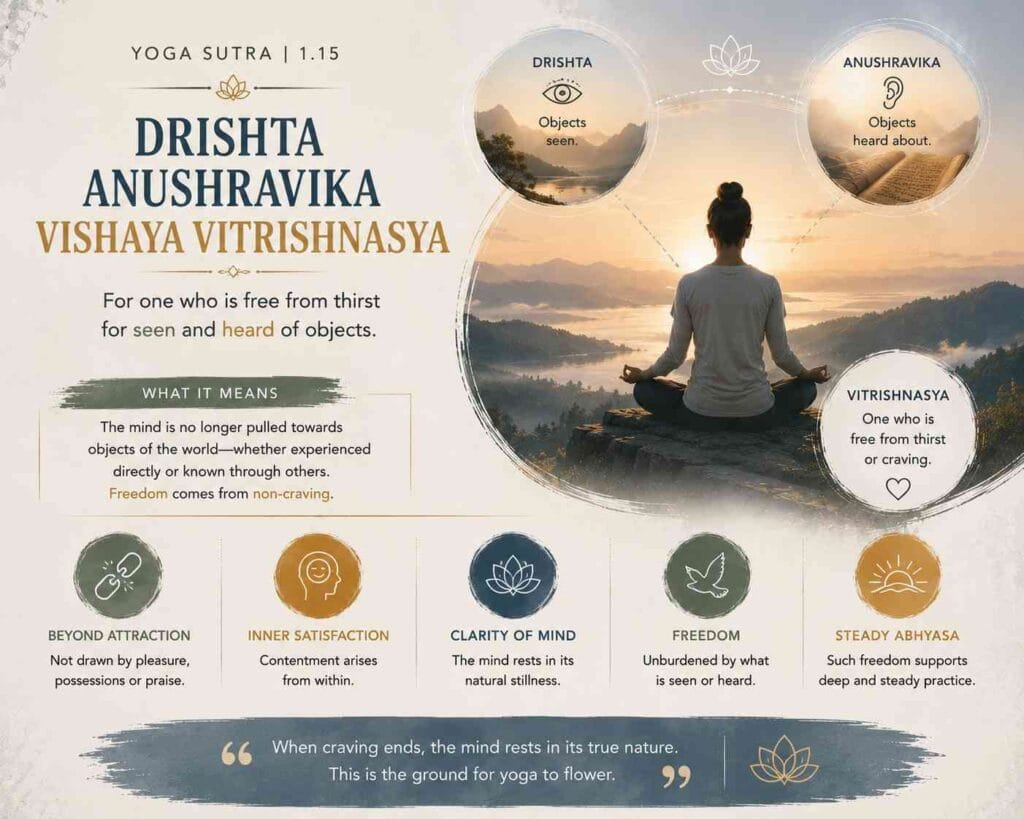
Explore Yoga Sutra 1.15 of Patanjali in depth and understand the true meaning of vairāgya (non-attachment), craving, psychological freedom, and inner steadiness through authentic yogic philosophy and classical interpretation.
Sutra 1.15 – दृष्टानुश्रविकविषयवितृष्णस्य वशीकारसंज्ञा वैराग्यम्
Dṛṣṭānuśravika-viṣaya-vitr̥ṣṇasya vaśīkāra-saṁjñā vairāgyam
Translation
“Vairāgya (non-attachment) is the state of mastery in one who has become free from craving toward objects experienced directly or described through tradition and scripture.”
Literal Breakdown of the Sutra
- Dṛṣṭa – seen, directly experienced
- Anuśravika – heard about through scripture, tradition, testimony, or teachings
- Viṣaya – objects of experience, sensory objects, experiences of enjoyment
- Vitr̥ṣṇasya – free from thirst, craving, longing, or compulsive desire
- Vaśīkāra – mastery, control, inner governing power
- Saṁjñā – known as, designated as
- Vairāgyam – non-attachment, dispassion, freedom from compulsive attachment
Introduction
In the previous sutras of the Yoga Sutras of Patanjali, Patañjali explains that the fluctuations of the mind (vṛttis) are regulated through two essential disciplines:
abhyāsa – sustained practice
and
vairāgya – non-attachment.
After defining abhyāsa carefully in the earlier sutras, Patañjali now turns toward a deeper explanation of vairāgya itself. This transition is extremely important because it reveals something profound about the nature of human suffering and mental restlessness.
The mind does not become disturbed only because thoughts exist or because concentration is weak. Much of inner disturbance arises because consciousness becomes emotionally entangled in craving, attachment, fear, expectation, emotional dependence, and the constant search for fulfillment through external experience.
A person may meditate sincerely every day, follow disciplined spiritual routines consistently, and appear calm externally, yet internally still remain deeply attached to: pleasure, recognition, success, sensory gratification, validation, emotional security, achievement, comparison, or imagined future fulfillment.
As long as awareness remains continuously pulled outward by craving and emotional fixation, lasting steadiness becomes difficult.
This is why Patañjali introduces vairāgya immediately after discussing practice. Practice alone is not enough if attachment continues operating unconsciously within the mind. A person may develop concentration while still remaining psychologically bound by desire, fear, egoic striving, or emotional dependence upon outcomes.
In such a condition, the mind may become disciplined in certain ways while still remaining inwardly disturbed.
The Hidden Movement of Craving
Ordinarily, the mind continuously seeks completion through external conditions.
It assumes: “If I achieve this…” “If I obtain this…” “If I become this…” “Then I will finally feel fulfilled.”
This psychological movement operates constantly beneath ordinary mental activity. The mind moves toward pleasure and away from discomfort. It seeks praise and fears criticism. It seeks success and fears failure. It seeks emotional certainty and fears loss or instability.
As a result, consciousness becomes trapped within a continuous cycle of craving and resistance. Even when desired experiences are achieved, the satisfaction they provide rarely remains permanent. The mind quickly begins searching again for another source of emotional completion.
One attachment transforms into another. One achievement creates the need for further validation. One desire gives rise to the next.
Patañjali recognized that this endless movement prevents genuine stillness because awareness remains psychologically dependent upon changing external conditions for emotional balance.
Vairāgya Is Often Misunderstood
One of the most important things to understand about this sutra is that Patañjali’s understanding of detachment is extremely subtle and psychological.
Vairāgya does not mean emotional numbness. It does not mean rejecting life, suppressing emotion violently, abandoning responsibility, or withdrawing completely from ordinary human experience.
Yoga is not teaching hatred toward pleasure or denial of life itself. Rather, vairāgya refers to freedom from compulsive psychological thirst. This distinction is essential. A person may renounce possessions externally while inwardly remaining consumed by craving, comparison, fear, resentment, fantasy, or egoic attachment.
Similarly, another person may remain fully active in ordinary life while gradually becoming inwardly freer from compulsive dependence upon outcomes and experiences. Thus, for Patañjali, detachment is not primarily external. It is inward freedom. The issue is not whether experiences occur.
The issue is whether awareness becomes psychologically enslaved by them.
Understanding “Dṛṣṭa” – Attachment to Direct Experience
The word dṛṣṭa refers to objects and experiences already encountered directly through the senses.
This includes ordinary forms of worldly experience such as: pleasure, comfort, possessions, success, praise, recognition, relationships, sensory enjoyment, emotional gratification, and social approval.
Patañjali begins with directly experienced objects because they represent the most immediate and obvious forms of attachment operating within ordinary consciousness. The mind naturally moves toward experiences that feel pleasurable, rewarding, emotionally satisfying, or psychologically affirming.
When pleasure arises, the mind wants repetition. When success occurs, the mind fears losing it. When recognition is received, identity gradually begins depending upon external validation. When comfort becomes familiar, uncertainty and change begin producing anxiety.
Over time, consciousness becomes psychologically conditioned to seek stability through favorable external conditions.
The Cycle Between Craving and Fear
One of the deepest insights within this sutra is that attachment naturally creates fear. The more strongly the mind clings to pleasurable experience, the more it fears losing that experience. The more identity becomes attached to achievement, the more failure threatens psychological stability. The more emotional security depends upon external conditions, the more uncertainty creates anxiety. Thus, craving and fear operate together continuously.
The mind moves constantly between: wanting pleasant experiences to continue, and fearing unpleasant experiences or loss. This cycle creates instability because awareness becomes emotionally controlled by circumstances that are constantly changing. Pleasure changes. Relationships evolve. Success fluctuates. Recognition fades. Situations shift unexpectedly. Yet the mind seeks permanence within impermanent conditions.
Patañjali recognized that this psychological dependence becomes one of the major causes of suffering and inner disturbance.
The Problem Is Not Pleasure Itself
Importantly, Patañjali is not condemning pleasure, beauty, relationship, creativity, or ordinary enjoyment. Yoga does not teach rejection of life. The issue is not that pleasurable experiences exist. The issue is compulsive attachment to them. A person practicing vairāgya may still appreciate beauty deeply, love sincerely, work responsibly, experience joy naturally, and participate fully in life.
However, inwardly, the relationship with experience gradually changes. Awareness becomes less psychologically dependent upon external conditions for emotional balance and identity. Pleasure may still arise, but it no longer completely governs the mind. Success may still be appreciated, but self-worth no longer depends entirely upon achievement. Loss may still create emotion, but awareness no longer collapses completely into fear, panic, or psychological instability.
This is why vairāgya is not emotional suppression. It is increasing inner freedom.
The Beginning of Inner Stability
As vairāgya deepens, consciousness gradually becomes less dominated by compulsive craving and emotional fixation. The practitioner slowly begins realizing that lasting steadiness cannot be built entirely upon unstable external experiences. This realization becomes transformative.
Instead of continuously seeking fulfillment outside oneself, awareness gradually becomes more grounded internally. The mind becomes quieter because craving weakens. Fear loses some of its psychological force. Emotional reactions become more observable rather than completely overwhelming. This is one of the central insights of yoga philosophy: true steadiness becomes possible only when awareness is no longer continuously controlled by craving, attachment, and psychological dependence upon changing experience.
Understanding “Anuśravika” – Attachment to Imagined or Promised Experience
One of the most profound and psychologically sophisticated aspects of this sutra is Patañjali’s inclusion of the word anuśravika, because this single term expands the meaning of attachment far beyond ordinary sensory pleasure and reveals how deeply the human mind becomes entangled not only in direct experience, but also in imagination, belief, expectation, fantasy, and conceptual projection.
The word anuśravika refers to experiences that are “heard about” through scripture, teachings, stories, promises, cultural conditioning, belief systems, social ideals, or imagination itself.
This is extremely important because Patañjali recognizes that the mind does not become attached only to what it has already experienced directly.
Very often, the mind becomes even more attached to what it imagines, anticipates, desires, idealizes, or hopes to obtain in the future.
Human beings constantly project fulfillment into imagined experiences that do not yet exist.
For example, the mind may become deeply attached to: future success, social status, idealized relationships, wealth, recognition, power, heavenly rewards, mystical experiences, spiritual achievement, or imagined emotional completion.
Even though these experiences may not exist in the present moment, the mind reacts to them psychologically as though fulfillment depends upon attaining them.
This insight is remarkably sophisticated because much human suffering does not arise only from present circumstances.
Very often, suffering emerges from continuous mental projection toward an imagined future.
The mind creates idealized narratives:
“When I achieve this, I will finally feel complete.”
“When I become this, I will finally be fulfilled.”
“When I receive this recognition, then I will feel secure.”
As a result, awareness becomes trapped in anticipation, comparison, longing, and emotional dependence upon future outcomes that may never fully satisfy the mind even if they are achieved.
The Mind’s Attachment to Psychological Projection
Patañjali recognized that the human mind has a powerful tendency to live inside imagined realities.
A person may spend years psychologically attached to an idea of future happiness while remaining unable to experience steadiness in the present moment.
The mind continuously projects fulfillment outward: into future achievement, future recognition, future security, future success, future love, or future spiritual attainment. This creates a condition in which awareness rarely rests.
The present moment becomes psychologically insufficient because fulfillment is always imagined somewhere ahead. This movement becomes even more dangerous because imagined experiences often appear more perfect than reality itself.
The mind idealizes what it has not fully encountered. Fantasy becomes emotionally seductive. Projection becomes psychologically addictive. As a result, the individual may begin living more inside mental anticipation than direct experience itself.
Patañjali identifies this as another major source of inner disturbance.
Even Spiritual Desire Can Become Attachment
One of the deepest implications of this sutra is that attachment may continue operating even within spiritual life itself.
A person may become attached to: becoming enlightened, having mystical experiences, gaining spiritual powers, being recognized as spiritually advanced, feeling “pure,” or becoming superior to others through spiritual identity.
Externally, these goals may appear noble or sacred. Internally, however, the same psychological mechanism of craving may still be operating. The ego simply adopts more refined objects of attachment. This is why Patañjali’s analysis is so subtle. He warns implicitly that attachment remains attachment even when directed toward spiritual achievement.
The problem is not merely what the mind desires.
The deeper issue is the compulsive psychological dependence created by desire itself. A person may renounce worldly ambition while becoming deeply attached to spiritual ambition instead. Thus, yoga requires careful self-observation because attachment can disguise itself in sophisticated forms.
True freedom requires release not only from material craving, but from compulsive psychological craving altogether.
The Meaning of “Vitr̥ṣṇasya” – Freedom from Psychological Thirst
The term vitr̥ṣṇā literally means freedom from thirst, craving, or compulsive longing.The imagery here is extremely powerful. Ordinarily, desire functions psychologically like thirst.
The mind experiences itself as incomplete and continuously seeks fulfillment externally through objects, experiences, emotional validation, stimulation, relationships, achievement, identity, or imagined future satisfaction.
As long as this inner sense of insufficiency remains active, awareness continues searching compulsively for something capable of permanently stabilizing the self.
However, Patañjali observes that craving itself becomes one of the primary causes of instability within consciousness. The more strongly the mind depends upon external conditions for happiness, the more fragile inner balance becomes.
Awareness becomes continuously disturbed by: wanting, anticipating, fearing loss, comparing, resisting, remembering, hoping, and emotionally clinging.
The mind rarely rests because craving continuously projects fulfillment outside the present moment.
Craving and Fear Operate Together
One of the deepest psychological insights within yoga philosophy is that craving naturally produces fear. The more strongly the mind desires something, the more it fears not obtaining it or losing it once acquired. Attachment and anxiety therefore reinforce one another continuously. A person attached to success fears failure. A person attached to recognition fears criticism. A person attached to pleasure fears discomfort and loss.
Thus, craving creates psychological vulnerability because inner stability becomes dependent upon unstable conditions.
Patañjali recognized that as long as awareness remains governed by compulsive thirst, genuine steadiness becomes impossible.
Vairāgya gradually weakens this dependence. This does not mean human feeling disappears. Pleasure and pain may still arise naturally. Emotion may still exist.
Experiences may still occur fully. However, awareness becomes less psychologically enslaved by them. The mind gradually develops the ability to experience without compulsively clinging.
“Vaśīkāra” – Mastery Over Attachment
Patañjali describes this growing freedom as vaśīkāra, meaning mastery, governing power, or inner control.
This is one of the deepest psychological insights in the entire Yoga Sutras because it shifts the understanding of freedom from external control toward inner mastery over compulsive mental movement itself.
Ordinarily, the mind is governed automatically by attraction and aversion. Pleasure controls behavior. Fear controls reaction.
Desire controls attention. Emotional impulse controls decision-making. External conditions continuously dictate inner state. Most people experience this process unconsciously.
They assume: “If desire arises, it must be followed.” “If fear appears, it must control behavior.” “If craving intensifies, fulfillment must be pursued immediately.”
Patañjali presents another possibility. Through vairāgya, awareness gradually becomes capable of observing desire without immediately obeying it. Thoughts may still arise. Emotions may still arise. Impulses may still appear. But identification weakens.
This creates increasing psychological freedom because awareness is no longer completely controlled by every movement within the mind.
The practitioner begins responding more consciously rather than reacting automatically. This is true mastery in yoga philosophy: not domination of the external world, but increasing freedom from unconscious inner compulsion.
Vairāgya Is Psychological, Not Merely External
One of the most misunderstood aspects of detachment is the assumption that it requires external renunciation alone.
Patañjali’s teaching is far more subtle and psychologically sophisticated.
A person may abandon possessions outwardly while inwardly remaining consumed by craving, fantasy, resentment, comparison, emotional fixation, or egoic attachment.
Similarly, another person may remain fully engaged in ordinary life while gradually cultivating increasing inward freedom from compulsive dependence upon outcomes and experiences.
Thus, vairāgya is fundamentally psychological rather than merely behavioral.
The deeper question is not simply: “What does a person possess externally?”
The more important question is: “How strongly is consciousness psychologically bound?”
This distinction prevents yoga from becoming superficial performance or external moralism. True detachment concerns inward freedom. The goal is not lifeless withdrawal from experience. The goal is the gradual release of compulsive psychological bondage to experience itself.
The Relationship Between Attachment and Suffering
Sutra 1.15 reveals one of the deepest and most psychologically sophisticated insights within yoga philosophy:
much human suffering does not arise merely from external events themselves, but from the mind’s attachment to experience and its constant attempt to seek permanent stability within conditions that are inherently temporary and continuously changing.
Ordinarily, the mind attempts to create security through external circumstances. It seeks stability through pleasure, success, recognition, emotional attachment, possession, identity, achievement, and sensory gratification, believing that if these conditions remain favorable, lasting happiness and inner balance will finally become possible.
However, Patañjali recognized a fundamental problem within this psychological movement: all external experiences are impermanent. Pleasure fades. Success changes. Relationships evolve. Situations shift unexpectedly. The body changes. Identity transforms. Emotions fluctuate. Even the most desirable experiences eventually pass or alter with time.
Yet despite this reality, the mind continuously seeks permanence within impermanent conditions.
This creates a deeply unstable relationship with life because awareness becomes psychologically dependent upon experiences that cannot remain fixed indefinitely.
The more strongly consciousness clings to external conditions for emotional security, the more vulnerable it becomes to fear, anxiety, disappointment, and suffering whenever change inevitably occurs.
This is why attachment naturally creates instability. The more tightly the mind clings, the more fragile inner balance becomes. A person strongly attached to praise becomes deeply disturbed by criticism. A person psychologically dependent upon success becomes overwhelmed by failure or uncertainty. A person emotionally attached to control becomes anxious when life becomes unpredictable.
Thus, suffering often intensifies not only because experiences change, but because the mind resists that change and seeks lasting fulfillment through what is inherently unstable.
The Mind’s Search for Permanent Fulfillment
One of the most important insights within this sutra is that the mind continuously searches for permanence in external experience.
Even after obtaining what it desires, the mind rarely rests completely.
A pleasurable experience creates temporary satisfaction, yet soon another desire emerges.
Achievement creates relief briefly, yet quickly gives rise to further striving.
Recognition creates emotional gratification temporarily, yet eventually the fear of losing recognition appears.
As a result, craving becomes endless.
The mind remains psychologically conditioned toward “more.”
More success.
More pleasure.
More validation.
More stimulation.
More emotional reassurance.
Patañjali recognized that as long as consciousness remains trapped within this cycle, genuine steadiness becomes difficult because the mind continuously projects fulfillment outside itself.
Vairāgya Weakens Psychological Dependency
This is why vairāgya becomes so essential within yoga philosophy.
Non-attachment does not eliminate human feeling or ordinary participation in life.
Rather, it gradually weakens compulsive psychological dependence upon external experience for inner balance.
The practitioner slowly develops the capacity to engage with life fully while becoming less inwardly controlled by craving and fear.
Pleasure may still arise.
Loss may still occur.
Success and failure may still exist.
However, awareness becomes less psychologically enslaved by them.
This creates increasing steadiness because inner balance no longer depends entirely upon circumstances remaining favorable.
The practitioner becomes capable of participating in life sincerely without becoming completely overwhelmed by attachment to outcomes.
Vairāgya in Meditation Practice
Meditation directly reveals why vairāgya is necessary.
When a person first begins observing the mind carefully, it quickly becomes clear how continuously awareness becomes attached to mental activity.
During meditation, the mind constantly moves toward: thoughts, memories, fantasies, emotional reactions, judgments, expectations, planning, sensory impulses, and internal narratives.
Ordinarily, this process happens automatically. A thought arises, and awareness becomes absorbed in it immediately. An emotional reaction appears, and identification follows unconsciously. A memory surfaces, and the mind begins replaying it repeatedly. Without non-attachment, awareness becomes continuously pulled into these movements. This is why meditation often feels difficult initially. The practitioner begins recognizing how strong attachment to mental activity already is.
Meditation Reveals the Nature of the Mind
Many people mistakenly assume meditation means instantly stopping thoughts completely.
Patañjali’s approach is far more subtle.
Meditation first reveals the conditioned tendencies of the mind itself.
The practitioner begins observing how attention constantly grasps at experience: wanting pleasant thoughts, resisting unpleasant thoughts, following fantasies, judging experience, or emotionally reacting to internal movement.
This observation becomes transformative because awareness gradually learns not to cling compulsively to every thought or reaction that arises.
Thoughts may still appear. Emotions may still move through consciousness. Memories and sensations may still arise naturally. However, identification begins weakening.
The practitioner gradually develops the ability to observe mental activity without becoming completely absorbed within it.
Why Abhyāsa and Vairāgya Must Work Together
This is why Patañjali presents abhyāsa and vairāgya together earlier in the Yoga Sutras. They are inseparable. Practice stabilizes attention through repeated returning to awareness. Detachment loosens compulsive attachment to mental movement. Without practice, the mind remains unstable. Without detachment, awareness remains psychologically entangled in every thought, emotion, and impulse.
Together, however, they gradually create inner steadiness. Meditation therefore becomes a living expression of Sutra 1.15.
Each moment of returning to awareness is abhyāsa. Each moment of releasing attachment to thought is vairāgya.
Relevance in Modern Life
Sutra 1.15 remains profoundly relevant today because modern culture continuously intensifies craving, stimulation, and psychological attachment at unprecedented levels.
Advertising, social media, digital stimulation, consumer culture, performance pressure, comparison, and constant information exposure all reinforce the idea that fulfillment exists somewhere outside the present moment.
Modern environments continuously encourage the mind to seek: more stimulation, more achievement, more productivity, more recognition, more validation, more consumption, more attention, and more external success.
As a result, consciousness becomes conditioned toward continuous dissatisfaction. Even after obtaining what it desires, the mind quickly begins seeking the next source of fulfillment. This creates chronic restlessness.
People may remain constantly stimulated externally while simultaneously feeling inwardly exhausted, emotionally fragmented, and psychologically unsettled.
The Modern Mind and Endless Stimulation
One of the defining characteristics of contemporary life is that attention rarely rests.
The mind is continuously pulled outward by notifications, media, comparison, entertainment, ambition, and emotional overstimulation.
Silence becomes uncomfortable.
Stillness feels unfamiliar.
The present moment often appears insufficient because awareness has been conditioned to constantly anticipate something else.
Patañjali’s insight therefore remains extraordinarily contemporary.
He recognized long ago that lasting steadiness cannot emerge while the mind remains continuously governed by craving and psychological dependence upon external conditions.
Vairāgya as Inner Freedom
Vairāgya offers another possibility.
It does not require rejecting life or withdrawing completely from society.
Rather, it involves engaging with life fully while gradually becoming less inwardly enslaved by compulsive attachment.
A person may still work, create, love, achieve, and participate in ordinary life sincerely.
However, awareness becomes less psychologically dependent upon outcomes for identity and emotional stability.
This creates increasing inner freedom. The mind becomes quieter because craving weakens. Fear loses some of its force. Emotional reactions become more observable. Awareness becomes steadier amidst changing conditions.
This is one of the central promises of yoga philosophy: not escape from life, but freedom from unconscious bondage within life itself.
The Deeper Philosophical Meaning
At a deeper philosophical level, Sutra 1.15 reveals that yoga is ultimately concerned with inner freedom rather than mere behavioral control or external renunciation.
Patañjali is not simply teaching techniques for temporary calmness. He is examining the fundamental relationship between consciousness and attachment itself. Ordinarily, human awareness remains continuously governed by attraction and aversion.
The mind moves toward what it desires and resists what it fears. As a result, inner stability becomes dependent upon constantly changing external conditions.
When experiences feel pleasant, the mind clings. When experiences become painful, the mind resists. When uncertainty appears, anxiety arises. When loss occurs, suffering intensifies. Thus, consciousness becomes trapped within a continuous cycle of craving, fear, attachment, disappointment, and psychological dependence upon experience.
Patañjali recognized that as long as awareness remains unconsciously identified with these movements, genuine freedom remains impossible.
This is why yoga does not merely attempt to suppress experience externally. The goal is not emotional numbness or withdrawal from life.
Rather, yoga seeks freedom from unconscious bondage to experience itself. This distinction is extremely important.
A person may continue participating fully in ordinary life while gradually becoming less psychologically enslaved by craving, fear, emotional fixation, and compulsive dependence upon outcomes.
The practitioner slowly learns how to experience life without becoming completely consumed by it internally. Pleasure may still arise. Pain may still arise. Success and failure may still occur. Relationships may continue evolving. Responsibilities may remain present.
Yet awareness gradually becomes steadier amidst these changing conditions because identity no longer depends entirely upon controlling experience continuously.
From Compulsive Grasping to Inner Stability
One of the deepest insights within this sutra is that much mental suffering comes not from experience itself, but from compulsive grasping toward experience.
The mind constantly attempts to hold, preserve, repeat, or control what is naturally temporary.
It wants pleasure to remain permanently. It wants recognition to continue indefinitely. It wants emotional security without uncertainty. It wants success without failure. However, reality itself remains dynamic and constantly changing.
The more tightly the mind clings to impermanent conditions, the more fragile psychological balance becomes. Vairāgya gradually weakens this compulsive grasping. Awareness begins recognizing that lasting steadiness cannot be built entirely upon unstable external experiences.
This realization creates increasing psychological freedom. The mind becomes quieter because craving weakens. Fear loses some of its intensity because attachment loosens. Emotional reactions become more observable rather than completely overwhelming.
The practitioner gradually develops greater balance amidst changing conditions rather than remaining continuously controlled by them.
Yoga as Inner Liberation
At its deepest level, Sutra 1.15 reveals that yoga is a path of inner liberation. Freedom does not arise merely from obtaining everything the mind desires. In fact, endless desire often strengthens psychological restlessness further.
True freedom emerges when awareness is no longer inwardly dominated by compulsive craving itself. This does not remove human feeling or ordinary participation in life. Rather, it transforms the relationship between awareness and experience.
The practitioner learns how to live fully without becoming psychologically imprisoned by constant wanting, resisting, comparing, fearing, or emotionally clinging. This creates increasing clarity within consciousness.
Awareness becomes less fragmented. Attention becomes steadier. Inner balance becomes less dependent upon external circumstances.
Thus, vairāgya becomes one of the essential foundations of yoga because without freedom from attachment, the mind remains continuously disturbed by the endless movement of desire and fear.
Conclusion
In Sutra 1.15 of the Yoga Sutras of Patanjali, Patañjali defines vairāgya as freedom from craving toward both directly experienced and imagined objects of enjoyment.
This teaching reveals detachment as a deeply psychological condition rather than mere external renunciation or withdrawal from life.
The practitioner gradually becomes less controlled by compulsive attraction, fear, emotional dependence, craving, and attachment toward both worldly and imagined forms of fulfillment.
Patañjali’s analysis is remarkably sophisticated because he recognizes that attachment operates not only through direct sensory pleasure, but also through imagination, expectation, projection, ambition, spiritual desire, and psychological longing for future completion.
Vairāgya therefore does not reject life.
It transforms the relationship between awareness and desire. Pleasure and pain may still arise. Experiences may continue changing. Life may continue unfolding dynamically.
However, consciousness gradually becomes less psychologically bound by the endless movement of craving and aversion.
Through non-attachment, the mind becomes steadier, clearer, less reactive, and less dependent upon unstable external conditions for inner balance.
Sutra 1.15 therefore presents one of the central truths of yoga philosophy: inner freedom does not arise from possessing everything the mind desires, but from no longer being inwardly dominated by desire itself.