Discover powerful 5–10 minute micro-meditation practices for stress relief, focus, emotional balance, and nervous system regulation inspired by yoga and mindfulness traditions.
Introduction
One of the biggest shifts happening in mindfulness and wellness right now is the rise of micro-meditation.
Instead of long silent sessions lasting 30–60 minutes, more people are turning toward short, accessible practices that fit naturally into daily life:
- 2-minute breathing resets
- 5-minute awareness practices
- short nervous system resets between work
- mindful pauses during stress
- walking meditation
- quick body scans
- and brief moments of conscious stillness
This trend is growing rapidly because modern life has created a paradox: People need mindfulness more than ever, yet many feel they “do not have time” for meditation. Micro-meditation emerged directly from this reality.
Recent wellness and mindfulness trends show increasing interest in “micro-practices,” “micro-rest,” and “micro-mindfulness” as practical tools for stress regulation, focus improvement, emotional balance, and nervous system recovery.
What makes this movement important is that it changes how meditation is understood. Meditation is no longer viewed only as something requiring perfect silence, long retreats, or ideal conditions. Instead, awareness becomes integrated into ordinary life.
And surprisingly, research increasingly suggests that even very short mindfulness practices may create measurable psychological and neurological benefits when practiced consistently.
Why Micro-Meditation Is Becoming So Popular
The rapid rise of micro-meditation is closely connected to the way modern attention has changed over the last decade. Human attention today is rarely allowed to rest for long periods without interruption. Most people move continuously between screens, notifications, conversations, tasks, social media feeds, emails, and streams of information that demand immediate response.
As a result, the nervous system often remains in a near-constant state of stimulation.
Many people now experience:
- continuous digital engagement
- information overload
- shortened attention spans
- emotional overstimulation
- chronic low-level stress
- mental exhaustion
- and fragmented concentration
This environment makes traditional meditation feel difficult for many beginners. The idea of sitting silently for 30–60 minutes can feel psychologically overwhelming to individuals whose minds are conditioned toward constant movement and stimulation.
Micro-meditation lowers this barrier significantly. A five-minute practice feels manageable. A two-minute reset feels realistic during work. Even a single conscious minute of breathing feels possible during stress. This accessibility is one of the major reasons short mindfulness practices are spreading rapidly across wellness culture, productivity communities, mental health discussions, and even workplace environments. The modern wellness movement is gradually shifting away from perfection-based self-improvement.
For many years, wellness culture often promoted highly optimized routines that felt difficult to sustain consistently:
- long morning rituals
- intensive meditation schedules
- strict productivity systems
- and idealized lifestyles
People increasingly realized that extreme routines often fail because they are difficult to maintain under real conditions. Micro-meditation reflects a different philosophy.
Instead of:
“Transform your life perfectly overnight.”
The emphasis becomes:
“Interrupt stress consistently in small ways.”
This shift is psychologically important. Small practices feel achievable. And practices that feel achievable are more likely to become sustainable habits. This is one reason micro-meditation resonates so strongly today. It adapts mindfulness to the reality of modern attention rather than demanding ideal conditions before awareness can begin.
The Ancient Roots Behind the Trend
Although the phrase “micro-meditation” sounds modern, the underlying principle behind it is deeply connected to ancient contemplative traditions.
The Bhagavad Gita repeatedly emphasizes steadiness of awareness not only during isolation or formal spiritual practice, but amidst ordinary action itself. Krishna does not teach awareness as something limited to caves, monasteries, or withdrawal from life. Instead, he repeatedly points toward clarity within movement, responsibility, conflict, uncertainty, and daily experience.
Similarly, the Yoga Sutras of Patanjali focuses on regulating mental fluctuations (vṛttis) through disciplined awareness and observation. Patañjali’s teachings are not concerned only with formal seated meditation. They are fundamentally concerned with the relationship between awareness and the movements of the mind. Classical yoga therefore never suggested that mindfulness belonged only inside structured meditation sessions. Awareness was meant to transform ordinary perception itself.
Even the Hatha Yoga Pradipika repeatedly links body, breath, attention, nervous system regulation, and mental steadiness together. The text recognizes that awareness can be cultivated through many entry points:
- posture
- breath
- internal observation
- energetic balance
- and disciplined attention
Micro-meditation applies these same principles practically within modern conditions.
Instead of waiting for perfect silence or ideal circumstances, awareness is inserted directly into ordinary life:
- between meetings
- during emotional stress
- while commuting
- during walking
- before sleep
- after overstimulation
- or during mental exhaustion
This reflects something deeply consistent with classical yogic understanding: awareness is not meant to remain separate from life. It is meant to enter life directly. In this sense, micro-meditation is not truly a new invention. It is an adaptation of ancient contemplative principles to the realities of contemporary attention and modern nervous system overload.
Why Short Practices Actually Work
One of the most common misconceptions about meditation is the belief that it only becomes meaningful when practiced for long periods. Many people assume meditation only “counts” if it involves extended silence, deep concentration, or dramatic spiritual experiences. This assumption is increasingly being challenged both by contemplative practitioners and modern research.
Recent studies and wellness research suggest that even brief mindfulness practices may positively influence:
- stress response
- attentional regulation
- emotional balance
- cognitive clarity
- and nervous system activity
Some reports have shown that even 2–3 minutes of mindful breathing or awareness practice may create measurable changes in brain-wave activity associated with calmer attention and reduced anxious mental activation.
Why does this matter? Because meditation works partly through repetition and nervous system conditioning rather than intensity alone. The nervous system responds to patterns. Small interruptions of stress and reactivity repeated consistently throughout the day can gradually alter habitual psychological responses over time.
This is an important shift in understanding meditation. Meditation is not always about escaping life temporarily through one long session. It can also function as repeated moments of recalibration throughout daily experience.
For example:
- one conscious breath before reacting emotionally
- a three-minute body awareness pause during stress
- or five minutes of mindful walking during mental fatigue
may seem small individually.
But repeated consistently, these moments begin changing the baseline relationship between awareness and reactivity.
Over time, the practitioner becomes less automatically driven by mental momentum because awareness begins appearing earlier within stressful situations. This is why micro-meditation works particularly well within modern lifestyles. It is realistic enough to become consistent. And consistency often produces deeper transformation than occasional intensity without continuity.
The Science of the “Reset”
Modern neuroscience increasingly supports what contemplative traditions observed intuitively for centuries: the nervous system continuously shifts between activation and regulation.
Stress activates survival-oriented physiological responses involving:
- rapid thinking
- muscular tension
- shallow breathing
- emotional reactivity
- increased vigilance
- and cognitive overload
When this activation continues without interruption for long periods, the body and mind may remain trapped in chronic overstimulation. Micro-meditation helps interrupt this cycle. Even brief pauses involving conscious breathing, awareness, and nervous system regulation can influence the body’s stress response by slowing automatic escalation.
This is one reason many people report that a one-minute mindful pause can feel surprisingly calming despite its short duration. The nervous system responds strongly to repeated signals of safety and regulation.
Importantly, recovery does not depend only on long periods of rest. The nervous system also benefits from repeated micro-moments of regulation throughout the day. This idea is becoming one of the defining wellness trends of 2026: small interventions practiced consistently may create significant cumulative effects over time.
Instead of waiting until complete burnout occurs, people are increasingly using brief mindfulness practices proactively throughout the day to reduce stress accumulation before it intensifies fully. This shift reflects a larger transformation happening within wellness culture. Health is increasingly being understood not only as recovery after collapse, but as ongoing nervous system regulation integrated into ordinary life itself.
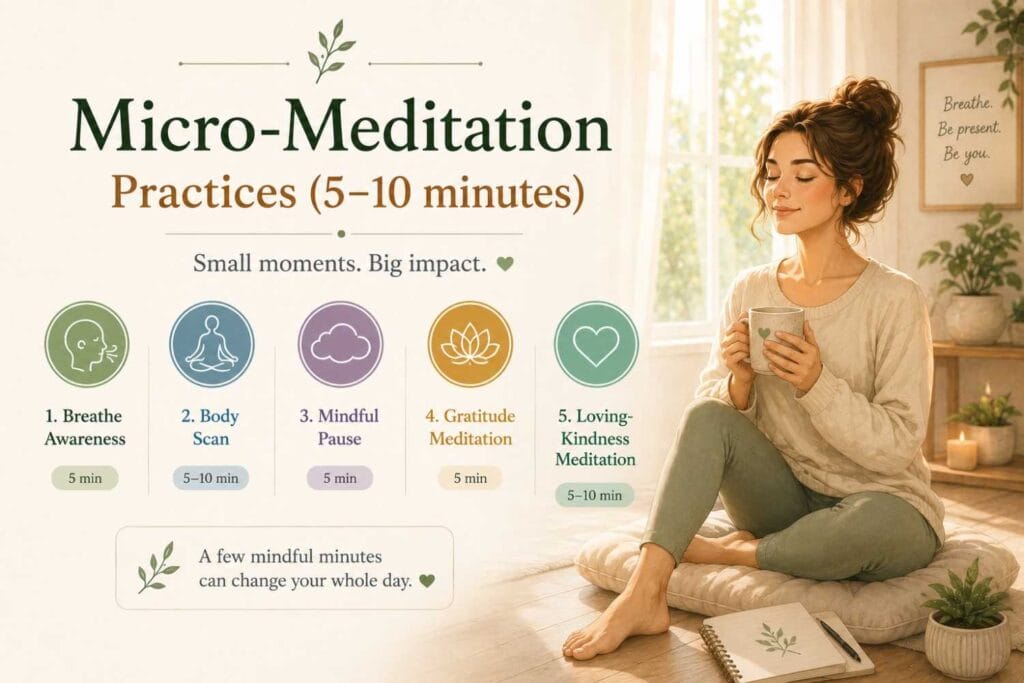
5 Powerful Micro-Meditation Practices (5–10 Minutes)
1. Breath Awareness Reset (2–5 Minutes)
Among all mindfulness practices, breath awareness remains one of the most widely recommended because it is both simple and neurologically effective.
The breath is constantly present, directly connected to the nervous system, and capable of influencing mental state almost immediately. This is why breath-centered awareness appears repeatedly across contemplative traditions, including the Yoga Sutras of Patanjali and the Hatha Yoga Pradipika.
The practice itself is intentionally uncomplicated. Sit comfortably. Allow the body to settle naturally. Then bring attention toward breathing without attempting to control it aggressively.
Simply observe:
- inhalation
- exhalation
- movement within the chest or abdomen
- pauses between breaths
- and the natural rhythm of respiration
At first, many people notice how quickly attention wanders. Thoughts arise immediately. Plans appear. Memories surface. Mental commentary continues. This is normal.
The purpose of the practice is not to force the mind into total silence instantly. The purpose is to repeatedly return awareness gently back to direct experience whenever distraction occurs. That repeated return is the training itself.
Over time, this simple process begins reducing mental overstimulation because attention is no longer pulled continuously into unconscious thinking. The breath acts as an anchor bringing awareness back into the present moment and back into the body itself. This is one reason even a few minutes of conscious breathing can noticeably reduce anxiety, emotional intensity, and cognitive overload.
The nervous system gradually shifts away from constant activation toward greater regulation and steadiness.
2. The STOP Technique (1 Minute)
The STOP Technique has become one of the fastest-growing mindfulness practices because it adapts awareness directly into real-life stressful situations. Rather than requiring long meditation sessions, it creates a brief interruption in automatic reactivity.
The method follows four simple steps:
- S – Stop
- T – Take a Breath
- O – Observe
- P – Proceed
Its effectiveness lies in its timing. Most emotional reactions happen extremely quickly. Stress accelerates thought. Fear accelerates reaction. Anger accelerates speech. The mind often reacts before awareness fully enters the situation.
The STOP Technique interrupts this momentum. For a brief moment, the practitioner intentionally pauses instead of continuing unconsciously into reaction. That pause may last only seconds. Yet psychologically, it creates space between stimulus and response. Within that space, awareness reappears.
The individual becomes capable of observing:
- emotional intensity
- bodily tension
- anxious thought patterns
- mental overwhelm
- impulsive urges
- or escalating frustration
Instead of reacting automatically, there becomes an opportunity to respond more consciously.
This is why the technique is especially effective during:
- stress
- conflict
- anxiety
- overthinking
- emotional overwhelm
- workplace pressure
- and difficult conversations
Its popularity continues growing because it is practical under real-life conditions. People do not always have time for extended meditation during stressful moments. But most people can pause for one conscious breath. And sometimes, that single pause changes the entire direction of reaction.
3. Mini Body Scan (5 Minutes)
The mini body scan is a shortened version of traditional body awareness meditation practices designed to reconnect attention with direct physical experience.
Modern life often disconnects people from bodily awareness entirely. Attention becomes absorbed in screens, thought, stimulation, deadlines, and emotional pressure while physical tension accumulates unconsciously in the background.
The body scan reverses this disconnection.
The practitioner slowly guides awareness through different regions of the body, such as:
- feet
- legs
- hips
- abdomen
- chest
- shoulders
- neck
- jaw
- and face
The goal is not to “fix” sensation immediately. The goal is observation without judgment. Many people discover during body scan practice that they have been holding muscular tension continuously without noticing it:
- tight shoulders
- clenched jaw
- shallow breathing
- abdominal tension
- or nervous system activation hidden beneath mental activity
Bringing awareness into the body interrupts unconscious tension accumulation.
This is one reason body scan practices are increasingly recommended for:
- nervous system regulation
- stress recovery
- burnout prevention
- emotional awareness
- and anxiety management
The practice also trains a deeper skill: remaining present with experience without immediately reacting to it. This observational quality aligns closely with mindfulness traditions and classical yogic awareness practices. The body becomes a gateway back into direct presence.
4. Mindful Walking (5–10 Minutes)
Mindful walking has become increasingly popular because many people find movement-based mindfulness easier than stillness-based meditation. For individuals with highly active minds, sitting motionless may initially increase restlessness or frustration. Walking meditation provides another entry point.
Instead of removing movement, the practice transforms movement into awareness itself.
During mindful walking, attention is gently placed on:
- footsteps
- shifting weight
- breathing
- posture
- rhythm of movement
- surrounding sound
- and sensory experience
Walking, which normally occurs automatically and unconsciously, becomes intentional and observed.
This shift is significant because much of modern life is lived on “autopilot.” People often move physically while attention remains absorbed elsewhere:
- replaying conversations
- anticipating future tasks
- worrying
- consuming information
- or mentally multitasking
Mindful walking reunites awareness with direct experience.
Even short mindful walks may help:
- reduce mental clutter
- improve concentration
- regulate stress
- and restore attentional steadiness
The practice also demonstrates an important contemplative principle: mindfulness does not require withdrawal from movement. Awareness can exist within ordinary activity itself. This reflects teachings repeatedly emphasized throughout yogic traditions, particularly within the Bhagavad Gita, where steadiness is cultivated amidst action rather than separate from life entirely.
5. One-Minute Sensory Grounding
Sensory grounding practices are becoming increasingly popular because they work quickly during moments of anxiety, overstimulation, panic, or emotional overwhelm.
When anxiety intensifies, attention often becomes trapped inside mental projection:
- catastrophic thinking
- imagined future outcomes
- repetitive thought loops
- emotional spiraling
- and cognitive overload
Sensory grounding interrupts this by redirecting awareness back into immediate sensory reality.
One of the most common versions involves consciously identifying:
- 5 things you can see
- 4 things you can feel
- 3 things you can hear
- 2 things you can smell
- 1 thing you can taste
This process appears simple, but neurologically it shifts attention away from abstract mental projection and back toward direct sensory experience. The mind becomes reoriented toward the present environment rather than remaining fully absorbed in anxious anticipation. Grounding practices are especially effective because anxiety often pulls awareness away from present reality and into imagined scenarios. Sensory awareness restores contact with what is actually happening now. This creates psychological stabilization and reduces cognitive escalation.
Why These Practices Are Going Viral
Micro-meditation is spreading rapidly because it addresses one of the biggest problems in modern wellness culture: People want calmness, focus, emotional regulation, and mental clarity, but they do not want systems that feel impossible to maintain consistently. Long and highly demanding routines may appear inspiring initially, but many people struggle to sustain them realistically within daily life.
Micro-practices feel different. They feel achievable. A one-minute pause feels manageable. A five-minute breathing practice feels realistic. A short mindful walk feels accessible during work or stress. And accessibility increases consistency.
This is one of the most important reasons these practices are going viral across:
- social media
- wellness platforms
- productivity communities
- mental health discussions
- and workplace wellness programs
Modern wellness culture is increasingly moving away from extreme optimization and toward sustainable nervous system care.
There is growing emphasis on:
- emotional regulation
- mindful pauses
- digital wellness
- nervous system recovery
- stress interruption
- and “micro-rest” practices integrated throughout the day
Micro-meditation fits perfectly into this cultural shift because it adapts mindfulness to real modern conditions rather than idealized lifestyles.
The Deeper Meaning of the Trend
At a deeper level, the rise of micro-meditation reveals something important about the condition of modern attention itself. People are exhausted. Not only physically. Mentally. Emotionally. Digitally. The nervous system rarely experiences uninterrupted stillness anymore.
Attention is continuously fragmented by stimulation, information, emotional intensity, and constant engagement. The popularity of micro-meditation reflects a growing desire not necessarily for spiritual perfection, but for moments of genuine psychological quiet within environments dominated by noise and acceleration.
This is why even very short moments of awareness can feel surprisingly powerful today.
A single conscious breath may feel restorative because modern attention rarely pauses deeply enough to experience one fully. The trend therefore reflects more than wellness culture alone. It reflects a broader human need for regulation, steadiness, and reconnection amidst continuous overstimulation.
Common Misunderstandings
One common misunderstanding is believing that short meditation practices are somehow “less authentic” than longer forms of meditation. Depth matters. But consistency matters deeply as well.
Five conscious minutes practiced daily may gradually transform attention more effectively than occasional hour-long sessions practiced inconsistently without continuity. Micro-meditation works through repetition. Awareness is strengthened not only through duration, but through frequency and integration into ordinary life.
Another misunderstanding is expecting instant peace or complete emotional control immediately after beginning mindfulness practices. Micro-meditation does not eliminate stress automatically. Nor does it remove all emotional difficulty overnight. Its function is more subtle and more realistic.
It gradually trains awareness to appear earlier within moments of reactivity. And over time, repeated moments of conscious observation begin weakening automatic psychological patterns. The transformation is often gradual rather than dramatic. But gradual change sustained consistently can become profoundly significant over time.
Micro-meditation practices are becoming one of the defining mindfulness and wellness trends because they make awareness practical within the conditions of modern life.
Instead of requiring perfect environments or long uninterrupted sessions, they introduce mindfulness directly into ordinary moments:
- during work
- during stress
- during movement
- during emotional overwhelm
- and during everyday routines
Although modern in presentation, these practices align deeply with principles found throughout the Yoga Sutras of Patanjali, the Bhagavad Gita, and the Hatha Yoga Pradipika:
- awareness
- steadiness
- observation
- regulation of attention
- and conscious relationship with the mind
The growing popularity of micro-meditation reveals something increasingly important about modern society:
In a world dominated by continuous stimulation, even a few minutes of genuine presence can begin changing the quality of experience in powerful ways.