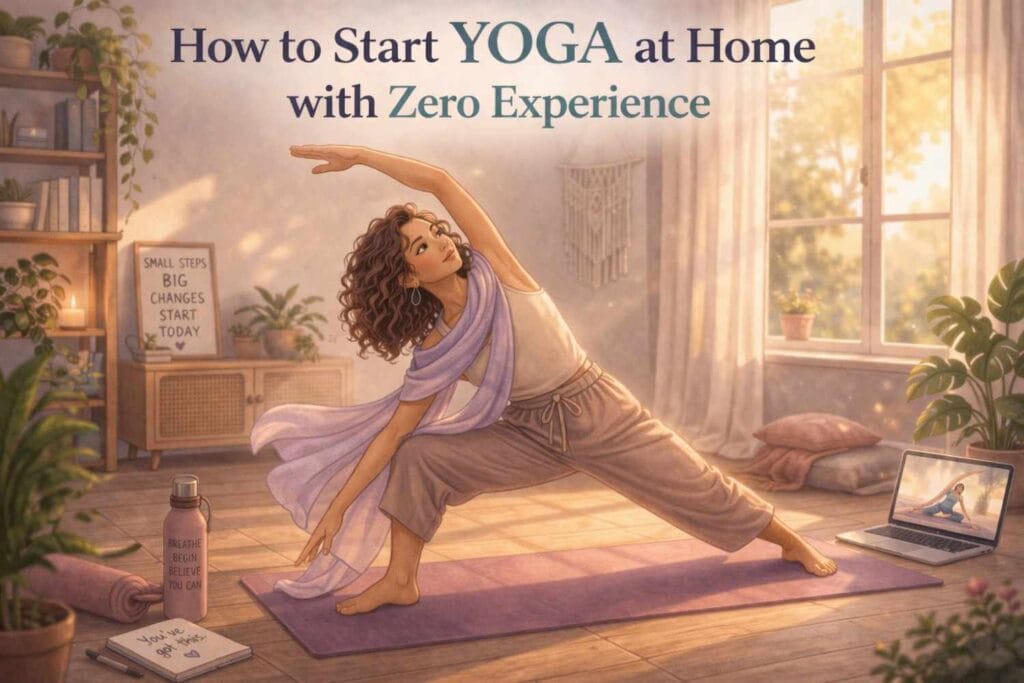
New to yoga? Learn how to start yoga at home with zero experience using a simple, structured, and realistic approach.
Beginning Without Overcomplicating It
Most people don’t hesitate to begin Yoga because it is physically difficult. They hesitate because it feels unclear. There is too much information, too many approaches, and too many expectations attached to what should be a simple beginning. You sit down, try a few movements, perhaps follow something online, and within a few days a subtle doubt appears, am I even doing this correctly?
This doubt is not caused by lack of ability. It comes from approaching Yoga as something to perform rather than something to understand. When seen through the Yoga Sutras of Patanjali, Yoga is not something that begins with correctness. It begins with observation. Without that, even correct actions feel uncertain.
Starting at home with zero experience does not require preparation in the usual sense. It requires removing unnecessary complexity.
Why Most Beginners Feel Lost
When someone starts Yoga today, they usually begin with what is visible, postures. This seems logical because it is the most accessible part. But very quickly, the practice becomes mechanical. You follow shapes, repeat movements, and try to improve flexibility, yet something feels incomplete.
This happens because posture, in the classical understanding, is not the starting point. It is a stage that becomes meaningful only when there is some stability already present. Without that, the practice feels disconnected from itself.
The confusion beginners feel is not because Yoga is difficult. It is because the entry point is misunderstood.
The First Step Is Not Movement
One of the most overlooked aspects of beginning Yoga is that it can start without movement at all. This feels counterintuitive in a world where activity is equated with progress. But if you sit quietly, even for a few minutes, something becomes immediately clear, the mind does not stay where it is placed.
It moves. Repeatedly. Without direction.
This is usually taken as a problem. But in the context of the Yoga Sutras, it is the first correct observation. You are not failing to concentrate. You are seeing how the mind behaves.
Starting here changes everything. Because now, the practice is not about controlling experience. It is about understanding it.
Creating a Space That Supports Practice
The Bhagavad Gita speaks about choosing a place that is steady and undisturbed. This is often interpreted as a spiritual instruction, but it is deeply practical.
At home, your environment constantly pulls attention in different directions. Objects, sounds, devices, everything competes for awareness. If you try to practice in the middle of this, settling becomes difficult.
Choosing a specific place does not mean creating a perfect setup. It means reducing unnecessary input. A simple corner, a mat, a quiet space. Over time, this consistency begins to influence the experience. The body becomes familiar with the space, and the mind resists a little less each day.
Understanding the Body Before Trying to Improve It
The Hatha Yoga Pradipika does not treat the body as something to be shaped quickly. It emphasizes preparation, not in terms of strength or flexibility, but in terms of steadiness.
For a beginner, this means shifting the intention. Instead of trying to improve the body, you begin by understanding it. Where does tension appear? Which movements feel natural? Where does the body resist?
Simple movements are enough for this. Gentle stretches, basic postures, slow transitions. The goal is not to achieve anything visible. It is to reduce interference. When the body is less tense, it stops distracting the mind.
The Real Meaning of Asana
Postures are often approached as physical goals, something to achieve or perfect. But the classical definition is much simpler. A posture is something that can be maintained steadily and comfortably.
This immediately changes how a beginner should practice. If a posture creates strain, it is not appropriate. If it requires constant adjustment, it is not stable.
This does not mean avoiding effort. It means avoiding unnecessary effort.
A few simple postures practiced with attention are more aligned with Yoga than many performed without awareness.
The Subtle Role of Breath
Breath is often ignored in the beginning because it happens automatically. But as practice develops, it becomes one of the most important aspects.
The Hatha Yoga Pradipika describes the relationship between breath and mind very clearly. When the breath is irregular, the mind is unsettled. When the breath becomes steady, the mind begins to follow.
For a beginner, this does not mean controlling the breath. It means noticing it. Observing how it changes with movement, how it reacts to tension, how it settles when the body becomes still.
This awareness gradually creates regulation without force.
Why Consistency Matters More Than Effort
Many beginners start with enthusiasm and then stop within a few weeks. This is not due to lack of interest. It is due to imbalance in effort.
Trying to do too much in the beginning creates fatigue. Doing too little without consistency creates no progress.
The Yoga Sutras emphasizes sustained practice over time. This does not mean long hours. It means regularity.
Even ten minutes daily, when done with attention, creates more stability than an hour practiced occasionally. The effect of Yoga is not immediate. It accumulates.
The Problem of Expectation
One of the biggest obstacles for beginners is expectation. The idea that Yoga should quickly bring calmness, clarity, or noticeable change.
When this does not happen, the practice feels ineffective.
But in reality, the early stages of Yoga often reveal more disturbance, not less. This is not because the practice is creating it. It is because it is being noticed more clearly.
Understanding this prevents unnecessary frustration.
What Happens When You Continue
If the practice continues without excessive expectation, small changes begin to appear. They are not dramatic. They are almost easy to ignore.
The body feels slightly more comfortable. The breath becomes a little more even. The mind reacts slightly less.
These are not final results. They are indicators of direction.
Over time, these small changes become more consistent. And consistency is what allows deeper stability to develop.
Discipline Without Rigidity
The Bhagavad Gita emphasizes moderation. Not extremes. This applies directly to practice.
Discipline is necessary, but rigidity creates resistance. Flexibility is useful, but inconsistency creates imbalance.
The middle approach is simple, practice regularly, without forcing intensity. Some days will feel easier, others less so. Both are part of the same process.
Practicing Without Comparison
Practicing at home removes comparison, which is one of the most beneficial aspects for a beginner. There is no external standard to match.
Comparison often leads to unnecessary pressure, and pressure leads to incorrect effort.
When you practice alone, you can observe more honestly. Not how it looks, but how it feels. This makes the practice more accurate, even if it appears simple from the outside.
There Is No Urgency to Progress
A common assumption is that progress means doing more, more postures, more time, more complexity.
But in Yoga, progress is often the opposite. It is seen in reduction, less strain, less restlessness, less unnecessary movement.
When a posture becomes easier to maintain, that is progress. When sitting becomes more stable, that is progress. When attention stays slightly longer, that is progress.
There is no need to rush beyond this.
Starting Yoga at home with zero experience does not require skill, flexibility, or detailed knowledge. It requires a clear approach.
When understood through the Yoga Sutras, the Bhagavad Gita, and the Hatha Yoga Pradipika, Yoga is not about doing more. It is about becoming more steady.
The body becomes less tense, the breath less irregular, and the mind slightly less scattered. These changes are not immediate, but they are reliable.
Over time, practice stops feeling like something you are trying to do. It becomes something that continues on its own, with less effort and more clarity.
And that is where Yoga truly begins, not in complexity, but in consistency.