
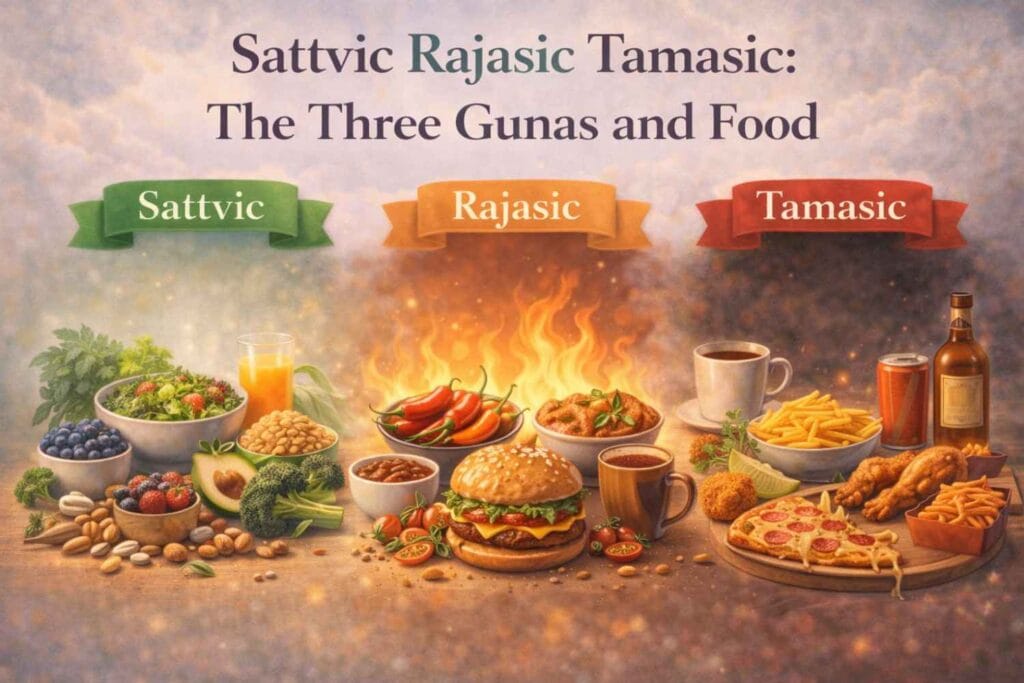
Learn how Sattvic, Rajasic, and Tamasic foods influence the body and mind. Understand the deeper Yogic perspective on food and balance.
Understanding Food Beyond Nutrition
When food is discussed today, the focus is usually on nutrients, calories, proteins, fats, and vitamins. While these are important, they do not fully explain how food influences us. Two people may eat similar meals, yet experience very different states of mind and energy. This difference is not always captured through nutritional analysis alone.
In Yogic understanding, food is not only a source of physical nourishment. It also influences the quality of the mind. This perspective is clearly described in the Bhagavad Gita, where food is categorized according to three fundamental qualities: Sattva, Rajas, and Tamas.
These are not just classifications of food. They are classifications of tendencies.
The Three Gunas as Fundamental Qualities
The concept of the three Gunas is central to understanding both mind and matter. Sattva represents clarity and balance, Rajas represents activity and movement, and Tamas represents inertia and heaviness.
These qualities are not separate from each other. They exist in varying proportions in everything, thoughts, actions, and food.
Food becomes an important factor because it is something we engage with daily. What we eat influences not only the body, but also the tendencies that become more dominant within us.
This is why the Bhagavad Gita does not treat food as neutral.
Sattvic Food: Supporting Clarity and Stability
In the Bhagavad Gita, Sattvic food is described as that which promotes longevity, vitality, strength, and clarity. It is fresh, light, and naturally balanced.
This does not refer to a specific cuisine or set of dishes. It refers to the quality of the food.
Fresh fruits, vegetables, whole grains, and naturally prepared meals fall into this category. These foods are not overly stimulating or heavy. They support steadiness rather than disturbance.
From a Yogic perspective, Sattvic food supports a mind that is less reactive and more stable. It does not create excess stimulation or dullness.
This becomes particularly important for practices that require attention, such as meditation.
Rajasic Food: Stimulation and Restlessness
Rajasic food is described as excessively bitter, sour, salty, hot, or spicy. It is stimulating by nature.
This type of food increases activity in the system. It can create energy, but that energy is often accompanied by restlessness.
In modern terms, this may include heavily spiced food, overly processed items, or anything that creates strong sensory stimulation.
Rajasic food is not inherently negative. Activity is necessary in life. But when it becomes dominant, it leads to imbalance.
The mind becomes more reactive, less stable, and more easily disturbed.
Tamasic Food: Heaviness and Inertia
Tamasic food is described as stale, overcooked, processed, or lacking freshness. It is heavy and dulling in nature.
Such food does not support clarity. Instead, it contributes to lethargy and reduced awareness.
This includes food that has been stored for too long, reheated repeatedly, or prepared without attention.
Tamasic food does not just affect physical energy. It influences the quality of the mind, making it less alert and more resistant to effort.
Food and the State of the Mind
The connection between food and mind is not symbolic. It is experiential.
The Hatha Yoga Pradipika emphasizes that the body and mind are interconnected. What affects one influences the other.
If the body is heavy, the mind becomes dull. If the body is overstimulated, the mind becomes restless.
Food plays a direct role in this relationship.
This is why Yogic texts pay attention to diet, not as a rigid system, but as a supportive factor.
Balance Rather Than Elimination
A common misunderstanding is that one should completely eliminate Rajasic or Tamasic food.
This is not practical, nor is it aligned with the broader understanding.
Life requires activity, which involves Rajas. Rest involves Tamas. Both have a role.
The aim is not elimination, but balance.
Sattva is emphasized because it creates stability, which allows the other two to function without causing disturbance.
The Influence of Modern Eating Patterns
Modern eating habits often increase Rajas and Tamas simultaneously.
Fast food, irregular meals, excessive stimulation, and lack of attention while eating all contribute to imbalance.
Eating while distracted, watching screens, rushing, or multitasking, reduces awareness.
Even if the food itself is balanced, the way it is consumed affects its impact.
The Role of Awareness While Eating
In Yogic understanding, how food is consumed matters as much as what is consumed.
Eating with attention allows the body to respond more accurately.
Eating in a distracted or hurried state reduces this connection.
The Bhagavad Gita emphasizes moderation, which includes not only quantity but also the manner of consumption.
Sattva and Stability in Practice
For someone engaged in practices like meditation or Yoga, Sattvic food becomes supportive.
It does not guarantee progress, but it reduces interference.
A stable body supports a stable breath. A stable breath supports a stable mind.
This chain is subtle, but consistent.
Why Diet Alone Is Not Enough
While food influences the system, it is not the only factor.
The Yoga Sutras of Patanjali focuses on the patterns of the mind. Food can support or disturb these patterns, but it does not replace practice.
Someone may eat Sattvic food and still experience restlessness if other aspects of life are imbalanced.
Diet is supportive, not sufficient.
A Practical Understanding for Daily Life
Understanding the three Gunas does not require strict categorization of every meal.
It requires observation.
How does a certain type of food make you feel? Does it create clarity, restlessness, or heaviness?
This direct observation is more useful than rigid rules.
Over time, patterns become clear.
Moving Toward Balance
The shift toward Sattvic food does not need to be sudden.
It can be gradual.
Reducing excess stimulation, choosing fresher options, and eating with more awareness are simple steps.
These changes, though small, begin to influence the overall state.
Conclusion
The classification of food into Sattvic, Rajasic, and Tamasic is not about labeling food as good or bad. It is about understanding how different qualities influence the body and mind.
Through the teachings of the Bhagavad Gita, supported by insights from the Yoga Sutras and the Hatha Yoga Pradipika, food is seen as part of a larger system of balance.
When approached with awareness, food becomes more than nourishment. It becomes a factor in how one experiences clarity, activity, and rest. And in that understanding, the focus shifts, not toward restriction, but toward balance.