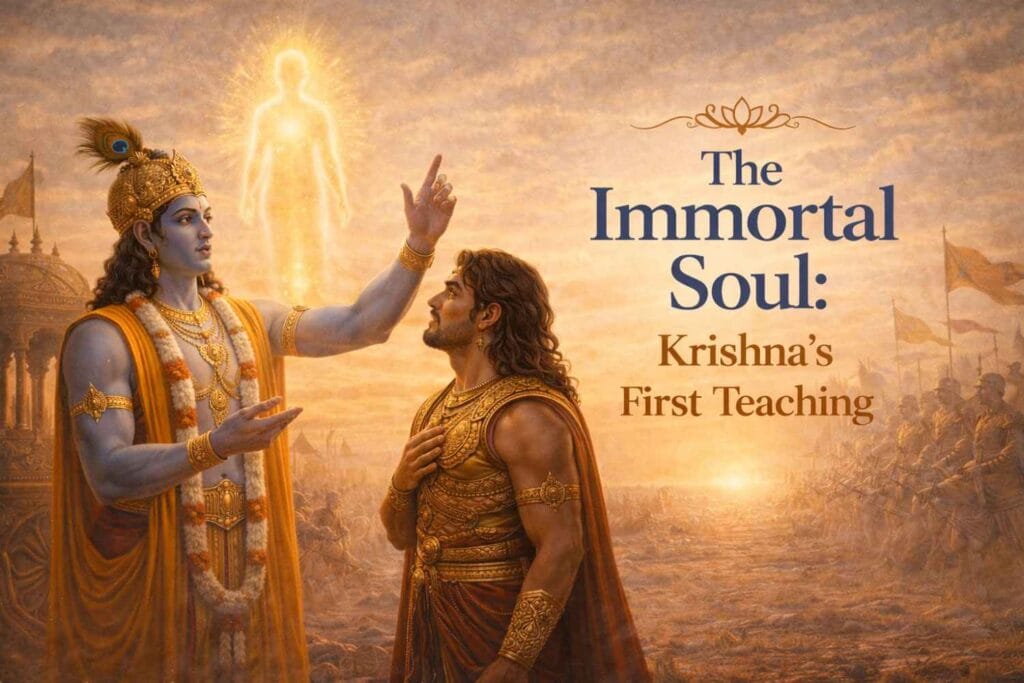
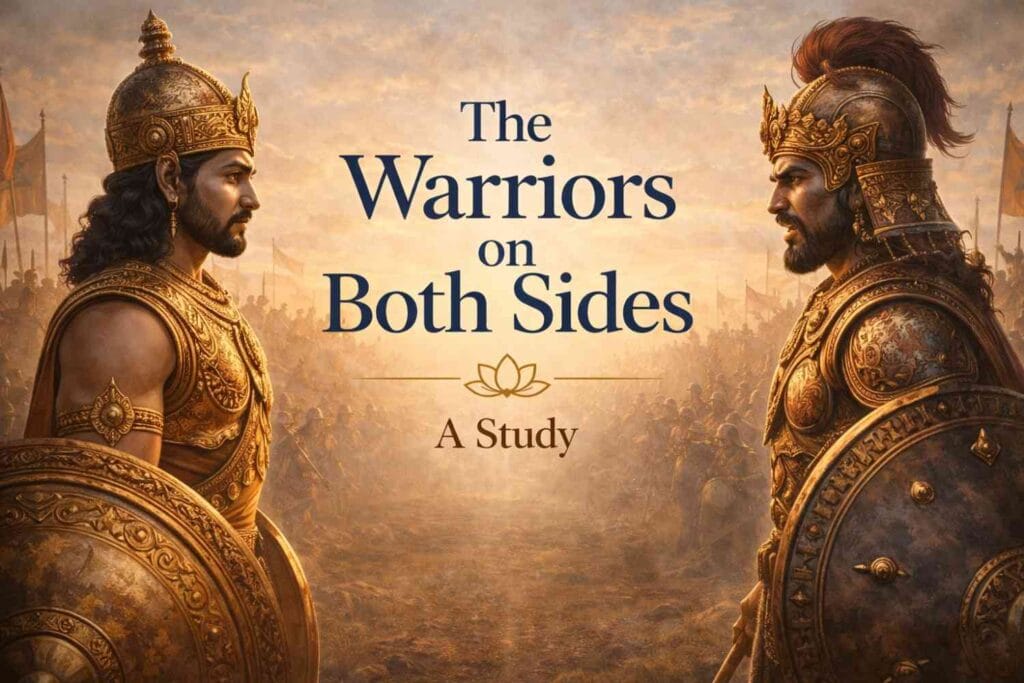
Explore the warriors on both sides of the Mahabharata battlefield and understand the depth, relationships, and complexity behind the Bhagavad Gita.
The Battlefield Is Not Made of Enemies Alone
When the first chapter of the Bhagavad Gita unfolds, it does not construct the battlefield as a space of clear opposition between right and wrong. What appears instead is a field where both sides are composed of capable, disciplined, and deeply established warriors. This immediately removes the possibility of a simple interpretation. The conflict is not driven by imbalance of power, but by the presence of strength on both sides.
This makes the situation fundamentally different from an ordinary struggle. If one side lacked strength or legitimacy, the direction of action would remain clear. But here, both sides carry weight, through skill, lineage, and authority. This creates a condition where action cannot rely on surface judgment alone.
The battlefield, therefore, is not merely a physical space of confrontation. It becomes a space where complexity is unavoidable. Each warrior represents not just strength, but history, relationship, and meaning. When all of these are present together, the situation cannot be reduced to simple categories. It requires a deeper level of understanding, which is precisely what Arjuna is confronted with.
The Kaurava Side: Power Without Restraint
On one side stand the Kauravas, led by Duryodhana, whose army is vast, disciplined, and strategically arranged. Their strength is not incidental, it is built upon some of the most experienced and formidable warriors of the time. This side is not lacking in skill or structure; it is a force that is fully capable of matching, and in many ways challenging, the Pandavas at every level.
At the forefront stands Bhishma, whose presence alone stabilizes the entire formation. His strength is not only physical, but rooted in experience, authority, and an unwavering commitment to his vow. He carries the weight of generations, and his mastery of warfare makes him one of the most formidable figures on the battlefield. His leadership gives the Kaurava army a sense of continuity and command that few others could provide.
Alongside him is Drona, the teacher of both sides. His strength lies in knowledge, discipline, and precision. He understands the capabilities and weaknesses of the very warriors he now faces, making his presence strategically significant. His role adds intellectual depth to the Kaurava side, where warfare is not only fought through force, but through understanding and technique.
Karna brings another dimension of power, intensity and personal conviction. His skill as a warrior is exceptional, but what distinguishes him is the force of his identity and loyalty. His strength is driven by a deep need to assert his place, making his participation not only strategic, but deeply personal. This gives his actions a sharpness that is both powerful and uncompromising.
Beyond these central figures, the Kaurava army is supported by other significant warriors. Ashwatthama carries both skill and inherited knowledge, reflecting the continuation of his father’s legacy. Kripacharya represents steadiness and experience, maintaining composure within the intensity of battle. Shalya adds strength and support, contributing to the overall structure of the army.
Together, these warriors form a force that is highly organized, deeply rooted, and fully capable. Their strength is not scattered, it is structured, disciplined, and reinforced by experience and loyalty.
However, the distinction does not lie in the absence of strength, but in its orientation. The power present on this side is refined and controlled, yet it is aligned with ambition, attachment, and the assertion of position. This alignment shapes how that strength is expresse, not as uncontrolled force, but as directed intensity that seeks to maintain and defend its stance.
The text does not present the Kaurava side as weak or incapable. Instead, it reveals a more complex reality: strength that is real, discipline that is undeniable, and capability that is complete, yet guided by an orientation that leads toward conflict. The challenge, therefore, is not the presence of power, but how that power is held, understood, and directed within the situation.
The Pandava Side: Strength with Responsibility
On the other side stand the Pandavas, often understood as aligned with dharma, yet their position is not defined by passivity or moral abstraction. Their strength is equally established, grounded in training, discipline, and the capacity to act when required. The Bhagavad Gita does not present them as hesitant by nature; it shows them as fully capable of engaging in a conflict of the highest intensity.
Each of the five Pandavas represents a distinct dimension of strength, and together they form a balanced force rather than a singular type of power.
Yudhishthira, the eldest, does not stand at the forefront through physical dominance, but through steadiness of judgment. His strength lies in restraint, adherence to principle, and the ability to hold clarity even in difficult situations. He represents stability, an anchoring force that keeps action aligned with a broader sense of responsibility.
Bhima embodies direct, physical power. His strength is immediate and forceful, expressed without hesitation. Yet, it is not uncontrolled. His actions are driven by loyalty and purpose, making his strength not merely destructive, but protective and decisive when required.
Arjuna stands as the most refined warrior among them. His skill with the bow is unmatched, but his true distinction lies in awareness. He is not only capable of action, he is capable of reflecting on it. This combination of precision and sensitivity is what places him at the center of the narrative.
Nakula contributes a quieter form of strength. Known for his mastery in swordsmanship and his composure, he represents balance, discipline, and refinement. His presence stabilizes the collective force, adding precision without excess.
Sahadeva brings insight and strategic understanding. His strength lies in perception, foresight, and the ability to read situations beyond their immediate appearance. This adds depth to the Pandava side, where action is informed by understanding rather than impulse.
Beyond the five brothers, their side is supported by major warriors whose presence strengthens the formation further. Satyaki stands as a skilled and loyal warrior, known for his courage and alignment with Arjuna. Dhrishtadyumna, the commander of their army, represents strategic leadership and purpose. Shikhandi carries a unique role within the battle, reflecting how individual histories also shape the course of conflict.
What emerges from this composition is not a lesser force, but a complete structure of strength, physical, mental, strategic, and ethical. The Pandava side is not defined by the absence of power, but by how that power is integrated and directed.
Strength here is not separated from responsibility. It is held with awareness of consequence, not merely for assertion. This creates a different orientation, not softer, but more measured and aligned. The battlefield, therefore, is not divided between strong and weak, but between different ways in which strength is understood, carried, and expressed.
The Presence of Shared History
What makes this battlefield particularly complex is that it is not composed of unfamiliar opponents. The warriors on both sides are connected through a shared past. They have learned under the same teachers, lived within the same lineage, and been shaped by the same environment.
Drona, who once instructed these warriors, now stands in opposition to those he trained. Bhishma, who once protected and guided, now faces those he once stood for. These are not distant figures, they are part of a continuous relationship that extends beyond the battlefield.
This shared history removes the possibility of treating the situation as impersonal. Each warrior is not only an opponent, but a part of a larger story that includes connection, memory, and influence. The conflict, therefore, is not limited to action, it carries the weight of what has come before.
Because of this, the battlefield cannot be reduced to strategy alone. It becomes a space where action and relationship intersect, where the past remains present within the moment. This is what transforms the situation from a simple confrontation into a deeply layered conflict, one that cannot be understood without acknowledging the continuity that binds both sides together.
The Role of Bhishma and Drona
Bhishma and Drona occupy a position in this conflict that cannot be understood through simple categories of right and wrong. Their presence does not arise from ambition or desire for power. Instead, it is shaped by layers of commitment, loyalty, and long-standing obligation that extend far beyond the immediate situation.
Bhishma, bound by his vow to the throne of Hastinapura, stands with the Kauravas not because he is unaware of the moral complexity, but because his life has been structured around a promise that he does not break. His strength is not only physical, it is rooted in his unwavering adherence to that vow. This creates a tension where personal understanding and lifelong commitment do not fully align, yet he remains where his obligation places him.
Drona’s position carries a different kind of complexity. As a teacher, he is connected to both sides. The very warriors he trained now stand in opposition to him. His participation in the battle is not detached, it is shaped by his role, his responsibilities, and the circumstances that bind him to the Kaurava side. He is not merely a combatant; he is someone whose knowledge flows across both sides of the conflict.
Through their presence, the battlefield reveals that participation in conflict is not always driven by clear intention or personal gain. It can arise from continuity, from vows taken, roles accepted, and responsibilities carried over time. Their position shows that strength and wisdom do not always resolve conflict; sometimes they exist within it, shaped by commitments that cannot be easily set aside.
Karna: Loyalty and Identity
Karna introduces another dimension to the battlefield, one that is deeply personal. His alignment is not determined solely by lineage or conventional ties, but by his lived experience. His life is marked by rejection, struggle, and the need to establish his place in a world that did not initially recognize him.
His strength as a warrior is unquestionable, but it is inseparable from his sense of identity. The recognition he receives from Duryodhana is not merely political, it is personal. It gives him a place, a position, and a sense of belonging that shapes his loyalty.
This loyalty is not strategic in the usual sense. It does not arise from calculation, but from gratitude and connection. His alignment with the Kauravas reflects not only where he stands, but why he stands there.
Through Karna, the battlefield reveals that alignment is not determined by strength alone. It is influenced by experience, memory, and the need for recognition. Personal history becomes a force that shapes direction just as strongly as skill or ability. This adds another layer to the conflict, where decisions are not only about action, but about identity itself.
Arjuna’s Position Among These Warriors
Arjuna does not stand outside the battlefield as a distant observer, he stands at its very center, where all lines of relationship, duty, and consequence intersect. The warriors before him are not unfamiliar figures to be assessed only in terms of strength or strategy. They are individuals who have shaped his life, his teacher, his elders, his relatives, and those who once stood beside him.
This is what makes his position fundamentally different. He is not simply confronting opponents; he is confronting connections. Each figure he sees carries a history that cannot be ignored. The battlefield, therefore, is not only a place of action for him, it is a place where memory and meaning are fully present at the same time.
This is why his collapse occurs. It is not the presence of powerful warriors that unsettles him, he is fully capable of facing strength. What disturbs him is the recognition of what those warriors represent in his own life. They are not just targets to be engaged; they are part of his own story.
In that moment, action becomes difficult not because it is impossible, but because it is no longer simple. Every movement carries meaning beyond the act itself. This is the weight Arjuna encounters, not the battle, but the significance within it.
Strength Exists on Both Sides
One of the defining features of this battlefield is that strength is present on both sides, equally established and undeniable. Both armies are composed of warriors who are trained, disciplined, and capable. They possess strategy, structure, and the ability to act with precision. There is no imbalance that simplifies the situation.
This removes the possibility of reducing the conflict to a clear division of right and wrong based on strength alone. If one side lacked capability, the direction of action would remain straightforward. But here, both sides carry power, legitimacy, and presence.
Because of this, the conflict cannot be resolved through simple judgment. It cannot rely on identifying one side as entirely correct and the other as entirely flawed. The situation demands something deeper than surface-level clarity.
Action, in this context, must arise in the presence of complexity. It must take place even when the situation does not offer simple answers. This is what defines the battlefield, not confusion, but the absence of easy certainty.
The Nature of Conflict Revealed
The arrangement of warriors on both sides reveals that conflict, as presented in the Mahabharata, is not structured around simple opposites. It is not a matter of choosing between what is clearly right and what is clearly wrong. Instead, it unfolds in a space where multiple truths exist at the same time, each carrying its own validity and weight.
On one side, there is duty, obligation, and established roles. On the other, there is relationship, memory, and consequence. These do not cancel each other out, they coexist. This coexistence is what creates tension. It is not confusion in the sense of disorder, but complexity in the sense of depth.
The battlefield, therefore, is not a place where clarity is immediately available. It is a place where clarity must be discovered through understanding. The presence of capable, respected, and meaningful individuals on both sides ensures that no decision can be made without encountering this complexity fully.
This is precisely the condition in which Arjuna finds himself. His dilemma does not arise because the situation is unclear, it arises because it is too fully clear in multiple directions at once. Each perspective reveals something valid, and these perspectives do not align easily.
Why This Study Matters
Understanding the composition of both sides is essential to understanding the Bhagavad Gita itself. Without this context, Arjuna’s hesitation may appear as a lack of resolve, a moment of weakness in the face of action. But when the depth of the situation is recognized, that interpretation no longer holds.
His hesitation does not arise from fear of conflict, it arises from encountering the full structure of the conflict. He sees not only what must be done, but what that action involves at every level. This includes relationship, consequence, and meaning, all present at once.
In this sense, he is not turning away from the situation. He is seeing it more completely than before. The inability to act immediately is not avoidance, it is the result of perception expanding beyond what can be handled through simple frameworks.
This is why the study of the warriors on both sides is not secondary, it is foundational. It reveals that the Bhagavad Gita does not emerge from a simple battlefield, but from a situation where action and understanding must meet within complexity.
Beyond the Battlefield
The situation at Kurukshetra, as presented in the Mahabharata and unfolded through the Bhagavad Gita, is not limited to a single historical event. Its structure reflects a broader pattern that appears whenever life presents conditions that cannot be resolved through simple judgment.
In many situations, opposing sides are not clearly defined. Individuals carry multiple roles at once, professional, personal, relational, and these roles do not always align. What seems correct from one perspective may conflict with what is meaningful from another. This creates a condition similar to the battlefield, where clarity is not immediately available.
In such conditions:
- Strength exists in more than one direction, without a single clear center
- Relationships introduce layers that complicate direct decisions
- Action cannot depend on fixed definitions of right and wrong alone
This is what the battlefield represents beyond its physical form. It is a condition where life does not present itself in simple divisions, but in layered realities that must be understood carefully. Clarity, in such moments, is not given, it must be discovered through deeper observation and reflection.
Conclusion
The warriors on both sides reveal that the conflict described in the Bhagavad Gita is not built on simplicity, but on depth. Strength, skill, and legitimacy are present on both sides, making it impossible to resolve the situation through surface-level understanding. The battlefield is not a place where one side can be dismissed and the other affirmed without question.
It is this very complexity that gives rise to Arjuna’s dilemma. His hesitation is not separate from the situation, it is a direct response to its depth. When meaning exists on both sides, action cannot arise without understanding that meaning fully.
This is why the teaching of the Gita becomes necessary. It does not emerge in a situation of clarity, but in a situation where clarity must be found. The battlefield, therefore, is not defined only by opposition, it is defined by the presence of significance on all sides.
And it is within this significance that the need for deeper understanding begins to unfold.
Also read: Chapter 1: Arjuna Vishada Yoga – The Grief of Arjuna