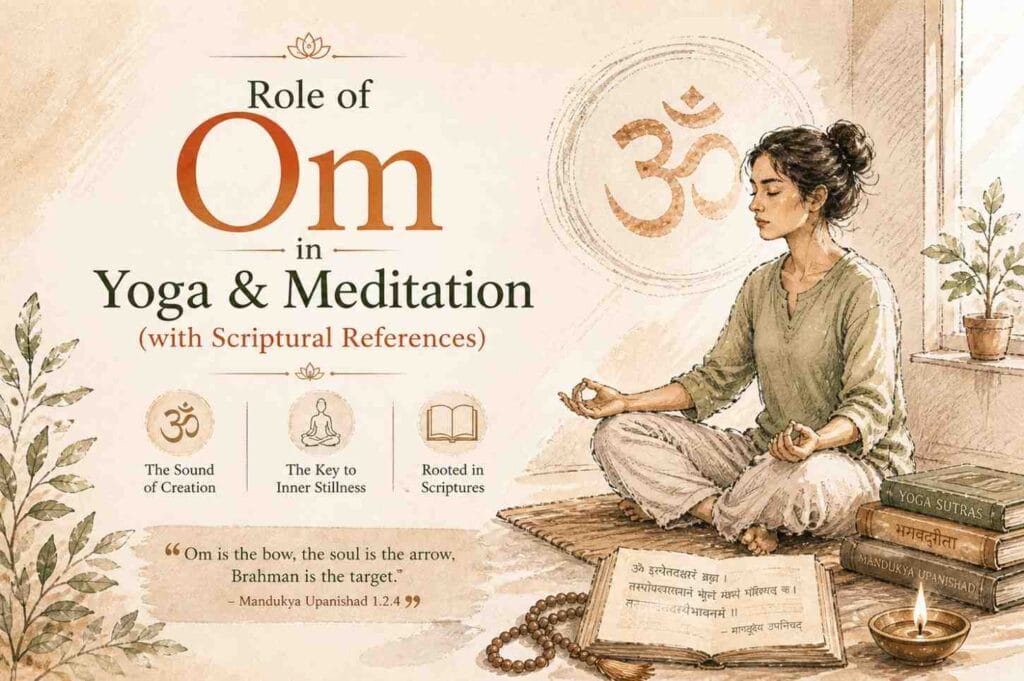
The role of Om (AUM) in yoga and meditation with scriptural references from the Mandukya Upanishad and Yoga Sutras. Learn how Om helps reduce anxiety, calm the mind, and deepen awareness.
What is Om (AUM)? – A Deeper Understanding
In yogic philosophy, Om (AUM) is not just a sound you chant—it is considered the fundamental vibration of existence. It represents the idea that everything in the universe is in a state of vibration, and Om is the most subtle, original expression of that vibration.
Unlike ordinary sounds, which are produced by physical objects, Om is described in ancient texts as a cosmic sound—one that underlies all forms, energies, and consciousness itself.
This is not just symbolic, but deeply rooted in ancient scriptures.
Mandukya Upanishad (Verse 1):
“Om ity etad akṣaram idam sarvam”
Om is all this — everything that exists.
The text further explains that A-U-M represents the three states of consciousness:
- A (अ) – Waking State (Vaishvanara)
This is the state you are in right now.
– Awareness is directed outward
– You experience the physical world through senses
– Identity is tied to body and external reality - U (उ) – Dream State (Taijasa)
This is the inner, mental world experienced during dreams.
– Awareness turns inward
– The mind creates its own reality
– No external input is needed - M (म) – Deep Sleep State (Prajna)
This is the state of deep, dreamless sleep.
– No active thoughts or perceptions
– No sense of individuality
– Yet, a form of awareness still exists
The Most Important Part: Silence After Om (Turiya)
After chanting Om, there is a natural silence.
This silence is not empty it is the most significant aspect.
The Mandukya Upanishad calls this:
Turiya – the fourth state of consciousness
It is:
- Beyond waking, dreaming, and deep sleep
- Pure awareness without content
- The state of stillness, clarity, and unity
This is what meditation ultimately points toward.
Why This Matters in Yoga
This explanation shows something powerful:
Om is not just a sound – it is a complete map of consciousness
When you chant Om:
- You move through A → U → M (all states of experience)
- Then naturally enter silence (Turiya)
This is why Om is used in meditation:
- It guides the mind inward step-by-step
- It helps transition from activity → stillness
- It allows direct experience of awareness beyond thought
A Simple Way to Understand It
- A → Your external world
- U → Your internal world
- M → The absence of both
- Silence → Your true nature beyond all experiences
Om is not just a chant – it is the sound representation of consciousness and existence itself.
Om in Yoga Philosophy
In the Yoga Sutras of Patanjali, Om (Pranava) is described as the sound representation of supreme consciousness (Ishvara).
Yoga Sutras of Patanjali (1.27):
“Tasya vācakaḥ praṇavaḥ”
The sound that represents the supreme consciousness is Om (Pranava).
Yoga Sutras (1.28):
“Taj japas tad-artha-bhāvanam”
Repetition (japa) of Om and contemplation of its meaning leads to inner clarity.
Core Understanding
- Om acts as a bridge between mind and pure awareness
- It gives the mind a single-pointed focus, reducing distractions
- Repetition calms mental fluctuations (chitta vritti)
- Contemplation deepens awareness beyond surface-level thinking
This establishes Om as:
- A tool for meditation
- A means to steady the mind
- A gateway to deeper awareness
Om is a practical method in yoga to move from a restless mind to a state of inner clarity and awareness.
Om in Hatha Yoga Tradition
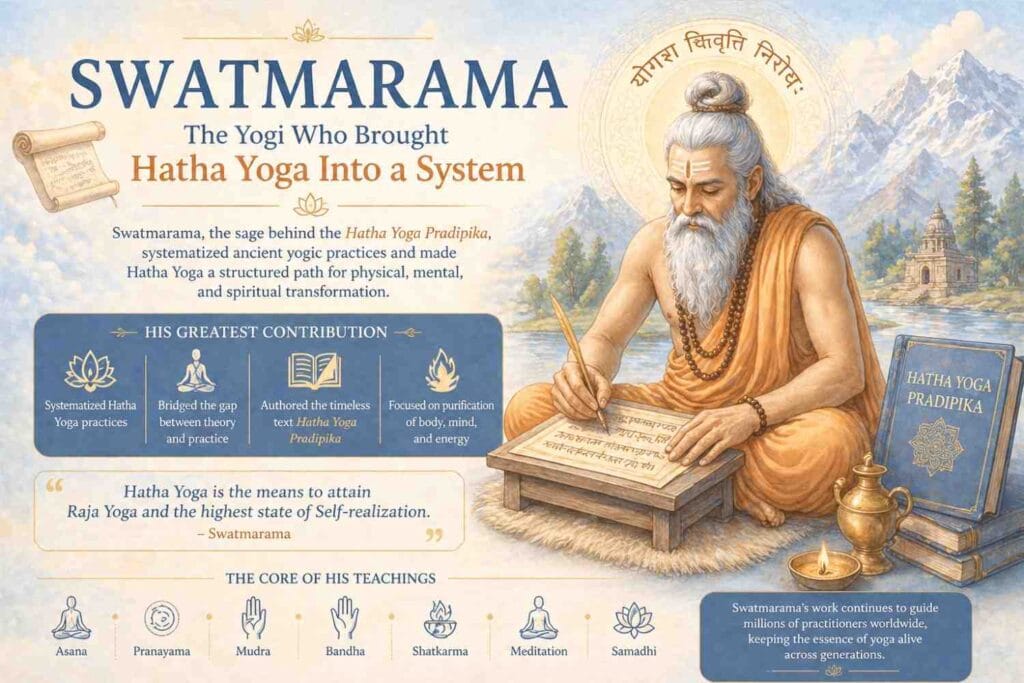
n the Hatha Yoga Pradipika, especially in Chapter 4 (Nada Yoga), sound is introduced not just as something we hear—but as a subtle inner experience that can guide the mind toward stillness.
Understanding Nada (Inner Sound)
The text explains that as the mind becomes quieter through practice, one begins to perceive Nāda (inner sound).
This is not external sound, but:
- A subtle vibration perceived internally
- A tool for drawing attention inward
- A method to reduce mental fluctuations
The text explains that inner sound (Nada) becomes a powerful tool for dissolving mental fluctuations.
While Om is not always described as a chant in isolation, it aligns with:
The principle of Nada (inner sound meditation)
Leading the mind towards Laya (absorption)
How Om Helps with Anxiety (Scriptural + Practical View)
Ancient yogic texts may not use the modern term anxiety, but they describe its exact inner experience with remarkable clarity.
- Chitta Vritti (चित्त वृत्ति) → Continuous mental fluctuations
- Dukha (दुःख) → Inner discomfort or unease
- Chanchalata (चंचलता) → Restlessness and instability of the mind
These are not separate problems they are different expressions of the same disturbed mental state.
In the Yoga Sutras of Patanjali, Patanjali defines yoga in one of the most powerful sutras:
📜 Yoga Sutras (1.2):
“Yogaś citta-vṛtti-nirodhaḥ”
👉 Yoga is the cessation of fluctuations of the mind.
Yoga is not defined as flexibility, fitness, or even relaxation.
It is defined as a state where the mind becomes still.
From a yogic perspective, what we call anxiety today can be understood as:
- A mind that constantly moves between thoughts
- A tendency to project into the future
- Lack of stability in attention
- Continuous internal noise
👉 In simple terms:
Anxiety = unchecked and repetitive chitta vritti
The more the mind moves, the less stable we feel.
Where Om Comes In
Om is introduced in yoga not as belief, but as a practical intervention for this condition.
It works directly on chitta vritti (mental fluctuations).
Instead of trying to stop thoughts forcefully (which often fails),
Om gives the mind a refined direction to follow.
How Om Reduces Anxiety
1. Japa (Repetition) Creates Stability
When you repeat Om:
- The mind shifts from multiple thoughts → one sound
- Attention becomes rhythmic and consistent
- Random mental activity begins to reduce
👉 This aligns with Patanjali’s method:
Replacing scattered thoughts with a single-pointed focus
2. Sound Vibration Draws the Mind Inward
The structure of Om (A-U-M) creates a natural inward movement:
- “A” begins externally
- “U” moves through the body
- “M” becomes internal and subtle
As the sound refines, attention follows it inward.
👉 This reduces outward distraction—the root of restlessness
3. Breath Regulation Calms the Nervous System
Chanting Om naturally involves:
- Slow inhalation
- Long, extended exhalation
This has a direct physiological effect:
- Activates the parasympathetic nervous system (rest mode)
- Reduces heart rate and internal tension
- Signals safety to the body
👉 Ancient practice, modern explanation
4. Vibration Releases Internal Tension
The humming part (“Mmm”) creates resonance:
- In the chest
- In the throat
- In the skull
This vibration:
- Relaxes muscular tension
- Reduces internal agitation
- Brings awareness into the body
👉 The mind stabilizes when the body relaxes
5. Silence After Om Introduces Stillness
The most powerful part is not the sound—but what comes after it.
After chanting Om:
- There is a natural pause
- Thoughts temporarily reduce
- Awareness
Mechanism (Connecting Ancient + Modern Understanding)
- Repetition (Japa) stabilizes attention
→ As per Patanjali, repetition reduces mental disturbances - Sound vibration (Nada) draws the mind inward
→ As described in Hatha Yoga tradition - Extended exhalation calms the system
→ Matches modern understanding of nervous system regulation - Silence after Om introduces stillness
→ Direct experience of reduced mental activity
A Simple Interpretation
Ancient texts suggest:
👉 Mind becomes unstable when it keeps moving outward
👉 Sound (Om) gives it a direction inward
👉 Repetition reduces distraction
👉 Silence reveals stillness
Conclusion
Om is not just a chant.
It is:
- A symbol of total existence (Mandukya Upanishad)
- A meditative tool (Yoga Sutras)
- A method for inner absorption (Hatha Yoga tradition)
When practiced consistently, it helps:
→ Slow the breath
→ Stabilize attention
→ Reduce mental agitation
Which, in modern terms, directly supports reducing anxiety and restlessness.
Also read: