A deeply researched explanation of Krishna’s Avatāra teaching from Bhagavad Gita Chapter 4 covering divine manifestation, dharma, consciousness, spiritual renewal, and the philosophical meaning of Krishna’s divine births.
Introduction
Among the most profound teachings in the Bhagavad Gita is Krishna’s explanation of divine incarnation, the doctrine of the Avatāra.
This teaching appears primarily in Chapter 4 of the Bhagavad Gita, traditionally known as: Jñāna Karma Sannyāsa Yoga, The Yoga of Knowledge and Renunciation of Action.
Within this chapter, Krishna reveals something philosophically extraordinary to Arjuna.
He explains that although he is unborn, eternal, beyond decay, and untouched by ordinary limitation, he still manifests within the world repeatedly whenever dharma declines and disorder rises.
These teachings later became foundational not only within Hindu theology, but also within broader Indian philosophical thought concerning: divine manifestation, cosmic balance, ethical order, spiritual evolution, the nature of consciousness, and the relationship between transcendence and history itself.
Today, the Avatāra doctrine is often simplified into the phrase: “God takes birth on Earth.”
However, the Bhagavad Gita presents something far deeper and more philosophically subtle than a literal divine descent alone.
Krishna is not merely describing biological birth in the ordinary human sense.
Nor are these verses intended only as mythological storytelling detached from metaphysical inquiry. Instead, the Gita explores a profound paradox: How can the timeless and unconditioned divine reality appear within time and history while still remaining beyond limitation?
This paradox lies at the very center of the Avatāra doctrine. The eternal appears within the changing world without becoming bound by change itself.
The infinite manifests through form without losing its transcendence.
The unborn becomes visible within history without becoming limited like ordinary embodied beings.
This is why Chapter 4 becomes one of the most philosophically important sections of the Bhagavad Gita.
It unites multiple dimensions of Indian spiritual thought into a single coherent vision: eternal consciousness, cosmic order, human suffering, moral crisis, spiritual decline, and divine manifestation.
The chapter therefore moves beyond simple religious devotion and enters the realm of deep metaphysical and psychological inquiry.
Krishna’s teaching suggests that ultimate reality is not distant from human existence.
The divine remains capable of entering history, restoring balance, and guiding consciousness whenever confusion and disorder dominate human life.
The Context of Chapter 4
To understand Krishna’s teaching on divine births properly, it is important to understand the dramatic context in which this revelation occurs.
The Bhagavad Gita unfolds on the battlefield of Kurukshetra just before the beginning of the great war described in the Mahabharata.
Arjuna, one of the greatest warriors of his age, suddenly collapses psychologically when he sees his own relatives, teachers, elders, and loved ones standing on both sides of the battlefield.
He becomes overwhelmed by: moral confusion, grief, compassion, fear, emotional paralysis, and existential uncertainty.
He no longer knows what righteousness truly demands.
This emotional collapse becomes the starting point for the entire Bhagavad Gita.
Krishna’s teachings therefore do not emerge in an abstract philosophical classroom detached from life.
They arise in the middle of conflict, crisis, moral tension, and psychological breakdown.
This is significant because the Gita consistently addresses human consciousness under conditions of confusion and suffering.
In the earlier chapters, Krishna already begins teaching Arjuna several foundational principles: the immortality of the Self (Ātman), the temporary nature of the body, detached action (Karma Yoga), equanimity, discipline of the mind, and inner steadiness amidst changing circumstances.
However, in Chapter 4, Krishna shifts the conversation toward a deeper question: Where does this wisdom itself come from? He explains that the yoga he is teaching is not new. It is eternal knowledge transmitted across ages.
This statement becomes the beginning of the Avatāra teaching.
Krishna Declares the Ancient Nature of Yoga
Krishna says:
Bhagavad Gita 4.1
इमं विवस्वते योगं प्रोक्तवानहमव्ययम् ।
विवस्वान्मनवे प्राह मनुरिक्ष्वाकवेऽब्रवीत् ॥
Transliteration
Imaṁ vivasvate yogaṁ proktavān aham avyayam
Vivasvān manave prāha manur ikṣvākave ’bravīt
Meaning
“I taught this eternal yoga to Vivasvān (the sun deity); Vivasvān taught it to Manu, and Manu taught it to Ikṣvāku.”
This verse is extremely important because Krishna presents yoga not as a recently created philosophy, but as timeless wisdom existing prior to human civilization itself.
The teaching belongs to cosmic order rather than historical invention.
In traditional Indian cosmology, Vivasvān is associated with the solar principle, Manu represents the primordial lawgiver and ancestor of humanity, and Ikṣvāku becomes the founder of a royal lineage.
Thus, Krishna is describing an ancient transmission of sacred knowledge extending across cosmic and human history.
This establishes yoga as something eternal (avyayam) rather than temporary or culturally accidental.
The teaching exists because it reflects the structure of reality itself.
However, Krishna’s statement creates a logical problem for Arjuna.
Krishna appears before him as a human being living in the present historical age.
So naturally, Arjuna becomes confused.
How could Krishna have instructed the sun deity in ancient times if Krishna himself appears to have been born only recently?
This question becomes one of the most philosophically important moments in the entire Gita because it directly leads into the doctrine of divine manifestation.
Arjuna’s Question About Krishna’s Birth
Bhagavad Gita 4.4
अपरं भवतो जन्म परं जन्म विवस्वतः ।
कथमेतद्विजानीयां त्वमादौ प्रोक्तवानिति ॥
Transliteration
Aparaṁ bhavato janma paraṁ janma vivasvataḥ
Katham etad vijānīyāṁ tvam ādau proktavān iti
Meaning
“Your birth is recent, while the birth of Vivasvān was in ancient times. How am I to understand that you taught this in the beginning?”
Arjuna’s question is deeply rational and philosophically intelligent.
He is not blindly accepting Krishna’s statement.
Instead, he challenges it logically.
From an ordinary human perspective, Krishna appears historically located within a specific generation.
So how could he exist before ancient cosmic beings?
This moment is important because the Bhagavad Gita allows questioning and inquiry.
Arjuna represents the sincere seeker attempting to understand reality rather than merely accepting doctrine mechanically.
His confusion reflects the limitations of ordinary human understanding when confronted with the idea of timeless consciousness appearing within time.
Krishna’s answer becomes one of the defining theological and metaphysical teachings of Indian philosophy.
Krishna Explains Divine Birth
Bhagavad Gita 4.5
बहूनि मे व्यतीतानि जन्मानि तव चार्जुन ।
तान्यहं वेद सर्वाणि न त्वं वेत्थ परन्तप ॥
Transliteration
Bahūni me vyatītāni janmāni tava cārjuna
Tāny ahaṁ veda sarvāṇi na tvaṁ vettha parantapa
Meaning
“Many births have passed for both you and Me, O Arjuna. I know them all, but you do not.”
Krishna now introduces a profound distinction between ordinary consciousness and divine consciousness. He explains that both he and Arjuna have undergone many births.
However, Krishna remembers them completely, while Arjuna does not. This difference is crucial.
According to Indian philosophy, ordinary human consciousness becomes conditioned through: ignorance (avidyā), egoic identity, memory limitation, attachment, and embodiment.
Human beings become identified with temporary personality structures and therefore lose awareness of deeper continuity beyond a single lifetime.
Krishna, however, speaks from a different level of consciousness entirely.
His awareness is not limited by ignorance or psychological fragmentation. He remembers all manifestations because divine consciousness remains unconditioned and continuous.
This teaching also reflects a larger principle within Indian spiritual traditions: forgetfulness is associated with ordinary conditioned existence, while awakened consciousness involves expanded awareness beyond limited individuality.
Krishna is therefore not speaking merely as a historical personality.
He is speaking from the standpoint of eternal consciousness itself.
This distinction becomes even more explicit in the next verse, which forms the philosophical core of the Avatāra doctrine.
The Famous Avatāra Verse
Bhagavad Gita 4.6
अजोऽपि सन्नव्ययात्मा भूतानामीश्वरोऽपि सन् ।
प्रकृतिं स्वामधिष्ठाय सम्भवाम्यात्ममायया ॥
Transliteration
Ajo ’pi sann avyayātmā bhūtānām īśvaro ’pi san
Prakṛtiṁ svām adhiṣṭhāya sambhavāmy ātma-māyayā
Meaning
“Although I am unborn, eternal, and the Lord of beings, I manifest Myself through My own divine power.”
This verse is one of the foundational philosophical statements in all of Hindu theology.
Krishna simultaneously declares several profound truths:
- He is unborn (ajaḥ)
- Eternal and undecaying (avyayātmā)
- Lord of beings (īśvaraḥ)
- Yet still capable of manifesting within the world
At first glance, this appears paradoxical.
How can something unborn appear to take birth? How can the eternal enter time without becoming limited?
The Bhagavad Gita answers this through the concept of ātma-māyā – divine self-manifesting power.
Krishna is not saying that the eternal divine becomes trapped in ignorance the way ordinary beings do.
Human birth occurs through karma, conditioning, attachment, and unconscious identification. Divine manifestation is fundamentally different.
The Avatāra manifests intentionally and freely. The divine remains aware of its true nature even while appearing within the world. This distinction is extremely important in Vedantic and yogic philosophy.
An Avatāra is not merely an extraordinary saint or spiritually evolved human being. Rather, the Avatāra represents divine consciousness manifesting deliberately for a cosmic purpose.
The eternal becomes visible without ceasing to be eternal. The infinite expresses itself through form without becoming limited by form itself. This is the profound philosophical mystery at the heart of Krishna’s teaching on divine births.
Why Does the Divine Manifest?
Krishna now explains one of the central purposes behind divine manifestation itself.
These verses from Chapter 4 of the Bhagavad Gita became some of the most influential spiritual statements in all of Indian philosophy because they answer a profound question:
Why would the eternal and transcendent divine enter the changing world at all?
Krishna says:
Bhagavad Gita 4.7–4.8
यदा यदा हि धर्मस्य ग्लानिर्भवति भारत ।
अभ्युत्थानमधर्मस्य तदात्मानं सृजाम्यहम् ॥
परित्राणाय साधूनां विनाशाय च दुष्कृताम् ।
धर्मसंस्थापनार्थाय सम्भवामि युगे युगे ॥
Transliteration
Yadā yadā hi dharmasya glānir bhavati bhārata
Abhyutthānam adharmasya tadātmānaṁ sṛjāmy aham
Paritrāṇāya sādhūnāṁ vināśāya ca duṣkṛtām
Dharma-saṁsthāpanārthāya sambhavāmi yuge yuge
Meaning
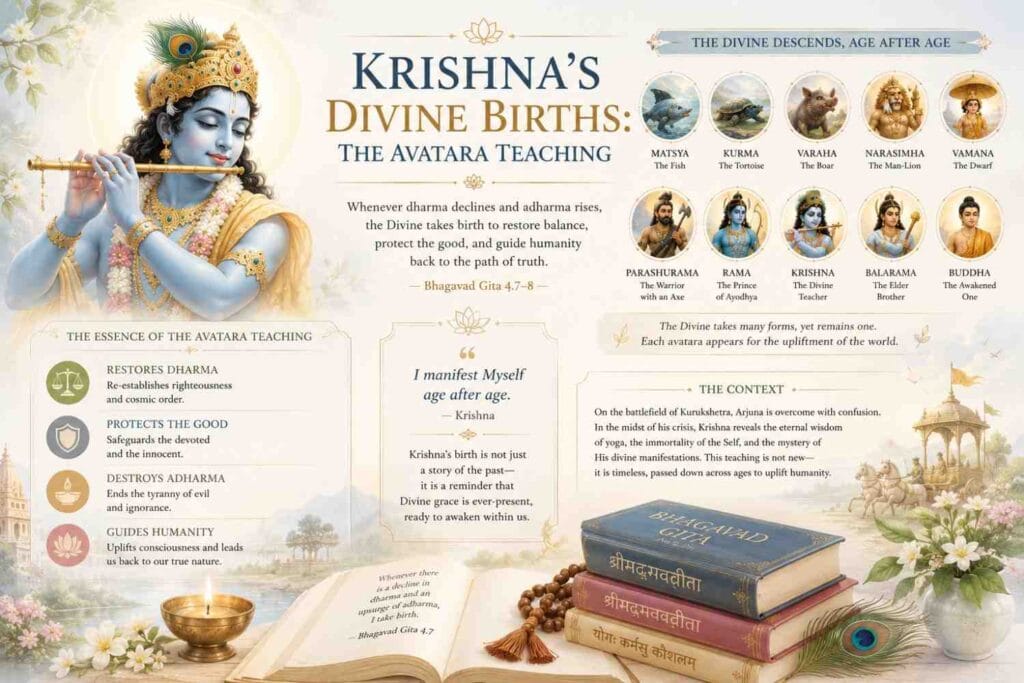
“Whenever there is decline of dharma and rise of adharma, I manifest Myself.
For the protection of the righteous, the destruction of harmful forces, and the restoration of dharma, I appear age after age.”
These verses are among the most quoted passages in the Bhagavad Gita, yet they are also among the most misunderstood when interpreted too narrowly or politically.
At first glance, the teaching may appear to describe only divine intervention during periods of social or moral collapse. However, the meaning of these verses is much deeper and far more universal than a simple historical prediction.
Krishna is not merely speaking about external conflict. He is describing a recurring spiritual principle operating within both the cosmos and human consciousness itself.
Understanding Dharma Beyond Religion
One of the most important aspects of these verses is understanding the meaning of the word dharma.
In modern discussions, dharma is often translated simply as “religion” or “duty,” but within the Bhagavad Gita, the term carries a far broader and deeper meaning.
Dharma refers to the underlying order that sustains harmony within existence.
It includes: truth, ethical balance, right living, cosmic order, spiritual alignment, inner responsibility, and the principles that sustain both society and consciousness.
In Indian philosophy, dharma is not merely a set of external rules imposed upon life. It is the natural order through which life remains balanced and meaningful.
When dharma weakens, confusion begins dominating both individuals and societies.
Human beings become disconnected from wisdom, clarity, restraint, and inner balance. Greed, violence, egoism, fear, and ignorance begin shaping collective behavior.
This condition is called: dharmasya glāniḥ, decline or deterioration of dharma. Krishna then contrasts this with the rise of adharma.
Adharma does not simply mean “evil” in a simplistic sense. It refers to forces that disturb harmony and disconnect consciousness from truth.
Whenever disorder, unconsciousness, cruelty, selfishness, or destructive imbalance dominate human life, adharma rises.
According to the Gita, divine manifestation occurs precisely during such periods of imbalance.
The Avatāra as a Restoring Force
Krishna explains that divine manifestation serves three interconnected purposes:
- protection of the righteous (paritrāṇāya sādhūnām)
- destruction of harmful forces (vināśāya ca duṣkṛtām)
- restoration of dharma (dharma-saṁsthāpanārthāya)
These purposes are often interpreted only externally, as though Krishna were speaking merely about defeating evil individuals or restoring political order.
However, the Bhagavad Gita consistently operates simultaneously on: historical, ethical, psychological, and spiritual levels.
The restoration of dharma is therefore not only social or political. It is also deeply inward.
The Gita repeatedly emphasizes the restoration of inner balance within human consciousness itself.
Krishna teaches Arjuna to move from: confusion toward clarity, fear toward steadiness, attachment toward wisdom, despair toward insight, and unconscious emotional collapse toward awakened awareness.
Thus, the Avatāra represents not only divine intervention in history, but also the re-emergence of higher consciousness whenever human beings become overwhelmed by ignorance and fragmentation.
This is why Krishna’s teaching remains timeless.
The battlefield of Kurukshetra becomes symbolic not only of historical conflict, but also of the human condition itself.
“Yuge Yuge” – Age After Age
The phrase: “Sambhavāmi yuge yuge” – “I manifest age after age” is especially significant.
Krishna does not describe divine manifestation as a single isolated event.
Instead, he presents it as a recurring principle woven into the structure of existence itself.
Whenever imbalance becomes severe, consciousness requires restoration. Whenever truth becomes obscured, wisdom re-emerges. Whenever humanity becomes consumed by disorder, forces of awakening appear again.
This cyclical understanding reflects the broader worldview of Indian philosophy, where time is not viewed purely linearly but cyclically.
Spiritual decline and renewal repeat across ages.
The Avatāra therefore becomes a symbol of recurring restoration rather than a one-time historical interruption.
The Philosophical Meaning of Avatāra
The Sanskrit word Avatāra literally means:
“descent.”
However, philosophically, the term is far more subtle than the idea of a deity physically descending from heaven alone.
The Avatāra doctrine expresses a profound metaphysical insight: ultimate reality is not separate from the world.
The divine remains capable of manifesting within history while still transcending it completely.
This creates one of the most important paradoxes in Hindu philosophy.
The divine is simultaneously: transcendent, eternal, unconditioned, and beyond form, yet also capable of intimate presence within the world.
The Bhagavad Gita therefore rejects the idea that ultimate reality is distant or indifferent to human existence.
Krishna becomes both: cosmic consciousness, and personal guide.
Infinite reality appears in relational form without ceasing to be infinite.
This is why Krishna can speak both as the eternal Self and as Arjuna’s intimate companion simultaneously.
The Avatāra doctrine thus bridges transcendence and immanence in a uniquely sophisticated way.
Divine Birth vs Ordinary Birth
One of the central teachings of Chapter 4 is the distinction between ordinary birth and divine manifestation.
Human beings take birth through karma and ignorance.
Ordinary consciousness becomes conditioned through: attachment, memory, egoic identity, desire, fear, and psychological limitation.
Human beings forget their deeper nature because awareness becomes absorbed in temporary identity structures.
Krishna’s manifestation is fundamentally different. He does not incarnate through unconscious compulsion or karmic bondage. He manifests intentionally and freely through divine power (ātma-māyā).
This is why Krishna says earlier: “I know all My births, but you do not.”
Divine consciousness remains aware of its true nature even while appearing within the world. This distinction became extremely important within later Vedantic and Bhakti traditions.
Krishna’s birth is therefore not viewed merely as biological birth in the ordinary sense. It is understood as conscious divine manifestation. The difference lies not in physical appearance alone, but in the nature of consciousness itself.
The Psychological Interpretation of the Avatāra
Beyond theology, many yogic and contemplative traditions interpret the Avatāra teaching psychologically and spiritually as well.
In this interpretation, Krishna symbolizes awakened consciousness itself.
Whenever the human mind becomes overwhelmed by: confusion, egoic conflict, fear, attachment, and inner fragmentation, higher wisdom must re-emerge internally.
The battlefield becomes symbolic of the psychological struggle within human life.
Arjuna represents the conflicted human mind.
Krishna represents the awakening of higher awareness capable of restoring inner dharma.
This interpretation became especially influential within Vedantic, yogic, and meditative traditions because it shifts the teaching from external mythology toward direct inner transformation.
The Avatāra therefore becomes both cosmic and psychological simultaneously.
Divine manifestation occurs not only in history, but within consciousness itself whenever truth reawakens after periods of ignorance.
Why the Teaching Remains Relevant Today
The doctrine of Avatāra remains deeply relevant today because modern societies continue experiencing many forms of imbalance and fragmentation.
Contemporary life increasingly struggles with: ethical confusion, consumerism, psychological exhaustion, violence, alienation, loss of meaning, digital overstimulation, and emotional instability.
In many ways, the condition described by Krishna, the decline of dharma, can also be understood psychologically and culturally in modern contexts.
The Avatāra teaching therefore continues resonating because it carries a message of restoration and renewal.
It suggests that consciousness is never permanently abandoned to confusion. Wisdom can re-emerge. Balance can return. Awareness can awaken again even amidst disorder.
Whether interpreted philosophically, spiritually, symbolically, or devotionally, Krishna’s teaching points toward the continual restoration of truth whenever life becomes disconnected from harmony and inner clarity.
Conclusion
In Chapter 4 of the Bhagavad Gita, Krishna presents one of the deepest teachings in Indian spiritual philosophy: the doctrine of divine manifestation or Avatāra.
Although unborn and eternal, Krishna explains that he manifests through divine power whenever dharma declines and disorder rises within the world.
These verses reveal that the relationship between the divine and existence is not distant or disconnected.
The eternal can become present within history while still remaining beyond ordinary limitation.
The Avatāra doctrine therefore becomes far more than mythology alone.
It expresses profound insights regarding: consciousness, cosmic order, ethical balance, spiritual renewal, inner transformation, and the restoration of wisdom.
Ultimately, Krishna’s divine births symbolize the recurring re-emergence of truth, awareness, and dharma whenever human consciousness becomes lost in confusion, fragmentation, and imbalance.