
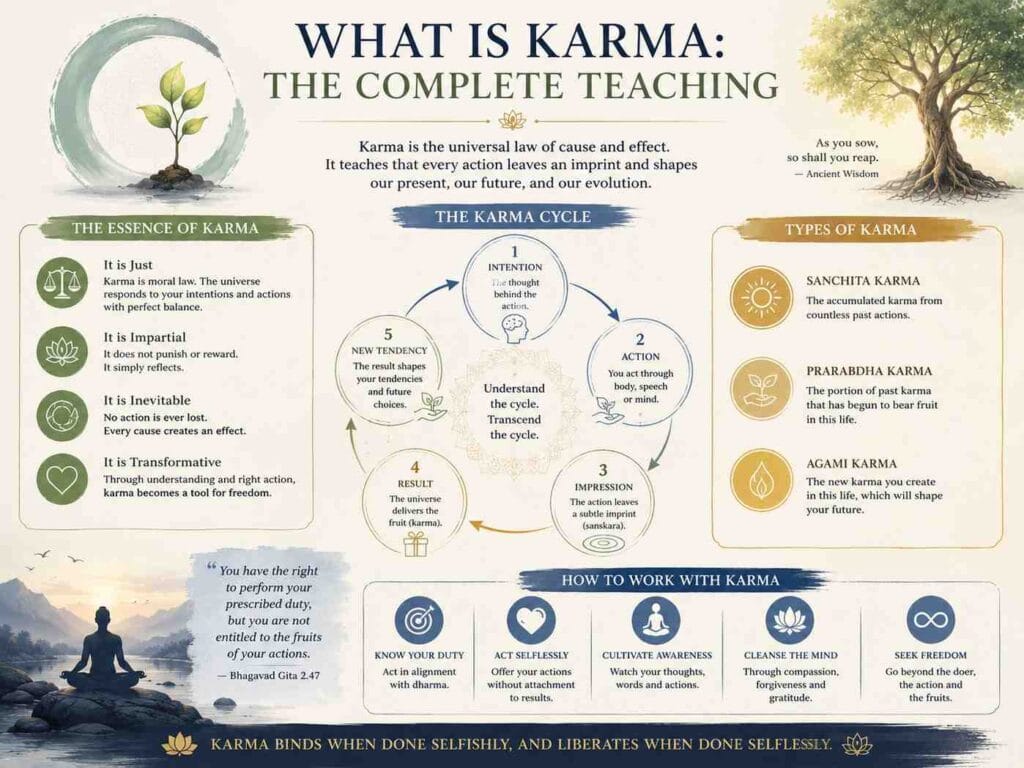
Discover the true meaning of karma through the Bhagavad Gita, Yoga philosophy, Buddhism, and Vedanta. Learn how karma relates to action, intention, conditioning, consciousness, rebirth, attachment, and inner freedom beyond the common misunderstandings of reward and punishment.
Introduction
Few ideas from Indian philosophy are as widely known, and as deeply misunderstood, as karma.
Today, the word is often used casually in everyday conversation. If someone behaves badly and later experiences difficulty, people immediately say: “That’s karma.”
If something fortunate happens unexpectedly, the same word appears again.
Over time, karma has become associated with instant cosmic justice, almost like a supernatural reward-and-punishment system operating automatically in daily life.
However, the original teaching found in Indian philosophical traditions is far more profound than this simplified interpretation.
Within traditions such as the Bhagavad Gita, the Upanishads, Buddhism, Jainism, Vedānta, and the Yoga Sutras of Patanjali, karma is not merely about external reward or punishment. It refers to the relationship between action, intention, conditioning, consciousness, and consequence.
Indian philosophy approaches human life as deeply interconnected rather than random. Actions are not seen as isolated events disappearing the moment they occur. Every action leaves some form of impression behind, psychologically, ethically, emotionally, and spiritually. Over time, these impressions influence future behavior, perception, habits, reactions, and even identity itself.
This is why karma becomes both an ethical and psychological teaching simultaneously.
The doctrine attempts to explain why certain patterns repeat within human life: why habits become deeply rooted, why emotional reactions feel automatic, why attachment strengthens over time, and why suffering often continues through repetitive cycles of thought and behavior.
Rather than describing supernatural punishment imposed externally, karma explains how consciousness gradually becomes conditioned through repeated action and experience.
In this sense, karma is ultimately connected to one of the deepest questions in Indian philosophy: How does consciousness become bound, and how can it become free?
The Literal Meaning of Karma
The Sanskrit word karma comes from the verbal root: kṛ, meaning “to act,” “to do,” or “to make.” At its simplest level, karma means action.
However, Indian philosophical traditions expanded this meaning far beyond physical behavior alone. Karma includes not only what a person does outwardly, but also: speech, thought, emotion, motivation, intention, and psychological reaction.
This is extremely important because ancient Indian thinkers recognized that human beings are shaped internally by what they repeatedly cultivate.
An action does not simply disappear after it is completed externally.
It also leaves a subtle effect within consciousness.
For example, repeated anger does not only affect other people. It gradually conditions the mind itself toward irritability and emotional reactivity. Repeated fear strengthens anxiety. Repeated craving intensifies attachment. Similarly, repeated compassion, patience, discipline, or mindfulness shape consciousness in very different ways.
Over time, these repeated patterns begin forming tendencies. Tendencies become habits. Habits influence personality. And personality begins shaping perception itself.
This is why karma is not merely about external events happening in the world. It is also about the gradual formation of character, identity, and psychological conditioning.
Indian philosophy therefore sees human beings not as static entities, but as continuously shaped by repeated patterns of action and awareness.
Karma and Intention
One of the most sophisticated aspects of karmic philosophy is the importance it gives to intention.
Two actions may appear identical externally while carrying completely different karmic significance internally.
For instance, a person may speak harshly out of cruelty, ego, or the desire to hurt someone emotionally.
Another person may speak firmly in order to protect, guide, or prevent harm.
The outward action may appear similar, yet the consciousness behind the action is entirely different.
Indian philosophy repeatedly emphasizes that the inner state shaping an action matters deeply.
This is especially visible within Buddhist philosophy, where intention (cetana) becomes central to the entire doctrine of karma. The quality of awareness behind an action influences the kind of conditioning created internally.
The Bhagavad Gita also emphasizes this repeatedly. Krishna teaches that attachment, ego, greed, and compulsive desire bind consciousness more deeply than action itself.
Thus, karma is not simply about behavior in isolation.
It concerns the relationship between consciousness and action.
The same external act performed with awareness, compassion, or selflessness creates a very different psychological effect than an act performed through hatred, fear, or egoic attachment.
This insight makes karma a highly refined psychological teaching rather than a simplistic moral system.
Karma Is Not Fate
One of the biggest misunderstandings about karma is the belief that it teaches fatalism, the idea that everything in life is already fixed and cannot change.
This is not how classical Indian philosophy presents karma.
Karma influences tendencies and circumstances, but it does not completely remove human freedom.
The past affects the present, yet the present also continuously shapes the future.
Every moment contains both conditioning and possibility.
This distinction is extremely important.
If karma meant absolute predestination, then spiritual practice would become meaningless. Meditation, self-awareness, ethical discipline, yoga, and inner transformation would have no real purpose because consciousness could never change.
However, Indian traditions consistently teach the opposite.
The entire spiritual path depends upon the possibility of transforming conditioning consciously.
Karma explains why patterns exist, but awareness creates the possibility of responding differently rather than mechanically repeating unconscious behavior forever.
For example, a person may carry strong tendencies toward anger because of years of conditioning. Karma explains the existence of that pattern.
Yet through self-awareness, meditation, discipline, and observation, the person can gradually weaken the pattern instead of remaining completely controlled by it.
Thus, karma is not rigid destiny.
It is a dynamic process involving both conditioning and conscious participation.
Karma and Psychological Conditioning
One of the most remarkable aspects of the karmic doctrine is its psychological sophistication.
Indian philosophy recognized long ago that repeated mental and emotional activity gradually conditions the structure of consciousness itself.
Every repeated thought strengthens a pathway. Every repeated reaction becomes easier to repeat again. Every emotional habit reinforces itself over time. This insight appears clearly in the Yoga Sutras of Patanjali through the concept of: saṁskāras, subtle impressions stored within consciousness.
These impressions influence: future desire, fear, behavior, habit, perception, and emotional reaction.
In other words, human beings gradually become conditioned by what they repeatedly experience and cultivate internally.
Modern psychology and neuroscience increasingly study similar mechanisms through ideas such as: habit formation, behavioral conditioning, reinforcement loops, emotional patterning, and neural pathways.
Indian philosophy approached these same dynamics not through laboratory science, but through meditation, introspection, and direct observation of consciousness.
This is why karma is much more than moral philosophy. It is also a theory of how consciousness becomes shaped over time.
Repeated unconscious patterns create deeper bondage. Repeated awareness gradually creates freedom. And this becomes one of the central goals of Indian spiritual practice itself.
Karma in the Bhagavad Gita
The Bhagavad Gita offers one of the clearest and most influential explanations of karma in all of Indian philosophy.
Unlike popular interpretations that reduce karma to simple reward and punishment, the Gita approaches the subject from a much deeper psychological and spiritual perspective.
Krishna explains that human beings cannot completely avoid action.
Even when a person appears inactive externally, the mind continues thinking, desiring, imagining, fearing, reacting, and identifying internally. In this sense, complete inaction is almost impossible as long as consciousness remains active.
This is why Krishna does not teach Arjuna to escape life or withdraw from responsibility. Instead, he transforms Arjuna’s understanding of action itself.
The central issue, according to the Gita, is not action alone.
The deeper problem is attachment to action and psychological dependence upon outcomes.
Krishna says:
Bhagavad Gita 2.47
कर्मण्येवाधिकारस्ते मा फलेषु कदाचन ।
मा कर्मफलहेतुर्भूर्मा ते सङ्गोऽस्त्वकर्मणि ॥
Transliteration
Karmaṇy evādhikāras te mā phaleṣu kadācana
Mā karma-phala-hetur bhūr mā te saṅgo ’stv akarmaṇi
Meaning
“You have a right to action alone, never to its fruits. Do not become attached to the results of action, nor become attached to inaction.”
This verse became the foundation of Karma Yoga, one of the central teachings of the Bhagavad Gita.
Krishna is not asking Arjuna to stop caring about life or to become emotionally numb. Nor is he teaching passivity or indifference toward responsibility.
Instead, he points toward a different inner relationship with action.
Ordinarily, human beings become psychologically entangled in results: success and failure, praise and criticism, gain and loss, recognition and rejection. Identity becomes dependent upon outcomes.
When success occurs, the ego strengthens. When failure appears, suffering intensifies.
Fear, anxiety, comparison, and frustration arise because the mind becomes completely attached to controlling results that are never fully controllable.
Krishna therefore shifts attention away from obsessive attachment to outcomes and toward conscious action itself.
A person can act with discipline, sincerity, intelligence, and responsibility while remaining less psychologically imprisoned by expectation and fear.
This is the essence of Karma Yoga: fully participating in life without becoming internally consumed by compulsive attachment to results.
The Bhagavad Gita repeatedly emphasizes that suffering often emerges not from action itself, but from identification and attachment surrounding action. Thus, inner freedom does not require abandoning life.
It requires transforming the consciousness through which life is lived.
Different Types of Karma
Over time, Indian philosophical traditions developed more detailed frameworks to explain how karma operates within human experience.
One widely known classification divides karma into three major categories.
Sañcita Karma – Accumulated Conditioning
Sañcita karma refers to accumulated karma from previous actions, impressions, and experiences.
It represents the vast storehouse of conditioning carried within consciousness.
According to Indian philosophy, every action, thought, emotional reaction, and attachment leaves subtle impressions behind. Over long periods of time, these impressions accumulate and influence future tendencies.
This accumulated conditioning shapes: habitual reactions, emotional patterns, fears, desires, and behavioral tendencies.
In many traditions, sañcita karma is viewed as the total reservoir of karmic impressions gathered across countless experiences.
Psychologically, it can also be understood as the deep conditioning influencing how individuals perceive and respond to life.
Prārabdha Karma – Karma Already Unfolding
Prārabdha karma refers to the portion of accumulated karma already bearing fruit within present experience.
These are the conditions, tendencies, and circumstances currently unfolding in life.
Traditional interpretations may connect this to birth circumstances, relationships, health, tendencies, opportunities, or major life patterns.
However, the deeper philosophical point is that certain consequences of past conditioning are already active within present experience.
This does not mean life becomes completely fixed or predetermined.
Rather, it explains why individuals often begin life with different tendencies, inclinations, strengths, struggles, and psychological patterns already present.
The Gita and later traditions emphasize that although some conditions are already unfolding, awareness still influences how one responds to them.
Āgāmi Karma – Karma Being Created Now
Āgāmi karma refers to new karma being created through present thoughts, intentions, choices, and actions.
This aspect of karma is especially important because it preserves the possibility of transformation.
Human beings are not merely prisoners of past conditioning.
Every present action contributes to shaping future consciousness.
Each moment of awareness, discipline, compassion, honesty, or mindfulness gradually alters the direction of conditioning itself.
Similarly, unconscious behavior continues reinforcing old patterns.
Thus, karma is dynamic rather than mechanically fixed.
The present continuously interacts with the past.
Karma and Rebirth
In many Indian philosophical traditions, karma becomes closely connected with the doctrine of rebirth (saṁsāra).
The idea is not merely that actions produce external consequences within one lifetime. Rather, consciousness itself carries impressions, desires, attachments, and conditioning forward.
As long as attachment, ignorance, craving, and identification remain unresolved, the cycle of conditioned experience continues.
Different schools explain rebirth differently. Some interpret it literally as continuity across lifetimes.
Others approach it symbolically or psychologically. However, the central insight remains consistent: conditioning perpetuates itself until awareness transforms it.
This is why liberation (mokṣa) requires more than moral behavior alone.
A person may behave ethically outwardly while remaining inwardly dominated by fear, ego, attachment, or craving.
Indian philosophy therefore emphasizes transformation at the level of consciousness itself. Liberation means freedom from compulsive conditioning and unconscious identification.
Karma Is Not Cosmic Revenge
Modern culture often treats karma like supernatural revenge:
“If someone hurts others, karma will punish them.”
Classical Indian philosophy presents a far subtler understanding.
Karma is not an emotional force rewarding and punishing individuals arbitrarily.
It functions more like a principle of causation woven into consciousness and experience.
Actions shape the mind naturally. Hatred increases inner agitation. Greed strengthens restlessness and dissatisfaction. Attachment creates fear of loss. Dishonesty fragments clarity and trust.
Similarly: discipline creates steadiness, compassion softens reactivity, truthfulness strengthens clarity, and self-awareness weakens unconscious behavior.
Karma therefore operates less like divine punishment and more like psychological and existential causation.
Human beings gradually become shaped by what they repeatedly cultivate.
This understanding removes much of the simplistic moralism often associated with karma today.
Karma and Freedom
One of the deepest insights within Indian philosophy is that bondage does not arise from action alone.
Bondage arises through unconscious attachment and identification.
Human beings suffer because awareness becomes trapped within: desire, fear, ego, craving, memory, comparison, and compulsive reaction.
The mind continuously seeks fulfillment through unstable external conditions and therefore remains psychologically restless.
This is why Indian spiritual traditions do not seek escape from action itself. Instead, they seek freedom within action.
The Bhagavad Gita repeatedly teaches that external activity can continue while inner attachment gradually weakens.
A person may remain fully engaged in work, family, society, and responsibility while becoming inwardly less dominated by anxiety, egoic fixation, and compulsive dependence upon outcomes.
Externally, action remains. Internally, awareness becomes steadier. This is the essence of Karma Yoga.
Action continues, but consciousness becomes less psychologically imprisoned by attachment to success, failure, praise, fear, and personal identity.
Why Karma Still Matters Today
The teaching of karma remains highly relevant because modern life continuously reinforces conditioning.
Social media, advertising, overstimulation, comparison culture, and emotional reactivity repeatedly shape attention and behavior.
Human beings become what they repeatedly practice mentally and emotionally.
Attention conditions consciousness. Habits shape perception. Repeated emotional states gradually become identity.
Karma reminds us that every thought, reaction, and action contributes to the direction of consciousness over time. This makes the teaching deeply practical rather than merely philosophical.
Conclusion
Karma is one of the most profound teachings in Indian philosophy.
Far beyond the simplistic idea of reward and punishment, karma describes the relationship between: action, intention, conditioning, consciousness, and human experience.
Every action influences the structure of awareness itself.
Repeated thoughts, emotions, and behaviors gradually shape perception, habit, identity, and psychological tendency.
The Bhagavad Gita, Yoga philosophy, Buddhism, and other Indian traditions therefore treat karma not merely as morality, but as a fundamental law of inner conditioning and transformation.
Ultimately, the teaching of karma points toward responsibility and awareness.
Human beings may not control every circumstance completely, but they continuously participate in shaping consciousness through the way they think, act, react, and live.