Discover the complete meaning, benefits, symbolism, and practice of Balasana (Child’s Pose). Learn how this deeply calming yoga posture supports relaxation, nervous system regulation, flexibility, mindfulness, and inner stillness through traditional yoga wisdom and modern understanding.
Introduction
Among all modern yoga postures, few are as underestimated as Balāsana, commonly known as Child’s Pose.
At first glance, the posture appears extremely simple.
There is no dramatic flexibility. No advanced balance. No impressive inversion. No intense muscular challenge.
Because of this, many people treat Balasana merely as a “resting pose” placed between more difficult postures during yoga practice.
However, within traditional yoga, simplicity does not imply lack of depth.
In fact, some of the most powerful yogic practices appear outwardly gentle while producing profound effects internally.
Balasana is one such posture.
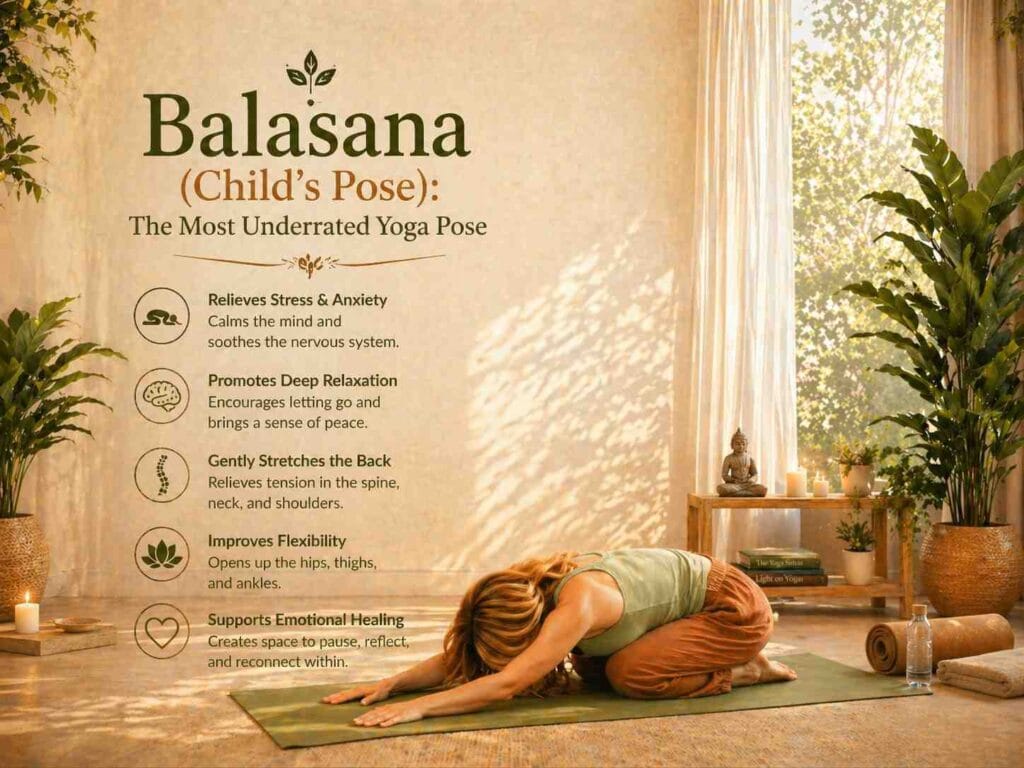
This posture represents far more than physical rest alone. When practiced consciously, Balasana becomes deeply connected to: nervous system regulation, breath awareness, mental quietness, emotional grounding, fatigue recovery, and inward withdrawal of attention.
In modern life, where the body remains constantly stimulated through screens, stress, noise, sitting, tension, and overactivity, the value of postures that encourage genuine relaxation has become increasingly important.
Balasana offers exactly this.
The posture creates a physical shape associated with safety, surrender, grounding, and inward stillness. The spine softens, the breath slows naturally, muscular effort decreases, and awareness gradually turns inward.
This is one reason why Child’s Pose is increasingly recommended not only within yoga classes, but also within stress-management practices, therapeutic movement systems, mindfulness-based approaches, and nervous system recovery work.
Interestingly, the deeper principles behind Balasana align strongly with broader teachings found throughout classical yoga traditions.
Ancient yogic systems consistently emphasized that yoga is not merely about exertion or physical intensity. The purpose of practice is ultimately steadiness of consciousness.
The Yoga Sutras of Patanjali defines yoga as:
योगश्चित्तवृत्तिनिरोधः ॥
Transliteration
Yogaś citta-vṛtti-nirodhaḥ
Meaning
“Yoga is the stilling of the fluctuations of the mind.”
Although Balasana is not directly mentioned in the Yoga Sutras, the posture reflects this principle beautifully because it naturally encourages quietness, reduced agitation, slower breathing, and inward attention.
Similarly, traditional Haṭha Yoga texts repeatedly emphasized the relationship between breath, nervous system balance, and mental steadiness.
The Hatha Yoga Pradipika states:
चले वाते चलं चित्तं निश्चले निश्चलं भवेत् ।
योगी स्थाणुत्वमाप्नोति ततो वायुं निरोधयेत् ॥
Transliteration
Chale vāte chalaṁ cittaṁ niścale niścalaṁ bhavet
Yogī sthāṇutvam āpnoti tato vāyuṁ nirodhayet
Meaning
“When the breath is unsteady, the mind is unsteady. When the breath becomes steady, the mind becomes steady.”
This insight becomes highly relevant in Balasana because the posture naturally encourages slower and deeper breathing patterns.
As the abdomen softens against the thighs and the body folds inward, respiration often becomes calmer automatically. This may help shift the nervous system away from excessive activation and toward greater relaxation.
For this reason, Balasana is not merely a “break” between poses.
When practiced with awareness, it becomes a posture of restoration, surrender, grounding, and conscious recovery.
What Does “Balasana” Mean?
The Sanskrit word: Bāla means “child.” Āsana means “posture” or “seat.” Thus, Balasana translates as: Child’s Pose. The name itself is psychologically meaningful.
Children naturally rest in curled, folded, grounded positions when tired, emotionally overwhelmed, or seeking comfort. The shape of Balasana reflects this instinctive posture of protection and rest.
The body folds inward toward the earth. The forehead lowers. The spine rounds gently. Muscular effort decreases. Breathing softens. The nervous system often interprets this shape as safe and calming.
This is one reason the posture feels emotionally restorative for many practitioners.
Unlike highly stimulating postures that demand intense muscular engagement or concentration, Balasana encourages release rather than performance.
The posture therefore represents an important dimension of yoga often forgotten in modern fitness-oriented practice: the capacity to soften consciously.
How to Do Balasana Properly
Although Balasana appears simple, practicing it with proper alignment and awareness makes a significant difference.
Step-by-Step Instructions
- Begin in a kneeling position on the mat.
- Bring the big toes toward each other while allowing the knees either together or slightly apart depending upon comfort.
- Slowly lower the hips back toward the heels.
- Fold the torso forward over the thighs.
- Extend the arms forward actively for a longer variation, or rest them alongside the body for a softer restorative variation.
- Allow the forehead to rest gently on the mat, a block, or a cushion.
- Relax the jaw, shoulders, abdomen, and facial muscles.
- Breathe slowly and naturally.
- Remain in the posture for several breaths or longer if comfortable.
The most important aspect of Balasana is not forcing flexibility.
The posture should feel supportive and grounding rather than compressed or strained.
Different Variations of Balasana
Balasana can be adapted according to comfort, flexibility, and intention.
Traditional Balasana
Knees together with arms forward.
This creates gentle spinal lengthening and a compact inward shape.
Wide-Knee Balasana
The knees widen apart while the torso rests between the thighs.
This often creates more space for breathing and reduces abdominal compression.
Restorative Balasana
Bolsters, cushions, or folded blankets are placed beneath the torso and forehead.
This variation is deeply calming and often used in restorative yoga practices.
Active Balasana
The arms reach strongly forward while the hips draw backward.
This creates a more active stretch through the spine and shoulders.
Physical Benefits of Balasana
Despite its simplicity, Balasana offers several important physical benefits when practiced consistently and comfortably.
Gentle Spinal Release
Balasana softly lengthens the back body, particularly the lower spine.
After long periods of sitting, standing, or intense physical activity, the posture may help release accumulated tension around the back and hips.
Because the spine rounds gently rather than extending forcefully, many practitioners experience the posture as relieving and grounding.
Hip and Pelvic Relaxation
The folded position encourages gradual softening around the hips and pelvis.
This can be especially supportive for individuals carrying muscular tension due to prolonged sitting or stress-related tightening.
Shoulder and Neck Relief
When the arms extend forward, the posture creates mild lengthening through the shoulders and upper back.
At the same time, lowering the forehead and relaxing the neck may help reduce unnecessary muscular holding patterns.
Support for Recovery
Balasana is commonly used between more demanding postures because it allows the body to recover without leaving the practice entirely.
Heart rate slows. Effort decreases. Breathing steadies. The nervous system receives an opportunity to reset.
Nervous System and Psychological Benefits
One of the deepest values of Balasana lies in its effect upon the nervous system and mental state.
Encourages Parasympathetic Activation
Modern life keeps many individuals in prolonged states of stimulation and alertness.
Constant digital exposure, stress, multitasking, noise, and performance pressure may contribute to chronic nervous system activation.
Balasana encourages the opposite response.
The folded shape, reduced muscular effort, slower breathing, and lowered head position may support parasympathetic nervous system activation, the state associated with rest and recovery.
This is one reason many people instinctively remain in the posture longer than expected.
The body often recognizes it as calming.
Creates Psychological Grounding
Balasana draws awareness inward. Vision becomes reduced. Movement decreases. Attention naturally shifts away from external stimulation. This creates a grounding effect psychologically.
For practitioners dealing with overwhelm, exhaustion, emotional agitation, or overstimulation, the posture may provide a temporary sense of containment and steadiness.
Encourages Surrender Rather Than Performance
Modern culture often conditions constant productivity and striving. Even yoga can become performance-oriented. Balasana interrupts this mentality. The posture teaches receptivity rather than achievement.
Instead of pushing aggressively toward external performance, the practitioner practices softness, stillness, and non-striving.
This reflects a deeper yogic principle often overlooked today.
Balasana and Breath Awareness
Balasana becomes especially powerful when combined with conscious breathing.
As the torso rests against the thighs, the practitioner can often feel the movement of breath more directly in the back body and ribcage.
This naturally increases awareness of respiration. The posture therefore becomes an excellent environment for practicing: slow breathing, diaphragmatic breathing, mindfulness, or simple breath observation.
Because breath and mental state remain deeply connected, slower respiration often supports greater inner steadiness.
This reflects principles emphasized repeatedly throughout traditional yoga literature.
The Symbolic Meaning of Child’s Pose
Beyond physical benefits, Balasana also carries symbolic depth.
The posture reflects: humility, surrender, rest, trust, and inward return. The head lowers toward the earth. The spine curves protectively. External performance disappears.
In many ways, Balasana represents temporary release from psychological striving.
This symbolism becomes especially meaningful in modern environments built around constant stimulation, competition, productivity, and external identity.
Balasana reminds practitioners that softness itself can be transformative.
Who Should Practice Balasana Carefully?
Although generally considered safe, some individuals should approach the posture carefully or modify it.
This includes: people with severe knee injuries, acute ankle limitations, certain hip conditions, or pregnancy in later stages depending upon comfort.
Using props such as blankets, bolsters, or blocks can make the posture significantly more accessible. As with all yoga practices, the posture should never be forced aggressively. Pain is not the goal.
Why Balasana Is So Underrated
Balasana is often overlooked precisely because it appears simple.
Modern yoga culture frequently prioritizes difficulty, flexibility, athleticism, and visually impressive postures. As a result, quieter postures are sometimes treated as less important.
Yet many practitioners eventually realize that the ability to truly rest consciously may be more difficult than performing advanced poses.
Stillness challenges the modern mind differently.
Balasana therefore becomes profound not because it looks dramatic externally, but because it addresses something deeply needed internally: the capacity to soften without collapsing, to rest without distraction, and to become still without losing awareness.
Conclusion
Balasana, or Child’s Pose, may appear simple externally, yet it contains remarkable depth physically, psychologically, and symbolically.
The posture gently supports spinal release, breath awareness, nervous system regulation, grounding, and inward attention while encouraging softness rather than force.
Traditional yoga philosophy consistently emphasized steadiness, awareness, and the relationship between breath and mind. Balasana reflects these principles beautifully through its calming and restorative nature.
In a world increasingly dominated by overstimulation, exhaustion, and constant movement, the value of postures that encourage genuine stillness becomes even more important.
Perhaps this is why Balasana continues resonating so deeply with modern practitioners.
It reminds us that sometimes the most healing practices are not the most intense ones. Sometimes the deepest transformation begins through stillness, breath, and the simple willingness to rest consciously.