A deeply researched guide to desk yoga for remote workers covering posture, mobility, stress relief, nervous system balance, breathing practices, mental wellbeing, and why this modern wellness trend is growing rapidly worldwide.
Introduction
One of the biggest wellness trends quietly transforming modern work culture is not extreme fitness, expensive biohacking, or productivity optimization.
It is something far simpler: desk yoga.
Across remote work communities, wellness platforms, ergonomic health discussions, corporate wellbeing programs, physiotherapy channels, and mindfulness spaces, increasing numbers of people are turning toward short yoga-based movement practices specifically designed for desk workers and people working from home.
What began as occasional “office stretches” has now evolved into a much broader movement focused on: mobility, posture recovery, nervous system regulation, stress reduction, breath awareness, and sustainable work-life balance.
This shift is not happening randomly.
Remote work fundamentally changed how millions of people use their bodies daily. Large numbers of workers now spend 8–12 hours sitting in front of screens with limited movement, reduced outdoor activity, poor posture habits, and continuous cognitive stimulation.
As a result, complaints involving: neck stiffness, lower back tension, tight hips, eye strain, fatigue, mental exhaustion, and postural discomfort, have become increasingly common within modern work culture.
At the same time, wellness conversations are gradually shifting away from aggressive productivity culture toward sustainability, recovery, movement snacks, nervous system health, and long-term wellbeing.
Desk yoga fits directly into this transition because it offers something modern workers desperately need: small moments of physical and psychological reset throughout the workday.
Importantly, desk yoga is not simply about stretching muscles mechanically.
Its deeper value lies in interrupting prolonged immobility and restoring awareness to the body, breath, posture, and nervous system.
Interestingly, while desk yoga feels modern and trend-driven, many of its underlying principles align closely with ancient yogic teachings that emphasized the deep relationship between body, breath, attention, and mental steadiness.
The Yoga Sutras of Patanjali defines yoga as:
योगश्चित्तवृत्तिनिरोधः ॥
Transliteration
Yogaś citta-vṛtti-nirodhaḥ
Meaning
“Yoga is the stilling of the fluctuations of the mind.”
Although ancient yogic texts never discussed laptops or remote work directly, they repeatedly explored how physical state, breath, sensory overload, and mental agitation remain interconnected.
This insight feels remarkably relevant in modern desk-bound life.
Why Desk Yoga Is Trending So Strongly Right Now
The rapid rise of desk yoga reflects broader changes occurring within modern work culture.
Remote work created convenience and flexibility for many people, but it also dramatically increased sedentary behavior.
Millions of workers now spend most of their day: sitting, looking downward at screens, typing continuously, remaining indoors, and moving far less than previous generations.
At the same time, digital work environments create constant cognitive engagement.
Notifications, meetings, multitasking, emails, performance pressure, and endless screen exposure keep the nervous system continuously stimulated.
Many people therefore experience a strange combination of: physical stillness, and mental overactivity.
This imbalance has become one of the defining health patterns of modern remote work culture.
As awareness surrounding posture, ergonomics, mobility, and mental health grows, desk yoga has emerged as a practical response because it requires: minimal space, no equipment, short time commitment, and low physical intensity.
Unlike intense workout routines, desk yoga can be integrated directly into ordinary work life.
A person may practice for: 2 minutes, 5 minutes, or between meetings without needing a full exercise session.
This accessibility is one of the biggest reasons the trend continues expanding globally. Modern workplace wellness conversations increasingly emphasize that small consistent movement throughout the day may support better comfort and recovery than remaining completely sedentary for long periods.
Ancient Yoga Already Emphasized the Body-Mind Connection
Although desk yoga appears modern, its deeper foundations align strongly with classical yogic understanding.
Ancient yoga traditions consistently observed that the condition of the body influences the condition of the mind.
The Hatha Yoga Pradipika explains:
चले वाते चलं चित्तं निश्चले निश्चलं भवेत् ।
योगी स्थाणुत्वमाप्नोति ततो वायुं निरोधयेत् ॥
Transliteration
Chale vāte chalaṁ cittaṁ niścale niścalaṁ bhavet
Yogī sthāṇutvam āpnoti tato vāyuṁ nirodhayet
Meaning
“When the breath is unsteady, the mind is unsteady. When the breath becomes steady, the mind becomes steady.”
This insight becomes highly relevant for desk workers because prolonged sitting and stress often unconsciously affect breathing patterns.
Many people working under pressure begin breathing shallowly while sitting in compressed positions for long periods.
Desk yoga practices frequently combine: gentle movement, spinal mobility, neck release, and conscious breathing. Together, these practices may help interrupt accumulated tension patterns created by prolonged screen-based work.
Ancient yoga systems approached this relationship experientially long before modern ergonomics and neuroscience existed.
Desk Yoga and the Nervous System
One reason desk yoga has become so popular among remote workers is because modern work environments place the nervous system under continuous low-level stress.
Unlike physical labor, digital work exhausts people differently.
The body often remains still for hours while the brain stays constantly active through: meetings, notifications, decision-making, deadlines, and nonstop information processing.
Over time, many workers begin experiencing a strange combination of physical stiffness and mental exhaustion simultaneously.
This is where desk yoga becomes useful.
Small movement breaks throughout the day help interrupt long periods of muscular tension and mental overfocus. Changing posture, stretching tight areas, and slowing down for even a few minutes may help the body shift out of prolonged stress patterns created by continuous screen exposure.
Breathing also changes significantly during focused work.
Many people unconsciously begin taking shallow breaths while concentrating intensely, especially during stressful tasks or long meetings. Desk yoga practices often encourage slower and more conscious breathing because it naturally creates a feeling of steadiness and relaxation.
This is one reason workers frequently report feeling mentally lighter after short desk yoga sessions even when the physical movements themselves are simple.
The benefit is not only muscular.
The entire mental state often changes when the body finally stops remaining frozen in one position for hours.
Simple Desk Yoga Practices for Remote Workers
One of the biggest reasons desk yoga became such a rapidly growing wellness trend is because it feels realistic for ordinary life.
Many people want healthier routines, but modern work schedules often leave very little time or energy for long exercise sessions during the middle of the day. Remote workers may spend hours moving between meetings, deadlines, messages, and continuous screen-based tasks without enough time to attend yoga classes or complete full workouts regularly.
Desk yoga fits naturally into this environment because the practices are intentionally simple and accessible.
People do not need: a yoga studio, special clothing, large movement space, advanced flexibility, or expensive equipment.
Most movements can be performed directly in a chair, beside a desk, or within a small room in just a few minutes.
This practicality is one of the main reasons desk yoga resonates so strongly with modern workers.
The goal is not athletic performance or intense calorie-burning exercise.
The purpose is creating small moments of movement, mobility, posture awareness, and nervous system recovery throughout long workdays.
Even short movement breaks may help interrupt the physical stiffness and mental fatigue created by remaining seated for extended periods.
Seated Spinal Twist
One of the most common effects of long desk work is the feeling that the spine becomes rigid, compressed, or “stuck” after remaining in the same position for hours.
Most remote work involves very little rotational movement. The torso stays almost completely fixed while the hands and eyes remain focused forward toward screens.
A seated spinal twist gently reintroduces movement into the upper and middle back.
The movement usually involves placing one hand on the opposite knee or chair arm while slowly rotating the torso and shoulders to one side. The twist should remain soft and controlled rather than forceful.
The purpose is not achieving extreme flexibility.
Instead, the movement helps reduce the feeling of physical stagnation that builds throughout long sitting periods.
Many people notice that even small spinal movement creates a feeling of relief because the body finally moves outside its repetitive work posture.
The twist may also help improve awareness of how much unconscious tension is being held around the back, shoulders, and ribcage during focused work.
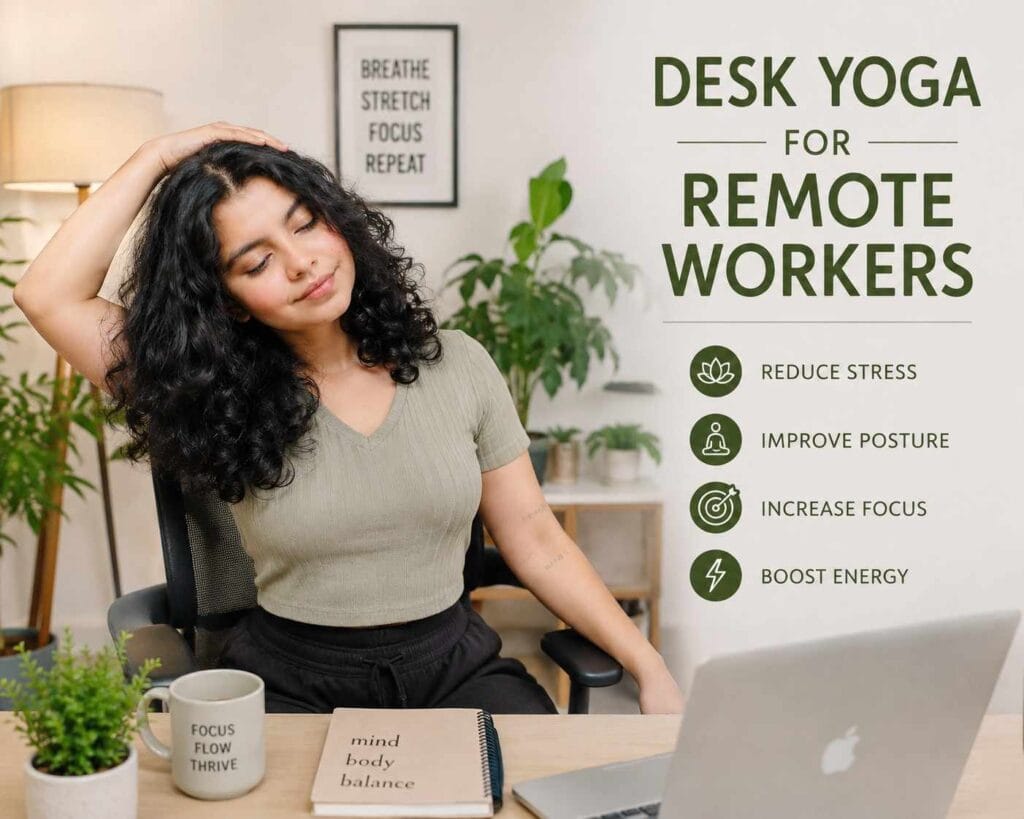
Neck Release Stretch
The neck and shoulders are some of the first areas where remote workers accumulate tension.
Long hours of laptop work often cause the head to move slightly forward while the shoulders slowly tighten upward without conscious awareness. Over time, this positioning may create stiffness, reduced mobility, headaches, or general discomfort around the upper body.
Neck release stretches help interrupt this pattern gently.
These movements usually involve slowly tilting the head side to side or forward while consciously relaxing the shoulders and jaw.
The emphasis should remain on softness rather than aggressive stretching.
Many people instinctively try to “force” flexibility into the neck, but desk yoga focuses more on releasing accumulated muscular holding patterns gradually.
This practice becomes especially useful after long video calls or periods of intense concentration because mental stress often manifests physically around the neck and shoulders without people realizing it.
Wrist Mobility Practice
Modern digital work places enormous repetitive demand on the wrists, fingers, and forearms.
Typing, scrolling, clicking, tapping, and trackpad usage create repetitive movement patterns repeated thousands of times throughout the day.
Over time, this may contribute to stiffness, fatigue, or restricted movement around the wrists and hands.
Desk yoga often includes simple mobility exercises such as:
wrist circles,
finger stretches,
gentle forearm extension,
and opening-and-closing hand movements.
Although these exercises appear small, they help restore movement variation to areas that otherwise remain locked into repetitive digital actions for hours.
Many workers ignore these areas until discomfort becomes significant. Desk yoga encourages earlier awareness before tension accumulates excessively.
Seated Cat-Cow Movement
The seated cat-cow movement is adapted from a traditional yoga spinal mobility practice.
While seated, the practitioner alternates between gently rounding the spine and opening the chest while coordinating the movement with breathing.
As the spine rounds, the head and shoulders soften forward.
As the chest opens, the spine extends gently and the shoulders move backward.
This movement helps restore mobility through the spine after prolonged sitting while also encouraging greater awareness of posture and breathing patterns.
Many remote workers remain almost motionless during focused work sessions without realizing how little the spine actually moves throughout the day.
The seated cat-cow introduces gentle rhythmic movement back into the body and often creates a feeling of openness and release around the back and chest.
Because the movement synchronizes with breathing, it may also help calm mental overactivity and improve present-moment awareness during stressful work periods.
Conscious Breathing Pause
Perhaps the simplest desk yoga practice is also one of the most effective:
pausing briefly to breathe consciously.
Many people unconsciously hold tension in the breath during work.
When concentrating intensely, dealing with stress, or multitasking continuously, breathing often becomes shallow, fast, or restricted without conscious awareness.
Short breathing pauses help interrupt this pattern.
Even one or two minutes of slower breathing may help reduce the feeling of mental overload created by nonstop digital engagement.
The practice itself is extremely simple:
the person pauses,
sits comfortably,
relaxes unnecessary tension,
and slowly follows the natural rhythm of breathing for a short period.
The effectiveness comes not from complexity, but from interruption.
For a moment, attention stops rushing toward tasks, screens, and deadlines and returns toward the body and breath itself.
This creates a subtle mental reset before returning to work again.
Why Desk Yoga Resonates Psychologically
Desk yoga resonates strongly today because modern work culture often keeps attention externally occupied from morning until night.
Many people move continuously between: emails, notifications, virtual meetings, deadlines, messages, and multitasking, without experiencing genuine pauses during the day.
Over time, this creates a state where people become mentally overstimulated while simultaneously disconnected from physical awareness.
A person may spend entire workdays without noticing: tight shoulders, shallow breathing, jaw tension, fatigue, poor posture, or physical discomfort, until the exhaustion becomes overwhelming.
Desk yoga interrupts this cycle.
For a few minutes, attention shifts away from external demands and returns inward again.
The individual notices: movement, breathing, physical sensation, posture, and accumulated tension.
This shift feels psychologically significant because modern digital environments rarely encourage embodiment or stillness.
The nervous system remains continuously engaged, reacting to new information constantly.
Desk yoga creates small moments where the body is finally allowed to reset instead of remaining trapped in repetitive work patterns for hours.
This is one reason many practitioners describe desk yoga as calming even though the movements themselves are physically simple.
The relief often comes not from intensity, but from finally giving the body and mind a momentary break from nonstop stimulation.
Important Clarification
It is important not to exaggerate desk yoga as though it is a complete solution for every physical or psychological problem created by modern work culture.
Social media wellness trends sometimes present simple practices in unrealistic ways, making it seem as though a few stretches can completely reverse years of sedentary lifestyle habits, chronic stress, poor sleep, burnout, or serious physical conditions.
The reality is more nuanced.
Desk yoga can be genuinely helpful, but it also has limitations.
It cannot replace: proper medical care, regular physical exercise, strength and mobility training, healthy sleep, nutrition, hydration, outdoor movement, or an ergonomically supportive workspace.
For example, someone experiencing severe chronic pain, nerve compression, repetitive strain injury, or serious spinal issues may still require professional medical guidance and individualized treatment rather than relying only on stretches performed at a desk.
Similarly, desk yoga alone cannot fully compensate for a lifestyle built around extreme inactivity and constant digital overload.
However, this does not reduce its value.
One of the biggest problems in modern work culture is not only lack of exercise, but lack of movement throughout the day itself.
Many people remain seated and physically static for extremely long periods without interruption. Desk yoga helps break this pattern by reintroducing movement, posture variation, breathing awareness, and small recovery periods into the workday.
Its effectiveness often comes from consistency rather than intensity.
A few minutes of stretching or breathing once may not create dramatic results. But small movement breaks repeated daily over months can gradually improve body awareness, reduce feelings of stiffness, and help workers feel less physically compressed during long work hours.
The same applies psychologically.
Desk yoga is not a cure for chronic anxiety, burnout, or emotional exhaustion. Yet many people find that short pauses involving movement and conscious breathing create small moments of mental reset during otherwise highly demanding workdays.
In many ways, the practice works precisely because it is simple and sustainable.
Rather than forcing dramatic transformation, desk yoga introduces small acts of recovery into environments that often leave very little room for rest, movement, or physical awareness.
Conclusion
Desk yoga has become one of the fastest-growing wellness trends among remote workers because it directly responds to the realities of modern digital life.
Today, millions of people spend most of their day: sitting in front of screens, working indoors, multitasking continuously, and remaining mentally engaged for long periods with very little physical movement.
Over time, this lifestyle often contributes to physical stiffness, postural discomfort, cognitive fatigue, and nervous system exhaustion.
Desk yoga emerged as a practical response to these conditions because it fits naturally into modern work environments without requiring major lifestyle disruption.
Short movement breaks, posture resets, stretching, and conscious breathing practices help create moments of recovery during long hours of screen-based work.
Although desk yoga appears like a modern workplace wellness trend, many of its deeper principles reflect ideas that yoga traditions explored long ago: the relationship between posture and comfort, breath and mental state, movement and awareness, and the importance of balance within daily life.
What makes desk yoga resonate so strongly today is not complexity, but accessibility.
The practice acknowledges an important reality of modern life:
many people may not always have time for long wellness routines, but they still need moments of movement, stillness, and recovery throughout the day.
In this sense, desk yoga reflects a larger shift happening within wellness culture itself.
People are gradually moving away from the idea that health must always involve intensity, exhaustion, or extreme optimization.
Instead, there is growing recognition that sustainable wellbeing often depends upon smaller, more consistent practices that support the body and mind within ordinary daily life itself.