
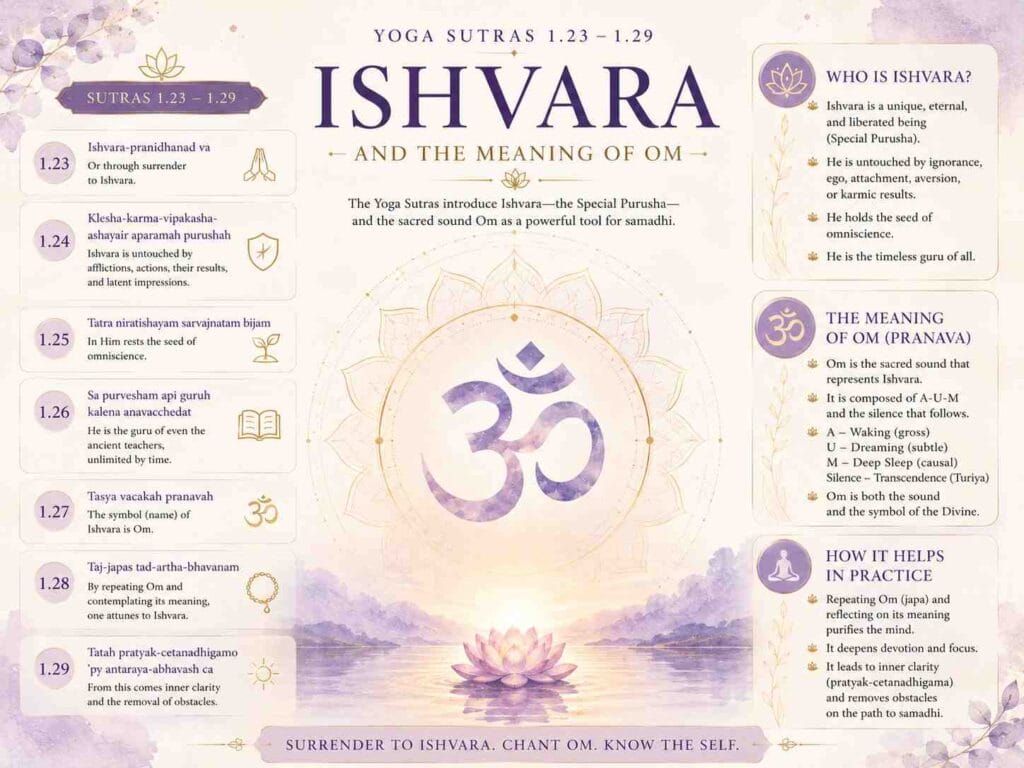
A deeply researched explanation of Yoga Sutras 1.23–1.29 exploring Īśvara, Om, surrender, mantra meditation, consciousness, and the philosophical meaning of sacred sound in the Yoga Sutras of Patañjali.
Introduction
Until this point in the Yoga Sutras of Patanjali, Patañjali has focused primarily on the psychological foundations of yoga: the fluctuations of the mind, practice (abhyāsa), non-attachment (vairāgya), meditative absorption (samādhi), and the progressive refinement of consciousness.
The teachings have been deeply introspective and psychological in structure.
However, beginning with Sutra 1.23, the Yoga Sutras introduce a profoundly important new dimension:
Īśvara – often translated as the Supreme Consciousness, Lord, Divine Principle, or special Purusha.
This section of the Yoga Sutras became one of the most discussed and debated areas within Indian philosophy because it introduces devotion, sacred sound, and transcendence into a system often perceived as purely meditative or psychological.
At first glance, these sutras may appear theological. Yet their depth goes far beyond religion in a conventional sense.
Patañjali is exploring a profound question: Can consciousness stabilize itself entirely through personal effort alone, or is there also a transformative dimension of surrender, devotion, and attunement to a higher principle beyond the ordinary egoic mind?
This question lies at the heart of Sutras 1.23–1.29.
These teachings also contain one of the earliest and most influential philosophical explanations of: Om (ॐ), the sacred sound regarded throughout Indian spiritual traditions as the primordial vibration of consciousness itself.
Today, Om is widely recognized globally, yet its meaning is often reduced superficially to decoration, symbolism, or aesthetic spirituality.
Within the Yoga Sutras, however, Om is presented as a profound meditative doorway connected directly to the realization of higher consciousness.
This section therefore becomes philosophically significant because it bridges: psychology, meditation, devotion, sound, consciousness, and transcendence, into a unified yogic framework.
Sutra 1.23
ईश्वरप्रणिधानाद्वा ॥
Transliteration
Īśvara-praṇidhānād vā
Translation
“Or through surrender to Īśvara.”
This small sutra carries enormous philosophical depth because it introduces a completely different dimension of yoga practice compared to the earlier emphasis on discipline, concentration, and mental restraint.
Until this point, Patañjali largely describes yoga as a path requiring sustained effort: steady practice, withdrawal from attachment, careful observation of the mind, and gradual refinement of awareness.
The practitioner appears responsible for stabilizing consciousness through continuous inner work.
Then suddenly, Patañjali introduces another possibility: surrender.
This transition is extremely important because it reveals that the deepest forms of inner stillness may not arise through effort alone.
Sometimes excessive effort itself becomes part of the disturbance.
The mind can become trapped in spiritual striving just as easily as it becomes trapped in worldly craving.
A person may meditate while constantly thinking: “Am I progressing?” “Why is my mind still restless?” “When will I achieve samādhi?” “Why am I not spiritually advanced yet?”
In such cases, even spiritual practice becomes driven by tension, self-monitoring, comparison, and subtle egoic ambition.
Patañjali recognizes this danger. Īśvara-praṇidhāna introduces another orientation entirely.
Instead of trying to dominate consciousness through constant psychological control, the practitioner begins relaxing the compulsive need to control every inner movement.
This is why the sutra becomes psychologically profound.
Many human beings spend their entire lives trying to maintain control over: identity, emotion, future outcomes, thoughts, relationships, success, and even spiritual experience.
The mind remains in continuous contraction because it fears uncertainty and loss of control.
Surrender interrupts this contraction.
Not by creating passivity, but by softening the psychological rigidity created by endless self-centered effort.
The Meaning of Īśvara-Praṇidhāna
The term Īśvara-praṇidhāna cannot be translated adequately through a single English word because it combines emotional, philosophical, and experiential dimensions simultaneously.
The term may include: devotion, trust, inner offering, reverence, dedication, or surrender toward a higher reality. Importantly, Patañjali does not present this as blind obedience to dogma.
The Yoga Sutras remain philosophically subtle.
Īśvara here is not introduced primarily through mythology or religious identity, but as a transformative principle connected with consciousness itself.
Praṇidhāna especially implies deep inward orientation or complete placing of oneself toward something higher.
This creates an important psychological shift.
Ordinarily, the ego operates as though it alone must carry the burden of existence constantly.
Everything becomes organized around: “My success.” “My control.” “My fear.” “My identity.” “My achievement.” “My suffering.”
Īśvara-praṇidhāna weakens this self-centered contraction gradually.
The practitioner begins experiencing moments where awareness no longer revolves entirely around personal grasping and mental struggle.
This creates spaciousness internally. Meditation becomes less aggressive. Less self-conscious. Less driven by performance. Stillness emerges more naturally because the mind stops fighting itself continuously.
Why Patañjali Says “Or”
One of the most overlooked parts of this sutra is the final word: vā , “or.”
This single word changes the entire meaning of the teaching. Patañjali is not claiming that surrender is the only path. Nor is he abandoning the earlier teachings regarding practice and discipline.
Instead, he acknowledges that human beings approach transformation differently.
Some individuals naturally move through: analysis, concentration, self-observation, and meditative discipline.
Others transform more deeply through: devotion, trust, love, surrender, or sacred orientation.
The Yoga Sutras therefore avoid becoming rigidly one-dimensional.
Patañjali understands that consciousness itself is complex.
Different temperaments require different gateways into inner stillness.
This flexibility became one reason yoga philosophy remained influential across so many different spiritual traditions throughout Indian history.
Surrender and the Ego
One of the deepest implications of this sutra is its insight into the nature of ego itself.
Ordinarily, the ego does not only seek worldly success. It also seeks spiritual achievement. A practitioner may secretly become attached to: being pure, appearing wise, having mystical experiences, being spiritually superior, or “achieving enlightenment.”
Thus, even meditation may strengthen identity unconsciously.
The person remains psychologically trapped while believing they are becoming free.
Īśvara-praṇidhāna weakens this tendency because surrender dissolves the illusion that awakening is something the ego can possess like an accomplishment.
The practitioner gradually realizes that deeper consciousness cannot be controlled or manufactured through personal will alone.
This realization creates humility.
And humility becomes psychologically liberating because the mind no longer needs to maintain the exhausting illusion of mastery over everything.
The Experiential Dimension of Surrender
At a deeper experiential level, surrender often feels less like “giving up” and more like releasing unnecessary internal resistance.
Many people carry constant psychological friction internally.
They resist: what they feel, what they fear, what they cannot control, what already happened, or what may happen in the future.
This resistance consumes enormous mental energy.
In moments of genuine surrender, awareness stops struggling against experience continuously.
There is less inner conflict.
Less compulsive management of every thought and emotion.
The practitioner begins observing rather than constantly controlling.
This creates a very different quality of meditation.
Instead of forcefully suppressing mental activity, awareness becomes softer, quieter, and more receptive. Stillness begins arising through openness rather than domination. This distinction is central to understanding the depth of the sutra.
Sutra 1.24
क्लेशकर्मविपाकाशयैरपरामृष्टः पुरुषविशेष ईश्वरः ॥
Transliteration
Kleśa-karma-vipākāśayair aparāmṛṣṭaḥ puruṣa-viśeṣa īśvaraḥ
Translation
“Īśvara is a special Purusha untouched by afflictions, actions, consequences, or latent impressions.”
After introducing surrender to Īśvara, Patañjali immediately clarifies what he means by Īśvara philosophically.
This clarification is important because without it, readers might assume Patañjali is describing a conventional deity similar to anthropomorphic religious gods.
Instead, his definition remains deeply philosophical and psychological.
Īśvara is described as: a special Purusha, pure consciousness, untouched by conditioning, karma, mental affliction, or latent psychological impression.
This definition becomes clearer when contrasted with ordinary human consciousness.
Human beings experience reality through layers of conditioning continuously.
Perception becomes shaped by: memory, fear, attachment, desire, trauma, identity, habit, and emotional reaction.
Most people do not experience reality directly. They experience reality through conditioning. This is why two individuals may react completely differently to the same situation.
Their consciousness is filtered through different saṁskāras and kleśas. Patañjali describes Īśvara as entirely free from these distortions.
This means Īśvara represents consciousness untouched by psychological fragmentation.
Understanding the Kleśas
The word kleśa refers to the fundamental afflictions that disturb human consciousness.
Later sutras describe them in detail: ignorance (avidyā), ego-identification (asmitā), attachment (rāga),
aversion (dveṣa), and fear or clinging to life (abhiniveśa).
These afflictions shape ordinary experience constantly.
For example: attachment creates dependency, fear creates contraction, ego creates defensiveness, ignorance creates confusion, and aversion creates inner conflict.
Human beings become psychologically entangled in these movements continuously without recognizing how deeply they condition perception.
Īśvara, however, remains untouched by all such disturbance.
This is philosophically profound because Patañjali presents the possibility of consciousness existing beyond psychological suffering entirely.
Karma, Saṁskāras, and Conditioning
Patañjali also says Īśvara is untouched by: karma, vipāka (the results of action), and āśaya (latent impressions).
Ordinary human life unfolds through conditioning accumulated over time. Every experience leaves subtle impressions within the mind.
These impressions influence: reaction, habit, emotion, identity, and future behavior.
Human beings often feel trapped within repetitive psychological patterns because consciousness becomes conditioned by accumulated impressions continuously.
Patañjali describes Īśvara as entirely beyond this cycle. This means Īśvara is not merely morally superior. Īśvara exists outside the entire structure of psychological bondage itself.
That distinction is extremely important.
Īśvara as Pure Consciousness
One of the deepest aspects of this sutra is that Patañjali does not define Īśvara primarily through power, punishment, reward, or emotional judgment.
Instead, Īśvara is defined through freedom from conditioning.
This shifts the entire philosophical orientation of the teaching.
Īśvara becomes the symbol and reality of completely unconditioned awareness.
Thus, meditation upon Īśvara is not merely devotional in the emotional sense. It is also contemplative.
The practitioner orients consciousness toward the possibility of awareness existing beyond: fear, attachment, ego, conditioning, and psychological fragmentation.
This gives the sutra both metaphysical depth and profound psychological relevance.
Sutra 1.25
तत्र निरतिशयं सर्वज्ञबीजम् ॥
Transliteration
Tatra niratiśayaṁ sarvajña-bījam
Translation
“In Him lies the unsurpassed seed of omniscience.”
After describing Īśvara as consciousness untouched by affliction and conditioning, Patañjali now deepens the definition further by introducing the idea of sarvajña-bījam , the seed of complete knowledge.
This sutra is often misunderstood if interpreted superficially.
At first glance, omniscience may sound like the idea of a supernatural being possessing endless information or knowing every detail mechanically. However, classical yoga philosophy approaches knowledge very differently from ordinary intellectual accumulation.
Patañjali is not primarily speaking about encyclopedic information.
He is pointing toward a condition of awareness completely free from distortion.
Ordinary human knowing is fragmented because perception itself becomes filtered through limitation constantly.
People rarely experience reality directly.
Instead, experience becomes shaped by: memory, fear, personal bias, conditioning, attachment, desire, social identity, emotional reaction, and conceptual interpretation.
The mind projects continuously onto reality. Human beings therefore do not merely “see.”
They interpret, compare, judge, react, and psychologically color what they perceive.
This creates fragmentation within awareness.
Two individuals may encounter the same event yet experience it entirely differently because their perception passes through different layers of conditioning.
Patañjali contrasts this ordinary state with Īśvara.
Īśvara represents consciousness in its unobstructed form, awareness not clouded by ignorance, fear, egoic distortion, or psychological fragmentation.
Thus, omniscience here refers less to collecting information and more to complete clarity of awareness. This distinction is philosophically essential.
Knowledge in Yoga Philosophy Is Transformative
One of the deepest differences between modern intellectual culture and classical yoga philosophy lies in how knowledge itself is understood.
In ordinary life, knowledge usually means acquiring information: facts, theories, concepts, analysis, or intellectual skill. However, yoga traditions distinguish sharply between conceptual knowledge and direct realization.
A person may memorize scriptures, study philosophy for years, and discuss spirituality endlessly while remaining inwardly confused, reactive, fearful, or psychologically fragmented.
Intellectual sophistication alone does not necessarily transform consciousness.
This is why Indian philosophical traditions repeatedly emphasize jñāna as realization rather than mere information.
True knowing changes perception itself. Patañjali’s description of Īśvara points toward this deeper form of knowing.
Awareness becomes completely unobstructed because it no longer passes through the distortions created by ego and conditioning.
In this sense, Īśvara embodies perfect clarity rather than intellectual complexity.
Why Patañjali Uses the Word “Seed”
The term bījam, “seed”, is especially important in this sutra. Patañjali does not merely say Īśvara possesses knowledge.
He says within Īśvara lies the seed of all knowing.
A seed contains potential in its most concentrated form. This imagery suggests that all forms of wisdom ultimately arise from pure consciousness itself.
In yogic philosophy, truth is not artificially manufactured by the mind. Rather, awareness gradually uncovers what already exists beneath ignorance and fragmentation.
This idea appears throughout Indian spiritual traditions repeatedly.
Wisdom is revealed through purification of consciousness rather than created through conceptual construction alone.
The more the mind becomes quiet, clear, and free from distortion, the more awareness reflects reality directly. Thus, the “seed of omniscience” points toward the source from which all true knowledge emerges.
The Relationship Between Ego and Fragmentation
Another important implication of this sutra is its insight into how ego limits perception.
Ordinary identity constantly narrows awareness through self-centered interpretation.
People perceive life through questions such as: “How does this affect me?” “Does this support my identity?” “Will this increase my success?” “Does this threaten my beliefs?”
The ego organizes perception around personal attachment continuously.
As a result, awareness becomes fragmented and defensive.
This fragmentation affects not only spiritual life, but everyday perception itself.
Fear changes perception. Desire changes perception. Attachment changes perception. Anger changes perception. Memory changes perception. Patañjali describes Īśvara as awareness completely beyond these distortions.
Thus, omniscience becomes associated with total freedom from fragmentation rather than domination through knowledge.
This is psychologically profound because it suggests that wisdom is inseparable from inner freedom.
The Philosophical Importance of Pure Awareness
This sutra also reveals an important principle within yoga philosophy: consciousness itself is considered fundamentally deeper than ordinary mental activity. Modern people often identify entirely with thought.
They assume thinking itself is the highest form of knowing.
Patañjali presents a radically different view. The ordinary thinking mind is unstable, conditioned, and fragmented.
Pure awareness exists beneath this fragmentation. The clearer consciousness becomes, the more directly reality may be perceived.
This is why meditation within yoga is not merely relaxation. It is a process of reducing distortion within awareness itself.
In this context, Īśvara represents the complete fulfillment of unobstructed consciousness.
Why This Sutra Still Matters Today
Modern culture contains more information than any civilization in history, yet psychological confusion remains widespread.
People are constantly exposed to: opinions, media, analysis, argument, and endless mental stimulation. However, information alone does not necessarily create wisdom.
In many cases, excessive mental noise may even increase fragmentation further.
Patañjali’s teaching remains deeply relevant because it suggests that clarity does not arise merely through accumulating more concepts endlessly.
True insight requires transformation of awareness itself. This is why stillness, contemplation, and inward clarity remain central within yoga.
The goal is not merely to think more. The goal is to perceive more clearly.
Sutra 1.26
स पूर्वेषामपि गुरुः कालेनानवच्छेदात् ॥
Transliteration
Sa pūrveṣām api guruḥ kālenānavacchedāt
Translation
“He is the teacher even of the ancient teachers, being beyond time.”
Patañjali now describes Īśvara as the primordial guru, the original source of wisdom beyond all temporal limitation.
This sutra is philosophically profound because it shifts the discussion from ordinary historical knowledge toward timeless consciousness itself.
Human existence unfolds within time continuously.
Everything within ordinary life changes: the body ages, memories fade, civilizations rise and disappear, ideas evolve, cultures transform, and identities shift.
Human knowledge itself remains historically conditioned. What one era considers absolute truth may later appear incomplete.
Patañjali, however, describes Īśvara as untouched by time altogether.
The phrase kālena-anavacchedāt means “not limited or divided by time.” This is an extraordinarily deep idea.
It suggests that ultimate truth does not depend entirely upon historical period, intellectual fashion, or cultural circumstance.
Instead, yoga proposes that consciousness contains timeless dimensions accessible through direct realization.
Why Īśvara Is Called the Primordial Guru
The word guru here does not simply mean a teacher in the ordinary educational sense.
In Indian spiritual traditions, guru refers to that which removes darkness or ignorance.
Patañjali describes Īśvara as the teacher even of the earliest teachers because pure consciousness itself becomes the ultimate source of wisdom.
This idea appears repeatedly throughout Indian philosophy: truth is discovered rather than invented.
The deepest spiritual insights are not viewed as products of intellectual creativity alone.
Rather, sages and yogis are understood to realize truths already inherent within consciousness itself.
Thus, wisdom flows from direct realization rather than from historical novelty.
This is why many Indian traditions place such importance upon silence, meditation, contemplation, and inward observation.
The deepest forms of knowing are believed to arise through direct experience of consciousness rather than conceptual argument alone.
The Meaning of “Beyond Time”
The idea of being beyond time carries several layers of meaning philosophically.
Ordinary consciousness experiences reality sequentially: past, present, future. Human identity becomes heavily shaped by memory and anticipation.
People remain psychologically trapped between: regret about what happened, and anxiety about what may happen next.
The mind rarely experiences direct presence fully because it remains entangled in temporal movement continuously.
Īśvara, however, is described as beyond this limitation.
This does not simply mean “very old.”
It means consciousness existing beyond the fragmentation created by time-bound identity itself.
This insight becomes psychologically profound because much human suffering depends upon temporal attachment: fear of aging, fear of death, regret, nostalgia, anticipation, and attachment to personal narrative.
Patañjali points toward a dimension of awareness not imprisoned within these movements.
Timeless Truth in Yogic Philosophy
This sutra also reflects one of the central assumptions of yoga philosophy:
truth ultimately transcends cultural and historical fluctuation.
External forms of teaching may change across centuries, but consciousness itself remains fundamentally accessible.
This is why ancient yogic traditions continue resonating today despite enormous differences in civilization, technology, and lifestyle.
The human mind still experiences: fear, attachment, restlessness, egoic conflict, desire, and psychological suffering. Similarly, stillness, awareness, clarity, and inward freedom remain recognizable experiences across time periods.
Patañjali’s teaching suggests that the possibility of awakening belongs to consciousness itself rather than to any single historical moment.
Sutra 1.27
तस्य वाचकः प्रणवः ॥
Transliteration
Tasya vācakaḥ praṇavaḥ
Translation
“His expression is Praṇava (Om).”
With this sutra, Patañjali introduces one of the most sacred and philosophically important symbols in all Indian spirituality:
Om (ॐ).
The significance of this statement cannot be overstated.
Patañjali declares that the sound-symbol expressing Īśvara is Praṇava – Om.
Importantly, Om is not presented merely as a religious chant or cultural ornament.
Within Indian philosophical traditions, Om became understood as the symbolic vibration of consciousness itself.
This teaching later influenced: Vedanta, mantra yoga, tantric traditions, meditation systems, and devotional practices throughout India for centuries.
Why Om Is More Than a Sound
One of the biggest misunderstandings about Om today is reducing it to decoration, branding, or aesthetic spirituality.
Within the yogic tradition, Om carries immense contemplative depth.
The sound is traditionally understood as containing multiple dimensions of consciousness simultaneously.
The Mandukya Upanishad explains Om through four dimensions: the waking state, the dreaming state, deep sleep, and the transcendent state beyond them.
Thus, Om becomes a symbolic representation of total consciousness itself.
The sound begins audibly and gradually dissolves into silence.
This movement became spiritually significant because it mirrors the movement from mental activity toward stillness.
The silence after Om is considered just as meaningful as the sound itself.
Sound and Consciousness in Indian Traditions
Indian spiritual traditions long explored the relationship between sound and consciousness in remarkably sophisticated ways.
Mantras were not viewed merely as words carrying symbolic meaning intellectually.
Sound itself was understood as capable of influencing attention, awareness, and inner state.
Repeated sound affects the rhythm of the mind.
Ordinary thinking constantly fragments attention. Mantra repetition gradually unifies awareness around a single subtle object.
This is one reason Om became central within meditation traditions. The sound is simple yet profound. It reduces conceptual complexity while drawing awareness inward.
Why Patañjali Introduces Om Here
The placement of this sutra is important.
After discussing surrender to Īśvara and the nature of pure consciousness, Patañjali now provides a practical meditative support.
Om becomes the bridge between philosophy and direct experience.
Instead of merely thinking about higher consciousness intellectually, the practitioner uses sound itself as a contemplative doorway.
This reflects one of the defining features of yoga philosophy:
truth must ultimately become experiential rather than merely conceptual.
Om therefore functions simultaneously as: a symbol, a vibration, a contemplative tool, and a meditative pathway toward inward awareness.
Sutra 1.28
तज्जपस्तदर्थभावनम् ॥
Transliteration
Taj-japas tad-artha-bhāvanam
Translation
“Its repetition and contemplation of its meaning.”
After introducing Om as the expression of Īśvara, Patañjali now explains how the practice should actually be approached.
This sutra is extremely important because it prevents mantra practice from becoming empty mechanical repetition.
Patañjali emphasizes two dimensions simultaneously: japa – repetition of the mantra and artha-bhāvana – contemplation of its meaning and essence.
This distinction is profound.
Many people assume mantra practice simply involves repeating sacred sounds again and again. However, the Yoga Sutras suggest that true meditative transformation does not arise from repetition alone.
The quality of awareness accompanying the sound matters deeply. Without awareness, repetition may remain superficial.
The mind may continue wandering while the mantra runs automatically in the background.
Patañjali instead points toward total inward participation.
The practitioner gradually allows awareness to become absorbed in: the sound, its vibration, its silence, its symbolic depth, and the state of consciousness it represents.
Thus, Om is not merely “spoken.” It is contemplated experientially.
The Meaning of Japa
The word japa traditionally refers to repeated recitation of a mantra, either aloud, whispered softly, or mentally repeated within awareness.
However, in yogic traditions, japa is not simply verbal repetition.
It is a method for stabilizing consciousness.
Ordinarily, the mind moves constantly from one thought to another: memory, planning, reaction, fantasy, fear, desire, comparison, and distraction.
Attention becomes fragmented because it continuously jumps between mental objects. Mantra repetition interrupts this fragmentation gradually.
Instead of allowing awareness to scatter endlessly, attention repeatedly returns toward a single subtle focus. This repetition creates rhythm within consciousness.
Over time, the mental field may become less chaotic because awareness stops feeding countless competing thoughts simultaneously.
This is one reason mantra traditions became so central across Indian spiritual systems.
The mantra acts almost like an anchor for attention. Not through force, but through continuity.
Why Contemplation Matters
Patañjali does not stop at japa alone.
He adds: tad-artha-bhāvanam, contemplation of its meaning.
This changes the entire depth of the practice. The practitioner is not merely producing sound mechanically.
Awareness gradually reflects upon what Om symbolizes.
Within Indian philosophy, Om represents: total consciousness, the unity underlying existence, the source from which experience arises, and the stillness beyond mental fragmentation.
Thus, contemplation transforms mantra from sound into realization-oriented meditation.
The practitioner slowly begins feeling the difference between: ordinary mental noise, and the deeper silence underlying awareness itself. This is why mantra practice within yoga is not merely devotional ritual.
It is contemplative psychology. The sound becomes a doorway into subtler dimensions of consciousness.
The Relationship Between Sound and Silence
One of the deepest aspects of Om meditation is that its significance lies not only in the audible sound, but also in the silence into which the sound dissolves.
When Om is chanted slowly, the sound emerges, vibrates, and gradually fades into stillness.
This process itself became spiritually symbolic in Indian contemplative traditions.
Ordinary human consciousness remains filled with constant internal movement: thinking, reacting, remembering, anticipating, and identifying.
The mind fears silence because silence removes distraction.
However, meditative traditions observed that beneath mental noise there exists another quality of awareness altogether.
Stillness. Presence. Pure witnessing. The fading of Om into silence symbolically reflects awareness returning toward this deeper stillness beyond conceptual activity.
This is one reason Om became far more than a chant. It became a meditative map of consciousness itself.
Om as Vibrational Awareness
Ancient Indian traditions explored sound with extraordinary philosophical depth. Mantras were not viewed merely as symbolic religious phrases carrying intellectual meaning.
Sound itself was understood as capable of influencing awareness directly.
Different sounds create different psychological atmospheres.
Harsh sound affects the mind differently than gentle sound. Fast rhythm affects consciousness differently than slow rhythm. Similarly, sacred sound was believed to refine attention and internal perception.
Om became especially important because of its simplicity and universality. The sound does not describe a specific object or concept.
Instead, it gradually draws awareness beyond ordinary conceptual thinking.
This is why many practitioners experience Om meditation as calming even before understanding its philosophical meaning fully. The sound itself alters the rhythm of attention.
The Psychological Importance of Repetition
Psychologically, repetition plays a very important role in the functioning of the mind.
Ordinarily, the human mind already operates through repetitive patterns constantly.
People repeat: fears, worries, desires, resentments, memories, self-criticism, and mental narratives internally all day long. In many ways, ordinary thinking itself is repetitive conditioning.
Mantra practice introduces a different kind of repetition.
Instead of strengthening fragmentation, the repetition begins organizing attention around steadiness and continuity. This changes the internal atmosphere gradually.
The practitioner becomes less absorbed in compulsive mental movement because awareness repeatedly returns toward the same subtle focal point.
This is why many contemplative traditions across cultures independently developed repetitive meditative practices involving sound, prayer, or rhythmic attention.
The repetition itself changes consciousness over time.
Why Patañjali Combines Philosophy and Practice
One of the most remarkable things about this sutra is how seamlessly Patañjali combines abstract philosophy with direct meditative technique.
He does not leave Om merely as a theoretical concept. Nor does he reduce it to blind ritual. Instead, philosophy becomes practice.
The practitioner directly engages with the meaning of consciousness through meditative repetition itself.
This reflects one of the defining features of yoga philosophy overall: truth must ultimately become experiential.
The goal is not merely to discuss consciousness intellectually. The goal is transformation of awareness itself.
Sutra 1.29
ततः प्रत्यक्चेतनाधिगमोऽप्यन्तरायाभावश्च ॥
Transliteration
Tataḥ pratyak-cetanādhigamo ’py antarāyābhāvaś ca
Translation
“From this comes realization of inward consciousness and the removal of obstacles.”
Patañjali now explains the effects of meditating upon Om and Īśvara.
Two major transformations occur through sustained practice: awareness turns inward, and the obstacles disturbing yoga begin weakening.
This sutra is psychologically profound because it describes a complete reversal in the normal direction of human attention.
Ordinarily, consciousness remains almost entirely outward-oriented.
Attention constantly moves toward: objects, people, screens, thoughts, sensory stimulation, desire, fear, memory, and external activity. The mind becomes habituated to continuous outward engagement.
Very few people spend time directly observing consciousness itself. Instead, awareness remains absorbed in whatever appears within the mind moment by moment.
Patañjali describes meditation as a reversal of this movement.
Attention gradually withdraws from compulsive outward scattering and begins recognizing inward consciousness directly.
Understanding “Pratyak-Cetanā”
The phrase pratyak-cetanā refers to inward-facing consciousness or awareness turning toward its own deeper nature.
This idea is central to yoga philosophy.
Ordinarily, human beings identify almost completely with the contents of experience: thoughts, roles, emotions, identity, social image, and mental activity. Very little attention is given to the awareness within which these experiences arise.
Meditative practice changes this relationship gradually.
Instead of becoming completely absorbed in every mental movement, the practitioner begins recognizing the witnessing dimension of consciousness itself.
This creates psychological distance from compulsive identification. Thoughts still arise. Emotions still arise. Memories still arise.
But awareness becomes less trapped within them continuously.
This inward shift becomes transformative because the practitioner begins experiencing consciousness not merely as reactive mental activity, but as stable witnessing presence.
The Meaning of Obstacles in Yoga
Patañjali also says that antarāyas , obstacles , begin weakening through this practice.
This is important because the Yoga Sutras recognize that meditation is not simply difficult because people “lack discipline.”
The mind contains many forces that disturb steadiness naturally.
Later sutras describe obstacles such as: doubt, carelessness, mental agitation, fatigue, instability, restlessness, and distraction. These obstacles fragment attention continuously.
Meditation upon Om gradually weakens them because awareness becomes more unified and inwardly stable.
The practitioner stops feeding distraction constantly. This is not suppression. Rather, the mind slowly becomes less scattered because attention gains continuity.
Why Inward Awareness Changes Experience
One of the deepest insights in this sutra is that suffering often intensifies because awareness remains permanently outward-facing.
People continuously seek stability through changing external conditions: achievement, approval, possession, status, or stimulation.
However, external reality remains unstable constantly. When identity depends entirely upon external movement, inner instability naturally increases.
Patañjali points toward another possibility: awareness discovering stability within consciousness itself rather than endlessly chasing fulfillment outwardly.
This is why inward realization becomes spiritually important in yoga.
The practitioner gradually recognizes that consciousness itself is deeper than the constantly changing experiences passing through it.
The Philosophical Importance of Om
The importance of Om within Indian philosophy cannot be overstated because it became one of the central symbols through which consciousness itself was explored.
Across centuries, Om became associated with: creation, meditation, awareness, sacred vibration, transcendence, and the unity underlying existence.
Yet modern culture often reduces Om superficially into decoration, branding, or aesthetic spirituality disconnected from its contemplative depth.
Within yoga traditions, Om was never merely ornamental. It functioned as a direct meditative symbol pointing toward the structure of consciousness itself.
The sound begins audibly, vibrates, and gradually dissolves into silence. This movement became deeply symbolic.
Ordinary mental life is filled with noise, movement, and fragmentation. Meditation gradually moves awareness toward stillness beyond this fragmentation.
Thus, Om represents both movement and transcendence simultaneously.
It contains: sound and silence, expression and stillness, manifestation and return.
This is why Om functions simultaneously as: a sacred sound, a philosophical symbol, a contemplative method, and an experiential doorway into deeper awareness.
The practitioner does not merely think about Om intellectually. The practitioner gradually experiences what it points toward internally.
Psychological Relevance in Modern Life
These sutras remain surprisingly relevant today because modern life intensifies many forms of fragmentation: constant stimulation, mental overactivity, identity fixation, information overload, and psychological restlessness.
Patañjali offers practices aimed not merely at relaxation, but at deep inward stabilization.
The idea of surrender also becomes psychologically important in modern culture because many people remain trapped in endless self-optimization and compulsive striving.
Īśvara-praṇidhāna introduces another possibility: inner quietness emerging through release of egoic tension rather than endless control.
Similarly, mantra repetition practices such as Om chanting continue attracting scientific and psychological interest because repetitive sound and focused attention may influence emotional regulation, concentration, and mental steadiness.
Although ancient yoga and modern science use different frameworks, both increasingly recognize the importance of attention and mental regulation in human wellbeing.
Final Thoughts
In Sutras 1.23–1.29 of the Yoga Sutras of Patanjali, Patañjali introduces one of the deepest dimensions of yoga philosophy:
Īśvara and the contemplative significance of Om.
These sutras expand yoga beyond psychological discipline alone and explore surrender, sacred sound, inward consciousness, and transcendence.
Īśvara is described as pure consciousness untouched by affliction, karma, conditioning, or temporal limitation.
Om becomes the vibrational expression of this higher reality and a powerful object of meditation.
Through repetition, contemplation, and inward attunement, the practitioner gradually stabilizes awareness and weakens the obstacles disturbing inner stillness.
Ultimately, these teachings reveal that yoga is not merely physical exercise or stress reduction. It is a profound exploration of consciousness itself and the possibility of realizing awareness beyond the restless movements of the ordinary mind.