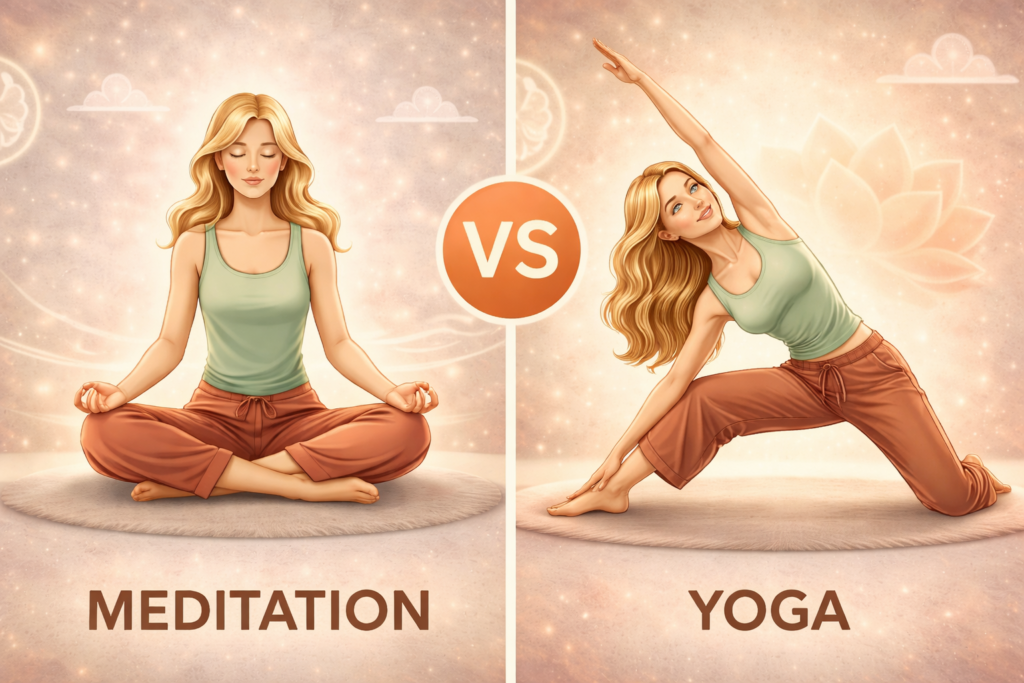
Most people treat meditation and Yoga as the same practice. This guide breaks that assumption and explains their real connection using classical Yogic understanding.
Meditation vs Yoga: What Is the Real Difference?
In modern discussions, meditation and Yoga are often treated as interchangeable. Sometimes meditation is presented as a part of Yoga; at other times, Yoga is reduced to a preparatory step for meditation. In many cases, the distinction between the two is not clearly understood.
This confusion is understandable. Both involve stillness, attention, and inward observation. Both are associated with mental clarity and reduced disturbance. From the outside, they can appear to be variations of the same process.
However, when examined through classical sources such as the Yoga Sutras of Patanjali, the difference becomes more precise.
Meditation is not separate from Yoga, but it is not identical to it either.
Yoga as the Larger Framework
To understand the relationship correctly, it is necessary to begin with Yoga itself.
In the Yoga Sutras, Yoga is defined as:
“योगश्चित्तवृत्ति निरोधः”
Yoga is the cessation of the fluctuations of the mind.
This definition is not describing a technique. It is describing a condition.
Yoga, in this sense, is the overall process through which the activity of the mind is understood, regulated, and eventually brought into a state of stability.
Within this process, multiple stages are involved. These stages are not independent practices, but parts of a progression.
Meditation is one of these stages.
Where Meditation Fits In
In the classical structure of Ashtanga Yoga, meditation (Dhyana) appears as the seventh stage, preceded by concentration (Dharana) and followed by absorption (Samadhi).
This placement is significant.
It indicates that meditation is not the starting point of Yoga. It arises after certain conditions have been established: ethical alignment, physical stability, breath regulation, and the withdrawal of sensory distractions.
Meditation, therefore, is not something that can be practiced effectively in isolation. It depends on the groundwork laid by the earlier stages.
The Nature of Meditation (Dhyana)
Meditation, as described in the Yoga Sutras, is not simply sitting quietly or attempting to relax.
It is defined as a continuous flow of attention toward a chosen object, without interruption.
This continuity is what distinguishes meditation from concentration.
In concentration, attention is repeatedly brought back. There is effort, and there are interruptions.
In meditation, these interruptions begin to reduce. Attention flows more steadily, requiring less deliberate correction.
This transition is gradual. It cannot be forced. It emerges when the mind becomes sufficiently stable.
Yoga Is Not Limited to Meditation
One of the key differences is that Yoga is not limited to meditative practice.
Yoga includes:
- The regulation of behavior (Yama)
- Personal discipline (Niyama)
- Physical preparation (Asana)
- Breath regulation (Pranayama)
- Sensory withdrawal (Pratyahara)
- Concentration (Dharana)
Meditation is one part within this broader system.
Reducing Yoga to meditation overlooks these other dimensions. It narrows a comprehensive discipline into a single practice.
The Perspective of the Bhagavad Gita
The Bhagavad Gita further expands the meaning of Yoga beyond formal practice.
It presents Yoga as a state of equanimity and as skill in action.
This perspective introduces an important distinction.
Meditation is typically practiced in a specific setting, seated, with minimal external engagement.
Yoga, as described in the Gita, extends into all aspects of life. It is reflected in how one acts, responds, and maintains balance under varying conditions.
In this sense, meditation can be seen as a focused practice, while Yoga represents a broader way of being.
The Role of the Body and Breath
The Hatha Yoga Pradipika provides insight into how the body and breath contribute to this process.
It emphasizes that the mind and breath are closely connected. When the breath is irregular, the mind tends to be unstable. When the breath is regulated, the mind becomes more manageable.
Practices such as Asana and Pranayama are introduced to prepare the system.
This preparation is essential for meditation. Without it, maintaining steady attention becomes difficult.
This again highlights the relationship: Yoga prepares, meditation emerges.
A Difference in Approach
Meditation is often approached directly. One sits down and attempts to observe the breath or focus attention.
Yoga, in contrast, approaches the mind more systematically. It recognizes that attention cannot be stabilized instantly and therefore introduces intermediate steps.
This difference in approach explains why meditation alone can feel difficult for beginners.
Without the supporting structure of Yoga, the mind remains too active for sustained attention.
The Role of Effort
Effort functions differently in Yoga and meditation.
In the earlier stages of Yoga, effort is more active. One regulates posture, controls breath, and disciplines behavior.
In meditation, effort becomes more subtle. Excessive effort can actually disturb the continuity of attention.
The practice shifts from doing to allowing, allowing attention to remain steady without constant interference.
This shift is not immediate. It develops gradually as the preceding stages mature.
Outcomes: Process vs State
Another way to understand the distinction is through outcomes.
Yoga, as a whole, is a process. It involves multiple stages, each contributing to the refinement of the mind.
Meditation is a state within that process, a condition where attention flows continuously.
Confusing the two can lead to misunderstanding.
If meditation is treated as the entire path, the preparatory aspects are neglected. If Yoga is reduced to meditation, its structure is lost.
Why the Confusion Exists
The confusion between meditation and Yoga is largely a result of how they are presented today.
Meditation is often isolated and taught as a standalone technique. Yoga is frequently reduced to physical practice.
Both representations are partial.
When viewed together through classical texts, the relationship becomes clearer: meditation is a stage within Yoga, not a separate system.
Can One Practice Meditation Without Yoga?
It is possible to attempt meditation without engaging in the full structure of Yoga.
However, the effectiveness of such practice is often limited.
Without preparation, attention remains unstable. The mind continues to fluctuate, making sustained observation difficult.
This does not mean meditation is ineffective. It means that its conditions have not been fully established.
Yoga provides these conditions.
A Subtle but Important Clarification
It is sometimes said that Yoga leads to meditation. This is partially correct.
But it is more accurate to say that meditation arises within Yoga when the mind becomes sufficiently stable.
This distinction matters because it shifts the focus from trying to achieve meditation to understanding the process that makes it possible.
Integrating the Two
There is no need to treat Yoga and meditation as opposing practices.
Meditation is an integral part of Yoga. At the same time, Yoga provides the structure that supports meditation.
Understanding their relationship allows practice to become more coherent.
Instead of approaching meditation as an isolated technique, it can be seen as a natural development within a broader discipline.
Meditation and Yoga are closely related, but they are not identical.
Yoga is the larger framework: a systematic process aimed at stabilizing and refining the mind.
Meditation is a stage within that process: a condition in which attention becomes continuous and steady.
Through the Yoga Sutras, the Bhagavad Gita, and the Hatha Yoga Pradipika, this relationship becomes clear.
When understood correctly, the distinction removes confusion. Meditation is no longer something to force. Yoga is no longer reduced to posture. Both find their place within a single, coherent process.