Mindfulness and meditation are often confused. This guide explains their difference through Buddhist and Yogic traditions, with clarity and context.
Mindfulness vs Meditation: The Difference Explained
The terms “mindfulness” and “meditation” are often used interchangeably. In everyday language, they are treated as if they refer to the same thing: both associated with awareness, calmness, and attention.
But when examined more carefully, especially through their original contexts, a distinction begins to appear.
Mindfulness and meditation are related, but they are not identical. They arise from different frameworks, serve different roles, and are practiced in different ways.
Understanding this difference does not complicate practice. It clarifies it.
The Source of Mindfulness
The concept of mindfulness comes primarily from early Buddhist teachings, where the term used is Sati.
Sati is often translated as “mindfulness,” but its meaning is more specific than simple awareness. It includes the idea of remembering: to remain aware of what is happening in the present moment without losing attention.
This is described in texts such as the Satipatthana Sutta, where mindfulness is structured as a practice applied to the body, feelings, mind, and mental processes.
What is important here is not just what is observed, but how it is observed, with continuity, clarity, and without immediate reaction.
The Meaning of Meditation in Yoga
In the Yogic context, meditation is referred to as Dhyana.
According to the Yoga Sutras of Patanjali, Dhyana is a state in which attention flows continuously toward a chosen object without interruption.
This definition is precise.
Meditation is not simply sitting quietly or observing thoughts. It is a condition of sustained attention that arises when the mind becomes sufficiently stable.
It is part of a sequence, preceded by concentration (Dharana) and followed by absorption (Samadhi).
A Difference in Structure
One of the key differences between mindfulness and meditation lies in structure.
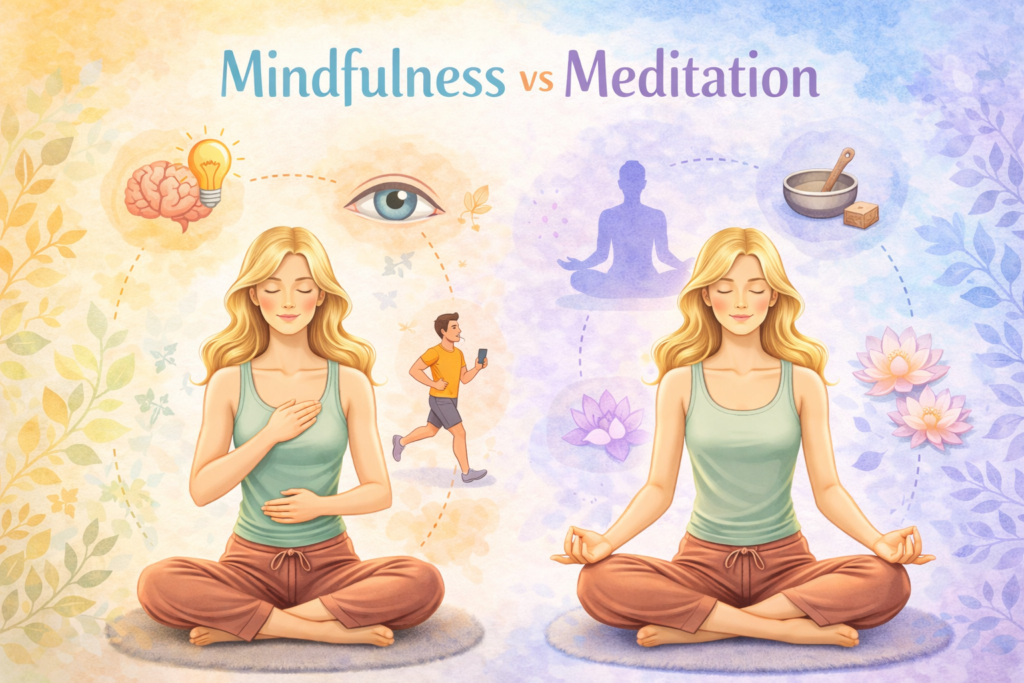
Mindfulness, as described in Buddhist teaching, can be applied broadly. It is practiced in various contexts: walking, eating, observing sensations, or noticing thoughts.
It is not limited to a single object or setting.
Meditation, in the Yogic sense, is more specific. It involves sustained attention on a chosen point. The aim is continuity without distraction.
This makes meditation more structured, while mindfulness is more flexible in application.
Observation vs Continuity
Another way to understand the difference is through the quality of attention.
Mindfulness emphasizes observation.
You notice what arises- sensations, thoughts, emotions, without immediately reacting or becoming involved. The attention may shift as different experiences arise, but awareness remains present.
Meditation emphasizes continuity.
Attention is not allowed to move freely. It is held steadily on one object. The movement of the mind is reduced, and attention becomes more unified.
These are not opposing approaches, but they are distinct.
The Role of Effort
The way effort is applied also differs.
In mindfulness, effort is directed toward remembering to observe. The mind drifts, and it is brought back to awareness. This process repeats continuously.
In meditation, effort gradually reduces.
In the earlier stage of concentration, effort is required to bring attention back. But as meditation develops, attention begins to sustain itself with less intervention.
This shift from effort to continuity is central to meditation.
Different Entry Points
Mindfulness is often introduced as a starting practice. It does not require extensive preparation. One can begin by observing the breath, sensations, or thoughts.
Meditation, particularly in the Yogic framework, is not considered a starting point.
It arises after preparation, ethical discipline, physical stability, breath regulation, and concentration.
This difference explains why mindfulness is often easier to begin, while meditation can feel more difficult.
The Scope of Practice
Mindfulness extends into daily life more directly.
It can be practiced while walking, speaking, or performing routine activities. The emphasis is on maintaining awareness within ongoing experience.
Meditation is usually practiced in a more controlled setting, where distractions are minimized.
This does not make one superior to the other. It reflects their different functions.
Where They Overlap
Despite their differences, mindfulness and meditation are not unrelated.
Mindfulness can support meditation. By increasing awareness of mental movement, it prepares the ground for more stable attention.
Similarly, meditation can deepen mindfulness. As attention becomes more continuous, awareness becomes more refined.
In this sense, they can complement each other.
A Common Misunderstanding
A frequent misunderstanding is to treat mindfulness as a simplified version of meditation.
This is not accurate.
Mindfulness has its own depth and structure within Buddhist teaching. It is not merely a preliminary step, nor is it interchangeable with meditation.
Similarly, meditation in Yoga is not simply “being mindful.” It has a specific definition and place within a larger system.
Recognizing this prevents oversimplification.
Practical Implications
For someone practicing regularly, understanding the difference changes how each is approached.
If the goal is to develop general awareness in daily life, mindfulness becomes relevant.
If the aim is to stabilize attention deeply and move toward meditative absorption, the Yogic approach to meditation becomes necessary.
Both approaches have value, but they serve different purposes.
The Direction They Point Toward
Mindfulness develops clarity in observation.
Meditation develops continuity in attention.
Both contribute to reducing the compulsive nature of the mind, but they do so through different methods.
Over time, both can lead to a more stable and less reactive way of experiencing life.
Mindfulness and meditation are closely related, but they are not the same.
Mindfulness, rooted in Buddhist teaching, emphasizes continuous awareness of present experience.
Meditation, as described in the Yoga Sutras, refers to a state of uninterrupted attention that arises through preparation and practice.
Understanding their difference does not divide practice, it refines it. It allows each to be used appropriately, without confusion or oversimplification. And in that clarity, both practices become more meaningful.